
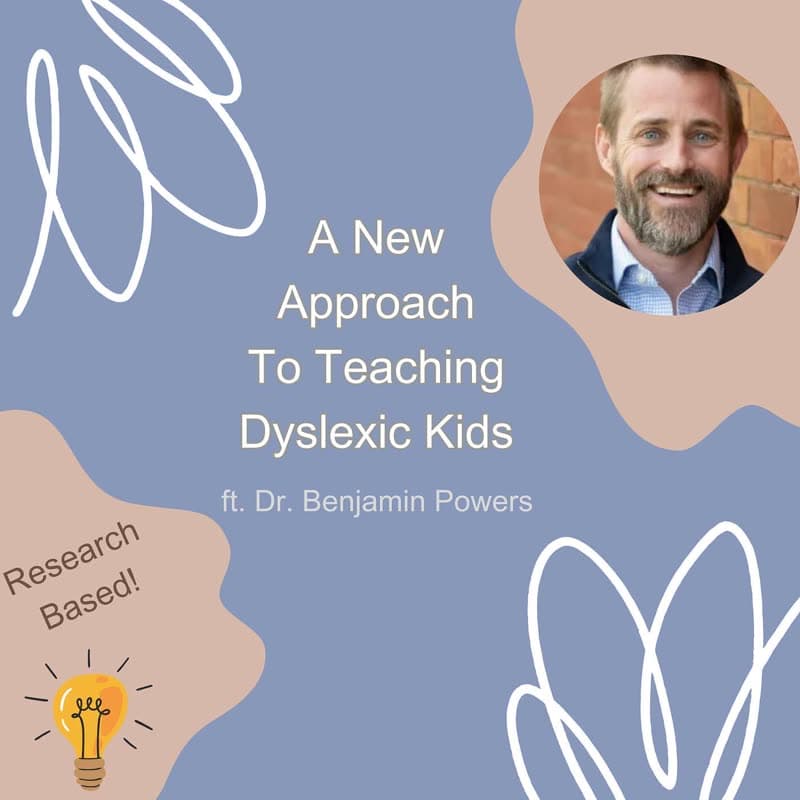
An Innovative Approach To Teaching Dyslexic Kids ft. Educator and Researcher Dr. Benjamin Powers
About this episode
Dr. Benjamin Powers is the executive director of The Southport School, an independent day school for neurodiverse children in grades 2-8 who have language-based learning differences and/or ADHD. Powers also serves as president of The Dyslexia Foundation, Founder & Executive Director of The Southport CoLAB, and as Director of the Haskins Global Literacy Hub at Yale University.
https://www.southportschool.org/
https://dyslexiafoundation.org/
https://www.southportcolab.org/
https://haskinsglobal.org/
Transcript
Full transcript · 8,468 words · about 42 min to read. Press a timestamp to jump to that moment.
You know, we have to be careful of labels because we're not just one thing. And we also have to be careful with labels because we don't want to kind of pigeonhole people based on other people's expectations or what, you know, unfortunately, a lot of people might not understand something like dyslexia or ADHD. At the same time, a label gives us community.
Hello, everyone. We are Sonja and Nick, and this is Dyslexia Journey. And today we are excited to welcome Dr. Benjamin Powers to the show. Dr. Powers is the executive director of the Southport School, an independent day school for neurodiverse children in grades two through eight who have language-based learning differences and or ADHD. Powers also serves as president of the Dyslexia Foundation and as director of the Haskins Global Literacy Hub at Yale University.
Dr. Powers, welcome to the show. Well, good morning. Thanks so much for having me today. Yeah, thank you so much for being here. So let's just start at the beginning. We're really curious about how you became interested in neurodiversity, or we could call it cerebrodiversity, and dyslexia specifically. Sure. So my trajectory was actually pretty interesting. I was somebody who struggled a little bit in school. I was in the resource room early on in elementary school, and I had, you know, bumps along the way.
And after college, after graduating from college, I really wasn't sure what I was going to do. I actually thought I was going to go into business. And by chance, I actually ended up substitute teaching one day and fell in love with this idea that we could really have the opportunity to change the conversation in the classroom. At that time, I knew nothing about neurodiversity or what we talk about at the Southport School, cerebrodiversity.
And then I stumbled on, or actually, I'll correct myself, my mom stumbled on an advertisement for a school called the Kildonan School, which was, at the time, one of the oldest schools in the country for children with dyslexia. I knew nothing about dyslexia, but I applied and started working there. And as soon as I started working with those students who primarily had either dyslexia or also maybe ADHD, I just really fell in love with working with those kids who were these amazing thinkers, but who had really struggled in mainstream learning environments.
And it just resonated with me and some of my challenges in school. And ever since then, I've been really passionate about working with kids with learning and attention issues. That's interesting. So there is sort of a personal connection there. That's right. So I am diagnosed with what's called combined type ADHD. So if people aren't familiar with combined type ADHD, there are typically three types of ADHD. There's ADHD hyperactive type, ADHD inattentive type, and then combined type, which is both of those things.
So what I like to say is it makes me a really good guest at the dinner party. Great. Yeah. So I guess tell us a little bit more about the Southport School and that where you are currently. Sure. So we are nestled in the village of Southport, Connecticut. It's just this beautiful little enclave in Fairfield County. And we serve about 125 students in grades two through eight who have a learning or attention issue like dyslexia or ADHD.
Those are our two main identifications. Our third most common identification would be auditory processing disorder. And so our students are coming to us typically after they've really struggled to thrive in a mainstream learning environment. And so they're with us for about three years. We do a lot of work around executive functions and maybe most importantly, we do a lot of work around self-advocacy skills, self-emotion, self-advocacy, self-efficacy, self-esteem, all the kind of those holistic pieces.
So that when our kids leave us, they don't just have the toolkit filled for the academic side, but they also have the social emotional side built so that they can really be empowered to achieve their full potential. Yeah, that's so important. We talked about our daughter on this show a lot who is dyslexic and she's in high school now. And, you know, her experience in early elementary school and in the public school system was very damaging to her self-esteem, to her sense of herself as an intelligent person, you know, capable of doing well in school.
And it really took a while to kind of undo that damage from the early public school experience. Well, I'm just thinking because you said, no, I was just going to say because you said, you know, that you usually are getting people, you know, not necessarily. So we had usually people either, you know, weren't diagnosed as a child who we talked to or they was more like that kind of situation. We did have our most recent dyslexic voices person who was diagnosed really early and never had that.
Right. But it sounds like you're mostly having people who already had the challenges and struggles. So I assume that makes it then, yeah, more of a challenge because you have there can be school resistance and all that kind of thing. That's exactly right. It's, you know, one of the exciting things is with all of these efforts around screening efforts, early screening for dyslexia, because we know we can screen children very, very early.
We can disrupt that kind of wait to fail model that's been in place for so many years. But unfortunately, at least for the present moment, that's still most of the kids that we serve. And I think like you're talking about with your daughter, that's unfortunately a pretty typical experience where our students have come from an environment where they felt less than because they've struggled with some aspect of school that seemingly comes easy to other kids.
And so all of a sudden they're feeling like, what's wrong with me? They feel a sense of shame. Their cortisol levels are through the roof by the end of the school day. And what I would say is one of the most exciting things at a school like ours is that when our students are dropped off in the morning and it's a school and these are kids. And so, you know, we have our good days and our bad, but the majority of time our kids are coming out of the cars excited.
I mean, kids are naturally curious learners. And so, you know, it resonates with me because, you know, by the time I hit middle school, there were there were moments where I really did feel less than I really could not understand why I was struggling with what things that just seems kind of easy for other kids sitting to my left and to my right. And so to have an environment where our students can come in, feel championed, feel like they have teachers who understand them, but maybe most importantly, have classmates, you know, who have similar relative areas of strength and relative areas of deficit in their profile really gives them that huge boost to understand that they're not alone, that there's community there for them.
Right, right. So, yeah. And so it sounds like this whole socioemotional sort of healing almost processes is one, if not the foundational part of success for the students. I'm just curious, what factors do you see as contributing? I'm sure there's so many to the success of the students at Southport. So, you know, it's, it's really kind of multiple prongs. One is, and I think this is most critical. Everything we do at the Southport school is based in research. So whether that is academic programming, whether it's social emotional programming, our firm belief is that kids get nine months for about 13 years of school, and that's it.
So we can't waste any of that time using strategies or theories that just aren't grounded in science. So everything we do across the board really has a strong emphasis in, in research and evidence. And so it's really multiple pieces. One is really that whole piece of teaching them in the academic classroom in a way that is, again, based in evidence and research that resonates with who they are as learners. And so we take research-based approaches, we leverage that with techniques we know work really well for students who have learning and attention issues, like we chunk things down, we lay out a lesson plan very clearly at the beginning of class.
I'd say a second, a second big piece of this is thinking about the co-curricular time. And so opportunities outside of like the traditional three R's, reading, writing, arithmetic, to give our kids opportunities to engage and explore in outlets that are, you know, they're still academic in nature, but they're less traditionally academic, like the arts and music and movement. And then the other piece, and again, perhaps the most critical piece, is underlying all of that with the real strong basis in being able to self-advocate.
And so all of our students at the Southport School have an advisor, and that advisor is like their personal champion. And so our students really have unfettered access to be able to reach out to that advisor if they're struggling at any point during the school day. And the job of that advisor is to be that champion and to support that student, but also to help that student build that bridge to that independent self-advocacy, so that by the time they leave us, they're comfortable and confident in being able to approach a circumstance or situation where they might feel like they're struggling or they might feel tension or difficulty, so that they can kind of flip that script and be able to engage and be able to really feel confident in tackling and navigating their school day.
That's really, yeah, that's so important. And I think it's something that we, even just maybe more recently, have tried to emphasize in distinguishing, I guess, the need for the bridge, right? Because so it's like, of course, self-advocacy is important. I think most people see that, but it's like there's this stage where you sort of have to teach that and like be the one who's doing the advocating, but then getting them to it.
So, you know, so it's not just like you're like, go self-advocate, but you're actually teaching it, right? That's exactly right. And, you know, I think part of that underlying that is that notion of resiliency. And so the challenge with resiliency, of course, is that we don't want to add yet like another layer or expectation on our students, our kids, who are already struggling because, you know, they're neurodiverse learners. At the same time, we really want to help prop up that resiliency and strengthen that resiliency so that they feel that confidence and that comfort.
And then alongside that, build that toolkit that says, hey, you know, it's not just about speaking out. It's about speaking out for yourself in a way that you can communicate what your needs are to be successful. And our mindset is imagine if every kid could walk into class on the first day and say, hi, you know, I'm Ben and I struggle with things like task initiation. So, you know, having a scaffolded framework for how, you know, long-term projects is going to be really helpful for me.
And I promise you that if, you know, if I have that structure in place, I'm really going to work so hard and do my best and be successful in your class. So, you know, giving our kids and helping them develop, you know, that roadmap so that they can really be in that position to articulate those things is just so critically important. And, you know, what's so amazing, I think, to us is our experience.
We've been doing this work at the Southport School for 40 years now. What we've realized over especially the last decade is that all the things we do for our kids, you know, when I say our kids, kids with learning and attention issues, it's not just good for our kids. It's good for every kid. You know, all the things we do in our school really would benefit all learners. Yeah, I think that's a common theme, too, in what we talk about often on this show, that a lot of the sort of techniques and whatever for working with dyslexic kids, I mean, you know, all kids can really benefit from.
I want to dig into one point here. One thing that we've observed and discussed and also covered in interviews with other people is that this idea of self-advocacy, you know, requires some level of sort of identification. Like, I am a dyslexic student. I am a dyslexic person, and this is what I need, you know, because of my dyslexia. Kind of how do you handle that? That sort of, I guess, it's like a labeling question and identification question, right?
That is, it's a great question, and it's something I think as a parent, and I've got four kids myself, you know, as a parent and as an educator and being in this field for about 25 years now, it's a really critical question. We have to be really careful with labels. And one of the things we know is that if you have something like dyslexia or ADHD, it's more than likely, you know, you're likely have some type of comorbid.
I know that's an awful sounding term, but you likely have some other co-occurring conditions. So, if you have ADHD, you know, there's a high likelihood that you may have some type of reading issue that goes along with that. So, you know, we have to be careful of labels because we're not just one thing. And we also have to be careful with labels because we don't want to kind of pigeonhole people based on other people's expectations or what, you know, unfortunately, a lot of people might not understand something like dyslexia or ADHD.
At the same time, a label gives us community. And so, you know, a lot of people struggle with this term learning disability. I struggle with it because, you know, our kids aren't learning disabled. They might be reading disabled or attention disabled in some ways, but they're not learning disabled. But at the same time, that notion of disability is what gives our kids community. It gives them rights, legal rights. And so, understanding that identification, and we're very particular about this term, it's, you know, we think about this as identification.
Understanding their identification is critically important, not just so they can have that access to those legal rights, but also that community. And the other thing is, it's really important that as part of that identification, the student or child really understands, you know, what does that mean? And I don't know if you've seen this, but a lot of times, kids go out, they get tested by a third party, that third party then meets with the parents, they go over all of this comprehensive multi-day testing.
And unfortunately, you know, in my experience, a lot of that isn't always absorbed, you know, by parents, it's overwhelming, or maybe it's not communicated effectively. And one of the things we've found highly effective is to actually be able to talk through a student's learning profile that, yes, you know, you have these relative areas of deficit, and that's why you qualify for this identification. But the flip side is, you also have these other relative areas of strength.
And so, you know, helping our students learn, they're not just one thing, there's a whole picture here. And how can we think about those relative areas of strength to help offset those relative areas of deficit? So I think if you go about it the right way, and really kind of dive into it and engage with the child and help them really understand what that means, and as part of that, with the parents or guardians as well, that can make a substantive difference.
Yeah, that sounds exactly right to me. Yeah, you're right. It's interesting. I don't feel like that breakdown often happens. So it's interesting. It's a lot to absorb. I mean, we're parents, right? I mean, you know, I remember when my second daughter was born, she had like a minor heart issue. And of course, you know, you're kind of panicked as a parent, and you want to try to learn about it. But, you know, I'm not a heart cardiologist.
So, you know, that's, I have to be reasonable with my expectations. And so it's the same thing with a learning or attention issue. Most parents don't have a background in that. And so to be in a, you know, a doctor's office or, you know, a psychiatrist's office, getting this download of all this information is overwhelming. And so, you know, having time to unpack that and really understand what it means, short term, long term, and then being able to really be able to support your child with that, that's, in a way, it's kind of truly a gift, because how many kids really know what their learning profile is?
So, in a way, that in and of itself can be used as a relative area of advantage. Yeah, definitely. So what's the kind of usual path of students at the Southport School? You said you usually have them for about three years. Is that right? And then what do they do kind of after that? Do they go to public school? Like, are they kind of set up for, you know, public middle school and high school with accommodations?
Or what's kind of the common, if there is a common path there? Sure. So, yeah, the typical students here for about three years, that might be, you know, that might be adjusted based on, and some of our kids are just super dyslexic. You know, on that bell curve, they might be more dyslexic or more ADHD, and so they might need a little more time. It also really depends on when they come in and enroll at the Southport School, because we want good moments of transition.
So, you know, that timeline might be adjusted a little bit. Our students, really, it's about a 50-50 split. Perhaps the slight majority go on to public schools, but most, almost all of our students are going to either, you know, public schools or what we would call kind of mainstream independent schools. Some of our families are independent school families by nature. Some of our families realize that by the nature of their child's learning or attention issue, perhaps an independent school with smaller classes, you know, even though it's a continued major investment for them as a family, maybe that's just a better pathway for their child.
One thing I would say, you know, based on experience of helping students transition from a school like ours into a more mainstream public school, or even my own experience with my children, the older they get, and especially with high school, in some ways, the easier the transition, because especially as you go into something like high school, there's just typically, you know, in most environments, just so many more choices in terms of, like, coursework, those co-curricular classes.
And the emphasis is, at that point, typically off of learning, like, skills and more really just super focused on content, which allows, in our experience, it's allowed our kids who might need, still need, like, accommodations to be able to, you know, have something like extended time or, you know, books on, well, we call them books on tape, but, you know, audio versions of text or text-to-speech kind of software. By the time they get to high school, the high school teachers seem not really to care about that so much relative to, like, middle school or elementary school teachers.
They just need to get the kids through the content. And so we found that a lot of our kids, especially when they're transitioning late middle school or really into high school, that bridge can be a lot easier in that regard. So, but, you know, again, our kids, I would say the most typical struggle for our kids, our classes are four to one, you know, a large class for us would have six kids.
So, you know, we work on that with the kids before they transition. We try to pull classes together so they have kind of a larger dynamic experience before they go in. So, you know, there's, there's sometimes an initial kind of jolt when they're going into a larger environment, but once they get settled and they feel confident applying the skills they've learned with us, they typical, just typically just really flourish in, in those mainstream environments.
So this is making me curious, going back to just, you know, even before the actual transitioning would happen. I'm curious about, you know, is, are the accommodation, because you mentioned, you know, the remediation being like pretty strong for reading. I'm curious how much there's the sort of a balance between that and using accommodations right from off the bat. And, and one thing I wanted to pull in from earlier too, you know, cause you mentioned the good balance with having the other classes with, curriculars.
I'm curious, like, because it's, you know, it just can be so exhausting with all of it, even so, like, I'm curious about homework actually too, like, and how that's handled. That's right. Yeah. So a couple, a few different points there. one is our kids are all getting intensive language remediation. We, you know, as the primary approach at the Southport school, we're using the Orton-Gillingham approach. And so every single one of our teachers, whether they're doing reading instruction or not, every one of them is trained the same way, including the Orton-Gillingham approach.
And so, you know, and we really layer in if it's necessary and the child is going to benefit from it, we will layer in levels of accommodation depending on the task or the subject. So if in a tutorial class where we're doing that intensive intervention, you know, if the goal is to really focus on reading, we're not going to use an accommodation. We're going to focus on building that skill through the intervention.
But if a child, you know, outside of that, like in a literature class or a content area class, if we can use an accommodation as a ramp into material that is commensurate with their intelligence, that's going to be a huge advantage. One of the disadvantages for kids with a reading disability, for example, is that, you know, they're oftentimes because of their difficulty with the printed word, they might be limited in their access to that reading material that is commensurate with their intelligence.
And that's going to slow things like their vocabulary growth, and it's going to, you know, make their exposure to different types of text, you know, and access to different types of content more limited. And so we want to ramp them into that, you know, accessibility so that they continue to develop all those other skills like, you know, a typical classmate would. So, you know, accommodations can be really important, not just when we're transitioning a student out of the Southport School, but also, you know, when they're here, so that, again, we can really develop the skill set through strong, intensive instruction, and then also provide that accommodation as they are, you know, accessing the other areas of content so that they, you know, they don't have to be held back in their academic growth.
Yeah, that's, that's so important. That's something we've talked about as well, how it's so frustrating, I think, for a lot of dyslexic kids, which is, you know, our experience, other kids with other learning differences, to really spend all their time on remediation and not get exposure to the more interesting stuff that's out there. And like, you know, in the case of our daughter, I mean, she struggled with reading, I mean, when she was, I don't know, maybe nine, 10, her reading level was still not that great.
But we were reading books like, like Agatha Christie mysteries to her out loud that she couldn't, you know, very totally orally follow, even though it was antiquated language and whatnot. So, you know, we're, we're definitely strong believers in, in that approach, sort of dual approach to things. No, that makes a lot of sense. I think, you know, a lot of times I'll encourage families, you know, reading, again, it's true for all kids.
So it's, it benefits everybody reading the kids in and of itself is just an amazing opportunity to give kids access to, again, vocabulary, content, genre, you know, modeling, all those great things. And so, you know, reading to kids using audio books, you know, all those different opportunities can be a huge lever up for them, and really help them close the gap. So, you know, doing that is in my mind, just exactly the right thing.
Yeah. And to follow up on one other thing, how do you handle homework at, at that level? I know it's okay. No, I kind of threw that one in there because I didn't want to forget, but it's really its own question. I knew there was a third thing there. It's really its own question. Yeah, it's really its own question. Homework is a good question. I think, you know, it's like, it's like the reading wars in a way where we've kind of vacillated between things like whole language and phonics, you know, in homework, you know, we've really kind of gone up and down where there's been a mindset to like, like really overload kids with homework, and then pull homework completely away.
And then, you know, you know, homework to me is a really good opportunity to reinforce skills, that you're teaching in the classroom. And so those can be a wide variety of skills. Part of that is helping students develop the structure to do independent work outside of the classroom. Part of that is to, you know, literally reinforce maybe skills that were taught as part of the day. So, especially when our students are younger, we're using homework as that opportunity to practice and reinforce.
We do not teach new material using homework. We teach new material in the classroom. So that's really, really important. The second thing is we provide scaffolded structured time during the school day for students to work independently. And so every one of our students, even starting in second grade, has a block of time, a study hall block, where there is a teacher who's actively proctoring that. It's not, you know, it's not a teacher who's just sitting, reading the newspaper.
They're actively proctoring that study hall. And so students have that experience to be able to work independently, but also ask for help, either from the teacher in the classroom or the way we structure our schedule. The way we, we do that, it gives them an opportunity to say, Hey, you know, I'm struggling with this math question. Can I go out and ask Mr. D, you know, for help with that? So it also gives them that self-advocacy piece.
When they're really young, second, third grade, we really don't want them taking homework home. We want to build that notion of homework in that study hall. And then as they get older, we want to kind of do, we do want to increase that dosage a little bit where they're starting to take work home outside of that study hall block. So they're gaining that experience at home. They're developing that structure independently at home, the time, the space, you know, we're giving tools and tips to parents so that they can help them be successful with that.
Because in our minds, the most important thing for our kids with homework is that they're identifying that they can be successful with it. For a lot of our kids coming in, maybe the experience with homework was not one of success. It was one where they, you know, they got a worksheet or they got material, they brought it home and they didn't know what to do, or it was teaching new material and they were stuck.
And then they either wouldn't do it or they wouldn't, you know, they wouldn't feel confident in how they were doing it. And then they'd go in the next day and get in trouble or, you know, just really feel badly about themselves. So we really want to inspire that level of authentic success and have them feel really comfortable and confident with that kind of independent work. I've never heard homework talked about that before.
That's exactly, it makes it sound so beautiful. It's actually like, you know, it's just, you know, not really, you know, at most it'll be like that it's a necessary thing with almost like the necessary but evil tacked on, I feel like. But yeah, I mean, it's an opportunity for success. Yeah, it's great. I mean, I feel like we kill, we like kind of crush kids with this stuff sometimes where, you know, again, they're not, you know, I think about, I always ask parents like, well, how was your child when they went to preschool?
And they're like, oh, they loved it. They were excited, you know, I mean, not all the time, but most of the time they're excited. They're curious. I mean, kids are curious by nature. Kids are good by nature. And so what are we doing wrong if by first and second grade, they don't want to learn anymore? Yeah, maybe there's a very, very small percentage of kids, you know, who are just wired that way.
But, you know, I would say 99.9% of kids are not wired that way. So what can we do to kind of, you know, keep that spark going? I don't think it's terribly hard. I think it's just how we kind of reframe that. Yeah. Yeah. Yeah, this is a good time maybe to shift the discussion a little bit. So you mentioned somewhere that I saw that you like to keep one foot in the classroom and one foot in research.
So do you want to tell us a little bit about the research that you do? Sure. So, you know, I think one of the most exciting things in my career has been that ability to kind of bridge that research with practice. And so when I first started teaching kids with dyslexia and ADHD, I learned a lot. I had a ton of professional development, but it was all on the implementation side. And I really didn't understand how was this form?
You know, what was the background? And so over the years, I've been very fortunate to be involved in the research community. And in 2017, I was invited to be part of Haskins Labs, which does a lot of really groundbreaking work in the area of speech and language development. And so I'm able to contribute on the education side and think about that intersectionality. And as an example, one of the projects that I'm involved with right now is a large NIH funded grant where the president and director of research at Haskins, Ken Pugh, he is doing this huge project to really understand individual differences in kids using fMRI imaging.
And so how can we think about what has to activate in brain to be able to have a student primed for intervention? So why are some kids responding to, like in an example of somebody with dyslexia, you know, why do we see some kids get intervention and just start to really take off? Why do we see some kids really take much longer or, you know, a very small percentage of kids we call treatment resistors?
So, you know, understanding the distinct individual differences in brain and understanding things like the pathway, the pathways between orthography and phonology and semantics. You know, how do we understand better, the more efficient pathways and what's going to work and how can we adjust the way we teach our kids in terms of the dosage, in terms of the emphasis in certain areas of that scaffolded reading instruction. So that's to me why the research is so important.
And we're really lucky to engage, you know, certainly with a lot of colleagues at Haskins, at Yale and UConn, but then also like last two weeks ago, we just had a team from the Florida Center of Reading Research from Florida State University up, you know, doing data collection. And so, you know, we've got a lot of different partners where we're either contributing to the collection of research data or, you know, we're doing research, ground level research to really help improve our understanding of the learning brain.
Yeah, I didn't realize all that was going on. That's interesting. That's, yeah, my next question is, if you have found anything particularly surprising in the research, I'm actually just surprised to hear that that level of research was going on. But have you had any particular findings that were surprising? Well, I think, you know, one of the, I think one of the most exciting things that's happened and, you know, 40 years ago, you know, in order to do dyslexia research or just research on, you know, ADHD, you literally, you had to dissect brains.
And so Dr. Norm Geschwind, who was up at Beth Israel, he was, he's really known as the father of cognitive neurology. And back then in his lab in the, you know, in the late seventies, up until the early eighties, you know, imaging research wasn't really, you know, it was just a very nascent, you know, part of the field. And now today, you know, we can image brains using fMRI, fNIRS, we can use EEG and actually the global literacy hub that I'm involved with.
We've got two in-school EEG labs that are directed by Dr. Nicole Landy. You know, it gives us so much more insight. And I think one of the things that it's done is it's really helped validate, hey, you know, when we're talking about dyslexia and we're talking about ADHD, these are real things. We can literally see distinct brain level differences. And not only, you know, not only between like typical brains and a brain with somebody with dyslexia, but, you know, we see brain, we see differences in brain, even with things like differences between somebody with ADHD and autism and things like inhibitory controls.
So I think it's really helped us understand, you know, for example, like somebody with dyslexia, one of the interesting findings is that their brain is lighting up in a lot more areas. So their brain's having to do more work to access the printed word than a typical brain because their pathways just aren't as efficient. And so, you know, understanding then kind of learning these things and watching this imaging research come out over the, you know, over the years really helps give a lot of perspective to not just how we can be better in the classroom with our kids, but maybe a little more empathy around the struggles that they're having, you know, with the academic school day.
Yeah, definitely makes it real when you can see it like that. I mean, we know, of course, anyway, just from seeing struggles, but sometimes there's all these other mixed things happening and how we think of it, too. Yeah. And so I guess the sort of follow-up question to that is what's your experience in sort of combining the research and the education? So, I mean, what I mean by that is like bringing research findings back into the classroom and into the school.
Like you mentioned early on that everything at the Southport School is research-based, all the educational philosophy and approaches. Is there anything specific? Do you have like a specific example of that, of maybe some recent findings that you've done or that you've read about that you've introduced into the school that you've found successful? Sure. I can think of a great example. Over the years, we've developed a metacognitive approach to executive functions. And so, you know, a lot of people, when they talk about executive functions, they talk about planning and organizing.
And planning and organizing, certainly, you know, that's a key part of executive functions. But there are other really important pieces like, you know, task initiation, task perseverance. You know, there's a lot of different components, the behavioral controls, the emotional controls. And so over the years, as we've developed this approach, the executive functions, we've updated and changed it, both as we've seen the research develop. So, you know, as there's been updates to our understanding of the executive functions, because it is a nascent, relatively nascent field, we've shifted and made changes to, in real time, to how we, you know, talk about and label the executive functions in the classroom.
And then, over the last three or four years, we've been doing a data collection with Dr. Lori Cutting at Vanderbilt University, where we've been doing audio capture in the classroom. We worked with Dr. Cutting's lab and the School of Engineering at Vanderbilt to develop a code book using machine learning, where we can pick out executive function phrasing and phraseology to really see, like, how many impressions are we getting of those different types of executive function?
From teacher talk, from student talk, from interaction, so we can see, like, literally class by class, like, where is the area of emphasis with these kids and executive functions? And, you know, how might that help us understand how we need to shift, you know, our area of emphasis with that as we continue to help our students develop their executive function skills? That's so amazing. I mean, just the level of the individualization we're talking about here is really amazing and just of adapting.
I'm curious to know, because, you know, this just sounds so wonderful, but, of course, not every student is going to your school. How, I'm wondering if you, how you see adapting some of these techniques or some of these research findings for other schools, whether private or public? That's such a great question. You know, unfortunately, a school like ours, you know, maybe, you know, just inaccessible for families, whether it's geography, whether it's finances, you know, we live in an area and work in an area in Fairfield County where, you know, there's, there's, there's, you know, just much more access to these types of things.
Not for everybody, not for everybody, of course, but, you know, just in that region. And so what we've really focused on over the last six or seven years is doing exactly what you're talking about. How can we take what we've learned from working with these kids year over year and export that into other schools? And so since 2018, we've been working with both public school systems and independent schools, independent schools to help bring out the types of teaching and learning that we've really honed, you know, through our experience and through research.
And so I can give you a really specific example over the past two years. We're entering our third year. We've been down working in the 35th largest school district in the United States, Anne Arundel County in Maryland, which is serving a really broad and diverse community of learners. And we've trained and coached and mentored teachers across there. I think they have 82 or 84 elementary schools. And this past year alone, that's impacted 887 students.
And so when you see the kinds of outcomes these students are having now that they've got teachers, you know, who in part were trained by us and coached by us, and you see the contribution of that to learning outcomes and seeing them help close that gap, it's really remarkable. So through the Southport CoLab, we've really been able to take what we've learned at the Southport School and make that really more accessible to a lot more students, educators and families.
That's great. Yeah, that's so important. Following up on that, that's really great that amazing that you're doing that training and getting that those techniques and philosophy out there. What sort of for people who might be watching this video who might be kind of new to this or may have worked with dyslexic kids but may need some guidance, like what advice do you have for teachers, all the teachers out there for working with dyslexic kids?
So that's a really important question. As we all, you know, or maybe people have heard, there's this whole movement for the science of reading. And I'm really excited about that because it's really making sure we connect our understanding of research and evidence and how we connect that to educators in the classroom. At the same time, we have to be really informed consumers because the whole science of reading movement, you know, it sounds great, but we have to be really careful about how those things are either packaged or what is being put in front of teachers.
So I think one of the most important things teachers can do is really make sure they're working with and, you know, working with the administration in their schools to really understand, like, where is this coming from? Are the materials, are the resources, you know, are the things that we're being given, are they grounded in research? You know, unfortunately, there's a lot of, you know, there's a lot of resources out there. And, you know, like Teachers Pay Teachers is an example.
There are some great resources on there. There are also some resources on there that are just not grounded in science. And so making sure we're really understanding that, you know, what we're taking into the classroom and working with kids actually does align with what we understand, that body of knowledge from something like the science of reading. I think the other piece is, you know, really understanding that these distinct differences we see in kids when we have a child in our classrooms who's identified with a learning disability or who we might think may be at risk, you know, understanding that these things, these are valid constructs.
You know, unfortunately, for a long time, I think people may have seen things like dyslexia or ADHD maybe as, like, an excuse. And that's been an unfortunate kind of stereotype that's existed for far too long. And so, you know, if a child does have that identification, it takes a lot to get that identification. It is not easy. As we know, kids have to go through, like, multiple rounds and days of testing.
And so if a kid is coming into the classroom with that, it's likely they actually do have that. And again, this is grounded in a thorough body of really valid research. And so if we can, you know, think about that in a way to have that empathy and to, you know, be mindful of that when we're working with kids and understanding that, you know, maybe a student in the classroom who's struggling and it might come off like they're being resistant or oppositional or, you know, you know, to give them, you know, I like to say, you know, the kids who come to the Southport school, it's like a, you know, it's like a car.
You need spark, you know, you need fuel and you need air for, you know, a gas powered car to run. Our kids come with plenty of spark and plenty of fuel. They just need that air. And so, you know, if we can give them that space, that air, you know, to have that ability to be able to show what they really can do, that's going to help reduce that stress, that anxiety.
It's going to help reduce those cortisol levels and it's going to give them the opportunity to thrive and show who they really are as learners. Yeah, definitely. That's a message we can't get out enough. Yeah, I really like the analogy, the car analogy, needing air. It's good. Well, so this may be the same thing you would want to say to the general public because that's probably good advice for everyone. But I'm curious if you have any final words, including anything that you would want the general public to know about dyslexia or perhaps other, you know, ADHD as well and all of these cerebro diverse issues.
I think, you know, maybe the most important thing to understand is, and we've covered this, you know, thoroughly, that there are distinct brain level differences, you know, not just between somebody who is neurodiverse or cerebro diverse and somebody who's not, but also within the realm of these different identifications. So, you know, we're really in that space where it's important to recognize that certain things like reading or like the kind of traditional classroom setting, those are relatively recent inventions in humanity.
And, you know, if you think about it, I always say to people, if you're on a safari in Africa, you want the tour guide with ADHD because that person is likely going to be the first one to spot the lion before it kind of jumps out and eats you. So, you know, even with things like there have been studies that have shown, you know, early migration, a lot of the DNA that's been collected of the early humans who migrated, a lot of them have showed genetic code for having ADHD.
And so, you know, from an evolutionary perspective, it's probably likely that there's a reason these things exist. We don't know the full picture on that. We've got to be really mindful of doing good research to understand why these things are, but there are likely reasons that these things exist. And unfortunately, you know, when we look at, you know, the timeline of humanity, again, something like reading, something like the classroom setting, these are, you know, these are really recent changes to environment.
And when you think about something like dyslexia, that's a challenge with an, it's an environmental challenge. It's a challenge with this expectation that reading is the gateway to information and the gateway to independence that did not exist a few hundred years ago for most people. And so, you know, the ADHD challenges we see in the classroom, it's an environmental challenge. And so, you know, we have to be really thoughtful about understanding that these things are brain-based and that they likely, in many cases, are a reflection of the environments we're creating for our kids.
Yeah, that's important. I really like the way that that implicitly reframes it from being not a problem with the child, but a problem with the system. That's exactly right. I mean, you know, again, you know, there's, and this is the whole notion of cerebral diversity. It's this, you know, it's the notion that our, you know, we are better off as a species because of our collective heterogeneity. And, you know, if you think about something like autism, you know, we needed people to specialize, you know, like, especially as we were learning to, like, grow crops.
We needed specialists in those areas as, you know, as humans to be able to survive and thrive. We needed people with ADHD to migrate so that we could find, you know, they needed that stimuli to go find new places, you know, to be able to push, you know, humanity forward. And so, again, we don't have all the knowledge and understanding about that that we would like to have. And that's why research is so important because we have so many unanswered questions still.
But I do think it gives us a lens to say, you know, hey, let's be mindful that we're not discounting those relative areas of strength that these students can bring into not just the classroom, but also, you know, to our world. And I would say, you know, one last thought on that is one experience I think is really exciting is thinking about the changes we sometimes make for kids in the classroom.
I'll give you, like, a really quick, specific example. My kids, I put a kitchen island in our kitchen, and my kids were tipping in the stools. And so I took the stools away, and I put in swings. And the kids, you know, kids need to move. They, you know, they need their vestibular system activated. But I didn't want my kids to get hurt. And so putting in the swings, you know, de-escalated the risk of them falling, you know, me kind of getting frustrated, like, oh, no.
But it also made my job so much easier cleaning underneath those swings rather than having to move the stools around. And so a lot of times the changes, the shifts we can actually make to improve learning for kids with learning and attention issues, again, can actually not just benefit other kids, but actually our whole environment. And so if we look for those opportunities, it's really an advantage for everybody. That's a wonderful place to end on today with both really holistic and, you know, just such a positive and even thinking outside the box sort of aspect there.
Thank you so much. Thank you so much for everything you brought here. You know, lots of these interesting and the research you do and for what you're doing in the school. And we really appreciate it. Well, thanks for the work you do to help share the news and really help advocate for our kids and adults with learning and attention issues. And thank you so much for having me on today. I really appreciate it.
More from the show
Learn to Love Listening ft. Cliff Weitzman, Dyslexic Founder and CEO of Speechify
In this installment of our Dyslexic Voices series, Cliff Weitzman, founder and CEO of Speechify (https://speechify.com/), tells us about his experiences growing up dyslexic, and shares his advice for how to succeed as a dyslexic child and adult.
Make Real Progress on Big Goals For Your Dyslexic Kid!
We all have goals for our dyslexic kids, but they often seem overwhelming and out of reach. In this episode we provide specific, practical tips for organizing the goals into smaller chunks and making daily progress.

The Attacks On Your Kids’ Rights to a Free Appropriate Public Education ft. Attorney Laura Heneghan
With all the changes in the US recently, it’s hard to keep track of all the implications. In this episode we dig into the changes at the Department of Education, executive orders, lawsuits, and more in order to understand how these changes could directly affect your kids!
Never miss an episode
New episodes every two weeks. Follow wherever you listen.