
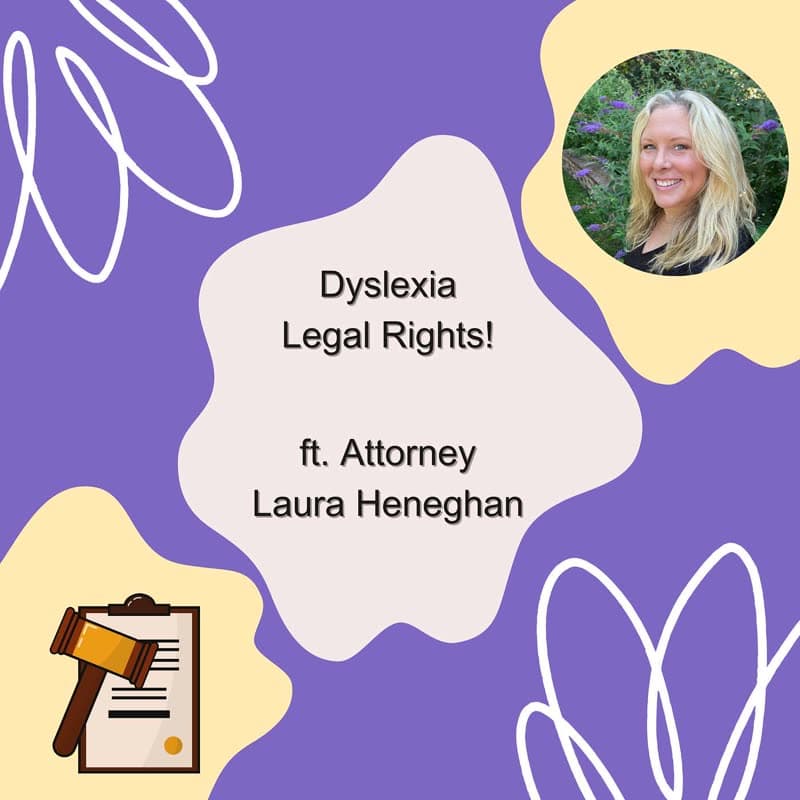
Dyslexia Legal Rights! ft. Attorney Laura Heneghan (Part 1)
About this episode
Are you confused about the difference between a 504 plan and an IEP. Have you heard the term, "Free and Appropriate Public Education" and want to know what it means? Do you want to know your legal rights when interacting with your kid's school? Listen to part 1 of this interview with special education attorney Laura Heneghan to learn about all that and more!
Attorney Laura Heneghan proudly practices solely in the area of special education,
representing children and adolescents with disabilities who are not receiving appropriate services from their public school district. She began practicing in this area after experiencing this process as the parent of a child with disabilities, including a son with dyslexia. She brings this experience, her passion, and her unique collaborative abilities to her clients to change their outcomes for the better.
In addition to her law degree, Laura holds a Certificate in Special Education Advocacy from the PELE Clinic at William and Mary Law School. In order to better serve her clients with dyslexia, she has completed a 60-hour course in Orton Gillingham Plus, an evidence-based program based on the science of reading and approved by the International Dyslexia Association.
She is a Board Member of Smart Kids with Learning Disabilities. She provides Pro Bono legal services to immigrant children seeking Special Immigrant Juvenile Status in Probate Court through Children’s Advocates of Connecticut. Laura previously served on the Board of Directors for the Western Connecticut Center for Human Rights, as a court-appointed Guardian Ad Litem for CASA of SW Connecticut, and as an Educational Surrogate appointed by the Connecticut Department of Education on abuse and neglect cases.
You can find Laura online at https://sped.esq/
Here are some links that Laura recommends:
https://www.smartkidswithld.org/
https://www.copaa.org/
https://www.wrightslaw.com/
Transcript
Full transcript · 5,583 words · about 28 min to read. Press a timestamp to jump to that moment.
When we're speaking about dyslexia, I would really hesitate to say that a student can be programmed for under 504 because one of the preeminent things we need in kids with dyslexia is that direct instruction on the skills relating to reading.
Hi, everyone. We are Sonja and Nick, and this is Dyslexia Journey. And today we are excited to welcome attorney Laura Hennigan to the show. Attorney Laura Hennigan proudly practices solely in the area of special education, representing children and adolescents with disabilities who are not receiving appropriate services from their public school district. She began practicing in this area after experiencing this process as the parent of a child with disabilities, including a son with dyslexia.
She brings this experience, her passion, and her unique collaborative abilities to her clients to change their outcomes for the better. In addition to her law degree, Laura holds a certificate in special education advocacy from the P.E.L.E. Clinic at William & Mary Law School. In order to better serve her clients with dyslexia, she has completed a 60-hour course in Norton-Gillingham Plus, an evidence-based program based on the science of reading and approved by the International Dyslexia Association.
She is a board member of SMART Kids with Learning Disabilities. She provides pro bono legal services to immigrant children seeking special immigrant juvenile status in probate court through Children's Advocates of Connecticut. Laura previously served on the board of directors for the Western Connecticut Center for Human Rights as a court-appointed guardian ad litem for CASA of Southwest Connecticut and as an educational surrogate appointed by the Connecticut Department of Education on Abuse and Neglect Cases.
Laura, welcome to Dyslexia Journey. Thank you very much. I'm happy to be here. So part of the reason, you know, we're so excited to have you is to drill down on some of this legal stuff, rights that people probably don't even know they have, and things, you know, hopefully getting some clarity, too, on things that can be really complex for people, including ourselves, you know, to understand fully and better. However, we would love to hear first just more about this personal journey, you know, with your dyslexic son and then how that led you to the work that you do.
Thank you. Yeah, it really was a journey. I am a lawyer, so first I have to start with a disclaimer. So my words here are not to be interpreted as specific legal advice. It's intended to help with an understanding of parents' rights so you can ask the right questions of a lawyer of your choice in your state and that this doesn't create any kind of attorney-client relationship between us. So it's – but that's my public service announcement.
So, yeah, I've had a really personal journey with this, and I was happily working as an in-house counsel for a corporation when I had my son and had, you know, was very happy, no intention of changing my career at any point, and then life just had other plans as life does. At three, he was diagnosed with Asperger's, which is now called high-functioning autism. I've always used Asperger's because it just kind of fits him, and that's what it was at the time.
And when he began school in the public school district, he had a lot of troubles with academics, which were at the time attributed to his anxieties and his other disabilities. I noticed a lot of things. He couldn't rhyme words when he was – from a time when he was really little, nursery rhymes just didn't hit for him. When he started writing, he had reversals of a lot of letters, and all of my concerns were kind of dismissed as all kids go through that.
He's just coming along slower than some other kids. In second grade, we had a private eval done, and a neuropsychologist diagnosed him with some deficits in reading and writing and spelling. We presented that to the public school district, and again, they kind of really didn't address it and just put in some no-spelling penalties and things like that, but didn't provide any direct instruction in actually how to spell. So myself not knowing any better, he made it to fourth grade, struggling, not reading, me falsifying his reading leagues because we couldn't deal with homework and all those things that parents do.
And at this point, his anxiety was really increasing because he recognized he couldn't do the work. He felt different from his peers, and we just started to look at some other options in our area. And we ended up moving all three of our children to a small private school in our area. They didn't specialize in learning disabilities, but they were smaller, and so I had to keep advocating for him. He had a tutor there to help, and they started Wilson Reading System, which is an OG approach program.
And they actually started teaching him some of the rules for decoding and encoding. And then he hit eighth grade there, and I was like, okay, he's going to high school. What are we going to do now? And the school he was in actually started a – they did have a high school program. They started a program for students with language-based learning disabilities who were fully included with the rest of the school population, and he was one of two inaugural students to that program.
And the program now, it has a wait list. It's tremendous in our area because there's really few programs that kind of exist. So, you know, I was home for a number of years. In his high school years, I realized he was doing really well, and I could shift my focus. I also had two daughters, so a lot of, you know, focus on them as well. And all along, I had been kind of helping friends with school issues and doing some volunteer advocacy stuff to keep my skills up.
And I realized that I could really potentially make a difference in people's lives in helping them – teaching them how to advocate for their children and helping them advocate for their children. So, I decided I was going to kind of jump back in, in this area of law, and I did some training. I reached out to some local special ed attorneys for advice, and I really haven't looked back. My son is actually turning 26 this weekend.
He's a college graduate. He has a full-time job in marketing. He lives up in Boston with some roommates and lives completely independently. And he still hates to read. He will openly ask how to spell things because it was never stigmatized with him. We always just kind of, you know, it's – we're all a little different. And he's happy, and he's the funniest person I know. So, even though I started practicing in this area, I still had no idea – even though I had a child with dyslexia, I had no idea about the prevalence of these reading issues in our country until I started speaking to another mom at the school.
Her name was Kate Pierce, who is an OG tutor. And we had a lot of discussions, and she really opened up my eyes to the issues and taught me a lot, and then kind of facilitated me getting the 60-hour OG training through the fellow she had worked with. And that's just really helped me tremendously in advocating for clients with dyslexia. So, yeah, that's kind of my journey. And OG, just to – so people remember, again, is the Orton-Gillingham method, correct?
Yeah. Correct, yes. Orton-Gillingham is an approach to reading, which is scientifically based. And then a lot of the programs you see come under it – Wilson, Barton, those kinds of things. But it is a structured literacy program, and the one I took is one of the kind of accepted programs by the International Dyslexia Association. Great. Great. Yeah, thank you for sharing that story. Sure. Let's delve in now into the legal rights, so specifically legal rights of dyslexic kids.
And, well, we're going to talk about the legal rights of dyslexic kids and their guardians. But let's start with why, I guess, we should consider a learning disability to be a civil rights issue. Sure. So I absolutely think that literacy, reading, is a civil rights issue. When we think about a civil right, it's a right or a freedom protecting us from unfair treatment or discrimination. And in order to access any of the known civil rights that we have, reading is vital to participate as a citizen in this country and to enjoy the other fundamental rights.
So literacy is the gateway to a lot of things, like driving, holding a job, reading a ballot to vote, reading your prescription bottle, buying and paying for groceries. You know, all of these things involve reading and enable us to access all of our other rights. So I and I think there's a bit of a movement now to kind of clarify that reading is, in fact, one of our civil rights. Yeah, that's a really important way to put it, how it's really this gateway and to so many other things to really almost everything else.
Yeah. Yeah. Civil rights. So let's talk more about the legal status of learning differences like dyslexia. So and particularly about some of the laws. This is probably going to be a big question, but we can dig in, of course, on anything that we want to go further into. But what are those laws? So there's there's a lot of them and I'm going to I'm going to talk about kind of the major ones and the ones you kind of interact with every day.
So the big one is the Individuals with Disabilities Education Act, the IDEA, which is a federal law which was created in 1975. And it ensures all children with disabilities have the opportunity to receive a free, appropriate public education. We call that a FAPE. And dyslexia is a neurologically based specific learning disability. And it's one of the categories of disability articulated in the IDEA. OK, so receiving services under this law means that you're getting specialized instruction supports and services designed to meet the individual needs of a child.
And the IDEA has very specific procedural requirements of school districts rules they have to follow and results in an Individualized Education Program. The document, the IEP document that is produced that documents the program that the child is going to receive and an IEP can be in place from preschool to graduation. The law covers from age three to twenty one, twenty two to qualify. You need to have at least one of the qualifying disabilities like dyslexia and that disability has to adversely affect educational performance.
The other big one you'll hear about if you hear somebody's got a 504 program or 504 plan. I didn't know what the difference between the two was for many years. So a 504 comes from Section 504 of the Rehabilitation Act, which protects qualified individuals from discrimination based on their disability and provides students with disabilities a free, appropriate public education. So also a FAPE, but a different one. This one is related to access.
So in a school setting, you have to be given the same access as non-disabled peers, which may happen through accommodations and failing to receive these is considered discrimination based on a disability. So a 504 is has got some less procedural requirements. It protects it also while the IDEA protects you while you're in your school ages, the Section 504 protects you for your life because you've got a disability that is for your life.
So in employment, in public access to buildings, in college, and to qualify here, you have to have a physical or mental impairment that substantially limits a major life activity, which includes learning. It can also include things like walking, breathing, talking. So students who have an IEP under the IDEA are also covered under Section 504, but you can have a standalone 504 and not have the protections of the IDEA. And we can spend the whole time on these two laws.
So that's kind of a top level look at the two big ones. Okay. One sort of probably quick question, just to clarify. So these are both federal laws, which means I think that they apply to everyone in every state of the U.S., correct? Yes. So some states have additional laws, kind of like in any area of our law. There's federal laws that we follow, and then states can make additional laws that are more restrictive, but not more broad.
So every state will have additional statutes and regulations pertaining to education. And I, you know, I advise people to look at those along with looking at your federal law, look at your state law in terms of what you are entitled to for education. And then, so I'm trying to still fully understand. I think this is probably what a lot of people try to understand is because of the two, right? And you've already started to explain it really well, but is it what it, so some people would have both then.
Is that correct? So if you, if you qualify under the IDEA, you automatically have the protections of the 504. Okay. It doesn't work the other way. You can have a standalone 504. So let's say you have a disability that affects a major life activity, like breathing. You've got asthma. You may need accommodations in the class in order to accommodate you for that. Food allergies also can fall under here. That's another like big area.
But you would not need direct instruction in special education in order to accommodate you for that. It's only when you need the special education, direct instruction, the, that you receive special, the protections under the IDEA. Your related services, like your occupational therapy or physical therapy can be delivered under a 504. So a lot of students are, are able to be, accommodated under a 504. When we're speaking about dyslexia, I would really hesitate to say that a student can be, programmed for under 504.
Because one of the preeminent things we need in kids with dyslexia is that direct instruction on the skills relating to reading. Right. So the 504 is really about, you know, with regards to something like dyslexia is about those accommodations because that's the access. So that's, that's kind of where they cross. Like under the IDEA, you would get those accommodations. You would get the OT, the PT that can all be included under an IEP that you would get under the IDEA.
If you're a student who solely needs accommodations in order to access, again, the 504 is about access. In order to access your education, you could be programmed for under a 504 plan. Okay. So it's like you're, even if it's an IEP that's including all of it, you're right about the accommodations is under the 504 really, but it might be all showing up as something called the IEP. So you're not going to have both documents at the same time.
You're going to have an IEP and you can kind of move fluidly between them if your needs change, right? Right. If you need, if you no longer need direct instruction under an IEP, but you still need some of them, the accommodation supports, your team, your IEP team can decide that you no longer need special education. You can be exited and then you would have a 504 team that would discuss what accommodations you need there.
Okay. You know, that's really helpful because I think that's, I actually didn't understand until I started asking the questions, what my confused was, but I think it's because the documentation sometimes can look like that. So either or. Absolutely. If you have a choice and you don't have a choice, but you know what I mean, you want an IEP because there are more protections. There are direct services, especially again, when we're dealing with kids with dyslexia, it would be really difficult to program.
You could give them extra time. You could give them no spelling penalty, but if a kid doesn't know how to spell or how to read, they really need that direct instruction that would be provided under an IEP. Okay. Interesting. Yeah. In our case, our daughter has only a 504 plan. And she was in private school for until high school. So it was a lot less kind of bureaucratic and official there. And we can get into your rights as a private school student later.
But yeah, and then when we went to high school, in her case, she was a, she is able to, to get by just with the extra time on the tests and the other accommodations without the, the specialized instruction. Although I also, I'm not sure we understood that that was a right. No, we, we did. So to be fair. Yeah. Yeah. When we're talking about older students, your high school students, you want to look at them a little bit differently because you're not necessarily going to be doing phonemic awareness and phonological awareness at them at that level.
They need to focus on, you know, the prefixes and the suffixes and kind of the, the bigger stuff. And if they have a good basis, they're, you know, cognitively compensating for things because they've got really good comprehension or things like that. They may be able to get by very well with some accommodations and those accommodations are a 504 is what would follow you to college. So that's, you don't get an IEP in college, but if you've been receiving accommodations, the extra time and all of those things, that's where you can receive the same kind of benefits in higher education.
Got it. So would it be safe to generalize it as saying that when you're first, speaking of dyslexia specifically here, if a child is kind of when they're first identified and they're going to need a lot of remediation, that they're, you're, you're going to want to start with an IEP. And then as they get that basis and transition into high school, that, that may be a transitions to just the 504 plan.
So, you know, the first, the first thing in the IDEA is individualized, right? So it really depends. And I'm a lawyer, so I have to say it depends on the circumstances, but it is true. It, you may have kids that that is the case, but you may have kids that all the way through high school, they require specialized instruction in addition to just the time. And there are programs based at those bigger skills that are not in kind of the minutia of what some of the other programs are that can help.
And there's also specific writing programs. There's, there's a lot, there's vocabulary programs. So we're not just talking about reading and spelling. We're talking about vocabulary and comprehension and fluency. You want to build on all those skills in a dyslexic learner, and some of them may develop more quickly than other. At the end of the day, we want them to be a fluent reader, which means they're going to be able to understand what they're reading, right?
Yeah, and that's interesting. I'm curious to know more, but I think it's going to come out as we do our next question. So I'm not going to linger here yet, but I'm curious, I'll be curious to sort of know what sort of the specific rights and possibilities are, because then, of course, when you're actually negotiating it, it's a little more complicated, right? But keeping it still broad here with the rights, tell us more about what rights a dyslexic kid has in the United States, like, particularly with the concept of a free and appropriate public education.
Sure. So, I mean, let's break it down. A FAPE is free, meaning that the child is educated in the public school at no expense to the parents, except for any fees non-disabled kids would also pay. So your sports fees, your club fees, things like that. It's appropriate. So it's the services meet the student's unique needs. It's public, meaning it's through the public school system and through your IEP team, which includes the parent guardian.
You're deciding what services that individual child needs, and it's an education. It's a program, including direct instruction, including related services, such as OTPT, things that we mentioned before. So the IDEA doesn't define appropriate, and it doesn't define a lot of these terms, unfortunately. And so it gets left to interpretation, sometimes in case law at state level. Once in a while, cases work their way up to the Supreme Court, and then if they decide a case, it becomes the law of the land.
And in 2017, the Supreme Court took a case referred to as Andrew F., that sets the standard for what appropriate is, and it's that an IEP must be reasonably calculated to enable a child to make progress appropriate in light of the child's circumstances. Meaning the services should be designed for your child to make meaningful progress. You'll notice that in defining appropriate, they use appropriate, so it's not like a clear definition. There's still a lot of interpretation.
But in a lot of areas, a lot of states, it raised the bar as to what an appropriate education is, and we can focus more on meaningful progress, which of course is also not defined. Right. I'm wondering how meaningful progress, not really versus, but like, and, you know, the idea of a kid's particular potential, like, how does that sort of fit together? Or how does that tend to play out legally? Yeah, so it's a great question.
Yeah. It really depends, again. So, to me, one of the biggest challenges we face is a lot of our kids with dyslexia are really smart kids, right? They cognitively are very capable, and they're just struggling with some of these skills that are foundational, and maybe they miss them in, you know, the lower grades or whatever it may be. But for whatever reason, they're able to compensate because what they hear, they're able to really process well, and their comprehension is really good.
So they're getting by in school, so when you say to the school district, you know, I think there's something going on here. They say, oh, I'm just getting all B pluses, all A's, everything looks great. There's no problem. And I really think that's one of the concerns, that we have to look at what the child is capable of in light of their circumstance. So, in that case, the child's circumstances, they're a very bright child.
They should be getting A's. They should be in AP classes. They shouldn't be struggling to get through their school day because they can't access, you know, the curriculum. So, it really put more of a light on looking at a child. That being said, the standard is not your child's full potential. And I think that's a mistake that a lot of parents kind of make is they go in and they say, well, we want the best for our kid.
We want, they should be living to their full potential. They should be able to make meaningful progress. And a lot of times what that will break down to is you've got to compare them to where are they with their peers. So, in second grade, they were a year behind. They're in fifth grade now, and they're reading at a second grade level. So, now they're three years behind. So, did they make meaningful progress?
I would argue that they did not, right? So, it really is kind of looking at each circumstance and formulating kind of your argument based on what the data tells you, if that makes sense. Yes, right. And so, for maybe for high school, you know, like you're saying, if it's someone who should be, quote, unquote, in AP classes or something like that, then those peers could be considered the other people in those classes.
Yeah, and it's really important that as kids get older, they have the access to that higher level vocabulary. And it's got to be taught, and they've got to learn how to, you know, bring it into their vernacular of language that they're using. Yeah, that's really helpful.
Let's see. Is there anything else we want to cover about the rights of dyslexic kids before we shift to the rights of parents and guardians of dyslexic kids?
I mean, I think they're kind of all glumped together, you know, that under the IDEA, parents have rights and the individual child has rights. And, you know, when your child hits the age of majority, depending on what your state is, most states, it's 18, they assume these rights. So it's when we when we talk about the rights, I always think about it, the parents kind of the guardian of the child. But the child has the right to learn as well.
Yeah. Okay. Well, yeah. So tell us more about parental rights. I mean, it's in that context, like you're saying, where it's the guardian of the child, but still, because of that role, it's sure, sure. So it kind of breaks down to procedural rights and substantive rights, which are legal terms. So I'm certainly going to explain them because, again, it took me a while to understand really what the difference was. The procedural piece is the process, the process of seeking eligibility, formulating the IEP.
The substantive rights are more the what the content is the IEP written correctly. Is it effective? Are the goals and objectives appropriate? Is progress being made? So, you know, the foundational parts of the IDEA would be the FAPE, as we talked about, the right to have your child evaluated if a disability is suspected, an IEP that meets that Andrew F. standard. Another big one is that your child is educated to the maximum extent appropriate with children who are not disabled.
This is known as the least restrictive environment or the LRE. And that a really big one to me that is very frequently overlooked is parents are equal members of this IEP team and have to participate in the decision making. So then the procedural rights, so where this gets confusing to me, you might hear procedural safeguards and procedural rights. So you, one of your procedural rights is to receive a copy of your procedural safeguards when you go to meetings.
And I think that's where the confusion is. So you're usually handed this pamphlet or now it's emailed to you. It's got lots and lots of words in tiny, tiny print. And the district will say, did you receive your procedural safeguards? And of course you say yes. You know, I encourage you to read those because that's where all of this is kind of spelled out. And those need to be provided to you in your native language.
Also procedurally, you have to receive notice of IEP meetings. And IEP meetings have to be scheduled with the parent in mind. The district can't say, we schedule our meetings every Friday at 3 o'clock. And the parent says, you know what, I work and I don't get out and I work late or whatever it is. They don't have to hold PPTs. Sorry, if I say PPT, that's what we call the meeting in Connecticut.
So I apologize if I say that. They're not going to hold it at 6 o'clock at night to have a parent because they also have contractual obligations with their teachers. But they have to work with the parent and they have to document that they are working with a parent to get the meeting at a time that makes the parent available for it. The parent has a very important right of consent. You have to consent to beginning special education services.
You have to consent to evaluation. You have prior written notice, which we'll probably go into a little more. You have access to your child's educational records. Everything that your child is able to identify through, you have a right to. You've got the formal complaint processes that exist in special education, which include mediation and your ability to file for due process. So your procedural rights, again, are described to you in that procedural safeguard document.
And that would cover kind of all of these rights. And is that true under both IDEA and the Section 504? No. So this is relating to IDEA. Under a 504, much less procedures, much less formal. You don't have to have consent from a parent in as many areas. The 504 team can convene, I believe, without the parent. So it really, when it comes to protections you have as a parent of a child with disabilities, a 504 can suffice.
But you have a lot more protections if you are covered by an IEP. And I wanted to just clarify, too, what does it mean to just, you know, for anyone out there who might not have heard that phrase before? What does that mean to file due process? So filing due process is kind of the ultimate right of a parent if they don't agree with their school's program. And it is essentially suing your school district.
And how it comes about is you file a complaint like you would. It's not generally in, it's not in a court system. It's in an administrative system. It can elevate to a court system in appeals. But generally, you are filing a complaint that your child has not been provided a FAPE or whatever the violations are. And then there are a lot of procedures involved in that, which you can check your State Department of Education.
This is one of those areas, again, there's a federal program. Your state can change timelines and things like that if they make them less. So if something is supposed to happen in 30 days, according to the IDEA, the state can say it has to happen in 20 days. They can't say it can happen in 45 days. So they can make things smaller, not bigger. If you, in the due process, you have some places you resolve along the way.
You have access to a resolution session, which is where you meet with the district to kind of re-discuss the issues that you haven't been able to come to conclusion with. You can go to a mediation, which is, there's a neutral party that helps you kind of get to a resolution. If none of those work, you do end up at what is like a trial. Again, it's not in a courtroom. It's in a, usually a district conference room.
A hearing officer is appointed, and that person is the person who is adjudicating. There is a presentation of evidence and witnesses and cross-examination and all of those things at a bit of a lesser level than in a true court situation. But it is, it is very lengthy process. It's a very expensive process. Here in Connecticut, we file for due process. I wouldn't say frequently, but not infrequently. And less than 3% of the cases go to this hearing, go to the trial portion of it, right?
And the, again, here in Connecticut, the wins and losses for the parents and the district is around 50%. Some years, it hovers a little higher for the district. Some years, less frequently, it hovers a little higher for the parents. So, you know, at the end of spending all of this time and additional money, you may not get the result that you like. If you don't, you have the ability to appeal. And that then would go to either a state court or a federal court.
You kind of have a choice then. And that's how a case works its way up to the Supreme Court, like Andrew F. did, through this appeal process. I am one for collaboration where possible and resolution where possible. And I generally find that it's in the best interest of the child to figure things out. Because you can, if you're fighting over spending money on a trial and you can put that money into an evaluation or a private school or a tutor, to me, a lot of times it just kind of comes down to a cost-benefit analysis of where it's best off to spend your money.
But that's, you don't need an attorney to file for due process, but you can be assured that the district will have their attorney. So it really is, I would highly advise if you're looking at it, to at least consult with an attorney in your state. All right, everyone. That concludes part one of our interview with Laura Hennigan. We'll release part two next week. So stay tuned.
More from the show
Learn to Love Listening ft. Cliff Weitzman, Dyslexic Founder and CEO of Speechify
In this installment of our Dyslexic Voices series, Cliff Weitzman, founder and CEO of Speechify (https://speechify.com/), tells us about his experiences growing up dyslexic, and shares his advice for how to succeed as a dyslexic child and adult.
Make Real Progress on Big Goals For Your Dyslexic Kid!
We all have goals for our dyslexic kids, but they often seem overwhelming and out of reach. In this episode we provide specific, practical tips for organizing the goals into smaller chunks and making daily progress.

The Attacks On Your Kids’ Rights to a Free Appropriate Public Education ft. Attorney Laura Heneghan
With all the changes in the US recently, it’s hard to keep track of all the implications. In this episode we dig into the changes at the Department of Education, executive orders, lawsuits, and more in order to understand how these changes could directly affect your kids!
Never miss an episode
New episodes every two weeks. Follow wherever you listen.