
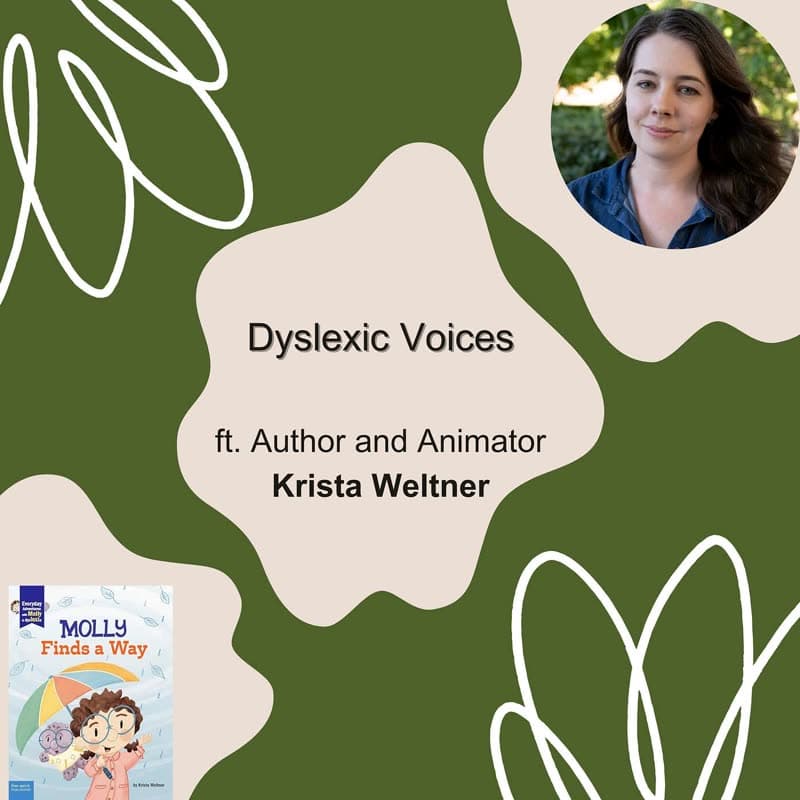
Dyslexic Voices: Author and Animator Krista Weltner
About this episode
You can find Krista online at https://www.kristaweltner.com/
Check out her fantastic animated short, "Partially Compensated" at https://youtu.be/4Dk1KAy16Fs?si=R1J8mDeYVBQM3tVm !
Find her children's books here: https://amzn.to/3ZfGFjt
Transcript
Full transcript · 6,295 words · about 31 min to read. Press a timestamp to jump to that moment.
So it's about giving kids the words and the language to discuss it in a positive light, but also in an honest way, because I think a lot of material out there can be kind of a little bit overly positive with the superhero, this is a superhero, this is a gift kind of messaging, and while that is good and we need to acknowledge the strengths, I also want to give an honest point of view.
It got me diagnosed when I was in third grade, and it was the most relieving day of my life, because I finally had like kind of a place to hang my hat and say, see, I told you, I'm not lazy, definitely not stupid, I just learned differently, like that's totally okay. We dyslexics, we were often, you know, just set up for failure, because, you know, we were given books and tasks that really are not appropriate for the level that we were at.
So how do you expect anyone to be open to learning, when their entire relationship with reading, with learning, is physical pain? Wish I had understood when I was younger that the fact that my brain worked differently than people meant that I would be good at things in ways that other kids were not going to be good at. I just assumed, I can't be dyslexic, because letters don't jump up and down for me.
Dyslexia is not a disorder. It is not a disease. Once you sort of own it and embrace it, then you can have the power to deal with it. It's sort of empowering and also enriching to the whole community. To those who don't understand what dyslexia is, that it's not a negative, it's not a problem, it's, like we keep saying, superpower. Hey, everyone. We are Sonja and Nick, and this is Dyslexia Journey.
And today we are excited to welcome Krista Weltner to the show. Krista, welcome to Dyslexia Journey. Hey, nice to meet you virtually. And we're having you on as part of our Dyslexic Voices series, because you are dyslexic. So we just like to always just start at the beginning when we're talking to people, even though, of course, we want to hear about your life now. And what trajectory your career has taken and all of it.
So we will definitely get to that. But let's go way back to the beginning, even before you were identified. What was it like for you? Yeah, well, I was identified when I was seven. So it's hard for me to remember that much about how dyslexia was impacting me prior to that. Because, you know, I was about first grade. I think I was second grade when I got diagnosed. So I was experiencing, what, first grade and kindergarten before I was technically diagnosed.
But I know I was struggling, but I always know, I also know I was excited for school. I remember having like particular issues learning, learning numbers, like compared to compared to my classmates. Like I remember that specifically, like learning my phone, my family's phone number, their home phone number, dating myself a little bit. That's OK. We're all in the same boat, so it's all good. And then, yeah, I was diagnosed when I was seven, second grade.
Yeah. And I always really liked school. I was always very curious and interested to learn. But my test scores didn't always match up to that curiosity, I guess. To you, I don't know how aware you would have been when you were seven, but do you kind of know how it came about? Like, was it a teacher who suggested that you might be dyslexic? Yeah, I think it was, I do believe it was a teacher, but my mom is also a teacher.
So I'm not sure if maybe she maybe had like an extra layer of interest and knowledge towards me on that. She's an art teacher, but still like she's worked with kids and everything. So I'm not really sure how it came about, but my instinct says it was the school who said it first. And then she probably was like, yeah, that's probably maybe we should get her tested. I do remember getting tested, though, really vividly because I was actually having a lot of fun getting tested.
I don't know how it is these days, but like for at that point, I remember they giving me like a lot of puzzles and activities. And yeah, I just remember that actually being kind of fun. And I don't remember my parents like sitting me down and telling me about dyslexia. We never really had like a conversation or I guess if we did, I just don't remember. But I did have accommodations through elementary school.
And yeah, I think third grade was probably my hardest year. Okay. Tell us more about that. What was extra hard about that year in particular? Yeah, sure. So, I mean, that was when I remember the accommodations really being very helpful, but also I had a really, really terrible experience. It wasn't my it wasn't my main teacher. It was a substitute teacher. So every Monday when we would come into school, our teacher would write our spelling words up on the board.
And I don't remember the exact number, but let's pretend it's 20. So she would write 20 spelling words up on the board and then we would copy them down. And then I would our routine was I would take my sheet back to her desk and she would quietly just circle the ones that I was going to be responsible for for learning. I think the setup we had was if I get the other ones right, it's just a bonus.
And so she left those she left instructions for the substitute like, hey, I have a student who's going to come to you for this for this accommodation or whatever. But I don't think the substitute understood the instructions. So she wrote them all up on the board and then she circled the ones I had to know on the board and then turned around and said, everybody copy these. But Krista only copy these 10.
So then the class like erupted and everyone was like, why does Krista only have to learn 10? That's not fair. You know, and she was an older educator, so we can forgive her. But she answered by just saying that Krista is just slower than the rest of you. Oh, my goodness. I know. I know. But, you know, I love telling the story because we were kind of a smaller town and I would go to her house for trick or treat.
And she was always the house that would give like pennies. She was like that kind of vibe of a person. Anyway, so she's like a little bit of a villain in my childhood stories. But yeah, that moment really impacted me. And then like from that, I remember in third grade specifically just feeling very isolated and confused and very ashamed. I think like with my Dyslexia Journey, I think that's a really important component to where I started.
I used to look at my books and rather than even try to read, I would just look around at the other students in the classroom and see how fast they were flipping the pages of their book. And I would try to like if my friend turned her page, I would turn my page because I was very nervous that people would see that I was dyslexic and notice that I was slower. And like after that moment when I was told I was slower, I thought I got to compensate for this.
I got to make people think I'm fast. So I did a lot of work to just combat that, I guess. Yeah, and I know this is jumping ahead, but I have to bring up your claymation film now because that was clearly, like, there's, I think, a couple scenes of the protagonist in that film looking at someone else to see when to flip a page. Yeah, yeah, and I put that in there because it is something I really, truly did.
Yeah. So, yeah, that's, yeah, exactly. So, like, that was a big moment for my, in my stop motion movie. And my stop motion movie, like, the character isn't exactly me, but I'm drawing a lot of inspirations from my personal experience. And the film is, is just completely nonverbal. It's just music with sound effects. And that was just to help the viewer kind of just get focused on her experience. The main character's name is Violet.
And, yeah. Yeah, since I brought it up, I guess, tell people the name of it. Sure, yeah, it's called Partially Compensated. It's free and available online. It's on YouTube. It's kind of tricky to find sometimes. You might have to type in my name. Okay, great. Yeah. Yeah. But it's also on my website. And I made it in school. I made it in grad school in 2015 or 16. I think I ended school in 2016.
So, it's been some time. And, yes, it's interesting. I love that it still resonates with people. And when I do events and things and offer this up as part of a visual medium that we can use to, like, kind of talk about dyslexia and have conversations around dyslexia. It's really rewarding for me to continue to hear new responses. Yeah, definitely. Well, we'll definitely link to it. And we encourage everyone to watch it because it really is beautifully done.
And maybe we'll get back to it in a little bit later. I want to make sure that we can go with your childhood. Well, yeah, so going back to school, so, yeah, so I have that sense of, like, you're getting the accommodations in elementary school, but now you're, you know, doing all that work to compensate. So, anything else about elementary school? Or I'm also curious because you mentioned that you had those, did the accommodations continue, you know, as you went farther, further along?
Or, yeah, so through elementary school, I had, at different points, I had tutoring outside of school hours, like after school. I had in-school sessions where I would, like, get taken out of class and put with, like, two or three other kids for specialized instruction. And, like, looking back, I think we were all dyslexic, but we never really talked about it. So, I wasn't quite, like, I thought we were all there for different reasons or I wasn't, like, quite sure, which I think is another good point.
You had a podcast recently, an episode talking about just the importance of mentorship for dyslexic students. And I think it would have been really valuable if I had known someone else who was dyslexic, even my peers, if it had been acknowledged, because I felt very alone. So, when I was entering junior high, I was kind of borderline on needing the help. And I was so ashamed at that point of being dyslexic, I just didn't want to be dyslexic, even though I was.
And I think based on my academic performance, my parents kind of said, okay, well, if you don't want to get tested, that's okay. Let's just, like, see how it goes. So, I didn't get any accommodations through junior high and high school, which worked out for my situation. I did, you know, I failed. I failed many classes, had to retake classes. But I was in an honors math, like, track, and at that point.
And so, it went okay. But I did struggle. And when I got to college, I also did not get accommodations in the beginning of college. But then I hit a wall when I was in second semester of Spanish. I have, like, a liberal arts degree in theater design and tech. But we had to take some language requirements. And I had to take Spanish. And I did the first semester. And then second semester, I had, like, full-blown panic attack in the class.
And at that point, decided, okay, I need to get re-evaluated, see where I'm at, get some help. And I did. And it was really helpful for me to have for the latter half of college, especially with paper writing, especially with time on tests, was really vital for me at that point. Because a lot of those tests would be, like, essay style, which, like, I can write and I can read. I'm just much slower.
So, like, that teacher said, I guess she was right. But in a good way, I just take my time. And I need more time to absorb things. So that was really vital for me to have extra time on tests. And, yeah. And then I went to grad school. And I did not have accommodations in grad school. But, yeah. I'm curious if you are able to identify where that shame came from that led you to wanting to or to not wanting to identify as dyslexic for a while.
Yeah, I just think that moment with the third grade teacher was super pivotal. And then my classmates, too, just, like, after that moment, I remember being on the playground and they were asking me, well, what's dyslexia? What is that? What's going on? And I had no way to talk about it or explain it in a positive way. All I could say was I'm bad at reading and writing, which we know now with the research and everything, we know that there's many, like, positive sides to dyslexia.
And that's really where my position on it has really changed. When I was in grad school and I was doing the film, I was doing so much research on it and learning about all the positive side of it and actually really, like, actually learning what's going on in your brain. And my position on it just really changed. When I was making my film, I was also doing a lot of research for my film and just learning about dyslexia from every angle and finding out that actually every way, all the ways, all the different creative ways that I think and operate and all these actual things that I've already identified about myself and love about myself were actually because of this thing that I thought I hated.
Right, right, right, because you didn't have that fullness, that whole picture of what it was really that was going on, because that is how it's often made to see, still even a lot of the time, because, like, it's one very specific thing. It's only about reading and writing, you know, it's only more difficult, you know. Yeah, and that's one of the key things we've tried to get across in this show is that dyslexia is like a whole brain difference, and there are lots of aspects of that.
And many strengths that come along with that. Right. Yeah. Yeah, absolutely. So, I'm curious then, I mean, this feels like a good time to talk about your career path. Sure. So, maybe we'll go, well, I'm switching the order of the questions we gave you a little bit, but I think it makes sense to talk about that, because I think often we do think of something like the arts, you know, being, you know, often, everyone's different, but often a strength for dyslexic people.
So, did you know, like, how was that trajectory for you? Did you kind of always know that that was your path? And then, you know, how did you end up? Yeah, I always knew that the arts and creativity were more my path. I think it's pretty interesting talking to artists, because most people, we feel like we started as children. And there's some, like, famous quote, I forget who's, I feel like it was probably Pablo Picasso or someone.
Somebody said that, like, everyone's born an artist, but the challenge is to remain so, or something like that. And, yeah, I think I came out of the womb creative, but also my mom, I said, my mom's an art teacher. Like, we had art in our home, and it was something that was really, like, valued and talked about. And I had ample opportunity to explore and play. And I used to make dioramas and make my own doll furniture.
And I had a grandmother who was an amazing quilter. And my mother, too, sews. And so we also got to experience a lot of just fiber arts and crafts in our house. Yeah. Yeah, and I was interested in theater later on. I also had, you know, I had a lot of opportunity. I think it's interesting, because with dyslexia, you kind of have to find your self-esteem outside of school or in other areas.
And for me, that was the arts. And it was also part of it, too, is, like, coping for me.
And some of what I do with my advocacy work is just try to help parents understand that they need to take care of the emotional part of it. And, of course, it's overwhelming what they have to deal with on the academic side as well. But just to remember that part of it. Yeah. Yeah, that's true that that's so important. So, yeah, tell us a little bit more about what you have done recently or what you're doing now, what you're up to.
Sure. Well, so I've worked in film. I worked on a Netflix film. I worked on a film with, like, a studio that's not out yet. And then I'm also an author and illustrator. And right now I'm in Orlando and I'm working in the theme park industry. So I kind of do do a lot of different things. But I'm very proud of my picture book series, Everyday Adventures with Molly and Dyslexia. And it was inspired by some of my experiences, but then also inspired by the community.
After I had come out with my film, I found myself in different places speaking with other people who were interested in the topic. So I really wanted to give the community what I felt like they needed. It does pull from my own experience. But, yeah, I also wanted to highlight specific things that felt like the world. For those who are watching this on video, if you want to show, hold up the book.
Oh, yeah. Or one of the books. This is the first one. Molly is a great discovery. So the first one is a diagnosing story. She doesn't know she's dyslexic. She gets diagnosed. But the main feature of my books is I've given her an imaginary friend named Lexi, who is her dyslexia. It's like a personification of her dyslexia and her imaginary buddy, who she can confide in and interact with. And this really allowed me to explore what we were kind of highlighting earlier, my own relationship that I'd been analyzing, my relationship to my dyslexia.
Right, right. Let's see. What do we have? Yeah, I mean, it's crazy looking at it now because I made it actually a couple of years ago. Where are these available? Can people just get them anywhere, Amazon? Yeah, they are available. I'd say that you can order them anywhere books are sold. If you like to get your book at Target, if you like to get your books at Amazon, you can order them.
But also, I like to support Bookshop, I think it's called bookshop.org. Because I believe that a portion of their profits goes towards local bookstores. So that's kind of cool. Or if you have an indie bookstore, you can probably order it through them. You just have to go through the extra effort of letting them know my name. So they should be able to get it. That's good. Yeah, any way you want to get them.
That's great. Yeah. Do you feel like, and maybe this is, sorry to spring this question on you, but do you feel like your, or how much of your sort of own feelings about dyslexia are you working through, like via the books and the film that you made? A lot of it, you know, in the second book of my series, Molly Tells the World, she's dealing with kind of what we talked about earlier, how when I was on the playground and children were asking me, what's dyslexia all about?
And I didn't really have an answer because I just wasn't equipped and I wasn't ready for that conversation. So Molly Tells the World is about, in that second book, she is questioning whether she wants to tell her classmates that she's dyslexic. And they have a new classmate who's come in named Leanne and Leanne is also dyslexic. And she's, the new classmate is really open about her dyslexia. Day one, she's like, I'm dyslexic.
And this is my imaginary friend, Izzy. So in this world, all the kids who have learning differences have a little imaginary friend. And so she introduces Izzy to the class. And then Lexi, Molly's learning difference is like, why, why can't I be known? Why can't you tell the class about me? So she's really grappling with that. She's not ready through the book, but I'll, I'll go ahead and spoil it because it seems pretty obvious where it's going.
She does tell the class. So it's about giving kids the words and the language to discuss it in a, in a positive light, but also in an honest way. Because I think a lot of material out there can be kind of a little bit overly positive with the superhero, this is a superhero, this is a gift kind of messaging. And while that is good and we need to acknowledge the strengths, I also want to give an honest point of view.
Yeah. Yeah. And then another thing I included in the book that I was like super, super invested in when we were, when I was working with my editor was I wanted her to be told she was smart multiple times throughout the series. Because I feel like dyslexic children don't hear that very often. It's not, it's not something that comes up organically for them. Like it does for their kids. So, yeah, that's all really great.
I was going to ask sort of about your, about within your process. and this maybe goes to all kinds of aspects of your process scheduling and everything. so it can be sort of the artistic process or otherwise. like how do you notice, like there's ways that you think are differences that you do things or how you, you know, almost accommodate some things yourself as an adult now. as an adult, I think, I mean, yeah, I use, so in part of my process, I do use Grammarly.
So I want to say something about Grammarly though, because they have added some AI features and I don't use those and I don't, I don't support those for creative writing and for coming up with work in the publishing industry. but there is, a lot of benefit for me in Grammarly because it, it's better than spellcheck. It's content aware. and using that just for grammar and basic spelling is like amazing. really speeds me up, but yeah, I run up against my dyslexia every hour of every day.
You know, I think, think about how often we come up with, come up to words, like when you're holding your phone, you know, so, and I only text my very good friends who know that there's going to be some crazy mistakes, who I feel comfortable texting with. and then, yeah, I, I'm, I made a mistake earlier online too. I, I make spelling mistakes all the time in particular recently. I've been doing this comic series where I'm like doing everything in Photoshop and I have to like dictate the words like within Photoshop.
I can't like copy and paste from a, or I could, but it's like a little, I don't know. So I'm, I'm kind of working out the kinks there, but I've had a couple instances where I've put something out online and didn't realize it was misspelled and people online will let you know in a way because I've kind of like, I look at it as like, I'm letting this out as like a beta test.
And before I said, admit it to a publisher. Right. Right. Okay. Yeah. That's interesting to hear. and just, I mean, it makes sense, right? Like that, like you said, every time you're encountering a word, it's, yeah, you're having that, but still it's different to hear it from you. So, yeah, I was going to, I wanted to dig in a little bit more about your art training, because you know, your illustrations in the books are beautiful.
The, the, film is, is amazing. I'm curious, how was it for you? Because I, well, I mean, our experience with our daughter who is dyslexic is that she loves art as well. Yeah. but she, she didn't love taking art classes in high school. She hasn't loved taking it because of, they want you to do things a very specific, particular way. I'm wondering what, what your experience was, if you can relate to that at all, or, or, you know, maybe it's different for you given that your mom is an art teacher as well.
well, I can relate to that. I can relate to that. Definitely. You know, in a lot of times when you're like learning, you kind of have to learn the rules before you can break them in a way. like for instance, in a lot of my drawings, I'm not really too worried about perspective, but it's become something that's kind of, it's a part of my style at this point. and, but learning those rules and having that foundation is important.
so I'm also a big like advocate of the arts and I hope to be a art, like a professor at some point. but yeah. And I, I do remember I would be like, and my mom had like an art studio in our attic and sometimes I'd be up there like creating or like doing something and doing just like little projects. and sometimes she would like start to come up the stairs and I was like, Oh, she's coming up here.
Cause I knew she was going to try to give me some instruction or something. And if she was like going to interrupt my process. Right. I can definitely relate to your daughter. How old is she? she's 17 now. Yeah. Okay, great. Yeah. Now, is she going to go off and study art in school? no, she's, she's, going to study, psychology. Yeah. At least as of now she's interested in becoming a therapist.
So we'll see. We'll see. Maybe she'll be a art therapist. That'd be cool. Yeah. I think that, in another world, I'm a, I'm, I've studied psychology. That's it. You know? Yeah. It's just another timeline. Right. Great. The one last comment on our classes too. I have a sort of a small little piece of a memory that I think sometimes depending on the teacher a little bit too, it was almost like bringing the other, parts of school into the art though.
Cause it was like, you know, if they put everything on the board and all those same kind of issues that can happen in other classes, which I think can be frustrating when it's like, feels like it should be the more. Oh yeah. Yeah. They had to keep a notebook. I remember in one of her art classes, they had to keep a notebook that was not just sketches. It was like notes about, you know, technique and stuff.
Gosh, you're reminding me of so many instances where I like broke the rules in an art class. Like, like I had this, so in grad school, I studied puppetry arts, which is like, kind of super niche. But one of our assignments was we had this marionette and it, it, it wasn't going to have legs. Like part of the design of this puppet we were making was it just has a head and it's got like a cape.
That was part of the criteria for us creating this performance piece. And I just like, for some reason forgot about that and like gave it legs. And then I, I was doing this whole piece. And then the other aspect of it was we weren't supposed to have words. It was supposed to, to our music, it was supposed to be like inspirational music, but then I used something with words. It's like, sometimes my creativity just like takes me.
and I have to slow down and remember that there's sometimes there's rules. Yeah. Yeah. so tell us more about the advocacy work that you do a little, I've sort of heard pieces of it here and there, but I'm curious about that. Like what have you been involved in and are there sort of hopes for what you'd like to be involved further in? Sure. well, my advocacy work really comes from doing things like this, telling my story, talking about my, my film and my books.
I've done a lot of, partnerships in different things over the years with the International Dyslexia Association. and that usually looks like, online events. Sometimes, sometimes we do them for free so that we can raise money for a cause or something, and then who else have I done work with? I'm working right now with the, the center for, what is it? It's the state, it's the Connecticut state education department, literacy and reading specialist or something.
But anyhow, we're doing like a awareness campaign and we're, the next presentation will be about my books. And the first one was about my film. And for that one, I actually gave a whole, like almost a lecture on stop motion and the history of stop motion, which was really cool. And I do school visits. yeah, it's kind of as often as I can kind of thing, because I, I can't do this stuff full time, unfortunately.
so maybe that's what I would like to see in the future. If I could, if I could be doing this full time, that would be really neat. So people could, you know, you might, or might not have time, but people could reach out to you for this kind of thing, then whether it's. Oh, absolutely. Yeah. Yeah. and you know, whenever I'm doing these events, it's, I like to, I, I, I love to be the, the person that can speak to the experience.
Like, you know, on this podcast, obviously you two are very passionate about this. and it's just fun to, to get in the room with other people who are passionate and I'm so inspired by mainly educators who are just so, it just feels like a life purpose for them to help these, these children. So, we'll make sure to put your website, of course, in the, so people can, can find all about, all about what you offer as well as your work.
so as we get sort of towards the end of this, we always like to, you know, have you even sharing your wisdom the whole way, just with your experience, but you know, there's sometimes there are perfect, certain things that people would like to get across. Like you had so many really intentional things, of course, in your picture books. so if you, if you could tell your younger self something right now, what would that be?
I think because I'm, I'm naturally so anxious and like, maybe it's from the dyslexia and maybe it's also other things. I think I would just tell myself it's going to be fine. it's going to work out. yeah, I mean, that's, that's kind of the crux of it a lot of the time, isn't it? Because it doesn't feel like that in the, I mean, in the moment, it's hard to sort of see that, but to know things do work out.
I guess you've also, I guess you've also written three books, sort of telling your younger self, maybe what you would have wanted to hear. Right. Ooh, yeah, that'd be kind of cool. You know what? I would go back and say, take a Photoshop class. Cause I, I taught myself digital illustration, like after school. and it would have been nice to get some formal instruction. Yeah. what about, well, would you, anything else you would want to tell dyslexic kids out there or perhaps their families?
Yeah. I think for dyslexic kids, I would say just dream big and set your goals high. Like there's no reason you can't achieve whatever you want to achieve. and it might just look different. Your path might look different, but that's okay. Yeah. And you can get there and you're smart. You're so smart. I think for parents, I would just say, you know, take a breath. I think, you know, I talked to a lot of parents.
I think I would just say, take a breath and you're doing good. And, you know, it's going to be impossible for the, it's probably going to be impossible for them to get through their early education completely unscathed. so it's just a part of the experience and you're just going to help them through it and it's going to be okay. Yeah. So important for the parents to hear too. Yeah. Yeah. and then, what would you like the general public to know about dyslexia?
Well, two really specific things. One that it's, I would, I would just wish that they knew more about what it is. I think a lot of people, they just think, oh, dyslexia. So you see letters and like backwards and like some people do, like there is a visual component that like some dyslexic people do, but it's just, it's so much more than that. It's a language. I don't quite know. I'm not a complete professional over here, but it's like a language based, like processing neurological thing.
I don't know if we say disorder, but it's, you know, it's just, it's a lot deeper than just, it's not a visual problem, I guess, is what I want to say. I just want them to know it's not a visual impairment, but there is a visual component potentially. I think it's hard to describe what that exact experience is like, right? I mean, how does one describe it? You know, a brain difference, what that experience is like.
And then the other thing is like, I, oh, I guess I would just say, if you're looking into literature, work like these picture books or like other books about dyslexia, just make sure you're looking at current, like, or not relevant, recent information, maybe published in the last 15 years or so, there's some stuff that's out there that I feel like is still very popular, but it's kind of older and might not have the best, language or it just, you know, it's just not up to date.
That is really important. That's actually something I hadn't thought about before, honestly, but like, that is a really good point because, yeah, because there's reasons that we do things the way we do now. And the first, in the first point too, you know, kind of any way that we try to describe dyslexia feels kind of reductivist, right? Like, like it's not complete. Yeah. Well, and it is, it can be this amazing thing.
Like there are a lot of, you know, like I was saying, I kind of am frustrated with the superhero messaging, but it's, there are a lot of positives and like some of my positives are that I'm a, I'm like a big picture thinker and I'm really good at storytelling because I can see the whole story and I'm really good at, coming up with new ideas and solving problems. And I think there was some study about that, about, like dyslexic kids will come up with like a certain percentage, more solutions to every problem.
Like if they're coming up with a hand, if one kid is coming up with a handful, a dyslexic kid has two handfuls or something. So, yeah, it's so important. You know, did, so if you have any last words you'd like to share, this is definitely your chance. but I really want to thank you for all that you have shared already. Like, you know, everything from the, that vulnerable and awful moment that you had to like your whole trajectory to all the beautiful work you're doing.
So thank you for that as well, for the community. Yeah. And I really encourage everyone to watch the film as well. We'll link to it. it's, it's really powerful. Yeah, please do. I'm, I put it out there for free online cause I just want people to see it. So beautiful. All right. Well, thank you so much. Thank you.
More from the show
Learn to Love Listening ft. Cliff Weitzman, Dyslexic Founder and CEO of Speechify
In this installment of our Dyslexic Voices series, Cliff Weitzman, founder and CEO of Speechify (https://speechify.com/), tells us about his experiences growing up dyslexic, and shares his advice for how to succeed as a dyslexic child and adult.
Make Real Progress on Big Goals For Your Dyslexic Kid!
We all have goals for our dyslexic kids, but they often seem overwhelming and out of reach. In this episode we provide specific, practical tips for organizing the goals into smaller chunks and making daily progress.
The Attacks On Your Kids’ Rights to a Free Appropriate Public Education ft. Attorney Laura Heneghan
With all the changes in the US recently, it’s hard to keep track of all the implications. In this episode we dig into the changes at the Department of Education, executive orders, lawsuits, and more in order to understand how these changes could directly affect your kids!
Never miss an episode
New episodes every two weeks. Follow wherever you listen.