
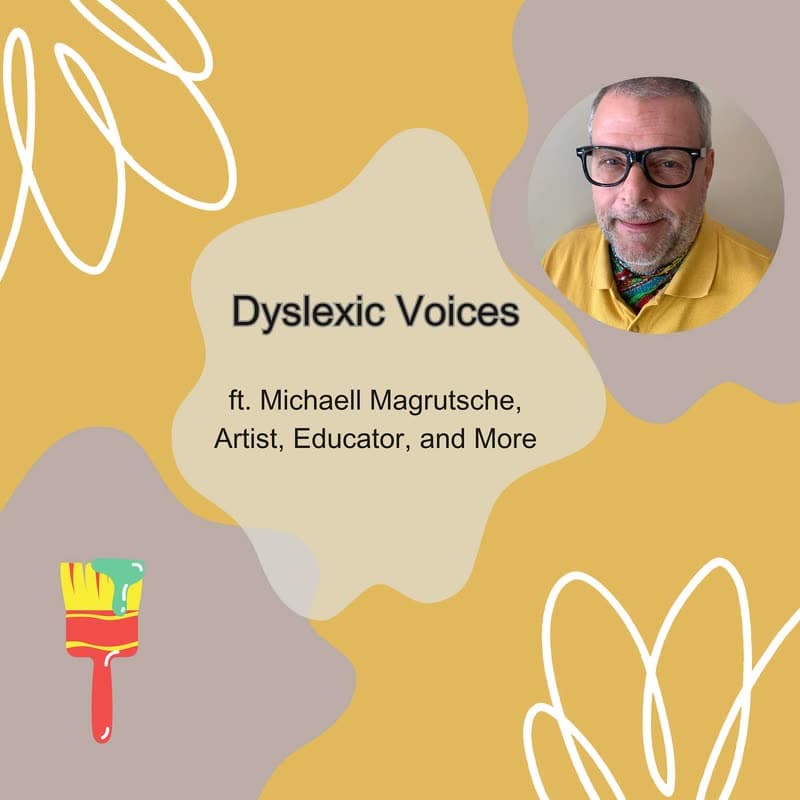
Dyslexic Voices ft. Michaell Magrutsche: Artist, Educator, and More
About this episode
In this installment of Dyslexic Voices, we had an engaging and wide-ranging conversation with Michaell Magrutsche. Here is his bio:
Austrian/Californian Michaell Magrutsche (mag-rootsh) is a multidisciplinary artist, strategist (private, corporate and political) Creativity-Awareness Educator, speaker and author.
Michaell works on raising the awareness of our limitless human-potential. Dyslexia/dysgraphia forced Michaell to develop an awareness to see the world contextually. Having a more human-centric perspective and art-creation saved his life feeling like a human being instead of an outcast.
Today, Michaell’s unique comprehension allows him to contribute to almost every topic. Michaell is an advocate for human-education and understanding neurodiversity.
Michaell is totally self-taught and wrote 6 books about art and humanity, man-made systems and human inclusivity. Creating art taught him understanding the nuances of human-centric vs system-relevant living.
You can find Michaell online at the following:
https://MICHAELLM.com
The Smart of Art-The Power of Art and Creativity 30 sec Podcast: https://podcasters.spotify.com/pod/show/michaellart
LinkedIn: https://www.linkedin.com/in/michaellart
Instagram: https://instagram.com/thesmartofart/
Threads: https://www.threads.net/@thesmartofart
Twitter: https://twitter.com/michaellart
YouTube: https://goo.gl/gPM7cq
Facebook https://www.facebook.com/Michaellcoach
SoundCloud: www.soundcloud.com/michaellart
Amazon (books): https://goo.gl/tpDQk3
Michaell’s writings about dyslexia:
DYSLEXIA from SHAME to FAME - An Introduction to Grasp Dyslexia’s Impact Part 1 by Michaell Magrutsche https://www.linkedin.com/pulse/dyslexia-from-shame-fame-introduction-grasp-impact-part-magrutsche/
DYSLEXIA, From SHAME to FAME - Getting a Grasp on Dyslexia Part 2 by Michaell Magrutsche https://www.linkedin.com/pulse/dyslexia-from-shame-fame-getting-grasp-michaell-michaell-magrutsche/
Transcript
Full transcript · 8,793 words · about 44 min to read. Press a timestamp to jump to that moment.
Don't think ever about your dyslexia. Think dyslexia is a blessing. And dyslexia cannot be, it's not the same, because my dyslexia is different than other people's. There's no, they've never found two dyslexia that are the same.
Hey, everyone. We are Sonja and Nick, and this is Dyslexia Journey. And today, as part of our Dyslexic Voices series, we are excited to welcome Michael Magruch to the show. Michael, welcome. Thanks, guys, for having me here. I enjoy it. And let's talk about dyslexia. You know, I don't want to, you know, I always, when people say, oh, you're dyslexic, when we put a name to something, when a kid says, sees a flower, sees a flower, and it says, ah, flower, a color, you know, and smells it. And then you say, you know what this is? This is a rose. This is a white rose.
It takes the whole experience away. And when you put, and we know that dyslexia is not the same. There's no two the same dyslexic. Everybody's different. So I really, I know you've got to, you know, coin it, because you want to talk about this. Obviously, that's the thing. But I think that's a good start when we talk about, you know, defining people as female, male, gay, race, anything. See, this is my whole thing that came out of my, because art creation helped me survive. I wouldn't live today if I wouldn't have art. And so since I'm five years old, I'm an artist. I was probably before, but, but I'm just constantly creating.
And it wasn't about the art product, but it was about the, the, the creation itself. It was born in Vienna in Austria. And it was very systemic and everything. So even when I wanted to play guitar, I had to, I wanted to play like Hendrix. I want to do, you know, shredding guitar, like Led Zeppelin or whatever. And they said, and they said to me, no, you have to learn classical guitar first to even get, I mean, nobody could even imagine this in America. You have to buy, you have to play, play classical guitar first to then go to electric guitar. And because I'm nerd, I'm also dysgraphia. So my hand, eye coordination did not work at all. I learned two years guitar, classical guitar, and I know four, four, four chords.
Yeah. Yeah. Yeah. Yeah. It's interesting. So, so you've obviously forged forward with your art and you were already an artist, as you said. So like, so what was that like, like you versus kind of how things were? I mean, how did, how did that unfold for you? So when I went to school, I think they said after the third grade, because I almost, you know, didn't pass the third grade and I wasn't a nasty boy that was just a rebel or anything.
And then, and then, so they put me to a doctor. That was 50 years ago. This is a different, this is a different time, you know? And they said, oh, you're dyslexic. And that's it. You still have to read. You know, I was stuttering. I couldn't read. You still have to do all this stuff. So there's no difference. It's basically just now we know you're, you know, you're crazy. And that's it. You know?
So basically, so that I could never, so I did eight years of school and I repeated two because in Europe, they don't pull you with you. Do you have to repeat it? And you know how that was when you're 12 years and you're with 10 year old in the class, you know? So life was very much for me, like a wall. It's like, I cannot live this life. I cannot fit in.
And what, what developed out of this was through art creation. I found other kids that created art too with me. And then I formed the human bond there, you know? And, and to this day, my strength is to have a human bond with humans. And that's forced me because if I was system relevant and could have fixed the school, I would have been like the world is today. They can't talk to each other.
Oh, it's a woman. Oh yeah. I don't like woman. Oh, you know, or it's a guy and he's an Asian guy. I don't want to like an Asian guy. You know, it's crazy. So, so actually, you know, my devastation helped me actually to learn and grow and, and realize the whole thing, you know, about, about the human centricity that I'm writing now. And, and, and, and, and, expel everywhere. Because I think when we see the, our lives as a, because we are 8 billion people with unique life perspectives.
And when we see life as, there's two parts. One is our metaverse. That's the systems that we created. And one is human centric. So we are all one of one with a unique life perspective. And why is that? Because nature gave us one of one so that we fit synergistically to each other, not on top. So this is, this is what, what helped me actually finding this. And, and a lot of people love it. They just say, Oh my God, now I see it. It's, it's decision-making is according to Harvard.
The hardest thing of stressor, the biggest stressor that we have, that is artificial, not I'm running away from a mean animal or something. When you have a, have a stressor like that, the, the stressor, the hardest stressor is the decision-making for all stresses is decision-making is the hardest stress. And when you look at life, at your life system relevance, Oh, I might not get that promotion or whatever. It's a system relevance. It's not a human. You still have your wife, you know, it's like you have your kids, your wife, and you didn't get the promotion.
Yes. That's makes it harder, but that's a system relevant thing. You know, it's not, it's not a human thing. And that helped me help me find that. Do you feel like you, do you feel like the fact that you were dyslexic and kind of different in that way helped you, come to this realization about humanity and about everyone's sort of unique characteristics? Yeah, because I, I, I've worked with the octopus movement and this is all neurodiverse people or mostly neurodiverse people.
And we find out that 40 people from all around the world can talk to each other while somebody is painting, while somebody is doing this, somebody, everybody is doing something different. And, what Perry, not, but is the, the, the, he is the founder of that. And he, I was so amazed that we could crank out white papers about AI and all this stuff with all these neurodiverse, they have twitches, they have whatever.
In an hour, we cranked this out and I'm with super, you know, I was a politician myself and, and, and, and I'm advisor, also political advisor. And when I talked to the top people, oh my God, it is so hard. This is all easy and the paper is good. We just did one on education. It's, it's, it's really good. It's just amazing how we can fit with each other. You know, how we can, I mean, you and me, you know, we, we don't know each other.
Boom. You know, it's just, it's just there. It's just natural. We have six senses and, and it works. That's the natural thing. It's not the not natural thing. Yeah. So what is it about neurodiversity or about dyslexia? Do you think that, that makes that kind of, maybe easier? I think it forces us because we have no, it's about life force. We don't have the life force to adapt. It's just, it's just, it's just, we're too sensitive and we are forced basically, you know, and it's funny because there's two kinds of neurodivergence.
So there is the, on one, on one spectrum, I am on the one side of the spectrum, total creative, always creative, always creative, always in the moment. And there's other ones that have, they were so shamed and so pushed, put down that they're completely copy system relevance. So they are the super AI guys. They are the super, you know, technical guys. They are the super, they know everything about philosophy and everything about, psychology and, and they know everything.
They just adapt it and, and, and, and, and so, so everybody's different, you know, but some people, when the shame and the, the, the degrading is too much, they actually move there or they die because a lot of people that I was friends with, they passed away. You know? Yeah. I'm wondering just to go back to your own journey a bit, if you could just give us, it's been so also diverse and, I think it's important for people to hear that sometimes, because I think that a huge part of the system, at least in this country.
And I think, you know, is that there's these like paths and, you know, it's like so structured, like in terms of how people view the unfolding of their life and their vocation. And so I think it's interesting to hear how that can unfold in a very different way with a lot more, to it. The, the thing is also, we have to see, we have to, I've always come back to that. We are all one-on-one.
So, but the, the synergistic learning is that's why podcasts are so powerful because they're not moneymakers, but they're very powerful for the human race. So, what do you guys do is very, very, helpful because then I can relate. It's about the relation. -huh. This one-on-one person has this. I cannot resonate with this, but the other person is a one-on-one. I can relate with them and I can learn something. And, and even when he sees me, he learns a little bit, meaning it opened.
Learning is not copying. Learning is opening the one-on-one perception that you guys have and I have, and you both have different views of me. And because you're one-on-one and there's nothing wrong with that. And so they, by dancing with each other, talking and podcast, especially, you open your, your perception. And even the listener opens their perception and that's like exponential growth, you know, because they take the five words they need or the two sentences they need or the word they need.
And, and it makes them, ah, I'm okay. And I will always say people, you are okay. You are one-on-one. There's nobody can tell you what to do because you were okay as one-on-one. So I'm one-on-one and did this. I want to come back to what you said is yes, I was, I wasn't one-on-one and a lot of people either got on drugs, got, you know, you have in the prisons, you have 90% neurodivergent people, you know?
So, so, because they can't fit in the system. So, and they can't, you know, make money the regular way. So they have to steal or do some crime or something because there's no other, other ways. and the stuff is, you know, I was blessed. I would really say I was blessed with a spirit that is strong because I was a sick child. Not only did I have dyslexia ending, I was a sick child.
I went to school with seven. So one year late, I, you know, I, and I was sick till I was like 50. So I was 50 years old. I hit the wall. I hit the wall. I hit the wall. I tried to fit in. I tried to do, and I knew it was dyslexia, but I still tried to do it. And, and, and I think this, you know, might, might also strengthen my spirit.
You know, it makes my, my strengths to me is because they say, you know, when you shower cold, it's good for you. When you, when you fast, it's good for you. So now the whole wave of doing, you know, stressing yourself, naturally, not like, you know, make a decision of what, you know, what to do in the next 10 years. So that might've made me also, because it was so extreme for me, but on the other hand, I, I, when I, I dealt with it because I found art creation.
And we know that dyslexia and neurodiversity, the art is, is, is wonderful because there is no structure. Art wants to just be created and exposed. So if I paint a picture, I want to show it to you, I show it to you. And that's it. I don't need to have, see, systemically says you need a hundred thousand followers. You need to make thousands of dollars and whatever. No, you just have to, art only asks to create and expose because in the exposure is, is, is the connection with other humans.
So when I create something and I show it to my grandmother, then I, you know, I, I have the feedback. I have a magical experience in creating. That's always a magical experience because otherwise you wouldn't create because you don't have to. So when you create, you have this magical experience. You could have watched a movie, but you're creating and you built this stuff where you said, I'm going to make this clean up the room and create that new and design it.
And then when other people look at it, you get a feedback, good or bad. It doesn't matter, but it hones you. And then you also get on a level, which I got. Yes. It's easy to say, you know, guys, I don't like this or I like it. It doesn't really matter because everybody's one of one. And then on the other hand, it's, you learn if the person hates it and he hates everything.
Then, you know, you learn every time I show you guys this, you hate my work. So, so it's not me. It's not you. It's just, it doesn't fit. So, so you, you learn from, because in nature, there's no mistakes, right? So you learn from experience and experience is much more than knowledge. What you learn from experience exponentially more than from knowledge. So one thing that you mentioned, I think that you're primarily self-taught and, you know, one thing I've noticed with our daughter who's dyslexic is she loves creating art as well.
But in a very, very much in her own way, she doesn't, she doesn't really enjoy kind of structured art classes. She likes to, she likes to, to do her own materials or her own just, you know, what she wants to represent. And was that kind of a similar experience for you? And do you think that's kind of universal to dyslexic people? Yeah, because I, I, I think I'm one of the very few people that really understand art creation, not the art product.
Because I was, you know, doing this for 60 years. So what happens is, and I'm focusing always about the creation because I couldn't do the, like your daughter, I couldn't do the portrait. I couldn't do the plein air like it was made. And I think what happens with this is, it gives you instant feedback when you create art. So let's say I'm angry. And you, you know, that's what the parents say, you know, go, go out and run in the woods, do some sports.
And I always say when kids are really crazy, I say, give them some sports or, or, or let them create. And when they create, you don't even need to tell your kid because your kid comes, that comes back a day later after they painted something. And they see, and, and, and they get the feedback. They don't need to say, oh, that's not bad. That's light. That's it. And you can ask the kids, why did you use these colors?
Why did you do? I just want to understand. And that is such a learning, awareness, you know, self-awareness tool because you, you created that, not your parents said you need to do that. You created that out of your freedom of expression. And when we believe that, you know, humans are a collaborative creative species, so we can create our own habitat, you know, houses and, and whatever, you know, ants have forever had ant hills and elephants were elephants, but human species can create their own, you know, that's why we are self-aware because we can create our own habitat, our own metaverse.
And that's, you know, and, and our first superpower is, our first superpower is creation. And the second is what we're doing now, dialogue, human-centric dialogue. And the third is adaptation. Because if you and I don't adapt with our six senses, we can't even talk. Yeah, I'm curious, because I know you've done, I can't remember your exact positions, but you've done work, like you said, politics and different positions, I assume sort of to promote.
These ideas. I'm curious, like how that went and like, what was the receptivity to it? No, there wasn't. There wasn't. Okay. So this is another thing I tell people. Success happens when the time and everything is right. I was, I was, I was, in documentary, creation, and I, I created, and so I was the first time in the, like the come film festivals. They were, before and after television, the same for television.
And I walked, you know, for my lunch, I walked back to my booth and, I worked for a documentary company and somebody tipped me on the shoulder and said, excuse me, are you Mr. Magruch? I said, yes. So it's right here. It's my tag. And he gave me his card and said, when you're next time in LA, can you give Mr. Evans a call? And I didn't even know who Robert Evans was.
And he was the, you know, longest, Paramount CEO. And I had no clue of what they did. And I said, okay. And I showed to him, he said, this was weird. The guy said, when I'm back in LA, why does he know that I'm not in, you know, that I'm in Austria and in LA? I'm in LA. But how, what, why, why, why? He said, are you crazy? That might be Robert Evans.
That is the chief of Paramount for 14 years. I said, I have no clue. I don't even know them. I've never heard about him. I heard, heard about the movies, you know, Godfather and Chinatown and all that stuff, but I didn't know who he was. And it's, it's a, and I thought it was like a hoax that my friends, they made a hoax on me. So I, I went, when I went back two months later, I went back to LA and I called the number.
I didn't even call the number first because I still didn't believe it. So I had some time and I was like, oh, oh, here, let me call him. Oh, Mr. McGroach. Hold on. And I got right away through and then he talked to me and then he invited me and then he wanted me to work with him on a documentary because I was in the documentary business. So, and he invited me to live with him.
So there was nothing, it was all human centric. He liked me and I was always driving from Newport to, to LA. And he said, don't move in here, move him to my house. And, and, and, and, and, and I have no, and I'm not a guy that lies. I'm not saying, oh, I'm all that, you know, like, like, you know, I have all the education. I said, Hey, I have no education.
I've never done, on this level, documentaries. It doesn't matter. You know, come, I, I know, you know, and he was very feeling too. I think he was also dyslexic. I don't know. I don't know, but, I think he was also a nerd. He did it all by feeling and we became really, really good friends. And he's a wonderful person. It was, it was a wonderful person. And, and then the other thing is I, I, I submitted and I was so upset about the, they did a sculpture garden.
And I was so upset because the plan of the sculpture garden was to buy sculptures and leave them. And I said, you can't do this. You have to rotate because that's better for the artists. And it's also better for creating a history about the sculpture garden. And I was fighting that very much with the Newport Beach, not fighting. I was just saying, I was in every dealing with it, with the, with the things and said it.
And I said, and I say, it didn't go anywhere. So I filled out the thing that I want to be an arts commissioner. And three years later, and that didn't win the first time. So three years later, I get a phone call. It said, you were just voted six of seven, council member voted for you. And I had no idea. I didn't, I didn't kiss anybody's butt or anything. It just happened.
So, so I want to say life happens no matter what you do or what you, it just happens. It's like, it's like, it happens in the positive and the negative. You know, something can happen to you. Something can, you know, you have a disease, you have an accident. Yeah. That's what everybody says, but the positive happens the same way. Yeah. If you're just open, if you just, just say, yeah, I'm being in the moment, you know, right now.
Yeah. Yeah. So it sounds like you, you have, I guess, live, live, you live your life fairly intuitively. Is that, is that a fair assumption? No, I cannot do it otherwise. I mean, I'm trying, if I try, I've never gotten a job from an application. Never. Because I, you know, I'm, they asked me saying, and they said, I know I can't do this because I know what I can do. I mean, if you want to put me in a, you know, you want me to make me a job where I do a lot of, computer work and a lot of, I think I can't do that, you know, you know, a balance sheet or something.
I can't do that. And I said, yeah, you know, I, I have never learned it. I can do it and I could do it, but it's very slow, you know, like dyslexic. We are very slow when we have to figure something out and have to concentrate and we need time to come back to the thing and, and all the stuff. So I know exactly what I don't know. And, and I know myself and I think that's the most important for any human and especially for neurodivergent kids that have to figure out themselves where they say, Hey, I don't know.
It doesn't matter if you don't, because you're one of one, it doesn't matter if you know somebody else will know what you need to know. Yeah. So it sounds like that, that's maybe kind of your main, I mean, I don't even know if you like the term compensation, but that's the term that sometimes gets used, right? It's, it's, it's, you know, as a dyslexic adult, sounds like the first thing is just to understand yourself and what, what you're good at and what you're less good at.
yeah. Yeah. So what other, are there other kind of techniques that you use, to, kind of deal with, the fact that you're dyslexic? Yeah. So there's a, there's a lot of things. First of all, you have to, I think for any dyslexics, because we are also going, you know, dyslexia comes often with depression and whatever. And when you're depressed, you're not in the now, you're, you're in mind constructs and what helped me is, I think I wouldn't have, is meditating, but I couldn't meditate like everybody, like consciously meditating.
I was just passing out. I was just passing out. So to keep my, my brain time to readjust, to digest. And today is so busy. Life is so busy, systemically so busy that you can't even think about it. You can't even think about it and saying to digest it and say, Oh, next time I'm not going to do this, you know, or I'm going to do this or I'm doing it different.
You can't digest what you experience. And I think for dyslexic and neurodivergent people is very important. And this is human. This is not, this is human that human need to digest and experience. And like I had friends that want to do a world trip in 14 days. I said, what the hell would you do that for? But money was no problem. Right. But I said, why would you want to do this?
That's like wasting your, what is more important, your time, because you cannot digest a world tour in 14 days. And everybody, you know, with the traveling, so it's, everything is done for what you have to do. You have to travel all over. I want you to travel all over. I want you to do this. I want you to do that. I said, that is crazy. You need the time. Remember, I mean, you guys are old enough.
You, you remember that, that in the old days you had, you drove, at least a vacation was a week or 10 days, right? Or perhaps 14 days. And Europe is three weeks and four weeks. It was. And today, I think it's two days, four days. You're flying, you're flying really hard to get four and four days, get back to India and back and, you know, you went in there. So what can you see of India in a week or, you know, five days or something?
You can't. Yeah. Because you can't even digest it. You can't digest the information that you experienced. The experience needs to be, the life experience needs to be digested. Yeah. I mean, that's something that we've, I think, noticed with, with our daughter and with, you know, that we've heard from, from other dyslexic people too, is that, I mean, I think, I think that's universally true what you said. Exactly. But also, people with dyslexia, it does seem to be maybe more manifest that, that they need kind of more time to digest things.
Yeah. And that's why we become conscious of, we become aware of what humans need. See, that's where the neurodiversity comes in. And what I wanted to also say with your daughter, when she's bored, don't entertain your daughter. Let her find her own, because that's connected with that digesting. So let her digest boredom, instead of constantly stimulating her, because then she, she doesn't trust her own expression. You know? So let her, let her part and let it come in, what she needs to express.
Yeah. Yeah. I mean, I think that's good universal advice as well. But yeah, it's really interesting because it's so true that it seems to be getting faster and faster and more, more of the orientation in the culture. So it's very, very countercultural, actually, to be saying, even though it seems so obvious too, when you say it, but it's very countercultural, actually, to try to live. Not that way. And so, yeah, I'm just curious.
Do you have any more thoughts or advice or tips or anything on that? Like what you'd like to see that people can be countercultural in that way? They don't have to, look, I believe, and what I want to see is, I told you, the system relevance, when an issue, when an issue, whatever issue you have to solve or make a decision about, to look at is, is a system relevant issue? Is this a human centric issue?
And I want to see, I don't want that, systems are not bad. Systems are just antiquated. I want really to be, people say, oh, you're anti-system. No, I'm pro-system. Because what is a system? It's an artwork, a collective artwork we created for us all. So, for example, the underground in YouTube in Russia, right in Moscow, these beautiful stations in, you know, they're like a palace, you know, for the underground, for the tube.
And I think all our systems would need to be updated. And because we didn't update our systems, education is 1845. We still have this very much same education. And they need to be updated not to a generally human thing, but that every human is not a species that has male, female race and sexuality. That's it. No, the race, the human species is one of one, everyone. And we know there is women that are much more masculine than any man can ever be.
And we know there is men that are more feminine than any woman can be. And it is about the one of oneness. And I want not to be anti or even unplugged, but encourage all the listeners to what can you do to update the systems or make people aware, hey, these systems need to be updated. They haven't been, you haven't changed, you know, you've been a building and if there's not asbestos, nothing would be changed.
I mean, this, you know, they have an asbestos thing. Okay, we've all know, we are aware, right? Asbestos is bad. No, they changed the ceiling and that's it. Yeah, but they say, why can't we make that beautiful? All of a sudden, all the artists, all the creative, all the neurodivergents would have jobs because we make it beautiful. We make, you know, going to a, I'm just saying, going to a restaurant or going to social services.
Why cannot social services be a wonderful experience? Why can't we make this a beautiful experience? Mm-hmm. Or a doctor's office? Yeah. I mean, give me a break. Mm-hmm. A hospital. Now, you know, the biggest breakthrough in a hospital is that we don't make white walls, but we make light beige color or a green. That's the only thing. But we still have the neon lights with the blue light banging down on us.
I mean, God, what are we doing to ourselves? Yeah. Yeah, for sure. Right? I wanted to pick up on something you said about how we're all kind of unique, where we, literally, we are all unique. We're literally all, I guess. Yeah. And, you know, this is something we've talked about, that we've talked about a lot on the show, is how the educational system is, you know, just sort of observation. Anecdotally, this isn't really qualitative, but it seems like, you know, it maybe works well for about maybe 10% of the kids, at most.
At most. At most. I think it doesn't work for anybody. Yeah. Yeah. And it's frustrating, you know, not just for dyslexic kids. I mean, there are plenty of people who are not dyslexic who, you know, do not do well in our systems. And it's frustrating, I think, that it seems so hard to... You know, unsystematize things and really recognize everyone's uniqueness. Yeah. But it's easy when you get it. When you're 101 and say, hey, everybody's 101.
It's not wrong if it doesn't agree with you or you don't agree with him. He's a 101. So, or she's a 101. Yeah. I would say something. What this is also because systems have not updated. I mean, you know, the iPhone updates pretty much every day, right? All the apps and everything, right? Because it's the most human-centric tool that we have. If we cannot talk to each other on the cell phone, you know, that's a problem.
So, that's why the cell phone needs to be updated. Every system needs to be updated all the time. Because what education has to become, and I work a lot with this age, because I'm an expert in education, because I haven't had any. I haven't had any. I'm the expert of education because I didn't have any. So, I work with a lot all over the world with education, people of education. And I've done a lot of podcasts.
So, you can look that up. You just put my name into YouTube. And then, if you were interested in that. But, what I found out is that the system became its own metaverse. So, I always call all systems metaverse. But, the education has its own set. Because, have you learned how to deal with a lawyer in school? Have you learned how to pay your taxes in school? Have you learned to do stuff that we always have to do?
Because, if you don't do it, we get in jail. Have you learned that in school? No. So, you have not learned that. And, you have learned stuff that you don't even need. So, basically, the stuff that you focus on in education is not what you ever need. It's just to get the certificate that you have that education. And, really, we know, you know, from all the education, that it's never what you learn.
It's the human context that you make. And, that's why you pay $500,000 in Harvard and Yale and stuff. You know, because, not because what you learn. Because, it's proven, too. They said, you learn in that school, that is a little school somewhere. Or, a little university somewhere. You learn the best thing. Not even Harvard or any Kintuchta. So, it's the human interconnection that's the value. The one-of-one, knowing the ones-of-ones that synergistically fit with you, that is the key.
So, I'm not against Harvard or a thing. But, they need to be updated. So, that it's not, you know, it's just, it can't be like that. But, where you don't learn what you need in school. I mean, the only thing you learn is meeting the right people. See, obviously, if I know the right people, I don't need to write a resume or anything. I just get the job. I say, hey, Sonja and Nick, we did this interview.
Can we do a thing? Can you hire me? Yeah. Oh, yeah. You know, it's just, that's how it is. And, if you don't like it, so, no, we don't hire you. But, it's, that's, I don't have to write hours of a resume and try to do interviews and whatever. And, it's simple. Humans are very simple, but systemically, we are. Yeah. This is sparking something that it's not quite full thought in my mind here.
So, let's see how I can come up with it here. Because, I'm just thinking about how, you know, what you're talking about isn't the whole extroversion thing. Like, I get irritated sometimes because there's such a huge push here. Like, everyone has to be the extrovert. You know, kind of like everyone has to be the leader, right? Like, you're all taught leadership skills. You have to put those on the resume. Oh, my God.
And, like, everyone said it. So, I guess I'm wanting to tease out how, because I know that it is. I can sense that it's totally different what you're talking about. But, yeah, this, like, this one-on-one connection is different. This is not extroversion. I wonder if you can speak to that a little bit more. Yeah. So, we are in a world where everything is a lie. Because it has become a lie. Because it wasn't updated, the systems.
It wouldn't have become a lie. But it has become a lie. So, when you go on any social media today, you see only two classes of humans, right? I said everybody's one-on-one. But you see two classes, the leaders, you know, like Elon Musk and blah, blah, blah, blah. And the people, the rest of us, they pretend we live the same life. And everybody is like, I'm one time, you know, I'm living with the pigs.
And then I go one time into the city in front of the Ritz-Carlton and then just make a photo of me. So, I'm not even expressing myself being, playing with the pigs and living with the pigs. I want to be like everybody else. And this is where the boredom comes. We all copy each other. We all want to be part of it and not looking at the one-on-one. And I say the only thing that we can actually make life interesting and excited is having a one-on-one perspective.
And being, you know, and not saying I'm insisting on mine. No, just I say it. You don't have to believe anything I say. It resonates with you in your perspective. And I think, I hope I answered you the question. You said why we are external. I think we are external because, and that's why we're lying. Because I could have said, you know, I was such a great macher. I did all this stuff.
I can, Robert Evans came to me and asked me and I was the thing. And I was like the arts commissioner. I wouldn't tell you I didn't have anything to do with it. Today you would have said, hey, I'm so good. I was with this. I did this. I wrote six books. Who cares? Who cares if I read six books? Six books. Do you think the people have time to read them?
That's why I made my podcast. It's 30 seconds long. It's just a quote about art creation that your daughter could read. That it's going to, I don't know how old is your daughter. She's a teenager now. Oh yeah. She could read it. It would, it would really make a very aware of human centricity as well of their first superpower being creative, you know? Yeah. And I think that's, that's the whole thing.
We need to stop lying to each other. And also nature. We are part of nature. We cannot segregate from nature. We can have our metaverse of systems. Have to update them, play in them. Absolutely. It's fun to play Monopoly. It's absolutely fun, but it's not life. You know, it's, it's, it's, it's still, you're not, not worthy because you're losing Monopoly, but we do that. We say it's not worthy. So everybody wants to copy each other because, and I am going to give you the answer for this because the systems weren't updated.
What happened is that we have, all systems are based on, I give you a very thing, but you will understand it's all systems are based on financial principles because we have the spirit, we have energy, we eat something, we have energy, systems need money. And the financial principles say, that's before even capitalism. It says it's never enough. So even if in communism, you need to make increase, it always is increasing. So let's say we make $100,000 today, we three.
Now we need to, tomorrow, we can't even enjoy that because tomorrow we have, we can be happy and say, ah, I don't have to stress, but tomorrow we have to make 110, 120 million. We have to always up it. And when you have that money equals survival, and when money equals survival, then people, the whole people in that system, in that outdated system, believe, oh my God, if I don't do the right thing, and they go into fight flight mode.
And this is what we right now experience. Everybody's in a fight flight mode. Now, when you're in a fight flight mode, what happens? Your DNA takes over. And when your DNA takes over, you cannot think rational anymore. That's why you say, I can't believe they did this. I get, because, and the more you're on top, the more you are in this irrationality, because you are so locked in, because the promise is, when we're all the same, and we're all the thing, then you're going to be free.
But it isn't, because you know, Elon Musk cannot just do what he wants to do, like you and I. Jeff Bezos, they cannot just do, they have to buy a $120 million bunker to survive. All this stuff, they cannot be free. You know, so it's the people that want to be leaders, leaders. Why do you want to be a leader? In nature, a leader is a position in the team. It's a team position.
You're a team player in nature, but in systems, you are above the people. And then when you're above, you're disconnected from them. So how can you lead them when you're disconnected from them? I do a lot of things with leadership, and it is the worst ever. I wish there wasn't a name like leader. And I don't want to believe that a CEO is a leader. A CEO is a financial person for finances.
A leader is not running the company. You know, it's the team that runs the company. Not Steve Jobs didn't do Apple. Jesus, I wasn't alone there and did the whole Apple. It was the collective creator animals that we are that helped him to create Apple, and he was the talking head of Apple. But he's not the person that said, I created Apple, and I did it all by myself. No, without he alone, I want to see what Steve Jobs would have done without humans around him, without the one-on-ones.
How would he, whatever, Bill Gates the same way. How would these guys actually fare without humans? Where would they be? You know? Does it make sense? Oh, absolutely. Absolutely. I'm just really into it. Yeah, the interconnection and that whole thing. Because I agree with you. I think that we, it's so interesting, because it's almost like the shadow side of the individualization, that we then somehow are like, we're separate from each other.
Exactly, we're segregating, yeah. And generalization. If I say woman alone, if I just say gender, I'm segregating. If I look at you as a human, but as a woman, in the systemic way, and you know, this is something for you, you like, and for your daughter, too. You're blessed that you never were system-relevantly equal. You are blessed, you were secretly blessed by something, because if your system would have made you equal or better than men, but because we see what women do, can do, actually, then you would be indebted to the system.
Because you're not, by nature, you're not valuable enough. The woman isn't valuable enough, so it needed the system. It would be the worst thing if the system said, all women are equal. They can't say that, but that's, they are equal by nature. You can't make something system-reverse-engineered and make them equal. You are equal by nature. Right. Tell me, in nature, where is the woman seen as a woman other than in mating season?
Where is the, it doesn't matter. If she wants to lead something or a healer wants to lead, it doesn't matter. You think a zebra says, no, no, there needs to be a male zebra that can, you know, do this. No. Everybody does everything. Everybody is synergistically working. You can do this better? Yeah. Oh, yeah. It's insane. We are insane. That's why I say, we gotta see human-centricity, and this is what, what I think is, is the keys.
We are, number one, we are first human-centric, because we created all the systems. Human-centric is, everybody is one of one, and we are a creative species of nature. We can create our own thing, and we are, that's why we are self-aware. We're not self-aware because we are better, because this is, we can create. And when I create, take out five trees to build a hut, and Nick can watch that, and then Nick can do his interpretation, and also can add to it, put windows in and stuff, and build his.
That's why we are conscious, and that's why we can copy each other, and open our perspectives on certain things, and that's it. That's first, and then is the system relevant, is, okay, we created a game that's called whatever system, it's like a monopoly game, and we play that. It's a play in the game. It's not serious, because serious is also a submission. It's submission. Where is seriousness in nature? Nowhere, unless there's an earthquake or something, but they know before.
When there's an earthquake anyway, so. Yeah, that reminds me of how you're talking about the fight or flight, and when you're talking about that, and then the other more, you know, natural way, when we're not lying to ourselves, that has that feeling of so much just, like, unburdening and lightness. Of course, because if we're feeling like we're in fight or flight all the time, it doesn't feel that way. Exactly. Exactly. Yeah.
I think it's great.
Any other questions? Yeah. We're getting towards the end of our time together for now, so let's see. I guess just any final thoughts, or would you like to offer any thoughts to someone listening to this, who, I mean, you already have so much, but let's say who is dyslexic and perhaps struggling with the antiquated systems? Don't think ever about your dyslexia. Think dyslexia is a blessing. And dyslexia cannot be, it's not the same, because my dyslexia is different than other people's.
There's no, they've never found two dyslexia that are the same. And that is actually amplifying what we talked about, being the one of one. Yeah. You must never compare yourself with others. Never, ever compare yourself with others, because you're lying to yourself. I want to have her hair. I want to have his, this, height. I want to have this. Never. Your body also, that's very important for this neurodiversity. Your body is your best friend.
Listen to your body. Don't do what people say and you should eat, what you should do, what you should, you know, how you should treat your body, how much you should work out. Listen, your best friend that you can be here physically is your body. So listen to your body and to your body. Be one of one. You can't listen to, I cannot listen to something else's body. You know, I cannot say what she, she said, I did this.
I said, why don't you do this? And we all want to copy something to get rid of it. Just be with it. Just be with your body. I think that's the thing. And also we can, you know, anytime, if you have a lot of questions that we can do another episode, it's no problem. You know? What, I guess one other question, just anything, I mean, we've talked a lot about this, but any sort of final thoughts on dyslexia that you, like, what do you wish that the general public could know about dyslexia?
That it's normal. That it's normal. That it's the one of oneness. That these kids have this dissonance that isn't system relevant. But it is normal because we have other, obviously, you see, I'm preaching what I, you know, I'm preaching what I live. So we have other uniquenesses. And it's like one person can cook a good meal and another one can't. So the other one that can't cook a good meal, is that a worse person?
When that person can do a better, whatever, something else, is a better artist? No, it's, we are all one of one. And this is the rethinking that we have to do in saying, okay, we are species that is defined in gender, race, sexuality, whatever. No, we are, we are all one of one. And the real excitement comes when you're not judging, because judging comes from, we have to all fit. We all have to be the same.
When you become and really observe the world, because thank you, you can't be in the moment. You know, I would, if I would have prepared for this meeting, I would have stuttered. And we said, oh, we have to talk exactly about this and tell the five steps of this. I don't have any steps. Awareness is what happens automatically. When you are aware about something, it happens automatically. You know, when you burn your hand on the stove, you don't touch hot stoves anymore.
Because you're aware, you experience this. But I can give you three books to read about, don't touch a hot stove. And it doesn't do anything until you touch it. The same is love. Everybody, there's a million books on love. If you have never felt love, the knowledge doesn't do anything. It's the experience. The dance with other humans is the most valuable and rewarding thing in your life. Ken is priceless. The dance with other humans, other one-on-oneness is the most rewarding, even if you argue with them, even if you argue, because even argument comes better when everybody's a one-on-one.
You're not right and he's not right. So what I find, we do a lot of research on this thing. What I found is that humans in general are all right. It's just a different perspective because it's just like people say, yeah, love is the only thing. Yeah, it is. And love is this. Oh, yeah, it is. It's all right. It's not either or. The system wants to be binary either or. It's because we are all one-on-one.
We need to express our individual experiences so we can open our perspectives and then really learn and experience the, because that you will count constantly. You will remember this instead of me giving you a book and say, learn this by heart. Yeah. Yeah. Yeah, as before, I mean, I feel like this is just generally useful information and advice that applies to everyone. And, you know, maybe the neurodiverse people are the kind of canaries in the coal mine.
They're seeing this first. Yeah. It's affecting them maybe. 100%. 100%. Maybe stronger. But really, this is affecting all of us. Yeah. And I'm not doing any products of mine, anything, my books or anything. It's not made for only women, only men, only for the artists, only for you. Whatever you, you know, the Smart of Arts podcast is, it's 30 seconds about creation. Yeah. That's our number one superpower. That's for every human.
Yeah. Yes. We'll definitely put that in the description box so people can... And we can also put a link in for the system-relevant and human-centric. Yeah. I wrote an article about that, yeah. Yeah. If you want to tell people your website, maybe? MichaelM.com. Michael, with two Ls, MichaelM.com. Yeah. And that's everything there. You get everywhere. You don't have to look for anything. You can access my interviews and everything. Great. Well, thank you so much.
This was such a wonderful, sparking... Yeah. Yeah, I don't even know what the words for it are, but lots of things are sparking in me. Thought for it. Human. That's the thing. Human. Yeah. Yeah. Human. It was human. Just be human. And there's so much to find in the human. Nobody wants to be human anymore. Yeah. I want to be spiritual. I want to be this. I want to be that. I want to be vegan.
Who cares? Yeah. You are vegan and you are spiritual. That's fine. But we are here. Yeah. We have to experience humanity. And the more you focus on humanity, the more fulfilled your life is. Yeah. It's just... And you know that from out of us, you wouldn't have the podcast. I think that's a great note to end on. Yes. Great note to end on. Thank you again. Thank you very much. We'll see you next week.
More from the show
Learn to Love Listening ft. Cliff Weitzman, Dyslexic Founder and CEO of Speechify
In this installment of our Dyslexic Voices series, Cliff Weitzman, founder and CEO of Speechify (https://speechify.com/), tells us about his experiences growing up dyslexic, and shares his advice for how to succeed as a dyslexic child and adult.
Make Real Progress on Big Goals For Your Dyslexic Kid!
We all have goals for our dyslexic kids, but they often seem overwhelming and out of reach. In this episode we provide specific, practical tips for organizing the goals into smaller chunks and making daily progress.

The Attacks On Your Kids’ Rights to a Free Appropriate Public Education ft. Attorney Laura Heneghan
With all the changes in the US recently, it’s hard to keep track of all the implications. In this episode we dig into the changes at the Department of Education, executive orders, lawsuits, and more in order to understand how these changes could directly affect your kids!
Never miss an episode
New episodes every two weeks. Follow wherever you listen.