
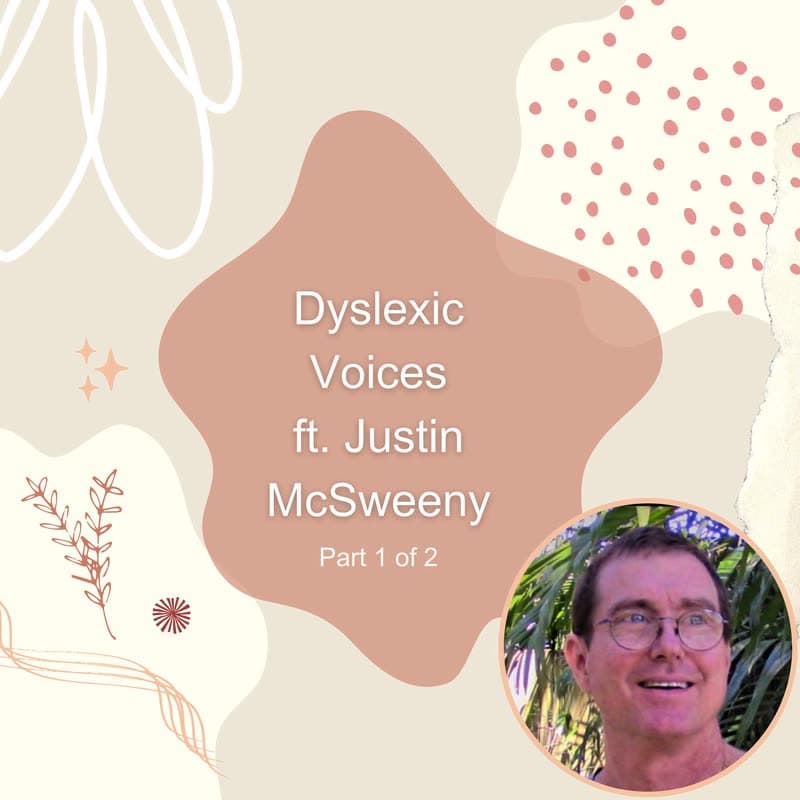
About this episode
Dyslexic Voices is a recurring segment where dyslexic adults share their journeys with us! In this episode we talk with Justin McSweeny about his childhood and school experience growing up with dyslexia. Stay tuned for part 2 of his interview soon!
You can find Justin at:
https://www.youtube.com/channel/UCoobO-TWsWR3YHmj7YgjBIQ
https://www.illuminelife.org/
Transcript
Full transcript · 4,650 words · about 23 min to read. Press a timestamp to jump to that moment.
I can remember being relieved getting that diagnosis, although I had no clue what dyslexia was, but at least we could label what was going on. And I also think my folks were relieved and that this was not a matter of me being the lazy child or the insolent child.
Hey everyone, we're Nick and Sonja, and this is Dyslexia Journey, where we help you support the dyslexic kid in your life. And today we are so glad to welcome Justin McSweeney, who will tell us about his own journey with dyslexia. And let me tell you a little more about him. Justin McSweeney is a small business owner and host of the IdeaCast interview series on YouTube. The series is a volunteer service that platforms persons from academia as well as everyday folks working to better the human condition.
Justin has an interest in horticulture and botany, as a self-taught explorer of all things green in Florida and beyond, and he has a YouTube channel for the plants, too. Justin lives on the Treasure Coast of Florida with his partner Kimberly and their cat, Spot. Welcome, Justin. Thank you. Thank you. And I do feel welcomed. You guys are very warm. And as I said before we hit record, I'm very grateful that you all are having me here as a guest.
So thank you for that. Thank you. Yeah, thanks. Thanks for coming on our show. So, Justin, let's jump in and start with talking about your childhood a little bit. So could you tell us a little bit about what it was like as a child with dyslexia before you were formally identified as being dyslexic? Sure, absolutely. And that's a critical place to start. And hopefully, I'm envisioning that families are coming here. And if anything I say can be of value to them, it'll just warm my heart to no end.
Because I'll confess before I start on that story, I've really never done anything about my dyslexia story. So, again, gratitude to you all for having this show and for allowing folks like myself to share their story, especially if it impacts the lives of other people in a positive way. So to go to my narrative as a young child, I was put in a unique situation early on from kindergarten, first grade. I went to the Waldorf school system, which was Rudolf Steiner's brainchild.
And he was focused on almost kind of a liberal arts perspective of how to start children out in life through education and learning. And so they focused primarily on aesthetics and arts and music and things like that. And there were mathematics involved in those first few years of elementary school. And so I was in the Waldorf system in the first and second grade. Unfortunately, part of Steiner's vision or the system's vision is they don't teach grammar and spelling and elocution and all these other things.
That early on, in the third grade, I went to a Catholic school, a parochial school. And so my peers in the third grade could read and they could write. I showed up illiterate and I could spell my name, but that was about it. So I didn't even get the basics of the learning cursive or how to how to write your letters out or anything. So I was really behind the eight ball on top of finding out several years later that I was dyslexic.
So that was just really setting the bar high as far as having to overcome two challenges at once. So going into the third grade was indeed a challenge. And and the the parochial school system is very discipline oriented and very theory X oriented or learning through kind of a coercive, you know, you you need to, you know, learn or else kind of thing. And so that that didn't help my Dyslexia Journey in the beginning.
However, I'm tough, I'm tenacious and stubborn and so forth. And so I, I, I caught up as quickly as I could. And probably by the fifth grade, I was probably on par with everyone, but nonetheless dealing with this issue that was, again, unknown to anyone, including myself. So to recall that third, fourth and fifth grade period, I would say that what I prior to knowing what my situation was, I noticed that I could not read without being able to focus clearly on what was what the flow was in a narrative in a book or whatever the instructions were.
I had a very hard time, it's almost like an ADD or ADHD type situation where just being able to, and I do this as an adult too, I could, I can just see the words and, and my mind would be somewhere else. And I'd have to really try to rein myself in. I didn't have so much of the transposition of words and the letters and so forth, but I, it, it does manifest itself, in my life history.
And I will, we can cover that later, but initially it was more having to be able to read a sentence or read a paragraph and then recall what I just read or make sense of what I just read. So that was the struggle, pre-diagnosis, and unfortunately between the, the parochial school system and, my folks trying their best and, and there's, and I'm not faulting them in this statement, but they just didn't know what was going on.
So they just naturally assumed I was lazy and that I was not committed and that, you know, the fault was mine through some intention or some intentionality. so, so that was, that was kind of a, a crossroads of, of, distressing, and, and, and, and sort of a feedback system of distress. And so, you know, it, it, I don't, I don't like the word trauma because I don't think I was traumatized, but it was just very, disheartening and upsetting, to know that I'm trying, but that, you know, nothing really good was coming.
But the grades were terrible C's and D's and, and my folks again would, would, try to incentivize me or motivate me by saying I was, you know, you can't be a failure. You have to, do you want to be a trash man or do you want to do that? You know, those kinds of lectures as a small child. And I thought, well, you know, I understand that. I'm curious how that was just, you know, with the other kids, like, were there any other nuances when you were actually at school about it too?
In terms of peer to peer relations, I don't recall. It wasn't enough of an issue that it stood out as a vulnerability on my part. So, so the bullies weren't picking up on it. and my lagging behind was not apparent or obvious to my peers as well. and I don't recall if there were other children in the class that were struggling. And I do recall though, that my teachers would, not embarrass me or mortify me in the class and say, you're a dunce, go sit in a corner, none of that.
but they would, it more discreetly, talk to me about these things and say, you know, we're, we're very concerned. We, you know, we want to have a conference with your parents, et cetera, et cetera. And, so that was pervasive throughout, from third grade all the way, into my junior high years or whatever they call that now, sixth, seventh, eighth grade, that kind of thing. And so, yeah, so, and, and principal's offices, oh, and parent teacher meetings and report card night.
Oh God, those were always, that was traumatic. They, I, my folks would come home after meeting with the teachers and my getting C's and D's and there was usually drama at the house after that. So, so, so if, if I could, sort of bracket something here right now for the audience that's listening and for parents that have children who have been diagnosed with dyslexia, I'm going to go ahead and, and, and just, give them the benefit that they are compassionate and caring towards their children.
But if you're coming here and you're just in that mode of discovery that my child does have dyslexia, that kindness is, is worth its weight in gold, and, and being tactful and, and understanding the relationship parent child and the psychology there that, the more reinforcement, positive reinforcement that you can give your dyslexic child, the better. again, I'm, I'm deeply stubborn and pigheaded and tenacious. And so I just learned to just blot out whatever my folks would say to me during those three or four times of the year when the report cards would come out and we'd have, you know, drama in the house and all that.
As far as going back to your question with the children, yeah, there was never any bullying or taunting or singling out or anything like that because it was all, I think my troubles were discreet and, or I was discreet about what was going on. I never shared anything, you know, I, I, so there were the kids in the class that were the, not quite the screw ups, but they were the clowns and the goofballs and they, they weren't taking their, learning seriously.
And I probably filed in with them and we just would, you know, just be kind of joke about it and not, not take the curriculum too seriously or the teachers too seriously. Yeah. thank you for bringing up the, that advice to parents. I think that's really key. yeah. so at what age then? were you actually, identified or diagnosed? This was a crucial, juncture in my life, in my, if you could call it my educational career.
so in the seventh grade, I was in suburban Washington in a very well-funded, public, education system, Montgomery County, Maryland. and in the public school system, I was in a junior high school that was run by the county and my folks were just, at their wits end. And so they submitted me to the school psychologist and they thought perhaps I was, dealing with mental, shortcomings, whatever the right way to say that is.
You know, that it's my faculties were not so low IQ, whatever it is. They thought, you know, maybe, maybe there was really something wrong. even though I was not exhibiting slowness or, or disability in any other way, I was sort of a normal act. If anything, it was a hyperactive child. so I, anyway, they submitted me to the, to the psychologist. They ran some stuff, ran some tests, and they ran me through an IQ test.
And when I took the IQ test, it, the score came back very high and they were shocked and they thought, okay, well, you know, he's got at least above average intelligence. If not, you know, I don't, they never told me what my quotient number was, but anyway, they, they were, they ruled out the fact that I was, you know, below par or below average IQ. And so then they started asking more questions of themselves to, to test me and screen me and find out what might be going on.
And in that, I believe they came up with a dyslexic, diagnosis, the school psychologist that was assigned to me. And I can remember being relieved getting that diagnosis, although I had no clue what dyslexia was, but at least we could label what was going on. And I also think my folks were relieved and, that, that this was not a matter of me being the lazy child or the insolent child that did not, and, you know, petulant child that didn't, listen to them and obey their, their, their wishes for me to be a better student and so forth.
So I think everybody was collectively, relieved that there was something to start with. After this diagnosis, what, in, in the early 1980s, when I was in, this was probably 1982 when I was diagnosed, from that point forward through, through probably to my freshman year of high school, I was put, or junior year of high school, maybe somewhere in there. I was put in the special needs, labs for, learning disabled people. and that was a rainbow of, neuro, I call it diversity.
So some might call it neurodivergence or whatever, but it was just a rainbow from, from people dealing with, IQ issues, like with, with learning disabilities that are related to that. and also people dealing with things that I was dealing with and other, all across the spectrum. So, so I was put in there, but basically that was just, it, the, the way it was described to me is this was a way, a period in classes ascending through the grades that I could catch up on my other work, which did nothing.
You know, I was, I was not being proctored or I was not being supervised. They, obviously the special ed teacher or whatever had, beyond just a regular education degree, they specialized in children with learning disabilities. But dyslexia was, I don't, I think it was kind of new and novel at the time. And so I never received any of the, more focused remediation or remedial work, assistance. It was more, they just put me in this classroom and they said, okay, here's, here are your assignments from the other five periods.
And, you know, just ask me if you have questions and I'll work, I'll help you with it. And so, I don't know what that dyslexia, oriented, remediation or, or assistance looked like, but I'm pretty certain that it wasn't what I experienced. and I, I say this all, you know, without judgment, without any kind of malice or anything like that. They were doing the best they could, I'm sure in the nascent period of understanding what dyslexia was.
Yeah, I'm curious, you, I guess before and after then diagnosis, or identification, I'm curious about, especially if you can look back and see what ways you use to compensate. Yeah, I, I, when you sent me that question, I thought, oh my gosh, I know I, I think my compensation was minimal, but I think the, what I, what I did was force myself to read slowly and keep bringing, it's almost like a horse with reins.
You have to keep turning, you have to keep pulling the reins to get the horse to go where you want it to go. So that's maybe a good metaphor is I would have to constantly struggle if I, if I were to read something to focus on that paragraph, focus on the sentence, and then try to digest the information. and it worked sometimes and other times it was exercise in futility. And there was that period between the seventh grade and I'd say my freshman or sophomore year where I, now knowing that I had dyslexia, I was able to then recognize that for me, learning was different.
It, the patterns were different for me vis-a-vis the status quo, the cookie cutter education system, that catered to most students within a sort of normal range of, of neuro, however you want to call it normality or what I say, you know, just in that area, I think it was tailored for, for standard fit. And so I recognized that. And then I, you know, to be honest, by the time I had my diagnosis, I, I was pretty much disparaged about the whole education process and the whole education system.
So I think those were probably some more shadowy years between seventh and eighth grade. I have to say, I reached out to my one remedial teacher a few years ago and she's still in the system. And this was in the early eighties again, and Mrs. Conyers, and I, I wrote her and I said, thanks, you know, thank you for your help. Even though, you know, again, it was just garden variety. It wasn't a laser focused on dyslexia, but I wanted to thank her after 35 years.
And she, she said, oh, I remember you. And I said, well, thank you, Mrs. Conyers. And I turned out fine. I'm okay. I'm not, you know, I'm not a reprobate or, you know, insane or anything like that. So anyway, that was a nice connection from the sort of closing the circle. But, so to continue on this, pretty much giving up on my education at, at, at the seventh or eighth grade, even though I found out that I was actually intelligent.
And capable, I, it was so disheartening to spend years of hearing that, oh, you're a failure, you know, why are you doing this? And, you know, this is, you're lazy and all the, you know, all these things, it kind of adds up. And what was an interesting turnaround period for me was between the freshman and sophomore year is that if I took an interest in a class, there's something happened. And I just, if, and history and even English, I loved.
And so I would, I would really do my best to just apply myself and focus on it. And ironically, math, which had always been fairly normal and easy for me, when, when, when I hit pre-algebra, I just, the number, the letters and the, the equations and the sequence of, orders of operation. And it just, that's a dyslexic nightmare, at least for me, it was, I was, and I, I just told my, I made it through pre-algebra and I got into algebra and it got even worse.
And I just told my algebra teacher to take me off the roster and I'm going to go play basketball because I met the requirements to graduate with pre-al because they were really loose back in the eighties. They just wanted to get you out, you know, if you weren't a motivated student and trying. So I just told her, to take me off her, you know, my, her, her, her student, roster and I just went and played basketball, but there were other classes that I loved.
And so I dropped it, I dropped the math and there were creative writing classes and history classes that if, again, it picked my interest, I was there, I was present and I did the best I could and I would get C's and B's and I, I did okay. So, so that's the highlight of my, K through, through, through senior year was by the time I hit the 10th, I think also emotional maturity and maybe a little bit of cortical maturity.
I was able to, reconfigure my approach and just say, okay, I really liked this teacher and I really liked this subject and they're taking an interest in me and I'm going to take an interest in the, in the coursework. And, and it worked. And so maybe of the last three years I was in high school, two thirds of the classes I took, I, I did. Satisfitionally. I love that word. I, I, I got B's and C's.
I felt good. And, and there was no drama. I especially appreciate you sharing how you, you actually were, interested in and able to do pretty well in, classes like English that I think there's, there's still, a misconception out there that people with dyslexia can't, you know, can't do writing and, and reading and those kinds of, those kinds of classes. So I think it's really important to get the information out there that, that, you know, people with dyslexia can actually, you know, do creative writing or, or, or, you know, whatever they're interested in.
Yeah. Yeah. And I, and for the record, I'm left-handed. So I kind of take the left, right divide with a grain of salt, but typically we think of the left hemisphere as being the more analytical part of our brain system and that it's, it's, it adjudicates more, it makes decisions. And whereas the right brain thinks more abstractly and it's more creative. And I think I could, kind of play that card of being the classic lefty.
And so when it came to creative writing, that really opened a door for me or a window of opportunity or whatever metaphor. And I loved that process. And, and my teacher responded positively. I, she, we, she would have us write essays and short stories and I've got pretty good imagination. And so I would just crank out these stories and she thought, well, she was very encouraging. And that was a positive feedback for once from a teacher or anyone, who was, who I was subordinate to at that time.
So, and then came graduation, they, I graduated, which to me, I still, I still have, I, for most of my young adult life, I had anxiety dreams. Like, you know, I'm not going to graduate. I, I, and, and I can't graduate or, you know, so, but now I've made peace with that. I was like, I did graduate. So I don't have those weird dreams anymore. It's like, ah, you don't have enough to graduate or whatever.
But yeah, for some, by some hook or crook, I managed to, to get through and graduate. And the bar was really low at the time. I hope they've raised it, to, for people to be competent, but I, you know, I was literate. I could spell, I could, I was, I, I could read, I had basic math skills. so I didn't come away being ill-prepared to, to take, to begin to adult and, and take on the adult responsibilities.
So I came away as best I could, it would be my summation or my summary of, of the experiences. I, given, given what was going on, given some of the barriers that I, I came away, as best I could. So then to, to reiterate what was, what I've just, all the anecdotes that I've just, demonstrated or, or, or spoke to, I would say to those parents out there, and more importantly to the children out there, that even if you are not in a place where you, or, or, education system where you can get the kind of focused attention that you need.
But if you should happen to find yourself in a place that is not, as supportive, I would say, don't despair and keep your chin up. You're, you're going to be fine and you will, have to rely on yourself a little more than others. And I speak to the children out there or to teenagers out there that you may have to be more reliant on your own self-confidence, your own, tenacity, your own desire to move beyond barriers and obstacles that may be asked of you or may be required of you.
If, if again, you're not in a very supportive environment and everything I just said speaks to that kind of non-supportive environment. So I'm here to say that if you can love yourself enough, care enough for yourself and see a broader vision of beyond where you are in the moment, where it may be tough and it may be challenging that you will be fine life, life will be good. And there are good things waiting for you on the other end of this.
And if you are getting that love and support from your parents and from, the people who are educating you, that your desire to, overcome and, and to move through it, will be rewarding for you. With that support and with your desire to go just that little extra step beyond and don't ever compare yourself to anybody else, that you will, you'll, you'll be fine. I think I really appreciate what you said though, because everyone's circumstances really are different.
And so I think that what you say is really foundational. I mean, that's really the foundation of all of it. you know, because people's circumstances will be a little different. and so, but if you have that, that's, that's the most important thing. Absolutely. Absolutely. And adversity can crush us. It's, it's a soul crusher, but it can also be a negative stimulus, just like a, when you catch a cold, you don't feel good, but then you get the antibodies and the reserves to fight off the next, rhino virus that might come along.
That's a cold virus. And so you think of that and they call this anti-fragility in business and, and psychology and things like that. And, and I'm not prescribing that to young people, but this, this is a thought and, and that if something, something provocative happens in your life and it's upsetting and it, it's a challenge and it's a, it's something to be overcome that you will come out of it stronger. Again, if you have support and you are capable of caring for yourself and that's a loaded statement because sometimes we get broken and we get hurt and that's when you have to be honest with your parents or your caregivers and say, look, this is beyond me.
I'm drowning in this. And so, so I will say that too, that you just know yourself enough to, to when to speak out for help or know yourself well enough to say, I've got this and I can, I can move through it. So we have to make those calls as young adults or teenagers or even a pre-adolescent to say, this is too overwhelming for me. And I need, I need somebody to mirror to me what's normal, what's good, what, what I should be feeling and, and, and go to somebody you trust like your parents or your caregiver to, to seek that kind of support.
And they can then help put you in that position where then you can practice again, the, what a cold would do to you, which is to build up your immune system, which is the word anti-fragility, like I was saying earlier, there's resilience, but that's a different thing. And resilience is important too, but, but building up your emotional immune system and your, psychological immune system, which is a lot to ask of somebody who's young.
But I'll just plant that seed in your mind and, and just carry that with you. And it'll make, it'll be salient to you or relevant to you as you get older and you say, oh, I get what that guy was saying now. And so I'm not really prescribing it necessarily, but it's just something, something to think about that, that resilience is good, but also learning to become stronger from that, which can, can seem to be provocative or seem to be negative or upsetting is that if you can come through it.
And this is where I speak, oh, I spoke earlier as being kind of bullheaded and stubborn and tenacious, it was already inborn in me. So, so the anti-fragility buildup thing was a little easier for me. It's still not pleasant and there were still a lot of dark, dark days, but I'm looking, I'm saying a lot of this in hindsight as a, as a quote unquote mature adult, which I can be mature sometimes, but I can be a clown sometimes too.
So I'm not a hundred percent mature, but. This is so helpful to have your perspective. Yeah. I think like this, I mean, that's exactly what's so helpful here with, with having this hindsight.
More from the show
Learn to Love Listening ft. Cliff Weitzman, Dyslexic Founder and CEO of Speechify
In this installment of our Dyslexic Voices series, Cliff Weitzman, founder and CEO of Speechify (https://speechify.com/), tells us about his experiences growing up dyslexic, and shares his advice for how to succeed as a dyslexic child and adult.
Make Real Progress on Big Goals For Your Dyslexic Kid!
We all have goals for our dyslexic kids, but they often seem overwhelming and out of reach. In this episode we provide specific, practical tips for organizing the goals into smaller chunks and making daily progress.

The Attacks On Your Kids’ Rights to a Free Appropriate Public Education ft. Attorney Laura Heneghan
With all the changes in the US recently, it’s hard to keep track of all the implications. In this episode we dig into the changes at the Department of Education, executive orders, lawsuits, and more in order to understand how these changes could directly affect your kids!
Never miss an episode
New episodes every two weeks. Follow wherever you listen.