
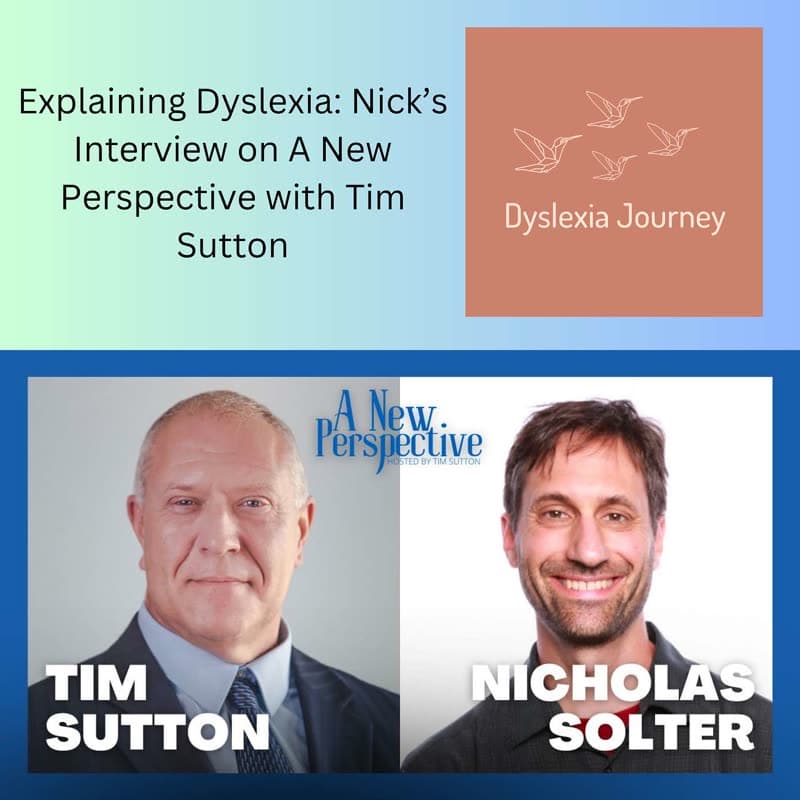
Explaining Dyslexia: Nick's Interview on A New Perspective with Tim Sutton
About this episode
We're pleased to be able to share an interview about dyslexia that Nick did recently with Tim Sutton on A New Perspective.
Thanks to Tim Sutton and Griffo Productions for allowing us to share this interview here!
###
Start your podcast today!
This podcast was produced by by Griffo Productions (griffoproductions.com)
Subscribe to our podcast at A New Perspective with Tim Sutton
Listen on Podcast or wherever you get your podcasts:
Spotify: https://open.spotify.com/show/2cjj1YoeWpNWMIghAkBcqs?si=9454017df60d4d48
A Better Understanding Non-Profit: ABetterUnderstanding.org
Tim Sutton's Website Tim-Sutton.com
Transcript
Full transcript · 5,383 words · about 27 min to read. Press a timestamp to jump to that moment.
Hey everyone, I'm Nick, and this is Dyslexia Journey, where we help you support the dyslexic kid in your life. And today's episode is a special episode. We're happy to be able to replay an interview that I did on a different show a couple months ago, and that show is called A New Perspective with Tim Sutton, and we are very pleased to be able to provide that interview to you on our channel and in our podcast feed today.
So without further ado, here it is.
Just because you have brain change doesn't mean you can't still do things. You may do it differently. You might need more time. I decided to turn my disability into my ability, and around 7th and 8th grade, I started playing able-bodied sports. If we were knowledgeable, if we were educated, we would have solved science earlier. You battle, and you battle for every single inch of help.
A New Perspective, hosted by Tim Sutton.
This broadcast is produced by Griffo Productions. Brought to you by A Better Understanding. Giving you a better understanding.
Hey, everybody. This is Tim Sutton, bringing you a new perspective. I'm glad to have you back. We have covered a lot of topics over the last few episodes. I know it's been a brief pause in things as life gets busy sometimes. But I wanted to get back on here and try to educate myself and educate you. If you're not familiar with me, I'm a retired law enforcement officer for 33 years. Over half of that time was spent working with individuals with disabilities and training officers to understand various types of disabilities that are out there.
So when we get the call to respond, we can get there and hopefully take care of the problem. Because we always revert back to our training, but if you haven't been trained on any type of disability, you do the best you can. So my job was to get out there and train officers to hopefully do their job more effectively. Currently still teaching. I've got a class coming up at the end of this week.
And I'm looking forward to educate some other officers. But as I'm retired, I've gotten more active in the disability community. And I'm educating myself and learning so much. And one thing that's really always concerned me is invisible disabilities. These issues where you look at somebody and you can't tell that there's something different or something they're struggling with. And I had the opportunity to, through my producer, refer productions. Anthony was able to put me in touch with a gentleman.
And I've been reading up and I've been listening and watching some videos. Because there's something out there that you hear a lot about, but many people don't know anything about it. And so many people are affected by. And hopefully my guest, Nicholas Salter, will come on and talk about what's going on in his life, what went on in his life. But we're going to talk about dyslexia and his dyslexia. And I believe he's got a child with dyslexia.
But in researching it, it has amazed me how prevalent it is. And it's really raised my eyebrows. But I'd like to bring on Nicholas and talk about what's going on in his life and hopefully learn something. And you all can learn something as well. Hello, Tim. Thank you. Hey, I appreciate you coming and being here with me tonight. I have spent the day looking at videos, watching you, just sharing the information that you have.
And give us a little bit about your background, what you do for a living, and what kind of work. And anything else you want to let us know? I know you've got a child with dyslexia as well. Yeah, sure. So I live in Colorado. I'm a software engineer. That's my day job. And I don't actually have dyslexia myself. So this has been a journey of discovery through our daughter, really. Oh, okay.
Yeah. So neither my wife nor I actually. Oh, I was on the impression that you did. I'm sorry. That's okay. No problem. I don't mind. It's really been a journey of discovery for both my wife and me, because neither of us had it. Neither of us had it. Wow. Until our daughter showed pretty early on some difficulty with reading. And this was in first grade, actually. And she was really struggling. This is kind of the age.
So this is about, she was about six years old. And this is, you know, we, my wife and I were both pretty well educated. We both are interested in education. We, and we, we felt pretty confident as parents, but even, even us, and we knew about dyslexia, sort of theory, right? But it took us still several years to really realize that that's what our daughter had. And, and, which is really kind of absurd to think about because there's actually one out of every five people, has dyslexia.
It's about 20% of the population, 15 to 20%, which, you know, you wouldn't really realize, because people don't talk about it that much. And, you know, maybe there's a little bit less stigma around it than there used to be. but I think it's really still misunderstood and, and I think really still, underdiagnosed. And so, you know, because of our experience, where we, we, you know, it took us so long to identify what was going on with our daughter and to get her the sort of accommodations and remediation work that she needed to be successful in school.
we, my wife, Sonja and I decided that we wanted to help educate other people out there about dyslexia because it's, it's something that affects so many people and that, that there just isn't enough information out, out there for other parents. and really we, we've broadened a little bit, you know, we started sort of, really trying to educate parents and it turns out there's a lot of dyslexic adults who are interested in what we have to say as well.
so really educating, everyone about this, like you said, kind of silent, invisible disability, right? Wow. That's, when you started noticing problems with your child, did you, was that even in your mind that that's what it could be, prior to the diagnosis or is that something, it was like a revelation when, when the diagnosis came about? Well, I think by the time we got the diagnosis, which really wasn't until she was in, I think the end of fourth grade, maybe three, three and a half years later.
it was, it was a relief actually, because we knew, like we knew she was a fire kid. we could tell you the ways that she talks, the way she interacts with the world. she just wasn't able to demonstrate it. And so, we knew there was something going on. And so when we finally had her assessed at the end of fourth grade, yeah, it really was a relief. I mean, I think we thought about dyslexia being a possibility and that's why we eventually did take her to, an educational psychologist.
so it wasn't a total surprise. It was really much more of a relief to know that, okay, this is, you know, this explains, this actually explains everything. Right. And we interviewed other dyslexic adults on our show and, and they all said the same thing. It's, it's that, that moment of, of realization that, oh, like I'm not dumb. I'm not lazy. Like I just, my brain just works differently from other people. Yeah.
Do you, do you find that there's a lot of denial, by parents, about, oh no, my child does not have dyslexia or yeah, I know with autism, a lot of times that the first. In the beginning, many times there's a lot of denial. Do you find that with dyslexia? I think so. I mean, certainly in our case, I, I think, I wouldn't say if it would, it was, I mean, denial is an interesting word.
I think maybe subconsciously. Yes, actually. I think, I think dyslexia is maybe not as stigmatized as, as autism is still perhaps. but it's, it's, it's the kind of thing where as a parent, you, you don't, you don't want there to be something quote wrong with your kid. Right. Right. and even though, dyslexia, and, and this is a whole other discussion we can get into this, you know, is it, is it actually a disability or is it, or is it just a brain difference?
but, but, but still, it, it is something that makes life harder for people. it makes school harder. It makes work harder. It makes daily life harder. anything that involves reading and writing really. And so, yeah, I think there, there, there probably is some amount of denial there. Like you just, you know, you want, you want things to be easy for you. Right. Yeah. I mean, nobody wants to see their child struggle and.
Obviously there's going to be a little bit of a struggle, struggle, but there's nothing you can't overcome. and then have a name to put with it, and finding resources. Do you find in the school system, I know you're in Colorado, but in the school system, is there a lot of support? Are there a lot of resources? there is, yes and no. So the, dyslexia is a protected disability under the Americans with Disabilities Act.
so, so schools are required to provide reasonable accommodations. so, so once you are diagnosed, then schools are required to, to give you accommodations like extra time on. And exams and, use of a computer to, to type instead of having to write things by hand. that's that sort of thing. I would say, I mean, I, I don't want to criticize schools and teachers. Like they, they, you know, almost every teacher that my daughter has had has been great and well-intentioned.
I think that it's overlooked for a lot of reasons. so, so that, you know, the first aspect is identification. and I think that unless a kid is doing very badly, it's, it seems to generally be overlooked. so if a kid's doing kind of average, it's not really going to be brought to their attention and they're kind of just going to muddle through. And so that's, especially the case with, people who are, I mean, again, I don't, I don't like the term smart or intelligent, but, but people who, who maybe can demonstrate a high IQ, but, but then also have dyslexia.
they're going to be able to compensate for that really well, in school. And so they'll be able to maybe do average or even above average. but, but not nearly anywhere close to their potential of, of how they could do. And so it tends to get overlooked. Like, there are only a few States that actually require, assessing every child for dyslexia. Colorado is not one of them. there's been some work in the, in the, at the state level to try to get that instituted, but, school systems and teachers groups are kind of resistant to that because it's, and I understand their perspective.
It's, it's another thing that they'd have to do that they're not particularly trained to do. well, well, why not train them to pick up on it? And I think part of that is if you train them to pick up on it, they're going to start picking on it and picking up on it. And then they've got to make reasonable accommodations and they don't really want to have to, you know, take that extra step.
Yeah. And again, yeah, I, no, I totally agree with you. And again, I mean, almost every teacher out there is working very hard. I really do admire, like I could never be a classroom teacher. I, you know, the amount of work they do, the amount of multitasking that they do in the classroom and, the work they do at home. so, you know, I don't want to criticize any teachers. I think it is more of a systemic issue that, that needs to be done with training at the, at the, you know, school district level.
Right. And one thing I was watching one of your videos, we were talking about the, timed tests that kids have to take, and you said a reasonable accommodation, maybe like time and a half. If it takes, you know, if it's an hour to take the test, maybe give them an hour and a half. but that's, that's one thing I always dreaded because it's having that time at one and it's stressful enough, but dealing with dyslexia, I can only imagine the stress that comes along with that while you're trying to process those questions, read all that stuff.
it's gotta be such a stress. Yeah. And that's really a pet peeve of mine because, it's so artificial. I mean, in the real world, there are very few circumstances where it really matters whether you can do something in an hour or an hour and a half. Right. And so, I mean, maybe, you know, maybe in very specific things like, okay, good law, law enforcement, which is your background. Like you have to be able to demonstrate quick decision-making perhaps.
Right. But that's, that's very specific. And, and both, you know, most situations, does it matter if you can solve 30 equations in an hour or an hour and a half? Right. It doesn't matter. And so, you know, there's a lot of, I think, reasons why we've ended up in this kind of environment where, where everything is so time pressured. But, I honestly wouldn't mind if, if, everyone got the time they needed regardless of diagnosis.
Yeah. And you look at the SATs, I mean, taking SAT all its time. And then, yeah, I've always been a terrible test tester like that. And I think too much into the questions and, you know, I, I second guess myself and I can only, I can only imagine if with dyslexia on top of that, if you have that always second guessing yourself, then you go back and reread it. And you're trying to figure out exactly what, you know, I, I just remember those days for me was they were exhausted.
Yeah. That's what really tipped me off. I'm thinking, okay, now I had, sometime I have to read something that I read it again. I remember in college, I would, I would be reading and I'll take a highlighter and make, and I go through it. Next thing you know, I'll come back and I've got a dyslexia highlighter and I'm reading it all again, highlighting this. And I'll take a red pen, come back and I'll read it just to get it to sink in.
so it kind of got, I mean, listen to this and learn about this kind of gets me thinking myself about, even today, I had a brief period where I was sitting, read some books, but reading was not that enjoyable to me. And I would, I felt like I would read it and just not even, not even remember what I read. Yeah, that's, that's really interesting. you know, one of the guests we had at our show recently, Cliff Whiteson, and he's, he's the founder and CEO of speechify, which is a really interesting company helping, helping dyslexic people out there.
And yeah, anyone else who wants stuff read to them, he, he, you see analogy, he said for, for someone with dyslexia, reading one sentence takes the same brain power as doing a long division problem. Yeah, I saw the, I saw that. Yeah. Yeah. It's, yeah, it's, it's, it's work. Cause he was talking about telling me to, you know, 10 divided by whatever this. Yeah. And I'm like, you know, you're trying to process all that.
And yeah, I can, I can see where that comes in. I'll tell you, the interest in talking about law enforcement, when I first started, I think I was two years into it. I know a girl went through the academy and I know there are different types of dyslexia. There, you know, there are a few different types, but apparently she had dyslexia and, yeah, you wonder, okay, well, if she's trying to pull a car over, is she going to be reading the, you know, I don't know if this is an aspect of it.
Is she going to be reading the tag backwards, the license plate backwards, or did, is that, is that something that actually happens in some forms of dyslexia? I think, yeah, for, for some people, I think it is, that's sort of the, that's sort of the like stereotypical, impression of dyslexia in, in the popular culture, right? Like, you read the words backwards or you read the sentence backwards. And I think there's some truth to that, like, what we've noticed, with our daughter and then with other people we, we've spoken with, and I'll get sort of a long-winded answer to this, which is that people with dyslexia, it is a brain difference.
And they tend to have, very strong visual spatial skills. And, so they are able to kind of, you know, rotate things in their mind. And so two people with dyslexia often, they can actually read upside down as well as they can read right side up. Oh, wow. Or they can read backwards as well as they can read forwards. Like, it's kind of the same to them. And so it's actually almost a whole different way of, of looking at the world because they're like, and that's why they often mix up letters because, you know, a lowercase B and a lowercase D versus that way.
Like they can just sort of flip that in their mind. And it's the same thing. Whereas those of us without, you know, sometimes we talk about it as a dyslexia, superpower, this, the visual spatial skills, those of us without that superpower, like can't do that quick rotation. And in our head. And so, so yeah, so there is some truth to like mixing up the letters, reading stuff backwards. but that's really only a, a small, really a small aspect of the whole scope of what dyslexia is.
I'm great. Cause I'd tell you what, that female police officer, she had been one of the best police officers out there. it's held at that job, but, yeah, I've often read stuff and other people read the same thing. And it's in my mind, I'm thinking, did we just read the same thing? Cause I didn't get anything out of it that they're talking about. And, but I mean, you know, and you talk about powers, you know, I often refer to, you know, autism.
I said, most people, and that's one thing I want to ask you, autism. Many times you find that they have a few, a couple of things that they're very, very good at. and I tell families, I say, you know, where would our country be without autism? I say, how many, how many of those rockets that they set off to go into space would have made it had autism not been involved. Do you find that people with dyslexia, have sometimes have certain, super abilities or things that they're really good at?
Yeah, for sure. there's a really good book that, has been written by a couple of medical doctors called The Dyslexic Advantage. and, they're, I think I'm gonna get their names right. It's Brock and Frenette Eide. I think they're both medical doctors. they really, it's a really good book. They go through, kind of, they start with like, okay, there's actually struck, like measurable structural differences in the brain between people with dyslexia and people who don't have dyslexia, that you can see like on MRIs and stuff.
and then, and then they go through sort of all the different traits that are kind of associated with people with dyslexia. and it's really, it's really impressive the kind of advantages they talk about. I mean, one of them are the, the visual spatial skills that I've talked to. so, and we've done a style, like with our daughter, she, she, like, she always knows where everything in the house is. Like I lose my phone.
She's like, oh yeah, that's like on the dining room table, you know, even though she wasn't like trying to remember where it is, she just has this really good sense of where things are in 3d space. and that's shown, there's been actual studies, like people with dyslexia do better on tests that test sort of 3d. Spatial abilities than people with, they're also really good at, sort of entrepreneurial skills. I think, there's some very famous, dyslexics who are, who are, successful entrepreneurs like Richard Branson.
Branson. That's the best example. also we talked about this on our show recently, the founder of Ikea, that was dyslexic. and if you think about it, that, you know, the way Ikea operates is very visually, spatially oriented. the, the furniture all comes in these flat boxes and then, yeah, you have to pack it back up in there. Yeah, yeah, exactly. It takes a dyslexic person to do that. and then, also, you know, there's, there's other, abilities.
I think, dyslexic are often very good at, kind of, holistic thinking. We call it, really like putting, you know, taking, you know, different pieces of information and putting it together in, in ways that, people like me who are more of a linear thinker, might not see connections between disparate kinds of things. Do you see the big impact, with the dyslexia where it comes to numbers or is it mostly the reading? So, yeah, it's, it's, it's actually, there's, there's technically another condition called dyscalculia, I think, which is when people, have kind of the similar trouble that dyslexics have with words that they have with numbers.
I think that some, I mean, anecdotally, like my daughter is quite good at math, with appropriate accommodation. So, like, she struggles with word problems unless they're, like, read to her or sort of explains to her. Like, she has trouble, like, reading a word problem and then, like, what they're trying to say. Right, right. but in terms of the logic and the connections, you know, that comes easily to her. but it does, you know, she does, and I assume this, I think this is, this is generally true for, for people with dyslexia.
Is it, they tend to, make, kind of, arithmetic mistakes maybe. you know, they, they tend to do, you know, maybe they'll understand, you know, they'll get the, the concepts right away. But then when it comes to actually writing down the steps in order, then that's a struggle for them. And so they'll make, you know, arithmetic mistakes. And so one of the common accommodations for people with dyslexia is to actually always be able to use a calculator.
so they don't have to do those kind of things. Otherwise they resort. I think part of it is just resisting writing things down because the writing is so difficult for them. It's exhausting. It's exhausting. So they'll try to do more calculations in their head and then they'll kind of make mistakes. I can't imagine an average day in school for somebody with dyslexia and how, man, they come home, get off the bus and they're probably just so exhausted.
They don't wonder how many people are at colleges who they know something's going on and it's such a struggle, but they still are severe and they push and push and push and get through college. I just can't imagine how exhausting that has to be. Yeah, it is. I mean, yeah, my daughter comes home from school and sleeps sometimes. I mean, it's just, it's just, yeah, mentally and then physically exhausting, really. Yeah.
And, and, you know, a lot of parents thinking that the child's lazy, they just don't want to do anything, you know, and think about how many undiagnosed are out there and they're having to deal with the parents or parents that don't pick up on some of that and try to take them and find out what's going on. Yeah, yeah, that's one of the things that really frustrates me the most about this and really one of the reasons we started this, this Dyslexia Journey show that we do is because there's still just, I feel like there's so many people who are just not diagnosed.
And, you know, we, we are, I guess, privileged that we were able to, diagnose her and, and it, it wasn't, you know, it was both that we were pretty well educated. We know, know kind of what to look for. And then also, honestly, that we had the money to pay for our private assessment because the school didn't diagnose her. and it wasn't cheap. I mean, it was like a couple thousand dollars.
Right. Right. And, and that's not right. Like you shouldn't need a couple thousand dollars to get, to get your child, the accommodations that they need in school. I mean, that's the worst, man. I mean, I think, you know, yeah, they should be trained on it. It's like the stuff I teach law enforcement, law enforcement. Yeah. We're training all the time, but, you know, I go out to trying to train that, autism, mental, electrical, disability, Alzheimer's, dementia.
but when people look at it on music, on pieces of paper, you know, agencies are like, well, no, but yeah, active shooters, they're big. Let's do that training. They don't realize how important what I'm trying to pass on to them. It's like, very easy to misinterpret a behavior and do something wrong. And then you're playing catch up on, oh, I guess we should have trained them. And again, yeah, teachers, teachers need to be educated to pick up on these things.
But again, do their supervisors, the school board really want teachers picking up on it and I guess stirring the pot getting the parents. So we're saying that, you know, this person's child is possibly dyslexic. Yeah. Leaves some negative image. So they don't want the teachers trained. Right. Yeah. And there's a lot of, I mean, I think there's a lot more discussion of neurodiversity in general. That's, that's sort of the term that, that people use, to kind of, you know, love it's really, when people say neurodiversity, they're talking about generally autism, dyslexia.
Right. and, yeah, and there's a, there is some overlap there. but there's, they're all, they are three very distinct things. And I think we, we did interview one person, who, well, I go, who said, you know, whenever she tells someone she, she has dyslexia, they say, oh, well, you really just have ADHD. She's like, no, I, I really don't. I actually just have dyslexia. No, but the thing is that people are other people with autism can have dyslexia, they can have ADHD, they can, you can have two of them, one of them, whatever, but it still needs to be addressed.
but if you're going to turn a blind eye out, or I know here, my County, it's under certain situations. If the school says they cannot provide for your child, the County actually has to pay for them to go to a specialized school. which the last I checked, one of them is about $65,000 a year. So the schools don't want to admit that they can't take care of your child. Right. they'll do it.
You know, they'll send notes home telling parents, everything is great. They're doing a wonderful job. Their social skills are great. I went in a situation and the mom actually set off to the side for two weeks, watching her daughter at recess, go dig in the dirt. And she kept getting these glowing notes on about our daughter was interacting with the other kids, playing with the other kids. So social security, right? Well, you know, where she's going to a specialized school now, but yeah, schools don't want to admit, that somebody needs accommodations.
and, and, and it's, it's just such a disservice. And, no, I admire you. I admire you for taking that stand, and push and push and push. And we need more parents like that. They're going to do that for the kids. And, you know, I can only imagine how is not being diagnosed, going to school, being scared to death to have to read out loud and things like that. and, and not just while the child doesn't want to participate, you know, so we'll dock them a couple of points here or there, but understand there is something going on that the child doesn't have any control over.
And let's, let's do the best we can to, to deal with it. Yeah, exactly. I mean, it's really just about recognizing. I mean, I mean, at root, I think it's just about recognizing and, and, and, you know, acknowledging and appreciating everyone's differences. And, you know, it doesn't, it's a, you know, identifying someone with, with dyslexia doesn't mean we have to pathologize it, but it's, it's helpful, you know, it's, it's a helpful way to say, okay, this, this person, you know, has trouble with reading and writing.
Let's, how, how can we help them? Like, that's, that's really all we're asking for. And that's what the teachers and everybody should be there for anyway. So, well, Nicholas, I want to thank you for coming on and talk to me. you've opened my eyes, and this is not something of every, every, every day I'm learning about some other thing out there that it's becoming more prevalent. and my hope is to just educate people and give them a new perspective on disability community.
other people who are making an impact on the disability community, you know, ADA and things like that. Just letting, making sure people understand that every single person matters. And I tell people when I was a police officer, I wasn't sworn to protect this group or that group. I was sworn to protect every group. So why not learn as much about every individual group, disability, disorder or whatever I can, so I can better serve people.
And, and luckily I've made it 33 years and was able to retire, but I still find myself passionate about going out there and trying to reach out and, making sure every single person knows that matter. So, yeah, your, podcast where, if people want to learn more about you to find out information, how do they contact you? Definitely. And also thank you, Tim, for what, for what you do. I really appreciate the work you're doing and educating everyone.
yeah, so we, my wife, Sunny, and I have, a podcast and a YouTube channel called Dyslexia Journey. and so, it's, it's, we, it's the same content. so we post the same content on both the YouTube channel and the, and the podcast. we do weekly episodes. Usually, I used to put them up on Saturday. Okay. Yeah. Good deal. Well, I want to thank you and, maybe we can get back on. That's why I, when I first started, I was doing our shows, but 30 minutes show, you get a lot of information and it affords you the opportunity to bring it back.
So, if you ever need that, anything from me out here in Virginia, please don't hesitate. and you've got, Anthony Griffo's information, my producer, but, just thank you so much for being here. And I hope to talk to you again soon. Thank you. Thanks.
This podcast is produced by Griffo productions.
More from the show
Learn to Love Listening ft. Cliff Weitzman, Dyslexic Founder and CEO of Speechify
In this installment of our Dyslexic Voices series, Cliff Weitzman, founder and CEO of Speechify (https://speechify.com/), tells us about his experiences growing up dyslexic, and shares his advice for how to succeed as a dyslexic child and adult.
Make Real Progress on Big Goals For Your Dyslexic Kid!
We all have goals for our dyslexic kids, but they often seem overwhelming and out of reach. In this episode we provide specific, practical tips for organizing the goals into smaller chunks and making daily progress.

The Attacks On Your Kids’ Rights to a Free Appropriate Public Education ft. Attorney Laura Heneghan
With all the changes in the US recently, it’s hard to keep track of all the implications. In this episode we dig into the changes at the Department of Education, executive orders, lawsuits, and more in order to understand how these changes could directly affect your kids!
Never miss an episode
New episodes every two weeks. Follow wherever you listen.