
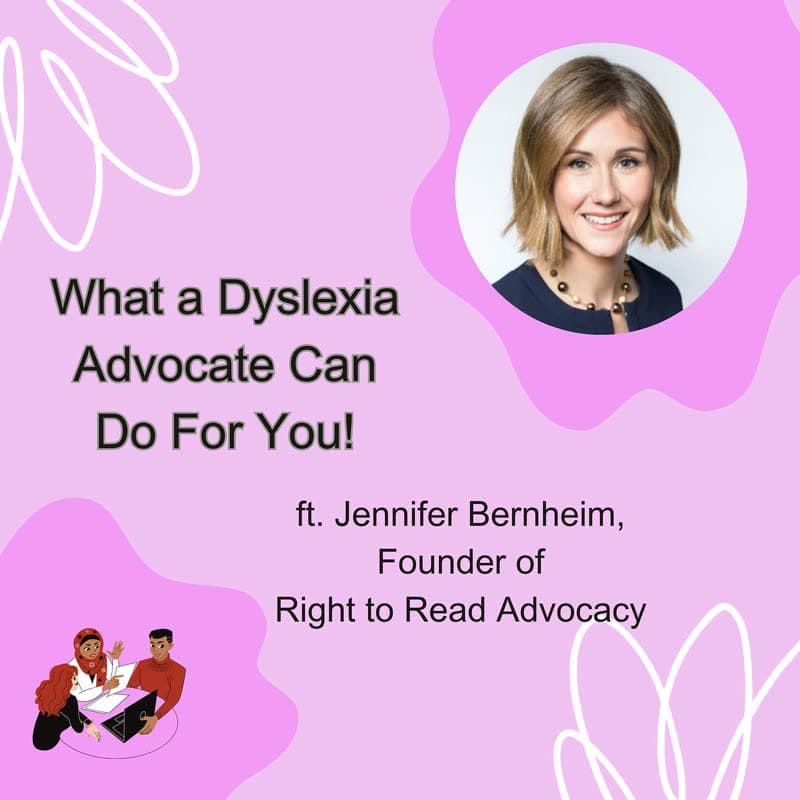
How a Dyslexia Advocate can Help You! Ft. Jennifer Bernheim, Founder of Right to Read Advocacy
About this episode
Did you know that you might be able to get your child's public school district to pay for an independent educational evaluation? We didn't either! Check out this fascinating conversation with Jennifer Bernheim, mother of a dyslexic kid, dyslexia advocate, and founder of Right to Read Advocacy (https://www.righttoreadadvocacy.com/).
As the mom of a dyslexic learner, Jennifer knows how challenging it can be to navigate the special education process in a public school district, which is why she founded Right to Read Advocacy. Jennifer helps parents demystify this overwhelming process and empowers parents to support their child's unique needs.
Jennifer has completed the esteemed Council of Parent Attorneys and Advocates’ (COPAA) Special Education and Advocacy Training courses, known as SEAT 1.0 and SEAT 2.0. She adheres to COPAA’s Advocate Voluntary Code of Ethics. Additional advocacy education includes the Orton-Gillingham Academy Subscriber Course and WrightsLaw Special Ed Law & Advocacy Training.
Prior to founding Right to Read Advocacy, Jennifer spent 20 years as a public relations practitioner, providing strategic communications support for purpose-driven companies. She has a master’s degree in communication studies from the University of Rhode Island. Jennifer lives in Weston, CT with her husband, their three children, and Australian labradoodle.
Jennifer is a non-attorney, educational advocate. She does not provide legal advice.
Transcript
Full transcript · 6,736 words · about 34 min to read. Press a timestamp to jump to that moment.
So in one meeting, I think there were 12 members of the school team and the parents and then me, right? So that's intimidating. And I think it helps to have an advocate, you know, by your side. Anyone can be an advocate, really. I mean, your neighbor, even if you just need another person to sit with you and help you maybe record the meeting, if your state allows that, that is state-specific. But in Connecticut, we're allowed to record our IEP meetings. And having an advocate or someone else with you helps to really reinforce with the key points or key messaging that you're trying to get across and kind of help you to digest what the district is saying.
Because, you know, these meetings sometimes go two hours and that is just tiring for anybody.
Hey, everyone. We are Sonja and Nick, and this is Dyslexia Journey. And today we are excited to welcome a special guest, Jennifer Bernheim. I will read a bio of Jennifer, and then we will jump in. As the mom of a dyslexic learner, Jennifer knows how challenging it can be to navigate the special education process in a public school district, which is why she founded Right to Read Advocacy. Jennifer helps parents demystify this overwhelming process and empowers parents to support their child's unique needs.
Jennifer has completed the Esteemed Council of Parent Attorneys and Advocates, COPA Special Education and Advocacy Training Courses, known as SEAT 1.0 and SEAT 2.0. She adheres to COPA's Advocate Voluntary Code of Ethics. Additional advocacy education includes the Orton-Gillingham Academy Subscriber Course and Rights Law Special Ed Law and Advocacy Training. Prior to founding Right to Read Advocacy, Jennifer spent 20 years as a public relations practitioner, providing strategic communications support for purpose-driven companies.
She has a master's degree in communication studies from the University of Rhode Island. Jennifer lived in Weston, Connecticut with her husband, their three children, and Australian Labradoodle. Jennifer is a non-attorney educational advocate. She does not provide legal advice. Jennifer, welcome to Dyslexia Journey. Thanks so much for having me. And we're very excited to dig into, you know, what you offer and both from the advocacy perspective and, you know, the help that you can provide people.
Before we do that, though, let's just, like, find out more about your own dyslexic journey as the parent of a dyslexic kid. So, yeah, just take us back. Like, what has that been like? Give us some sense of, you know, the identification process and some of the struggles perhaps there. For sure. Well, as you both know, it's certainly a journey and one that I am just at the beginning of for my youngest son, who is our third child.
And he is currently a fifth grader at a specialized school, which I know we'll talk about in a bit. But to back into it, obviously, everything became evident during COVID, right? When we were at home and on Zoom and watching him try to learn how to read and acquire those skills. So then he was in kindergarten and he had several years of preschool under his belt. It didn't matter. And interestingly, my mother-in-law is a retired reading specialist.
So she would Zoom in with us every day and provide additional support for our son, one-on-one support. And still things weren't sticking for him. When I think back about COVID, the one image that comes to my mind is sitting at our dining room table with him on Zoom. And then also all the oversized post-its all over our dining room, walls, sliding glass doors that had diagraphs, wearing words in our head. I mean, we tried everything we could to support him then.
And, you know, then summer came, we took a break. And when we were going to go back to school, it was going to be hybrid. And I knew that wasn't a productive way for him to learn, particularly how to read. So we enrolled him in a Catholic school. Their reading curriculum is a bit different. They assured us all would be fine. It would just click. And he was earning A's in the school.
And I still was very concerned because he wasn't reading at home. So I reached out to our home district, which is actually in Weston, Connecticut. And they were willing to evaluate him. And so we went through the process. And sure enough, you know, some things arose where there were deficits in his reading. And we wanted to bring him back into the district. And I remember very clearly, my husband and I recall this often, sitting at our PPT meeting where we went over the evaluations and asking, what, you know, should we do?
What are your recommendations? And the team at the time wouldn't provide a recommendation as to whether or not he should be in special education. And they left it up to us, which, as you know, at the IEP table, everyone should be an equal member of the team. And we thought we'd have feedback from everyone. Regardless, we chose, well, let's just go for it because he needs, you know, support in a structured manner.
So then he came back to the public school, was enrolled in special education through the end of his first grade year, all through his second grade year as well. And he was receiving, by the end of his second grade year, up to 10 hours of direct one-on-one support a week. And he still, despite the progress reports, wasn't making progress. At the end of second grade, he still couldn't read the word cath, per se, you know, if that was in a book at home.
And so we had some real concerns. But district data showed that he was reading at grade level. So we had to go outside for evaluations. And, you know, as you know, the evaluation process privately is both time-consuming and very expensive. But it was needed to kind of show me what I knew in my gut, right? That there was something going on. And really interestingly, at the same time, and very fortunately, Soul to Story came out.
And so all the pieces kind of came together for us, having that additional data and hearing the Soul to Story podcast. And, you know, our group here was an FNP, Pontus and Pinnell supporter. So he was certainly reading on grade level through that, through that assessment. And very long story short, we ended up enrolling him in a private specialized school for students with dyslexia. Yeah. Yeah. Interesting. So let's dig into just a few more details there.
I'm curious. This is, of course, you know, our perspective as parents when we try to evaluate what's happening. Like, what was your sense of how it was for him? Was he, you know, was it at all affecting relationships with peers or any sort of, you know, psychologically? Or do you feel like because, you know, you were already sort of in the process of figuring this out with him that that helped? How did that go?
For sure. It affected him greatly. He went from being a happy, carefree child to being really almost angry and frustrated and would have meltdowns at home. And so it was getting to him. And I never knew that was the reason why until we removed him from that environment and saw a huge shift in his personality and his executive functioning and his confidence. So, yes, it affected him. And then, as you know, it affects the whole family dynamic.
So, if you have a child who's coming home from school, melting down every day, screaming, has really no good emotional regulation because they're so stressed from the day, from being in school for eight hours with peers who know what they're doing and they feel like they don't. It was very stressful on the family and on him. Yeah. Yeah. Yeah. And has he already had a year at the specialized school or is this his first year?
Actually, this is his third year. Okay. So, yeah. So, he started there at the beginning of third grade. And what was really great was he actually went to their summer program. And it was just four weeks. And I thought, well, the district – this was before we had our evaluations privately. I was like, the district says he's not – he's on grade level. So, these four weeks, I mean, he's going to nail it and we're going to go back to school in the fall.
And at the end of four weeks, I was like, oh, no. And then the private evals came and showed he was a year and a half behind. So, anyways, it helped with the transition into third grade at Southport because he went in on the first day, had already been there, knew the teachers, had some of the same teachers, and seamlessly transitioned into the school. So, this will be his third and final year because most specialized schools, the intention is that, you know, it's a transitional school.
Okay. And how has the journey been for you as a parent, you know, since we are also fellow parents of a dyslexic? I mean, we know that we go through lots of emotions ourselves to, you know, doubting our own instincts, to getting mad at the school system, to, you know, feeling frustration and so on. What, you know, what were your – how has it been for you? The same. All of those.
So, it was very, very frustrating, disheartening, and really disappointing. And all of those mixed at the same time with real anger, right? And it's taken years for me to even be able to kind of get to this point where I can share his story sanely. Even preparing, even preparing, it was a little challenging because you just see your kid at such a really rough point. And, no, it doesn't really need to be that way.
We should have never really got there. So, for both of us, my husband and I, it was a challenging journey. And I remember those – we call them PPT meetings here, but throughout the country, IEP meetings. In a year and a half, we had nine of those meetings, right? And so, it's really – it's draining, it's time-consuming, and you kind of want to just hit your head every time you come out of one of those meetings.
But, really, it propelled me on this new professional path of advocacy, so I am grateful for that. Yeah, and I want to ask you – I think that's a good time to jump into that advocacy. One quick question about the Southport School before we leave off the educational journey piece. Yeah, I'm just curious what you feel like – what are the most essential pieces that you see working well that, you know, hopefully could be extrapolated eventually and somehow into other environments and that people can really look for?
For sure. Trying to, you know, either get from their school or go to a different school to find. Yeah, absolutely. That's a great question because I do think, you know, the secret ingredient is having staff who are authentically trained in the multisensory approach and that they're delivering with fidelity. So, every teacher, be it your course subject, your tutorial, your language, your art teacher, your math teacher, they all speak the same language as far as that multisensory approach.
And I think that is really helpful and it helps the child move through the day much more easily instead of being pulled out of a classroom, being taken out away from your peers, maybe missing core subjects or even specials, you know, such as a gym or a recess because you're trying to learn how to read. So, I think that, again, just having staff who are trained and I don't think there's necessarily one like method, but I think it's the important Gillingham multisensory approach that is most helpful.
That is what I've seen and it was really fascinating to have witnessed it firsthand, right? So, he had 10 hours a week of pullout in the public school district with progress monitoring data that showed some progress and he didn't really make progress and still couldn't read independently at home to being in an environment where all the teachers basically spoke the same language and within a couple of months he started to learn how to read.
I'm just going to make a quick comment that that's really, I think, underlines the point that it's not, it really isn't the amount of time you put in if you're not putting in time on the right thing. And when I say you, I mean a dyslexic kid. I mean, it's really, like you said, they could be putting in 10 hours a week and not make any progress because it's not the right pedagogical approach for that particular child.
And I just wanted to emphasize the, you know, the multisensory approach that, you know, you're talking about such a comprehensive thing and apply it to ways that we often don't in schools. Because I think sometimes there's, you know, I'll call it lip service, but maybe it's not completely lip service for kids who don't need it as much, where there is some attempt to bring in, you know, some different kinds of ways of learning.
But this is, yeah, this is something where really those teachers are trained and it's much more comprehensive. So I just want to emphasize that point for anyone who might be listening. Absolutely. And they're trained with a supervised practicum, right? So they had someone teaching them along the way. They didn't just go to a quick weekend workshop, right? So I think that's really important as well. Yeah. And I want to put in a quick plug.
We actually interviewed the head of the Southport School earlier this year, Dr. Benjamin Powers. And so we can put some links into that interview as well. For sure. Yeah. He's a great resource. Very well respected in the field. And we're grateful that we're grateful for Southport, I will say. That's fantastic. So, well, so let's shift over into advocacy and your own trainings. So maybe just to start, could you tell us a little bit about the trainings that you've had, the advocacy and special education trainings?
For sure. Through COPA. I don't know if they say COPA. Yeah, COPA for short, it's the Council of Parent Attorneys and Advocates. And it's an excellent resource, whether you're just a parent wanting to learn more or someone who wants to become a trained advocate or an attorney who wants to specialize in special education law. And I just wanted to read their mission because I certainly did not want to misstate. Their mission is to protect and inform the legal and civil rights of students with disabilities and their families.
And their primary goal is to secure high-quality educational services and to promote excellence and advocacy. So that is really the main organization that we find, that along with Dyslexia Training Institute, that provides advocacy training for those who want to focus on dyslexia or just special education law. So the trainings I had went through were called the Special Education Advocacy Training, known as SEAT 1.0. And that was just a nine-week course, which is great for parents who want to learn more about special education law.
And then there is also their 2.0, which is definitely a much deeper dive. And that's 28 weeks with a significant lift in reading and homework and final project and all that. And to finish out that course, you do a 40- to 60-hour practicum. So I'm just about finished with that practicum. And I was really fortunate to work with a local attorney, Attorney Laura Hennigan, over the summer. And actually, it continues, hopefully forever, because she's a really great resource for me.
But the practicum is really the hands-on experience that's very valuable. And so what does that hands-on experience look like? Are you involved in mediations or? Yeah. So it's a lot of consulting with her. I have questions about state-specific law, which has been really helpful because COPA really focuses more on the federal law, which, of course, sets the bar for state-specific law. And then also, I was fortunate to sit in several mediations with Attorney Hennigan over the summer, three within about a week, and my head was spinning at the end, right?
So that was helpful to see what mediators kind of are looking for, how they operate, and really what the cadence is to a mediation.
Interesting. Yeah. I'm curious to hear a little more about whatever you can tell us about some nuggets about what a mediation like that would be like or look like. For sure. So have you had the chance? Have you sat in one? I'm sorry. I'm not familiar. No. No, no, we haven't. Okay. I'm really curious. So, yeah, I'm happy to share generalities because we're not supposed to share anything specific to our own.
But, as you know, mediation is, you know, one of our legal rights. If you file for due process, typically the mediation comes first, right? So you don't have to go all the way to court, which is a very time-consuming and, you know, financially consuming way to exercise your rights. Really quick. So this is if a parent feels as though the school is not giving their child the education that he or she deserves under federal or state law.
Yeah. Thanks for clarifying. So if you feel that your child has been denied a free and appropriate public education, you can then exercise your right as a parent. And to give an example, that could be you request an independent educational evaluation. So your district did their evaluations. You don't agree that it represents your child and you think more information is needed. Then you can ask for an independent educational evaluation. And the district has to either fund that evaluation or they file for due process.
So that's one example of why you would get the ball rolling there legally. Another is, in our case, we wanted to unilaterally place him at a specialized school that is really a financial burden, right? And so we wanted the school district to help pay for that school. Okay. Yeah. So those are some circumstances that could lead to this. Okay. I just want to emphasize that, you know, I wasn't actually aware that one could even request that your public school district pay for an independent evaluation, let alone help offset the cost of a private school.
For sure. So that should be in your procedural safeguards, which is your document, you know, that you could find in your state. It also should be given to you at certain times, including the time you request an initial evaluations for special education, your first PPT meeting of the school year, anytime you ask for a copy of your procedural safeguards. That outlines these legal rights that you have as a parent and procedural, meaning anything around the procedures related to special education.
Yeah. Yeah, that's really super helpful. Yeah, and as you know, I mentioned we're coming out the Right to Read podcast, and we just did an episode on procedural safeguards, and I think it's going to be really helpful for parents because the document, and I joke, but I'm embarrassed I didn't read it to kind of like the end right before I was going to mediation, you know, but in the state of Connecticut, it actually is pretty well done, outlines very comprehensively in like 40 pages, you know, what you need to know about.
The process and the process and the procedures, but again, like who reads it, right? I know it's our obligation to, but, or you didn't even maybe know. So, so circling back, yes, if you feel that your district and the reason you would ask for an outplacement is because you think they didn't provide a free and appropriate public education, because perhaps your child is not making progress in light of their disability, right, which is the NGREF standard, reasonable progress in light of the child's disability.
Oh, yeah, that's very, very helpful. I can kind of give you a little glimpse then if you want into what a mediation would look like. So you could represent yourself as a parent or you could get and engage an attorney. So in this area of New England, retaining an attorney for mediation will probably cost you at least $7,500, right? So you retain the attorney, you share your case with them and they file for due process and you, you know, you get assigned a mediator because you're hoping to mediate beforehand as long as the school district, you know, agrees to that.
And let me just give you like a quick day of snapshot. I remember it very clearly because it was painful. So you're like this, you know, virtually on Zoom and you go into your waiting room and your mediator is there, which is a state. Each state has a set of, you know, mediators and you present your case. So you have about 20 to 30 minutes initially, depending upon your mediator, your attorney presents the case, kind of the legal side, and you present those personal antidotes.
And then that mediator leaves your Zoom room and goes to another Zoom room where the district is represented by their administration and their attorney. So you're not really sure what nuggets of information your mediator is bringing to the other Zoom room and to the district. And the district assumes, listens to the mediator, shares their side of the story. And then the mediator comes back to your Zoom room and you go back and forth like that.
And they'll say, well, the district said, the district disagrees with X or Y, whatever. And because of that, the district is going to offer you X. And then you say, oh, wow, that's like really only a tenth of what it's going to cost for my child or, you know, to go to school. Or they'll deny perhaps the independent educational evaluation, which could run up, you know, $6,500 for neuropsych, $3,500 for literacy eval, right?
So typically, it's a negotiation over money, right? That's what it comes down to. It's not really about, you know, your child can't read or, you know, et cetera. It really comes down to the resources that the district is willing to put forth.
Yeah, that's helpful to hear how that process plays out and kind of like that it's a financial, yeah. It's not like a one and done back and forth. It's like six, seven hours. It just depends on how intensive your case is, yeah. Yeah, and it's, you know, even, I mean, you said hiring an attorney. So even to kind of start the process, I mean, you said you can represent yourself, but even, you know, it's probably less effective.
So if you want to, you know, kind of get the most, best possible outcome, I mean, even hiring an attorney is a significant cash, you know, expensive, right? Yeah, absolutely. And that's why, you know, if we could resolve these issues, like at the IEP table, that would be much more helpful and cost effective. But we know that doesn't always happen easily. Yeah. Yeah, well, so this seems like a good lead into how you decided to start Right to Read Advocacy.
I assume it was lots of these different factors on your own journey. But what were the main issues, you think, or the main drive to why you wanted to start your own organization? For sure, you're right. It's really all of those things that happened along the way in not knowing what I wish I knew. Kind of what I know now, I wish I knew then, right? And hopefully helping other parents on that journey and giving that information up front so they're not waiting two or three years to say, oh, I didn't know.
You know, I have this right to do X or Y or to call an IEP meeting anytime I want. A lot of parents, you know, don't understand or know that, which is fair. I didn't either, right? But really helping with that learning curve. And I spent, you know, as you mentioned, over 20 years in public relations. And I really wanted at that point, after all we went through, to do something that would have a more, you know, greater impact and be a bit more meaningful.
But I use my PR skills every day, right, and my communication skills because I'm building the business and reaching out to parents. And I spent several years teaching at the university level. So I get to use that teaching piece. And that I'm obviously really passionate about our dyslexic learners, you know, because I've seen remediation happen and happen quickly and, you know, really change the trajectory of my son's education. Yeah, that sounds like a really amazing resource.
And it's so important and needed, so needed. I mean, like you said, I think this just really is not out there right now. No, I mean, when we were starting our journey, something like this would have been very useful for us. Absolutely. I wish we had it. And we ended up just pulling our daughter out of school partway through first grade because it was going so badly. For sure, yeah. But we didn't really, we didn't realize sort of how much we could ask of the public schools at that time.
Absolutely. Yeah. I mean, there in a little bit of that time was very informal, which perhaps is why we weren't provided. As far as I know, I don't remember ever being provided with a list of rights or anything like that. But I just, yeah, I didn't realize that that existed. So, but hopefully, because I think it will be patchy, right, people's experiences with that, if they can know that there's something like your organization out there, then that can be so helpful in understanding it, even if they're not getting it from where perhaps they should be from the district.
So, tell us more about what you offer. Like, what does the organization do? What do you offer yourself? What are the services and maybe community aspects? Sure, happy to. Before we dive in, I just want to follow up with what you said as far as advocacy. And I know, you know, we're not, we're a for-profit organization. We offer paid advocacy services, which maybe aren't always attainable. But we do offer a lot of educational resources, and there are organizations in some states, like we're very lucky in Connecticut.
There's a special education legal fund where parents can apply to get financial support for an attorney. I think it's up to $6,000. And then financial support for advocacy, too. So, you know, look at your state resources, do some boogling there. And then every state has a parent advocacy center, and that parent advocacy center offers, you know, these free resources and even a hotline where you can call and ask questions. You know, if I'm providing service in, like, a new state, because as an advocate, I could practice anywhere in the country.
It's not like an attorney where, you know, you have to take the bar, per se. If I have a question that's state-specific, I will call the parent advocacy center just to confirm, you know, my understanding of their state law, et cetera. But anyways, segwaying back into Right to Read, we do provide direct parent support for families who have dyslexic learners. I have other colleagues who also provide support for any classification. I can share how we do that as well.
But that support could be just I want to get another opinion or recommendation. Could you look at my child's IEP? Or they are having, you know, their evaluations are coming up. Could you help us to understand those evaluations? We have progress monitoring data. Is my child really making progress? Can you help us look at that as well or monitor it throughout the school year? Additionally, we can attend those IEP meetings with you, which I think has been helpful for several clients.
You're sitting at the table, right, because it can be intimidating when you have eight. I actually, in one meeting, I think there were 12 members of the school team and the parents and then me, right? So that's intimidating. And I think it helps to have an advocate, you know, by your side. Anyone can be an advocate, really. I mean, your neighbor, even if you just need another person to sit with you and help you maybe record the meeting, if your state allows that, that is state specific.
But in Connecticut, we're allowed to record our IEP meetings. And having an advocate or someone else with you helps to really reinforce with the key points or key messaging that you're trying to get across and kind of help you to digest what the district is saying. Because, you know, these meetings sometimes go two hours, and that is just tiring for anybody, right? So to have someone else there, I think, is helpful.
So we do sit in meetings or provide behind-the-scenes coaching. In addition, Right to Read Advocacy is a membership organization for other advocates and related professionals. So if you're an advocate focusing on dyslexia, we welcome that. And typically, people license the Right to Read brand. And then myself provides the PR support, the behind-the-scenes contracting or invoicing, any social media, marketing, etc. So I kind of take that PR skill set and use it to help other advocates also get the word out.
Our goal is to have at least one advocate that focuses on dyslexia in every state across the country. And we just launched that feature last year. So we're slowly growing that. And I hope in a few years I can come back and say we've achieved that. So for any of our listeners who might be interested, what qualifications would they need to become an advocate in their state? For sure. That's a good question because there are qualifications.
So in their state, I mean, again, anyone can become an advocate. But if you would like to work with Right to Read, we would love to see that you've taken at least COPA seat 1.0. And 2.0 would be ideal for the Dyslexia Training Institute out of California. They offer their Dyslexia Advocacy Certificate Program. So that is another one as well. But we definitely do recommend and require some level of training.
Yeah. Really interesting. One day we'll offer our own, but we're not there yet. But we'll get there. Right. But yeah, we were, we had been wondering how our listeners could get involved. So it sounds like one way is, you know, if they're interested in becoming an advocate. What would you say? Are there other ways that people could get involved as well? Sure. As far as Right to Read, you can always, you know, check us out on our website, righttoreadadvocacy.com.
Or follow us on social media platforms where we always try to share resources with our communities. Additionally, we love to speak about dyslexia, about advocating for your dyslexic child. We can do that, you know, zooming in anywhere. Or we do a lot of local, you know, library events or speak to PTAs, et cetera. But we're here as a resource. If you need us, you know, reach out. We're happy to help where we can.
Great. Yeah, no, it's good to mention that, too, because that definitely could be useful if someone maybe doesn't want to full-on become an advocate, but they want a little bit more of that advocacy brought into the community. That's something like a library talk or something could be a great way to go. For sure. Yeah. Great.
So maybe we should shift gears here a little bit.
As both a parent and an advocate, we'd love to, well, we often ask our guests sort of for their top tips. So if you can maybe share some of your top tips for parents of dyslexic kids. For sure.
I would say the number one is to trust your gut. You know, definitely if you think there is something a bit off as your child's learning to read, I would always recommend that you follow that instinct. And with that, don't delay. Right. So time is not really on the side of a dyslexic learner. You really want to provide appropriate, effective remediation as early as possible. And, you know, we are talking K-1-2, but it doesn't happen that way.
A lot of times our students are in middle school, sometimes even in high school before they're identified as dyslexic learners. So early identification and proper remediation are key. And, again, just trusting your gut when you think you should explore it, you should. Yeah, that's really important and definitely has been a part of, like, almost everyone we've talked to, I think, in our own journey as well. Is that you have to basically trust your gut and keep pursuing things in different avenues and keep going with it.
Because somewhere along the way, at least for everybody in some way, maybe there's one person who had a pretty quick identification. And I remember everyone we've talked to, but usually at some point, you've got to be doing that advocating for what you're sensing and really trying to keep exploring. So that's very, very true. Yeah, for sure. And, you know, in asking others, as we're talking about it, like, really ask others in your community, right?
Like, don't go it alone, because so many other parents, as we know, dyslexia is very common, have gone on this journey. And they're more than willing to help. And just asking other parents in your school district or in your community. And also, like you said, knowing your rights, right? Like, as a parent, what are your special education rights? It's because your child is entitled to a free and appropriate public education. Yeah, absolutely.
And then, you know, as you mentioned, being dyslexic is so common. However, you know, what we find and, you know, part of the mission of our own channel here is a piece of it is around general public education. And because I feel like still it's not perhaps talked about that much. There's still a lot of misconceptions. So if you had to pick one thing that you would want the general public to know about dyslexia, what would it be?
That remediation is possible, or at least closing that gap. And you just need the proper intervention with someone who is trained. I remember being at my breaking point and just asking a good friend of mine who happens to be a literacy evaluator, is he ever going to learn to read? Because I really wasn't sure. I didn't know. And she's like, yes, you know, it's going to be okay. He's going to learn how to read.
Obviously, it's taking a lot of time, which is fair. But I didn't know if it was possible then. And it is. Yeah, that is really important. And I think that helps motivate to really keep along with the process of trusting your gut and exploring and doing it as soon as possible. Because, you know, knowing that that is possible is so important. Yeah, and it's life changing for a child. For anyone, right?
Yeah, I mean, I think for a long time, people who have the dyslexia label, maybe I lost hope that they'd ever be able to go to college or do sort of an academic pursuit or things like that. And that's just not true at all. I mean, people with dyslexia can do lots of things. And I guess just adding in, because unfortunately, like you mentioned, so many people, it still can end up being later.
So even though we're emphasizing, you know, trying to make it happen sooner, there's still so much that can be done. Even if some of the remediation doesn't, you know, happen exactly the perfect way, just in getting the accommodations and starting to learn more, you know, those pieces of learning, that other learning that can fall away as well. I think so much of that can be helped, too, just by pursuing all of this, even if it's later.
Yeah, absolutely. I remember, you know, Dr. Sally Sheawitz, she does a free Coursera course on dyslexia. And she had someone on a course that I was watching, and I think it was 30 or 40 years old, and just crying, talking about how we finally learned how to read, right? So certainly possible at any age. Yeah. Yeah. So I guess wrapping up here, is there anything that you would like to mention that we haven't talked about?
And then also, where can people find you, Hand Right to Read Advocacy Online? Sure, yes. Well, October is Dyslexia Awareness Month, so I just wanted to share that and, you know, maybe help to inform your local community a bit more about dyslexia. And also, you can find us at righttoreadvocacy.com. And again, I guess my final tip is just don't go it alone, right? There's great resources like both of you and your podcast.
I think these really make a difference because stories that you share. I was even listening to yours on kind of like how much is too much of supporting your dyslexic learner? Like when do you have to step back? Like that is helpful to other parents. I mean, I'm very early on, but I need to know that as he gets older. Like how much should you really do for them along the way?
And I just think all these little tips accumulate and like really help parents on their journey.
Yeah, yeah, absolutely. And we totally agree. And so listening, it's wonderful too because of the podcast that you have. And so like you said with that first episode and then hopefully like lots more. I mean, I think that even sometimes it can be really wonderful to have communities and support groups where we're, you know, more directly in person. But when we're able to hear people's stories and get all these tidbits and not, you know, be reinventing the wheel every time.
That's like a big piece of it too. And just not feel it alone, yeah. Yeah, and the podcasts are so accessible, right? You're like working, you know, working out, working for a walk or fun, doing the dishes, folding laundry, like whatever, in your car. Or like it's accessible, it's free. And so I just encourage parents to leverage those resources such as your podcast. Yeah, well, we'll drop links to Write, Treat, Advocacy in the show notes.
And then I think, do you know when your podcast is going to go live? Do you have a date yet? I was hopeful for Dyslexia Awareness Month. I'm pushing for that. So late October or definitely early November. So we have a unique situation where we're really grateful to be collaborating with the Westport Public Library. They're out of Westport, Connecticut, and they're producing the podcast. So we're working with them. And that's why the release date is a bit in their hands.
All right. Well, thank you both for sharing so much with our listeners and viewers, but also for, you know, what you're doing. It's just really taking this on and in such a deep and meaningful way. Thank you so much. Thank you. Be well.
More from the show
Learn to Love Listening ft. Cliff Weitzman, Dyslexic Founder and CEO of Speechify
In this installment of our Dyslexic Voices series, Cliff Weitzman, founder and CEO of Speechify (https://speechify.com/), tells us about his experiences growing up dyslexic, and shares his advice for how to succeed as a dyslexic child and adult.

Make Real Progress on Big Goals For Your Dyslexic Kid!
We all have goals for our dyslexic kids, but they often seem overwhelming and out of reach. In this episode we provide specific, practical tips for organizing the goals into smaller chunks and making daily progress.

The Attacks On Your Kids’ Rights to a Free Appropriate Public Education ft. Attorney Laura Heneghan
With all the changes in the US recently, it’s hard to keep track of all the implications. In this episode we dig into the changes at the Department of Education, executive orders, lawsuits, and more in order to understand how these changes could directly affect your kids!
Never miss an episode
New episodes every two weeks. Follow wherever you listen.