
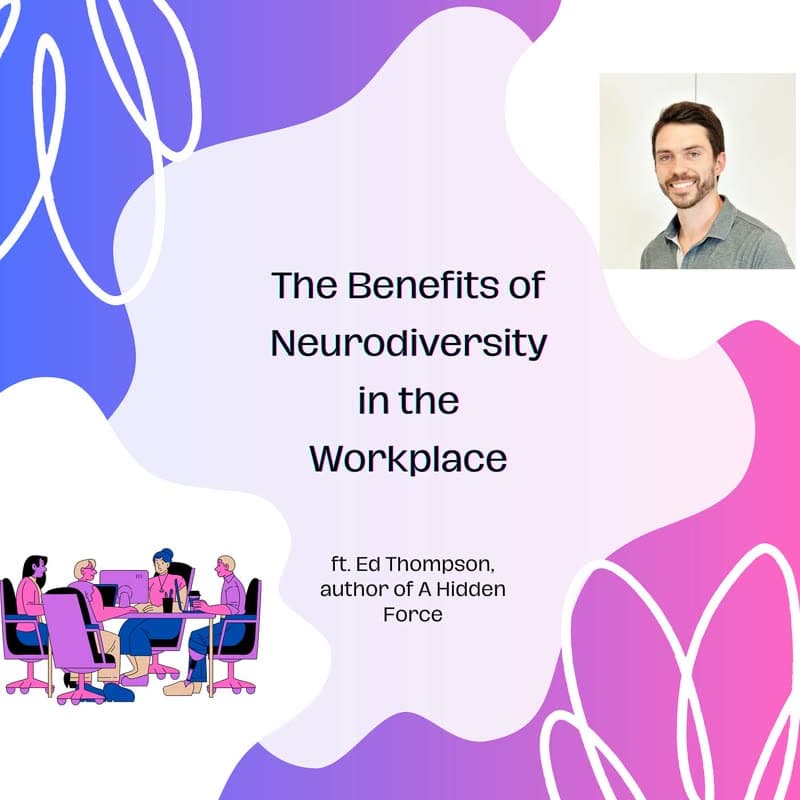
How Neurodiversity in the Workplace Benefits Everyone ft. Ed Thompson, author of A Hidden Force
About this episode
In part 1 of our interview with Ed Thompson, he explains how neurodiversity in the workplace benefits everyone.
Ed Thompson is the CEO and founder of Uptimize (uptimize.com), and the author of "A Hidden Force: Unlocking the Potential of Neurodiversity at Work". https://www.goodreads.com/book/show/124974772-a-hidden-force
Transcript
Full transcript · 3,667 words · about 18 min to read. Press a timestamp to jump to that moment.
Neurodiversity just means everybody has a different brain. There's no one normal brain. Neurodiversity means what it sounds like it should mean. It's just a fact of the human species.
Hey, everyone. We're Nick and Sonja, and this is Dyslexia Journey, where we help you support the dyslexic kid in your life. All right. And today we are excited to welcome Ed Thompson, who is the author of the book, A Hidden Force, Unlocking the Potential of Neurodiversity at Work. And I'll read a short bio about Ed. So Ed Thompson is the founder and CEO of Uptimize, the leading neuro-inclusion training company, whose mission is to help organizations embrace and leverage every type of thinker.
Born and raised in London and educated at the University of Oxford, Ed founded Uptimize in 2016, recognizing the urgent need for greater understanding and appreciation of neurodiversity within the working world. His role with Uptimize has afforded him unique insights and connections with pioneers in the neurodiversity at work field across the world. Welcome, Ed.
So to start with, we'd love to hear a little more about your background and how you got interested in this topic of neurodiversity in the workplace. Yeah. So for me, this started with having a quite serious car accident about four days into my career. So first job after university, the Friday evening of that first week, I had a major car accident and a traumatic brain injury. And that led to being off work, a substantial period eventually kind of coming back slowly.
But it also led to some differences in terms of how my brain worked, in terms of some new sensory sensitivities, some slightly different processing speeds, some issues with working memory and so on. Now, at the time, I'd never heard of the word neurodiversity. I wasn't thinking about neurodiversity at all. I was simply thinking about the fact that I'd had a car accident. I was lucky to survive and I'd had these injuries.
And it was years later when I actually took my first full time job after the accident. Once I was well enough to do so, I was working for a tech company in London. I was working for a CEO who'd hired me thinking, OK, he said a bit of a strange start to his career, but he went to Oxford, probably smart. You know, let's see what he can do for me. I found myself working in diversity and people, which was something of a surprise because these were really some of the big priorities that this CEO had.
And I think these days that's pretty common that what were HR priorities have kind of become CEO priorities, people, diversity. How do we make sure we don't all look the same, think the same and so on? How do we innovate? You know, this stuff is not just lip service. It really is, I think, critical to the future of business. So I got involved in very strategic diversity work with that company and then began to link up other organisations in tech in London and do the same with them.
And it was through that that I started joining the dots between diversity and what I'd seen it bring in the workplace and my own experience and the experience of some neurodivergent relatives. And realised, gosh, organisations don't know anything about neurodiversity. What if they did? Wouldn't that change the world? That was the genesis of Optimize to change that. That's a really interesting sort of backstory to your work. I should say also, we really enjoyed reading your book.
It's a really, we feel like it's a really well-written book, really important. And I think everyone, you know, every company, every person in every company should be reading this book. So thank you for getting that information out there.
Could you, you know, we've been using the word neurodiversity already quite a bit. Could you really quickly maybe explain the concept of neurodiversity to our audience and sort of the way that you talk about it in the book? Yeah, let me do it in a way that sort of relates to the workplace a little bit, because I think that's how we, or certainly where we focus as an organisation. And it's important to do this, I think it's often misunderstood.
Neurodiversity just means everybody has a different brain. There's no one normal brain. Neurodiversity means what it sounds like it should mean. It's just a fact of the human species. Interestingly, though, we're never taught that basic fact, really, at school and in education. And as a result, it's generally not really considered or fated for in organisations. This fact that we all have different brains, different ways of processing information, different ways of experiencing our sensory world, different preferences in terms of how we like to communicate and so on.
Nobody's thinking about this. So what happens in workplaces is norms emerge, right? Just ways of working that work for some and often work for the majority. That's why it becomes a norm, but don't always work for others. Now, yes, no two brains are the same. Some people have a shared sense of identity or what we call neuro identity due to having some traits in common. And that identity often comes or can be solidified through a diagnosis as, for example, autistic dyslexia, ADHD and so on.
And we know what's called neurodivergent people bring talent, bring different ways of thinking. And yet these norms I mentioned can often unintentionally exclude them. Neuro inclusion, which is what you described optimisers being our focus. It's about enabling everybody. It's about enabling every different brain to thrive and unleashing, if you like, true diversity of thought.
Yeah, I'm wondering, you started to cover this already, you know, in your backstory and just simply in that definition. But I'm wondering if you could give us a bit of an overview, just a brief overview of what the book covers and what your hopes would be for someone who reads it, what you want to get across. Yeah, I really wrote the book to share the exciting experiences and progress I've seen through my work at Optimise.
You know, yes, there's a long way to go. And we see also the issues that exist. And we've talked to and I talked to a lot of neurodivergent people who continue to face barriers at work. And of course, that's part of the story. But I really have seen great things happening. We get feedback from from learners in organisations that we train that can be quite emotional. We see neurodivergent people saying, you know, this is the first time I've ever been in an organisation that cared about people like me.
And the relief is kind of palpable. We also get really powerful feedback from managers, colleagues and so on who may be neurotypical, but who say, I never thought of this before. And this is the best thing I've seen in leadership in 20 years. And I think that kind of magic, you know, you're not getting that if you're training people in anti-bribery, you know, health and safety and so on. General leadership. These are things that, of course, are important, but have been around for decades.
I think something really exciting is happening here. And I wanted to kind of highlight that and share it for everybody. And of course, anybody in a team. I mean, our organisation in terms of training focuses largely on businesses. That neurodiversity is, again, just a human fact relates to any team. The idea of the book is to be approachable and tell any reader, you know, what this is, as we've been discussing today.
Why it matters, why it matters to them. And then how they can bring neuro inclusion to their own work or that of their team. Yeah, so one thing that we really appreciate about your book is how you emphasise that neurodiversity just really means that no brain is alike. And how the sort of work on neuro inclusion and flexibility really benefits everyone, whether they are neurotypical or neurodivergent. So I think one example that comes to mind is talking about how open office plans are often not great for autistic individuals, but they're also not great for a lot of people, like people who are more introverted or et cetera.
So do you want to talk a little bit more about how this sort of work on neuro inclusivity really benefits everybody? Yeah, exactly. I think it has to be careful to generalise a little bit that whether it's open offices or whether it's, you know, verbal interviews or whatever. Of course, those don't, I mean, the key point is they don't suit everybody, but they might suit an autistic person who is a verbal thinker, for example, or who enjoys that kind of social part of work.
But again, they don't suit everybody, and that's the key thing. And I think a common theme and realisation of work around neuro inclusion has been that everybody benefits. An interesting example of this, yesterday we had an event at Optimise and we had Lyric Rivera, who's well known for their blog, the Neurodivergent Rebel, coming to talk. They're a speaker, author, author, consultant, and they talk about the idea of neurodivergent people being canaries in the coal mine in the, in the modern workplace.
The idea that neurodivergent people can spot where things don't work that well and by fixing them, everybody benefits them and they have a story in their career around flexible working. And I'm paraphrasing, but the example in their book is sort of, you know, when I was accommodated as the first neurodivergent person in the organisation, everybody was accommodated. So let's think about how does that work. So neuro inclusion involves things like clear communication, flexibility in terms of how we work, when we work and so on.
It involves, as you mentioned, office spaces and attention to work environments to avoid unpleasant sensory stimulation. Now, you can see how some neurodivergent people may particularly benefit from those improvements and even find them mission critical. But it's also not hard to see how everybody else could too.
Yeah, we also appreciated how you addressed intersectionality. And so I'm wondering if you could say a little more about that, how other aspects of background and identity are also involved and intersect. Absolutely. Very important. There's all sorts of stereotypes of neurodivergent people. I think one that people probably be familiar with and may even hold subconsciously is that, for example, autistic people are male, nerdy, white. That's, I think, the mental picture for many.
Part of that comes through cultural representations, of course. Intersectionality is really important. Reminds us that anybody can be neurodivergent. Neurodivergence is present across all different demographics. In practice, it also seems like a disproportionate number of people who are neurodivergent are also within the LGBTQ plus community. Now, I don't have perfect data on that, but I know we've worked with organisations where that's very obviously been the case in their demographic. And I think you can see that through some of the stories in my book.
So, why does this matter? It's important. I think it's really important to recognise the challenges that people may have, where, in a sense, they find themselves in multiple minority groups. And in some cases, they may be faced with a double question of whether to disclose. Do you disclose as being queer and disclose as being dyslexic in your team? Bear in mind, any disclosure like that, people often find, I think, with good reason, stressful, difficult, and so on.
And, of course, feeling at the mercy of the culture that they disclose into. I've heard stories of people who've disclosed once as, say, death, but then don't want to disclose as an idiot because they think, well, gosh, how many things can I disclose to my team? So, I think it's an extra reminder that we need these cultures that really embrace people and their differences if we truly want people to bring their full selves to work.
And that idea of bringing people's full selves to work has been a big kind of buzz phrase, I think, for good reason over the last couple of years. I think intersectionality is also important if we are going to truly support other minority groups that we might, if you like, be more familiar with trying to support. So, of course, a lot of organisations have made efforts at ethnic minority inclusion, at gender inclusion.
Now, I don't believe those can be done properly if we don't consider the fact that this is a neurodiverse landscape in each case. And I think intersectionality is also a reminder, again, back to those stereotypes, to elevate, and I think it's the sort of thing we try to do, to elevate different voices to present the neurodivergent community in its true variety. Let's shift gears a little bit and talk about maybe, can you discuss a little bit the benefits and drawbacks of medicalising neurodivergence?
I know, it's a very controversial topic. Some people might recall that the idea of positives here, but in my book, I do acknowledge, and I just try to be as balanced as possible and kind of read this from as impartial a perspective as I can. I do acknowledge medicine as a whole role, at first, in appreciating these brain differences. Of course, this came from, from that world. And then, of course, many people get value from the medication and support that the medical world provides.
So, I do think there have been some positives, but it's important, I think, as well to acknowledge the drawbacks. And I suppose probably far fewer people are aware of these drawbacks, but those that are, feel them very, very, very strongly. I think one of those is the way medicine has framed these differences, as you like, in terms of negatives only. It's the idea of kind of deviations from, from a norm. I think rather than what we know now, the idea that brains are different, they've come from this idea that sort of brains are either kind of as they should be or something's wrong with them.
And, you know, a kid is expressing certain things less well than other kids and therefore, you know, there's something wrong with them and so on. And I think that's really been damaging. And what's called the neurodiversity movement, which is really disability rights or social activism movement here, is in a decades-long battle to change some of those core perspectives that neurodivergent people are sort of broken or less than, and actually stress that neurodiversity is just this human reality.
And everybody's brain is different with their own strengths and challenges and so on in different, in different contexts. So there's this real kind of rewiring, I think, that's, that's needed. And in the workplace is interesting. You can see this obvious dissonance, right? You know, neurodivergent people, many of the top business people of our time, you know, are in that category. Yet, if organisations do anything to include neurodivergent people, and often they don't, it can be kind of limited disability or even sort of charity initiatives.
Well, I think that's changing. I think the story of that change is kind of the story of the book. And yes, it's about inclusion. I mentioned norms that are excluding people, but it's also just about ways of working and how people as a whole, any team, any neurodiverse team, can work together, you know, to perform to its best. I was just going to say, this is very important to us as well.
And it can be a challenge because we're talking a lot of times about difficulties and challenge as well. But we really try to always get in as well, you know, the benefits of having a dyslexic brain, for example. And yeah, that's another thing that I really liked about your book is you don't talk about this as like a charity to sort of help neurodiverse individuals. Like, like, like you really emphasize that this, this benefits everyone.
Like a lot of, like you said, a lot of the top thinkers and people in, in business are neurodivergent, neurodivergent. And so this is real. I mean, even in the title of your book, right, a hidden forest, like you're really emphasizing that there are all these kind of untapped strengths, unrecognized strengths that really benefits everyone. And yeah, and just to go a little more specific, for examples, what have you seen in terms of dyslexic individuals in the workplace and some of the benefits?
Yeah, I mean, I mentioned many top business people in neurodivergent, many top business people are dyslexic. You look at the sharks on the TV program, Shark Tank, that the British version is dragons on what we call Dragon's Den. Many of them are dyslexic and reading their stories, as I did for the book, many credit this with their success. Barbara Corcoran, Kevin O'Leary, Damon John and so on. And of course, Richard Branson, one of the preeminent business icons of our days, describes being dyslexic as a gift.
So where does this come from? I think it comes from some of the dyslexic skills that Brock and Fernet Eide talk about in their book, The Dyslexic Advantage, a really great book. They talk about the idea of kind of flip side strengths and some of these same brain wiring that might lead to challenges also has these strengths. And they name and they really kind of go to detail as to some of these dyslexic thinking advantages, things like 3D thinking, being able to make connections, narrative reasoning, the idea of kind of insight.
We don't know exactly how a dyslexic brain has these strengths. I talk in the book about one neurologist called Manuel Casanova, who suggested it may be related to kind of longer brain fibres or what are called mini columns in the cerebral cortex of the brain. But we don't really know. I think that the point is, if you like, that dyslexic brains are made this way. And they may come with some disadvantages in some contexts, but they come with significant and less well-known advantages too.
And just to kind of summarise this, I think there was an interesting process for me, of course, as there has been building the company in writing the book. And I think one of the things I was most struck by is how you look at the top of almost any field of life. The amount of neurodivergent representation there is really striking. I don't know if that should be a surprise, but it really was.
You look at the top actors, the top sports people, the top Olympians, and there's this strong representation. And again, that was kind of a message I wanted to get in the book. Not necessarily the idea of superpowers, but just I think we need this major shift in terms of how we think about different brains. Yeah. One of the particular traits that you mentioned that could be one of the reasons that neurodivergent individuals are at the top of their fields is this idea of divergent thinking.
Do you want to talk a little bit more about that or maybe some of the other traits that you think might contribute to this success? I think people are used to this idea of kind of linear thinking. And linear thinking in its most kind of raw is that kind of building block model. Now, of course, some neurodivergent people may be very strong at that, particularly strong at that, really kind of building a linear argument grounded in data and facts.
So one thing leads to another, leads to another, leads to another. But many are also strong in divergent thinking, again, a concept that's not really that well known, something that seems to come a little less naturally to so-called neurotypicals than it does to neurodivergent people. Now, one interviewee for my book described divergent thinking as the difference between trying to break down a locked front door, just kind of bashing away versus going around to the back, exploring possibilities there.
So I think in practice, if we kind of build on that metaphor, it means, you know, people can see an issue or approach a problem completely differently. And of course, it's often valuable at work. You know, although I've got a friend, Stu Shader, who's a dyslexia advocate, who's a salesperson, and he talks about being able to use some of this divergent thinking to kind of get to answers around, you know, deals and how his organization can work with the customer.
And sometimes actually having to catch people up to that thinking or solution because it wasn't linear. It's come from this different angle. And again, I think that strength, sadly, can be a contextual challenge when it's not understood and appreciated in interviews, for example, where people can expect a certain type of answer, be a little thrown when they get a very different type of answer. I think that's wrong. I think that should be, you know, embraced, but I think that's what happens.
Or in work, you know, where a manager maybe expects a certain process to get from A to B. And actually, you know, what if this individual doesn't want to start at A, they want to start at D, you know, come back the other way. I think the lesson is focusing on the result over the how as much as possible and letting different thinkers work in the way that suits them best to get there.
More from the show
Learn to Love Listening ft. Cliff Weitzman, Dyslexic Founder and CEO of Speechify
In this installment of our Dyslexic Voices series, Cliff Weitzman, founder and CEO of Speechify (https://speechify.com/), tells us about his experiences growing up dyslexic, and shares his advice for how to succeed as a dyslexic child and adult.
Make Real Progress on Big Goals For Your Dyslexic Kid!
We all have goals for our dyslexic kids, but they often seem overwhelming and out of reach. In this episode we provide specific, practical tips for organizing the goals into smaller chunks and making daily progress.

The Attacks On Your Kids’ Rights to a Free Appropriate Public Education ft. Attorney Laura Heneghan
With all the changes in the US recently, it’s hard to keep track of all the implications. In this episode we dig into the changes at the Department of Education, executive orders, lawsuits, and more in order to understand how these changes could directly affect your kids!
Never miss an episode
New episodes every two weeks. Follow wherever you listen.