
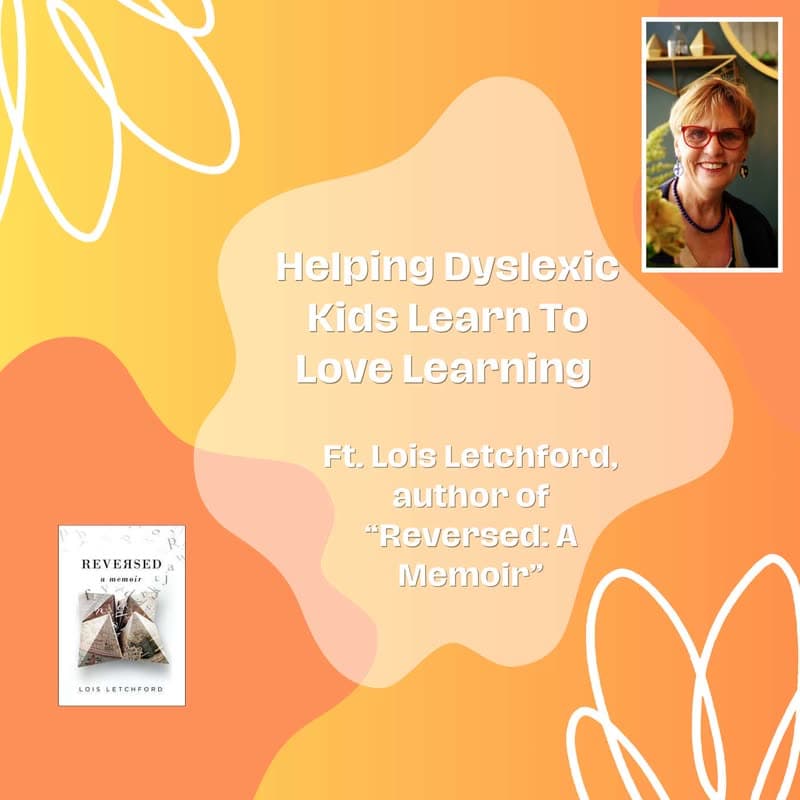
How To Excite Dyslexic Kids About Learning Ft. Lois Letchford, author of “Reversed: A Memoir”
Re-aired Jul 23, 2025.
About this episode
In Part 1 of our interview with Lois Letchford, we delve into her journey parenting her dyslexic son Nicholas who was told that he was "the worst student ... ever seen" by one of his early teachers, but who went on to earn a Ph.D from Oxford.
Here is a short bio of Lois: Lois Letchford’s dyslexia came to light when she faced teaching her son, Nicholas. Examining her reading failure caused her to adapt and change lessons. The results were dramatic. Lois qualified as a reading specialist using her non-traditional background, multi-continental experience, and passion for assisting other failing students. Lois received teaching degrees in Australia, Texas, and a master’s degree from SUNY, NY.
Reversed: A Memoir is her first book. In this story, she details her dyslexia and the journey of her son’s dramatic failure in first grade. https://www.goodreads.com/book/show/36163388-reversed
Transcript
Full transcript · 4,360 words · about 22 min to read. Press a timestamp to jump to that moment.
When a child is under the stress situation, they are in flight or flight mode. Absolutely nothing is going in their brain. They cannot function in the classroom. That's what happened to Nicholas. His brain shut down. When he and I were learning together and he's relaxed and I'm taking at his pace, the brain is not only saying, am I safe? The brain's going, this is fantastic. And that's when the learning happens. And the learning only happens when they are safe and feel confident in the classroom.
Hey everyone, we're Nick and Sonja and this is Dyslexia Journey, where we help you support the dyslexic kid in your life. All right. And today we are very excited to welcome Lois Letchford, the author of Reversed, a memoir. And let me read a short bio about Lois. So Lois Letchford's dyslexia came to light when she faced teaching her son, Nicholas. Examining her reading failure caused her to adapt and change lessons. The results were dramatic. Lois qualified as a reading specialist using her non-traditional background, multi-continental experience, and passion for assisting other failing students.
Lois received teaching degrees in Australia, Texas, and a master's degree from SUNY in New York. Welcome, Lois. Thank you, Sonja and Nick. I'm so pleased to be here and chatting with you today. Great. Yeah, we really, I should know, we really enjoyed reading your book. It's a really fascinating and very well-written memoir that really brings out the struggles with learning to read for someone with dyslexia. Yeah, it was really well-written and so vividly written. I just felt like I was right there.
So I definitely recommend that everyone read it. But just as an introduction, could you just give us sort of like an overview or summary, some highlights and lowlights of your son, Nicholas's struggles, you know, that first beginning of all of this and your journey with dyslexia. And, yeah, just anything you want to say about that to catch everyone up to speed a little bit on that. An overview. It's always good to start with an overview. My story, our story began in 1994 when I sent Nicholas to school in grade one.
He'd been to kindergarten and preschool, so he'd been in the system. And the kindergarten teacher said, well, I think you'll be fine. At the end of day six, I spoke to the teacher and she threw up her hands and said, well, I don't know how I'm going to teach him this year.
And in hindsight, how I wish I had removed him from school then and there. I didn't. So he goes to school for the whole year. He fails every day. He wets his pants. He bites his fingernails and he stares into space. So he learns nothing. At the end of grade one, he is tested and the testing reveals that he can read 10 words. He's got no strengths. And above all, he has a low IQ.
And once you're thrown into this basket, it's actually very difficult to get out of it. Our family were privileged. My husband is a university professor and the following year, he has study leave in Oxford, England, and the family go for six months. And I take Nicholas on. And initially, I fail. No different, no better than the first grade teacher. And then my mother-in-law is with me and she said, Lois, put away what's not working and make learning fun.
And that, and her words was transformative. And that put me in a position of saying, what else can I do? And I thought, what can Nicholas do? So I started to work on his strengths. He can rhyme words and he can see patterns. And he was very good at seeing patterns. I wrote one little poem, which led to the next and next and next. And the whole experience was unbelievably transformative. And during that time, I worked out, Nicholas has anything but a low IQ.
And we work on. But I think it's important to recognize it was the whole experience. It wasn't just writing poems, but we were seeing things. We were exploring the whole world and connecting writing to our experience. We returned to Australia in 1995. And I meet the lady who had done the testing, school diagnostician. I said, Nicholas has learned so much. And it's been so exciting. She stood in front of me, put her hands on her hips and said, well, I've spoken to the reading teacher.
And he's gone backwards. And in fact, he's the worst child I've seen in 20 years of teaching.
Perfect for writing a book. But I didn't know that. And I used her words to go back and say, well, you can call him that. But if he is the worst child you've seen in 20 years of teaching, don't expect him to learn like everybody else. And that really helped me, again, continue to change the teaching method. He's in the classroom. He's taking more away from the classroom. I'm supporting him at home.
And over the next five to six months, the child is reading. And then he just grows and grows and grows in school. And that's the start of the story. He graduates high school. He graduates college. And after he's graduated with two honors degrees, he takes, he does a PhD in applied mathematics at Oxford University. That's the short summary. Mm-hmm. Yeah. Let's put, I mean, I'm going to just pull apart a couple of things there to dive into a little bit more.
Because that was definitely noticeable to me on reading it, that one of the keys in how you were teaching, you know, definitely fun, like you said. But also you're making those connections. And so could you say a little bit more about, like, how maybe, you know, maybe for everyone to some extent, but dyslexic kids in particular, that can be more of a challenge and also needs to be addressed more to really connect that understanding with the words.
Okay, I became a reading specialist because of my son, Nicholas, and I went back into the literature and I read thousands. I think I've read a thousand academic papers. And there's a real disconnect between what, how we talk about reading and what's in the academic literature. And we think the problem is decoding. They can't decode the words. Well, they're right. They can't decode the words. And we have to ask why. Dyslexic people and people who struggle with literacy get the nouns and the verbs.
They really struggle with the abstract words. That's one.
Abstract words are also words that are not in our oral language. And we talk about decodable texts and using decodable texts for our struggling students. They're words like tot or tit or tat. Now, when was the last time you used those words in your oral language? There's my question to you. When did you use tot? Not often. Or rum. Or tum. You know, any of these three-letter words. And our children read them.
And because they read them, we think they've got it. And they don't. And so making connections becomes the critical component. And it's not just, I made a connection. It's understanding all of language. And I think what we forget about words is that even in early literature, inference comes up very quickly. Inference. Pronouns. And I've written an academic paper with Professor Tim Roszynski on pronouns and pronoun resolution. Why? Because we teach kids to read the words.
He, she, them. I'm not going to, they is a tough one. And it's spelt really difficult. Really difficult. That's a bad way of saying it. But those words have meaning. It. And they are some of the hardest words to comprehend in our language. Because it's got nothing to do with the word itself. And the ability. And teaching children. We forget to teach children a word like it has got to be what they call resolved.
You've got to work out where it comes from and what it refers to. And I was working with a six-year-old this week. And we wrote a poll about a caterpillar. Because we made a caterpillar. So we know what we're doing. I made a caterpillar. And the caterpillar has, the caterpillar has it. And I said, what's the it? Or what's the he? And the little boy said to me, it's me. It's my dad.
Right here. They have a problem. And when we teach reading, particularly to the average kids, they get it. Our children don't. They think what we call very concretely. So when you say, he is a man. Or she is a lady. And that's the end of the story. But it's not the end of the story. And we have to do more teaching. And that's where the gap happens. And that's why making connections is so critical.
And when I work with the most vulnerable students, what do I do? I take a story and I turn it into a play. Because it's taking away language being abstract. It's making it real. And then you know and I know what the child is thinking about. And that's another critical step. So I've said an enormous amount there. That's really helpful, though. I think that really makes it really clear what's meant by that, connecting the words.
And also, I think it's really interesting because we often observe that, counterintuitively, kids with dyslexia struggle with those sort of smaller words that, you know, maybe average readers think of as the easier words. Like he, it, right? And I think I've never really understood, actually, until your explanation just now, like, why exactly that is. Yeah. Yeah. And I think some of it comes from, some of it definitely comes from working with my students.
But part of it comes because I grew up reading words without comprehending. And I had to work out, as I'm teaching Nicholas, why was reading so hard for me? Yes, I can read all the words. So what stopped me from creating that picture? I mean, I don't have definitive answers, but it's certainly working out that pronouns are meaningful and you're reading a word without meaning. You know, who's the he? And does the he change?
Because the pronouns give us consistency throughout the paragraphs. And you, as the reader, have to do so much work.
You know, the big component and what I push for reading is active learners. And that's what happened to Nicholas in, in Oxford. He became an active learner and a lover of words during that time. And we ignore that, you know, and it doesn't matter what learning you're doing, whether you're learning to read or becoming a surgeon. If you're not an active learner, you lose it. And when we're teaching our kids to read, what do we forget?
Read the words, kid.
I've read it so long. Then we're not creating active learners. You give a great example in the book about how you engage Nicholas during your time in Oxford with your research on Captain Cook and actually looking at the maps of his voyages.
Can I tell you an amazing story? Definitely. It happened. You know, the book finishes in 2018 when Nicholas graduates. Well, in the book, it's when he completes his oral exam, which was really tough for him. After he graduated with his PhD, I spoke with him and said, Nicholas, tell me what happened in first grade. Because I didn't know. I don't know what happened. I just know it was a total disaster. My son, confident, articulate, ambitious, cried.
His tongue went round in his mouth and he couldn't say a thing. He couldn't articulate anything. And that blew me away. And I thought, I can't deal with this now. But I recognize that trauma had gone on and we hadn't dealt with it. And I said to him, Nicholas, well, tell me about the learning you had, you and I had in 1995. And instead of the crying, we've got this laughter. And he says to me, I remember the poems you wrote, windmill on a hill and mug of a bug.
And the first poems I wrote, 25 years later, he's telling me the story. And he said, learning about Captain Cook and the changing map of the world taught me to love learning. And I never want to stop learning. That blew me away. I knew what we did was good. I didn't know it was so important and so powerful.
And I think teachers and parents forget about social, emotional learning and the connection of the love of learning with words and letters and sound. And I've read, I don't know what you read, but I married this academic, so I read amazing things. And there are two books about the brain. One is why. And now I've forgotten the other one. One is Ian Leslie and the other is Mario Lovio. And Mario Lovio says we can take brain, MRIs of the brain, and it'll look like taking a slice of the ocean.
And he says that creative curiosity propagates in the brain in untold ways. That's what I did with Nicholas. And that's what I aim to do with my students. When we test, excuse me, I'm rambling. When we test students, we, you know, we take the number of words they can read, 10, 20. We come out with a number because it's measurable. And they haven't got these. So we put a cross against them.
And then we test on a standardized comprehension program. They've got this and they haven't made enough gains. We forget and we don't understand the power of what I did with Nicholas with curiosity. He made minimal gains in what they measured. The growth in his learning. And the other thing I did was gave him a reason to read and write. Why are we learning about these letters and sounds that are so, oh, we've got to learn about Captain Cook and Christopher Columbus and Ptolemy and, and, and, and, oh, isn't this so exciting?
And to go to the British Museum and see the hieroglyphics. Wow, this is the best in the world. And, and that's what becomes so important.
Yeah. Yeah. It's interesting. It's, it's so much about the deeper purpose, yet it ties perfectly into the actual techniques as well. So. Mm-hmm. Yeah. And we might only see these minor growths here, but we're not even attempting to measure their love of learning and their growth in why I'm doing it. Why is this important? Mm-hmm. Because they're harder to measure. Yes, absolutely. Yeah. And I think this really goes back to what you were saying earlier about when you told the reading specialist, or I can't remember who it was, at the school that, well, he's not, don't expect him to learn like everyone else does.
Brilliant. And, and I think that's, that's really true. You, I think, in a sense, in a sense, in a sense, it's true for everyone, because the best way to learn is through this individualized, you know, figuring out what your passion is, and then building the sort of incentive to learn around that particular passion. And that's just, I guess, it just, it seems like such a struggle to implement that properly in the existing school settings.
So, I guess, this is my long-winded way of leading into, I guess, do you have any sort of thoughts about, about that and how the sort of traditional schools can maybe improve in that regard?
Well, there's a lot to say. The first is we throw our children into standardized reading programs. That's a problem. We have ignored creative, we have ignored the first thing, gaining the child's attention.
We've got to have attention before we have active engagement. That's number two. Now, you said a lot, and my memory's gone blank.
How do we do it? There's a push and a pull as a teacher. You know, we can take children and the child and think, I don't like this, but by the teacher's love of it and the teacher's enthusiasm for it, we actually drag children along. And we think they haven't got it, but we've actually given more to the child than we recognize.
Individualized. Yes, we think it has to be. Now, I've got something for you. Every single person who speaks English, 100%, believe it or not, have to make the same jumps in literacy and in thinking and in decoding to go from the bottom to the top or to become a non-reader to a reader. The problem is that they make those jumps at such speed, we don't see them happening.
So, we forget the kids have got to do, we've got to do more work and we've got to break down the English language for those who are struggling. And that's where it has to be more individualized. And that's where it has to be more individualized. However, the more we individualize it for the lower students, the better it is for everyone.
I've taught in a classroom, not as a classroom, but as a reading specialist. And I was reading my students this book and I had a range of abilities in it. And I'm reading the book about a diary of a killer cat. That's a funny book. And what fascinated me was how the best readers in the class created the best picture. And as I read the story, I'd say to him, what's the picture in your mind?
And the best reader would do something. I said, show me, show me what that looks like. And then all of the other children would go, oh, is that what it means? We forget even when we're reading two children, our lower readers don't always create that picture.
So, yes, we do have to individualize it, but how can we do it more for the classroom and just do more activities? That's the big thing. Because, again, we're taking away that abstract nature of language. And that's what we forget. You know, we just read the words again.
I get a bit frustrated because our attitudes are so buried in decoding. But we forget all of the other aspects of literacy. And then we think, you know, it's a program. The child's got to go through it. Three years, they say, my child's going to take to learn to read. If it's taken three years, there's a significant problem with the program. Yeah. I want to pick up on what you were saying about pictures because that's reminding me of the Davis Methods clay words.
Could you say a little bit more about those? I believe you use them a bit with Nicholas as well. I use them with all of my students because of that. Okay. Yes. It slows the learning down so the child can take it in. So instead of just pushing the words out to the child and asking them to write it. Well, actually, it started with Nicholas in second grade, when he went into second grade, and I asked him to write the word cat or something.
And my little boy sat there, arm around his paper, pencil in hand, and froze. I thought, he doesn't even know where to start.
So I thought, Nicholas, let's get the clay. And, you know, we worked for an hour and a half on rhyming words, cat, hat, rat, sat, for him to get it for three days before we went to alphabet letters, and then he wrote it. And by Friday morning, he got all of those words. He went to school and he didn't get them right. But that didn't matter. What mattered was the next week.
He got them right. And the slowing down, and also, it tells you where to start. It helps you stay. You start at the top. We go from left to right and top to bottom. Because I noticed the way our children or my children, my students, write their letters, and it's anywhere. And we want to teach them top, bottom, left, right, so that we get a flow across the page. I had students do a K, and they'd do the sticks on the right-hand side, half a stick in front of the V, and then go back to the top, and you're thinking, how did they do this?
Well, it's interesting how the dyslexic brain often works, and I think we've noticed that in our daughter, too. I mean, she'll write, you know, or back when she was younger, I mean, you know, C-A-T or T-A-C looked the same to her, right? It's because it was, you know, her brain is able to just switch that, yeah, and it's the same thing. And we can help by saying, we start here. This is the first letter.
K is the first letter. And continue to reinforce that left to right component of language that helps them and their brain say, I've got to do it this way. And put the picture down and the cat on top, you start here. And rather than expecting them to know, I do more modelling, this is where we start, this is where we've got to do it, this is how we do it. And it's more supportive of our students, and it gives them more confidence.
And as they build their confidence, they then take over. And it takes, you think it takes longer, you think it's slower, but you're not putting them in a stressful situation. Okay, can I go back to my Nicholas when in grade one again? What I learned from talking to Nicholas was that when a child is under the stress situation, they are in flight or flight mode. Absolutely nothing is going in their brain.
They cannot function in the classroom. That's what happened to Nicholas. His brain shut down. When he and I were learning together and he's relaxed and I'm taking at his pace, the brain is not only saying, am I safe? The brain's going, this is fantastic. And that's when the learning happens. And the learning only happens when they are safe and feel confident in the classroom. That is such a key point. I think we can't emphasise that enough.
The person whose work is worth exploring is Dr. Mary Helen Immortano-Yang on social emotional learning. And it's phenomenal.
And I did it unexpectedly. And it's something I've worked with since. I didn't have the research for it for most of my career, but I have it now. Sorry, what were you going to say, Sonja? Oh, yeah, I was just going to say that it's reminding me of the piece that we, you know, noticed, which is that some people might think, you know, things aren't going well for a child in school.
Then it's counterintuitive to move to a different country, right? Like you did to Oxford. We actually did that at one point to Switzerland. And I think that, and I'd love to hear your thoughts on this, that sometimes when things aren't working, a big change, you know, a big reboot, a big, completely fresh approach is part of that. And so that's why that does work. And, you know, of course, in the case where there's stress happening, that's absolutely true.
You know, there are no answers, are there? There are no right answers. And my husband's fond of saying, light is an experiment you cannot repeat. And when you move children, you don't know what's going to happen, whether it's a good thing or a bad thing, or whether they get on with the teacher or they're friends or find friends. All of that is unknown.
So the answers are not simple. Yeah. I was going to say, in our case, I think the first major decision was pulling our daughter out of first grade to homeschool her. And I think in your case, it was, I think, similar age with Nicholas, although it was a little bit forced because of your move. But I think that's, I think it's really hard for parents to know, and it was hard for us to know, like, is this the right thing?
Are we doing the right thing? You know, is this going to work? It's a very scary proposition to sort of make that kind of active decision about changing things up. I totally agree with you. You know, with hindsight, I should have taken Nicholas out of first grade. Why? Because it was a disaster. And you've created this trauma in his brain that no one's recognized. I, as a parent, didn't know how to deal with it.
And then when it's over, you think it's just over. It's gone. It's not gone. It's there. It stays there forever. So your decision, as you say, very difficult decision, you know, I think is the best thing you could do. And the interesting part, you know, with Nicholas, if I had removed him from school at first grade and I didn't have the skills I needed. I know that. Even when we went to Oxford, I didn't have the skills.
But if you go back and you fail, the school could point the finger at you and say, you didn't. We would have done better. And that's really hard, I think, to live with. So you have to make it work, don't you? When you pull them out and we go, I think, the extra mile to make sure something happens that's positive. So I admire your choice. I think that, you know, is brilliant because the reality is we can't leave children, sit in the classroom and fail every day and expect them to learn.
It's not going to happen. It's not going to happen.
More from the show
Learn to Love Listening ft. Cliff Weitzman, Dyslexic Founder and CEO of Speechify
In this installment of our Dyslexic Voices series, Cliff Weitzman, founder and CEO of Speechify (https://speechify.com/), tells us about his experiences growing up dyslexic, and shares his advice for how to succeed as a dyslexic child and adult.
Make Real Progress on Big Goals For Your Dyslexic Kid!
We all have goals for our dyslexic kids, but they often seem overwhelming and out of reach. In this episode we provide specific, practical tips for organizing the goals into smaller chunks and making daily progress.

The Attacks On Your Kids’ Rights to a Free Appropriate Public Education ft. Attorney Laura Heneghan
With all the changes in the US recently, it’s hard to keep track of all the implications. In this episode we dig into the changes at the Department of Education, executive orders, lawsuits, and more in order to understand how these changes could directly affect your kids!
Never miss an episode
New episodes every two weeks. Follow wherever you listen.