
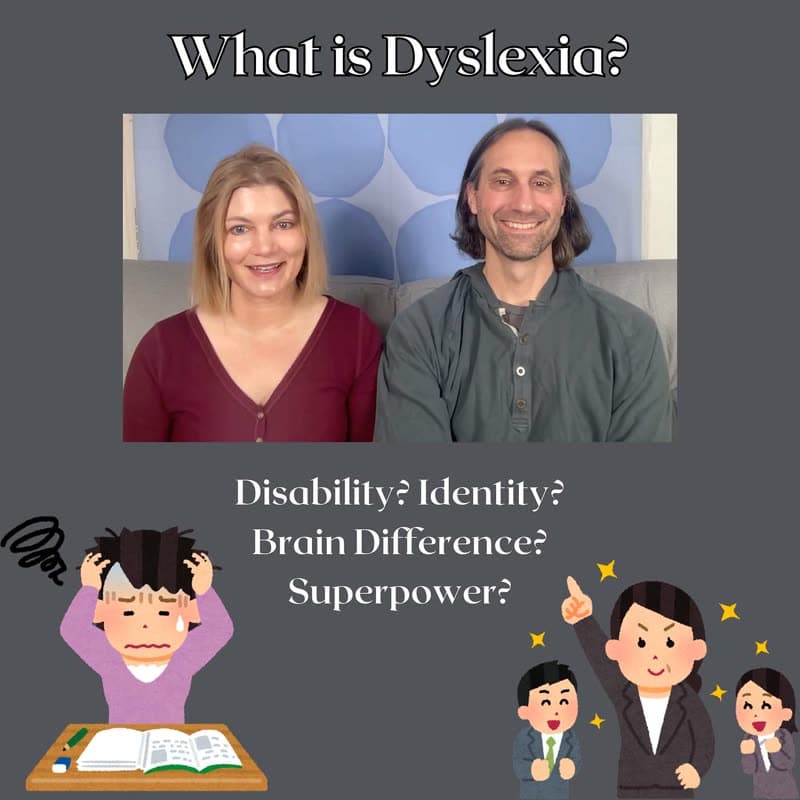
About this episode
Do you think you know what dyslexia is? You might be surprised!
Links to our sources for the episode:
International Dyslexia Association definition: https://dyslexiaida.org/definition-of-dyslexia/
British Dyslexia Association definition: https://www.bdadyslexia.org.uk/dyslexia/about-dyslexia/what-is-dyslexia
Yale Center for Dyslexia and Creativity definition: https://dyslexia.yale.edu/dyslexia/what-is-dyslexia/
Article about Dr. Manuel Casanova's research into the brain structure of autistic and dyslexic people: https://news.louisville.edu/news/autism-researchers-work-yields-insight-dyslexia
The Dyslexic Advantage, by Brock Eide and Fernette Eide https://www.goodreads.com/book/show/9897792-the-dyslexic-advantage
Transcript
Full transcript · 3,732 words · about 19 min to read. Press a timestamp to jump to that moment.
The top dyslexia-related search on Google is, what is dyslexia? So that's what we're going to cover today.
Hey everyone, we're Nick and Sonja, and this is Dyslexia Journey. And today we are going to tackle covering a big topic, but an important topic, which is what is dyslexia? And like I said in the intro, it is actually the top search on Google if people are searching about being dyslexic or dyslexia. So a lot of people want to know about this. And the challenge, as you'll see in how we approach it here, is that there's different ways to look at it. There's different lenses that you can look at it through. What do we even mean exactly by what is dyslexia? Is it more about the experience? Is it more about formal definitions?
So we decided to break it down into five lenses or ways to look at what is dyslexia. And I'll just say what they are at the outset, but then we're going to go into each of them a little more. So the first one is definitional. So purely like trying to define in the way we think of defining a word or a term, what is dyslexia? The second one is diagnostic. So, you know, when you go in to find out if you're dyslexic, what does it mean in that case?
The third is what is the brain perspective? Like are there brain differences? Are there anatomical or functional differences? The fourth is the actual experience of being dyslexic. So what does that mean in, you know, in someone's terms of someone's life and how it's experienced? And the fifth is more of an identity or neurodiversity perspective on what is dyslexia in that way. So without further ado, we will dive into number one, which is that definitional lens of looking at what is dyslexia.
And even with that, you know, there's different definitions. So we're going to read a couple of the sort of main in terms of like from main organizations and ones for you here and compare them. Yeah, it's really interesting because, as you'll see, I'll start with the definition from the International Dyslexia Association and then contrast it with some other definitions. So let's just I'm going to read first, just without comment, the definition of dyslexia from the International Dyslexia Association.
Dyslexia is a specific learning disability that is neurobiological in origin. It is characterized by difficulties with accurate and or fluent word recognition and by poor spelling and decoding abilities. These difficulties typically result from a deficit in the phonological component of language that is often unexpected in relation to other cognitive abilities and the provision of effective classroom instruction. Secondary consequences may include problems in reading comprehension and reduce reading experience that can impede growth of vocabulary and background knowledge.
So my initial commentary on that is that it is a very negative definition, right? If you listen to the words they're using, they talk about learning disabilities, poor spelling, deficit, problems, consequences. It doesn't acknowledge any positive aspects of dyslexia and it does not frame dyslexia within the spectrum of human neurodiversity at all. Right, right. So, and it's also pretty narrow, actually, in what it's covering because really, because it is a brain difference, it's affecting a lot of different areas.
And this particular definition is really only talking about reading and writing. Yes, so I would say that this is a very limiting definition of dyslexia. Yeah, well, and so let's contrast it with, so you can see how there can be a definition that's similar but different also with the British Dyslexia Association definition. So, I'll just read this one straight out too. So, quote, dyslexia is a specific learning difficulty which primarily affects reading and writing skills.
However, it does not only affect these skills. Dyslexia is actually about information processing. Dyslexic people may have difficulty processing and remembering information they see and hear, which can affect learning and the acquisition of literacy skills. Dyslexia can also impact on other areas, such as organizational skills. It is important to remember that there are positives to thinking differently. Many dyslexic people show strengths in areas such as reasoning and in visual and creative fields, end quote.
So, you can see that in a lot of ways it's similar. It definitely talks about the reading and writing right up front. It definitely is talking about the struggles as the main paragraph. That second part that was more positive was actually an additional paragraph added on. But it does bring that up. It definitely does bring that up. And so, just simply by bringing that in and broadening that it's – so, I think two things are happening.
One is that it's bringing in the positives at all, right? And so, that starts to help us see it more positively, but also get that sense of it as about more than just reading and writing and about, like, more of a brain difference. And then, also, they do mention information processing specifically, which also gives that broader sense where you can start to realize it's not, like, just one part of your brain that's dealing with spelling and writing or something like that.
Right. And then, just to make it clear that it's not just a British versus an American thing, here is a paragraph from the Yale Center for Dyslexia and Creativity. Dyslexia is defined as an unexpected difficulty in learning to read. Dyslexia takes away an individual's ability to read quickly and automatically and to retrieve spoken words easily, but it does not dampen their creativity and ingenuity. Right. Right. And so, some nice positive words in there.
Exactly. Right. And it's interesting, also, the first definition uses the term disability. And the second two definitions that we read is the term difficulty. Right. And it's not like any of these are perfect. Like, I think the choice of saying unexpected difficulty is interesting because, I mean, the more I learn about being dyslexic and how common it is, you know, probably up to one in five from the whole range. Right. I mean, why would that even be unexpected?
But the experience so far in sort of history has been that we somehow are surprised by. Yes. So, yeah. So, even with our first lens of just definitional, it's clear that there's actually not a kind of stringent, agreed-upon definition of dyslexia, which is super interesting. Right. It is interesting. Yeah. I mean, because it does have so much complexity. And as we'll get into the other definitions, you know, it'll become clear that there's a lot to it.
I mean, it's complex. Yeah. So, it's hard to capture it for that reason. And I will say, though, a caveat to that is that the International Dyslexia Association, the first definition I read, is considered kind of the most agreed upon in the U.S. in the sense that I think a lot of different states have adopted that language in their sort of official discussion of it. Right. And, you know, in terms of really putting the struggle up front, I mean, it's not like that doesn't make sense, right?
I mean, it's natural to do that. And, you know, that's probably a good transition into the second category here of lenses, which is diagnostic. Because, you know, when people are realizing they're dyslexic, it often is because of the struggle. And, you know, there is this need for diagnosis in order to get accommodations. So, it makes sense that we are, like, putting primarily the struggle up front in the definition. I mean, that does make sense, even though, as we get into some of the other definitions, you'll see the importance more of, like, the broader features, I think.
Yeah. So, let's jump into our second lens or way of looking at the question, what is dyslexia? And, from a diagnostic perspective, it's interesting because the diagnostic language does not include the word dyslexia. Right. And so, dyslexia is, it's diagnosed according to the DSM-5. Which is the Diagnostic and Statistical Manual. So, that's something that, you know, doctors, for example, use to, or, you know, psychiatric clinicians use to see the criteria for specific, to see if someone would have the different criteria for specific disorders.
Right. So, it's a psychological psychiatric diagnosis as opposed to a traditional medical diagnosis. Right. In this case, yeah. Yeah. And the exact wording in the DSM-5 is a, quote, specific learning disorder with impairment in reading. Right. And so, again, that's interesting that the word dyslexia or dyslexic is not actually used in it. And, you know, we don't have a lot more to say about that one, but I will point out that that is actually kind of confusing to people.
Like, sometimes, I can't remember which guest we had on, but one of the guests we had on was mentioning how sometimes parents will hear that that was the diagnosis for their child, and they don't realize their child's dyslexic because that wording wasn't used. Right. And it also, I mean, there are specific criteria listed for diagnosis, but it's open to a lot of interpretation, which is why you can get such inconsistent assessment results from different, depending on who actually does the assessment.
Right. Right. So, that's important to keep in mind as well. Yeah. All right. So, let's jump into our third lens for tackling the topic of what is dyslexia, which is the perspective of the brain, sort of the anatomy and, you know, anatomical setup and how that functionally affects things in the brain. And so, there are observable differences. I'm going to be reading to you something here, too, so that I say it correctly.
But there are observable differences in the brain, and we found that the dyslexic advantage by Brock and Furnett Eide in their book, you know, that was the dyslexic advantage, explained it really well. So, this is where we got the information from, you know, when they were talking about these particular studies. So, they explained that there are observable brain differences that lead to many, also to the strengths, right? So, the difficulties are related to these brain differences, but also the strengths, because it is just these ways that the brain is different from, like, a more holistic and broad sense.
And here, I'll go ahead and do a quote for you here. Dyslexia, or the dyslexic processing style, isn't just a barrier to learning how to read and spell. It's a reflection of an entirely different pattern of brain organization and information processing, one that predisposes a person to important abilities along with well-known challenges. So, that's just sort of how to think about the brain and the differences in the brain, that it's, you know, it really goes back into that, where the definition used information processing.
So, brain organization, brain processing, but to bring in, and so, there's a lot more studying to be done on this. There's a lot more in our own knowledge of, like, the actual studies to be done. But I think we'd like to reach you just a little bit about one specific kind of brain difference that's found as, you know, an example of something where you can kind of see how it seems like what the organization and function in the brain, how that difference is makes sense and seems to indicate, like, why there would be certain differences that we observe also, which is in the columns.
Did you want to go ahead and read it? Okay, so this is research done by Dr. Emmanuel Casanova at the University of Louisville in Kentucky. And this is research that was published in 2009. And I'm going to be reading from a press release from the University of Louisville. So, it says, Casanova and his colleagues have mapped the way tiny strands of brain tissue, called cortical cell mini-columns, develop and connect in normal people and in people with autism, dyslexia, and other language problems.
Their previous studies suggest that people with autism spectrum disorder may excel at mathematics and visual discrimination because their brains are structured to make short, local connections between mini-columns. And then he goes on to say, or the press release goes on to say, this study demonstrates that people with dyslexia show an opposite pattern of connectivity that favors longer connections at the expense of shorter ones as measured by the spaces between cell mini-columns.
This pattern of connectivity may yield a greater capacity for abstract, quote, visionary thinking. Right. So, how does this relate to what we observe and have talked about in this show about dyslexia? So, we often say that we find that dyslexic people are often good at sort of creative thinking, sort of leaps in knowledge or in connections, holistic thinking, thinking outside the box. And so, the fact that their connectivity favoring the longer connections at the expense of the shorter ones sort of does have that feel, almost that feel of, like, things being farther spread apart.
So, they might, it might take longer for the, you know, for the, for the impulses to, like, pass from neuron to neuron and the speed of what's happening in the connections. So, that's going to make reading slower. Right, but if, but that they're sort of farther apart, you know, that gives that impression of that, like, holistic thinking, that they're, they're sort of, like, they're gathering from more, almost, like, the bigger. Making connections between many different areas that people without dyslexia have a harder time doing.
Right. And, I mean, as you can see, it's a little imprecise talking about it that way. But, it seems like, you know, with this kind of studies, it's definitely onto something because it, it, it's pretty natural to think about what that seems to mean based on our observations. But, of course, more studies need to be done to figure it out more specifically. Anyway, so, that's just one example. But, the main point being that there are these observable differences.
You know, and then it also makes sense because it is, you know, we do find heritability. So, it makes sense that there's these brain differences. So, let's move on to our fourth category here, which is the experience of a dyslexic person. And so, we're not going to go into this very heavily, mostly because, you know, everyone's experience is still going to be so nuanced and different. I mean, honestly, listening to or watching a lot of our interviews on our Dyslexic Voices series would be most helpful here to get a sense of what each person's experience is like.
There are commonalities, but it's, you know, it's the kind of common truth that there will be commonalities. And then there might be someone who's dyslexic who doesn't have that particular one, even though so many people have it. And so, you have to take, kind of take it all with a grain of salt. But I think it's important to bring up because if we're talking about what is dyslexia, I mean, the lived experience of the people who are experiencing being, having a dyslexic brain, you know, like, should be an important way that we look into that.
Yeah, for sure. And so, neither of us are dyslexic, so we can't speak to this from a first-person perspective. But we have interviewed, as Sonja said, a number of people for this show who are dyslexic. And then, of course, we've talked many times about our daughter who's dyslexic and who has shared her experiences with us. And so, speaking of the experience just of trying to learn to read and what reading feels like, again, that varies.
Some people say the letters jiggle. Some people don't. Some people say that they are able to sort of see the whole page at the same time. And so, they have trouble reading linearly because it's sort of, their brain is sort of taking in all of it at the same time. Right. Some people talk more about difficulty sort of keeping their place in the line as they're tracking along. I think a lot of people, most people indicate, you know, and this makes sense just because if there's a struggle reading and you're focused on the decoding and the reading, then it's hard to take in the actual information and think about it at the same time.
So, a lot of people mention that, the decoding of the information and then to get the actual meaning of it at the same time can be a challenge, which is why sometimes having an accommodation is so important if you can be hearing it because, you know, the learning to read part doesn't always have to go together with and shouldn't always go together with other kinds of information that you're trying to get.
Right. And then, sort of more generally, we make this point a lot, but people with dyslexia have generally the same variation in intelligence as people without dyslexia, a lot of variation in interests. So, there are dyslexic people who are very interested in academics and go far with that. There are some people who are not, who do totally different careers. So, there's no kind of universal experience there. Right. And some people, some may come to love reading.
Some people may always prefer audiobooks. Some people might not like reading it, you know, just aren't interested in that. So, there's a lot of variation there, too, which may surprise people just simply because, of course, we think about the struggles with reading and writing so much. And then one interesting kind of shared experience of dyslexics, which is kind of a side effect of our school system and the way our society is set up is that most people with dyslexia do have a period in which they struggle at school and in which their self-esteem takes a hit because of that.
Again, this isn't universal, but it's fairly common. Right. And so, this isn't related to dyslexia itself, per se, but it's related to the experience of being dyslexic in our current culture. Right, in the particular society. Right. So, we can look at it a couple different ways, the experience. The experience of actually learning to read versus the experience of, like, being in our particular society as a dyslexic person. And that's actually a good segue.
So, you know, that was very quick, because we really do want to encourage you to listen to some firsthand experiences of dyslexic people to get sort of a sense for the broadness of everyone's experience, but also some of the commonalities. But it does sound like a good time to go into our fifth and final lens for viewing what is dyslexia, which is the identity or neurodiversity perspective. So, that's important because it's very holistic, right?
It's very holistic. It's very, like, also tied to the experience of the individual. And it can be an important definition for people to use of dyslexia or, like, or to embrace as the way they're taking in that they are dyslexic, because it tends to be a way that people can feel like, either A, like, I know why I'm having this experience. Or, B, it's not just, like, something wrong with me. It's this much bigger thing that, you know, is so much about my brain difference and how my brain works.
So, and embracing it as an identity is such a positive thing and such a positive way of looking at it and, you know, just thinking of oneself as part of the diversity of, you know, all of it, of nature of people. And so, it's a very important one, right? It's not necessarily the one we're thinking of when we do. I mean, I doubt that that is what people are thinking of when they are Googling what is dyslexia, because most people are probably either just curious about the experience or probably even more likely are looking it up because they're interested in diagnosis and those pieces of it, right, that do have more to do with the struggle.
But this piece is really important in other ways, too. Yeah, and it's interesting how this has evolved lately from a more sort of not embracing the identity to now really embracing the identity. So, the general advice used to be, don't say someone is dyslexic or is autistic. And so, people have come to realize that there are strengths to dyslexia and to autism and things like this, and also that it's a natural part of human neurodiversity.
And so, that way of thinking is now, I think, unpopular, and in my opinion, rightly so. Even though we still, you know, sometimes when you're talking, it's just easier to say, have dyslexia. And it's still used a lot, so we definitely still say it. Right. Sometimes. But there has definitely been a movement in recent years for people to really embrace the identity and say, I am dyslexic. I am autistic. Mm-hmm. As a really, really embracing that part of their identity.
Right. As both the strengths and the challenges that go along with it. Right, just more holistically, right, rather than only talking about the one way in which, or not the one way, but the few ways that it interacts with society that are the struggle aspects. Yeah, and so this is, again, our final lens of sort of looking at this as an identity is really fairly recent. Yeah. Yes. Well, so hopefully all that was helpful.
We'd love to hear in the comments if you have heard other definitions of dyslexia, if there's other lenses or perspectives that we haven't covered here, that'd be great to hear. And of course, if you have any ideas or topics, we'd love to hear about that, or if you have any questions for us. And you can always reach us, in addition to in the comments, you can always also reach us at our email address, which is parentingdyslexiajourney at gmail.com.
Thanks, everyone, for watching.
More from the show
Learn to Love Listening ft. Cliff Weitzman, Dyslexic Founder and CEO of Speechify
In this installment of our Dyslexic Voices series, Cliff Weitzman, founder and CEO of Speechify (https://speechify.com/), tells us about his experiences growing up dyslexic, and shares his advice for how to succeed as a dyslexic child and adult.
Make Real Progress on Big Goals For Your Dyslexic Kid!
We all have goals for our dyslexic kids, but they often seem overwhelming and out of reach. In this episode we provide specific, practical tips for organizing the goals into smaller chunks and making daily progress.

The Attacks On Your Kids’ Rights to a Free Appropriate Public Education ft. Attorney Laura Heneghan
With all the changes in the US recently, it’s hard to keep track of all the implications. In this episode we dig into the changes at the Department of Education, executive orders, lawsuits, and more in order to understand how these changes could directly affect your kids!
Never miss an episode
New episodes every two weeks. Follow wherever you listen.