

10 Tips For A Great New School Year!
Re-aired Aug 14, 2024.
About this episode
In this episode, we share 10 specific things you can do right now to ensure that your #dyslexic kid starts out the school year strong!
Links to a few resources that we mentioned:
https://portal.learningally.org/login
https://www.grammarly.com/
https://chat.openai.com/
Transcript
Full transcript · 4,123 words · about 21 min to read. Press a timestamp to jump to that moment.
As schools start back up again, how can you help your dyslexic kid get off to a strong start? Here's a checklist of 10 things that you need to do.
Hey everyone, we're Nick and Sonja and this is Dyslexia Journey, where we help you support the dyslexic kid in your life. So if you're like us, summer went all too quickly and now that school is starting again, it's time to think about how we can get things off to a great start for our dyslexic kids. So we've put together a checklist of our top 10 things that we think that every parent of a dyslexic kid should do as we start the school year.
And, you know, some of them might sound kind of big, maybe it sounds overwhelming to have 10 things, but hopefully by organizing them this way and thinking of them as a checklist and just trying to, you know, do them one by one and get them checked off, hopefully that can help you not feel overwhelmed. All right, let's jump in. So the first item on our checklist of things that parents of dyslexic kids should do to start the year strong is, and this is the number one, point on our list.
It's probably the most important point. it's to connect with your child's teachers, toward the beginning of the school year. And so if your child is in elementary school, they may have one main teacher. if they're in middle school, junior high school or high school, they're going to have, six, seven, eight different teachers. it's important to connect with each of the teachers, in person is best, but we usually start with an email.
so, we, we actually, compose an email to like our daughter's in high school now. So we compose an email to each of her teachers at the beginning of the school year and, and say something along the lines of, you've probably, seen that our daughter has a 504 plan, because of dyslexia and dysgraphia. And then we go into the sort of specific ways that that affects her related to that specific class. so again, if in an elementary school, it's a lot, it's a lot more general.
So, so you could just say something like reading and writing, takes them longer, in, in middle school and high school, we try to keep it specific to the subject. So, for example, in a science class or a math class, it might not be obvious to that teacher how dyslexia affects them. So it's important to explain the ways that it impacts them in that particular class. And then we also, talk about what accommodations that they are approved for, what accommodations they usually use in that particular class.
And then, of course ask if, if they have any, you know, concerns or questions throughout the school year to, to please talk to us. Yeah. And I had just a couple more things to add. One is don't neglect a class that you think might not be related, like more of an art class or a PE class. Try to really think about ways that it could show up there. you know, something just with instructions on the board or something like that, because, they're also more likely not to be thinking of it and miss it.
The other thing I wanted to point out is, especially as a kid gets older, teachers and schools are very, concerned with self-advocacy and dyslexic students. And that is absolutely valid. Like we want them to learn more and more to self-advocate. but I think it's still really important as a parent to help your kid in this way, because it's kind of intense for the kid, especially at the beginning of the school year to set this as the expectation.
It also sort of immediately opens that line of communication between yourself and the teacher if the need arises for that. But I think, I think it's good to actually address that in that first email, because then, then the teacher realizes that you understand about the self-advocacy too. Like in our daughter's case, she's actually a great self-advocate and that's grown over the years. So we'll tend to mention that, like, she's actually great at self-advocacy.
We just wanted to, you know, make sure this is all clear at the beginning. so they sort of have that on their mind. If you had a kid maybe who was shyer about it, though, I think that could be worth mentioning too. Kind of like we're working on self-advocacy, but this is their personality. And then the teacher will understand that you get it too about the self-advocacy and that you're not necessarily going to be stepping in in places that don't make sense.
But they'll understand that individual kid and how self-advocacy works in that case. Yeah, very good points. And then I want to add also, the importance of an in-person meeting if possible. and this is probably, especially important in the, the younger grade levels. when they have sort of one main teacher that they're with the whole time. you probably don't want to wait until the first parent teacher conference because those, at least in the districts that our kids have been in, have, occur maybe later in the fall.
you, you might want to set up or we encourage you to set up a meeting kind of early on and maybe even in the first few weeks of school to, to really establish, you know, make sure their teacher understands, your child. And exactly what your child needs, to really get off on the right foot. And sometimes there are back to school nights where you meet a lot of the teachers quickly. And I think that sometimes can work.
Like I encourage going to one if you can, like sometimes that does work, but sometimes there's a teacher who like has many people they're trying to see at the same time and just meet quickly. And so in that case, then it would need to be a separate meeting. and so just again, to summarize that main point, it's a really about connecting with your child's teacher by email and person, whatever way you're doing it at the beginning of the school year and making sure they're clear about, your child's diagnosis and also their accommodation.
So that's the key there. And one final point on why this is so important. And I promise the other tips aren't quite as long as this one. This is a really big, important one. So that's why it's so big at the beginning and long. But, but as dyslexia advocate, Sherry Ray pointed out in the interview that we did with her, and we can link that video below. it really helps, you know, when teachers have a lot of students in their class, particularly as they get older, and they have a lot of different classes with those teachers, it really helps also to like, just sort of ping their memory on who your kid is, like, and that kind of thing.
So it can be really important in that way as well, that they're, that they're more, maybe a little more aware of your child or that they remember it easier just because of that connection. Yes. Okay. And so before we go on to the other nine tips, if you're finding this content helpful, we'd really appreciate a like, subscribe, share, so we can get this content out to as many as people as possible who'd find it helpful.
All right. Moving on to our second tip for how to, start the school year strong with your dyslexic kid. it's similar to our first one, but this one is about connecting with the child's, counselors and or principal. and this is especially important if you have, an established 504 plan or IEP or something similar to that, that you want to review that with the counselor, and, make sure it's all up to date.
Make sure it, it actually properly captures the accommodations that your child has been using that various teachers have been giving them. and then again, it's just important to, to have that sort of, one-on-one connection with the administration of the school, as well as with the individual teacher. because, again, like, like Sonja was saying previously, it's just helping, you know, it helps to humanize your child and, and their, potential difficulties. it, it just, the, the more people who, who can, so in the school who sort of understand, what your child's, diagnosis is and what accommodations they have and just has that sort of forefront in mind.
I think the better the school year is going to go for your dyslexic child. Okay. So tip number three is if you haven't formally had your dyslexic kid assessed, now's the time to do it. So, you know, as both of those former points, we mentioned accommodations and, you know, sometimes, especially if you're at a smaller private school or something like that, or you just, you have a school where they're individualizing a lot to kids.
Maybe you haven't felt the need actually to do that yet because you're getting the accommodations anyway, but, whether that's the case or whether it's just time to get them assessed because you haven't yet. I would encourage as the school year starts up to start looking into that. It can take a little while to book it sometimes too, and to just sort of figure out the right resource to do it. So it's a good idea to start looking into that.
So you can make sure that they're getting those rights to the accommodations and to figure out sometimes even what they are, because sometimes as you do the assessment, you learn some nuances that you didn't even realize yet. And we do have an upcoming interview with someone who does these assessments, Dr. Linda Silverman. So hopefully that interview will be helpful to you to watch as well. Yeah. And I just want to add to that.
I know that some people are ambivalent about getting an official diagnosis. and you know, we've talked about this in previous episodes and I don't want to dwell on it here. but in our experience, and I think most dyslexia advocates, agree that, that getting that official diagnosis is going to be crucial in, in, making their, their school experience better. so we do strongly encourage if you haven't done that already to, look into that.
All right. Our fourth tip for, as the school year starts for helping your dyslexic kid get off to a great start is to look into, subscriptions to various online services that might help them. so a couple that are really popular are, learning ally and grammarly. and we can link to those, also consider a chat GPT subscription. we've talked about that in previous episodes, how the, AI chat bot can actually be really useful, especially as your child gets into.
middle school and high school, maybe not, not so important for elementary school. and there are other resources out there. generally, if you talk to your child's teachers and counselors, they may have suggestions as well. and we also have an upcoming, interview with a, a middle school language arts teacher who, put together a great list of resources that we're looking forward to sharing with you in future episodes as well. So our tip number five for getting your dyslexic kid off to a great start to the new school year is to really think about the place where they're going to be doing homework.
So creating a space in your house that is designated for that is really helpful. And it's going to look different though for different kids. So that's the nuance here. Some kids, you know, this is probably what we think classically of doing for a space like this. It's like quiet. You want to have like other people around rather than, you know, if it, let's say it's in the middle of the living room, then is that going to be difficult if pets or siblings are coming through or there's distractions like that.
But there are some kids who actually prefer to have something going on, in the background, particularly something like music. And maybe you have to think about what the right kind of music is that works in that case, but that's true for our daughter. I also tend to work better that way. and so just really thinking about what works best for the kid, but giving it some thought and helping your kid, you know, if they're younger, you might be guiding it more.
If they're older, you're just helping them to think about it themselves perhaps and figure it out. helping them create that space where they can really do that homework in the way that works best for them. And one factor to take into account as you're considering, the best space for your dyslexic kid to do their homework is that you're probably going to be helping them a fair amount. so sort of tucked away, you know, in a, in a, in a bedroom with a, a desk with one chair might not be the, the most ideal space.
so the space in our house that gets used for homework the most is actually the dining room table, which is, a good space to have sort of multiple people sitting there together, we're working on stuff together. Okay. Continuing with the homework theme, our sixth tip for helping your dyslexic child get off to a really strong start for the school year is to, establish patterns for homework, that include recovery time after school.
So, as we've discussed in previous episodes, school is exhausting, really for everyone, but for dyslexic kids in particular. And so, expecting them to come home from school and immediately jump into homework is, is probably, going to be disappointing and frustrating for everyone. So, just, it's important to establish a space for homework. It's also important to establish patterns around when that homework gets done. And we really recommend not trying to do that immediately after school, let them recover, let them have some downtime.
And then, and then maybe you can, jump into the homework. Our tip number seven for how to start your dyslexic kid off to a great start to the new school year is to take an active role in doing their homework with them. just offering what support you can. It's going to vary by year to year. It's going to vary by subject. It's going to vary in a lot of ways, but if they can feel like they have that support, it's going to go a long ways towards helping them.
It'll also go a long ways towards helping them do things more quickly. If you're able to provide that support, we understand that there may be situations where it's, that's really difficult to do. Maybe you work in the evening, something like that. So if at all possible, see if you can have someone else be there at the time so that it could provide certain, at least certain kinds of support, to your kid that, that would be helpful.
And the important thing to, to also realize here is that each year does tend to get harder and it can be a little different with different teachers. So even if your kid maybe was more independent the year before, don't assume that that'll be true, the following year. Maybe it will be because it has more to do with your kid having established their own patterns, but, just don't make that assumption because sometimes different years, different teachers can provide new challenges.
And then another reason that this is really helpful to be really active in being very aware of the homework, you know, in addition to helping is because you might realize that they just really are overwhelmed. Like maybe they just have way too much work and an accommodation that can be provided for dyslexia is to try to minimize certain kinds of work, particularly busy work, you know, where you can try to really get in those problems or, or the kinds of assignments that are helping them with their learning.
But if there's something that maybe is less important, they might be able to have a decreased amount of the homework. So that way you're a little more on top of, of how that's going interest in terms of actual volume and how long it's taking to get it done. And this actually goes back to our first point of why it's so important to establish that relationship with your child's teacher or teachers, early on.
So that if it reaches the point where your child is just spending hours on homework, you can, you already have that, that pre-established relationship with the teacher and you can reach out to them and talk to them and discuss the best approach. I also wanted to add that, as your child, gets into middle school and high school, you may not be as comfortable helping them with homework for all of their different subjects.
And, and also you may, not, not have the time to, to spend with them, you know, hours every night. it's important to look into resources that your school offers. So most, high schools have peer tutoring set up. and if it's a, you can always talk to the teacher of a particular class, or the counselor and they, there will often be, like I said, peer tutoring or times when the teachers are available to help, in a study hall like setting, things like that.
so, so even if you don't have the time to help yourself, it's important for you to be involved in helping your child, figure out what the resources are. Right. And it kind of gets back to the thing I talked about, about self-advocacy. It's not that your kid isn't going to start to figure this out themselves, but I think it's important to remember that kids haven't done this before. So what we're trying to do here isn't trying to do it for them, like that they'll never know how to do this for themselves or find resources.
but if you can do it in a way such that it's like you're teaching them about, this is how you go about finding resources, then that will serve them well, because we can't assume that they will just know or figure it out on their own necessarily either. So it's important to be guides, I think, in that way. Okay. Our eighth tip for getting off to a great start in this school year with your dyslexic child is to not neglect the emotional health of your child.
so we did a great interview with a therapist a few months ago, which we can link to, I highly recommend you go back and watch that for the, for the details on sort of all the, emotional and mental health, aspects of, of, of, that can sort of go along with, with dyslexia and school stress. but I just, just here want to remind everyone that school is, is stressful for everyone. Life is stressful for everyone and for dyslexic kids, especially.
And so it's really important to consider their emotional and mental health throughout this whole process. especially as the new school year is getting underway because they, were, were probably, very, happy to not have to do it. Deal with school during the summer. And so it's going to be, they may be resistant to going back to school. They may be, extra stressed. It's going to remind them about their learning difference and so on.
And so it's just a super important time to pay attention to their mental health as well. And she also gave some great tips for sort of things to be on the lookout for to, to, to, to realize that there might be an issue going on. and so there's lots of different ways that that could look too, in terms of what that emotional support is. Maybe it does involve a therapist, for example.
but there's also ways that we can be as supportive as possible. For example, sometimes we can really get into a fix it mode, you know, wanting to problem solve, but often our kid just wants us to listen. So that's an important thing to, to realize. So a related tip number nine for helping a dyslexic kid get off to a great start to the school year, is a little more focus on yourself.
So you are a big support person in their life and it's important really to acknowledge that and to take care of yourself. So there's lots of different ways to do that. Of course, paying attention, attention to your physical health is one of them. but here I want you to especially consider, you know, the emotional aspects of being a support person like this. And it can be really hard sometimes to watch your kid go through struggles.
And so whatever that means for you, if it's therapy, if it's being able to talk to a friend who can just listen, whatever that is for you, try to make sure that you have some support and maybe a couple different means of support in your life. And try to notice when you're feeling over, it'd be nice to actually do it regularly would be ideal, especially notice if you're feeling overburdened and you need to talk to someone.
But if you do it as a regular thing, then it's also like an established pattern. So I would definitely advise that as well. All right. Our 10th and final tip for helping your dyslexic kid got get off to a great start this school year. it's kind of a corollary to, the one about mental and emotional health. And this one is really focusing on, don't neglect their passions and make sure that they still have time to have fun.
So, school should not be their whole life. if they have a passion for a sport or arts or, anything like that, just make sure that they continue to have time for that. it's so easy to get sucked into the, the school stress and think that they need to be spending all their time doing homework and, and working on remediation, for their, for this, their dyslexia and so on, that we forget that they're still kids and they need to have fun.
And for some kids, this might be easy. There might be something they want to do all the time. And in that case, you're trying to really help them balance it. maybe trying to have some way in which they can have a lightened load at school to, to pursue the passion. for other kids, they might be resistant to doing anything more because they want a lot of downtime. And so in those cases, just keep encouraging them, you know, just try to really keep encouraging them, trying to help them put it in perspective about school and any given assignment.
and just reminding them what they really like and trying to provide, you know, let's say it's art or something like that. They have their supplies there, at least that there aren't other barriers so that they would have a chance to do it. And for, a child who does, want more downtime, just make sure not to overschedule them. It's probably the key aspect there. Right. And so again, for, for a kid, maybe who's less wanting to do, wanting to be as scheduled to remembering that these don't necessarily have to be scheduled activities.
So sometimes it just makes sense that they are scheduled activities, but something like art, maybe it's an art class, but maybe it's just that they have the resources at home and have an art area where they do their art.
All right. Well, that's our, that's our checklist for getting this school year off to a great start for your dyslexic child. we hope this is helpful. Please let us know tips that, that you might do that we haven't thought of. yeah, please share them in the comments. We all need all the tips we can get here. Yep. all right. I hope everyone's school year, gets off to a great start.
More from the show

The Definition of Dyslexia Changed: Here's What It Means for Your Family
For the first time since 2002, the International Dyslexia Association has rewritten its definition of dyslexia. The new version quietly removes two ideas that have kept kids from being identified for two decades: that dyslexia has to be 'unexpected' given a child's intelligence, and that a phonological deficit is…

"Everyone Else Can Read" Ft. Parent Fiona Rintoul
Fiona Rintoul, fellow parent of a dyslexic daughter, joins us to discuss her experiences. You can find Fiona online at https://purplecowrecruiting.com/.
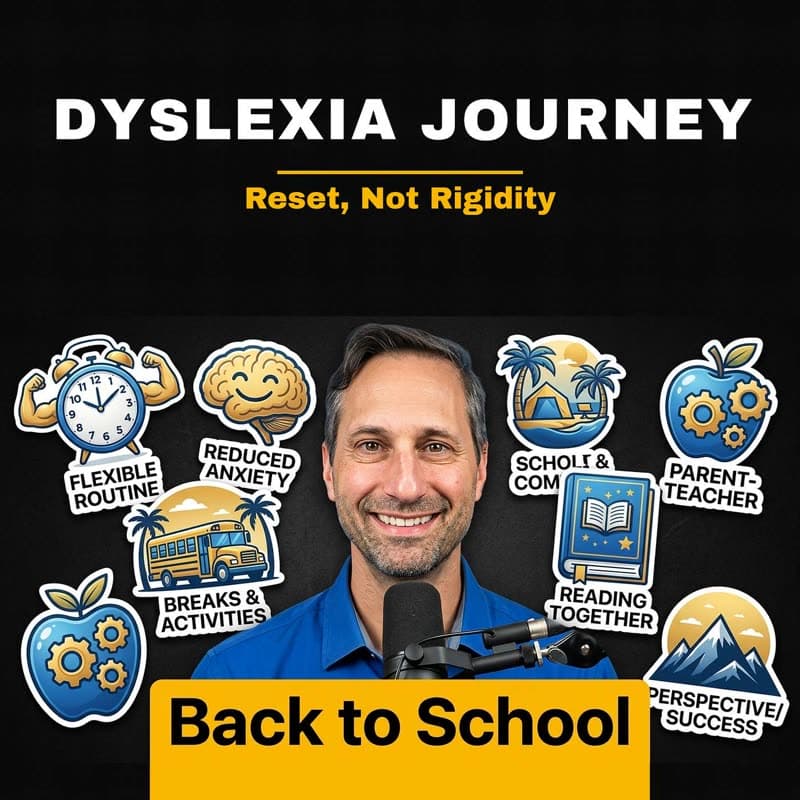
Back to School with Dyslexia: Reset, Not Rigidity
The first two weeks go great. Then, somewhere around week three, the crying starts, or the stomachaches, or the flat refusal to get in the car. If you've been through a back-to-school honeymoon followed by a hard crash, this episode is about setting things up so the crash doesn't take the whole year with it.
Never miss an episode
New episodes every two weeks. Follow wherever you listen.