
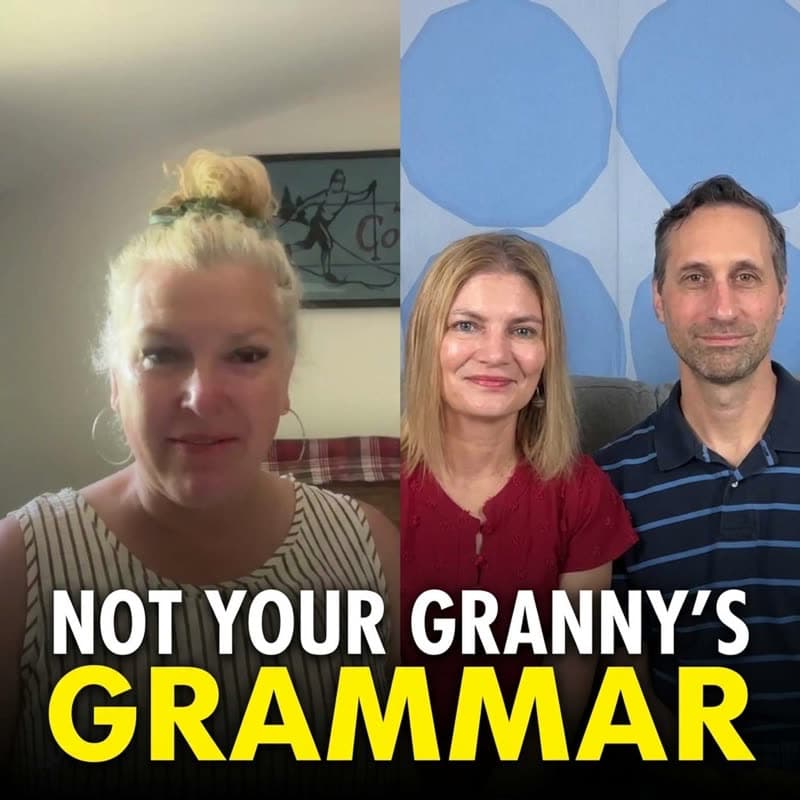
About this episode
Patty McGee is the author of Not Your Granny's Grammar and an experienced teacher and educator.
Follow us on Instagram!
Also check out our YouTube channel!
Transcript
Full transcript · 4,660 words · about 23 min to read. Press a timestamp to jump to that moment.
And there was a seventh grade boy who stood up and said, that's so much better than the old way. So I felt like, all right, you know, seventh grade boy, seal of approval on this grammar approach, I'll take it.
Got me diagnosed when I was in third grade, and it was the most relieving day of my life because I finally had like kind of a place to hang my hat and say, see, I told you, I'm not lazy, definitely not stupid. I just learned differently. Like, that's totally okay. We dyslexics, we were often, you know, just set up for failure because, you know, we were given books and tasks that really are not appropriate for the level that we were at.
So how do you expect anyone to be open to learning when their entire relationship with reading, with learning, is physical pain? Wish I had understood when I was younger that the fact that my brain worked differently than people meant that I would be good at things in ways that other kids were not going to be good at. I must assume, I can't be dyslexic because letters don't jump up and down for me.
Dyslexia is not a disorder. It is not a disease. Once you sort of own it and embrace it, then you can have the power to deal with it. It's sort of empowering and also enriching to the whole community. To those who don't understand what dyslexia is, that it's not a negative, it's not a problem. It's like we keep saying superpower.
Hey, everyone. We are Sonja and Nick, and this is Dyslexia Journey. And today we are welcoming guest Patty McGee. Patty is an author, literacy consultant, and Milken Educator Award recipient. Her latest book, Not Your Granny's Grammar, an innovative approach to meaningful and engaging grammar instruction, breaks the cycle of isolating grammar as drills and instead embeds it in joyful, meaningful contexts directly connected to student voices and real writing. Patty, welcome to Dyslexia Journey.
I'm so happy to be here. Thanks for having me. So we are eager to hear about your pedagogy and methodology and all of this, but I'd love to hear first just about your origin story here with all of this. So tell us about your background and how you started to get into this work. Yes, sure. So I began as a sixth grade teacher in the school that I went to. So my principal was my first grade teacher.
It's just a small town story. And she taught me how to read and she taught me how to teach. And I spent about 10 years in the classroom. And then I just love books. And I became a school librarian and then also an instructional coach in the same school. And then it just kind of moved from there where I started working with both grownups and kids in a regional office that we have in the northern New Jersey area where I live and work.
And it just kind of snowballed from there. I wrote my first book back in 2017 on writing instruction and feedback and then just had this latest one come out about a year ago. So that's it in a nutshell. A lot more details, but it's been a very unconventional educational path. And so you've worked with a lot of students over the years and also a lot of teachers. Now you train teachers, right?
Yes, I do definitely work with teachers and I also work with students. I'm still teaching in the sense of the things that I'm sharing with teachers. I go into classrooms and demonstrate. So it's a lot like the way doctors work together in their practice where they study each other's work. It's the same that I do with teachers. And I'm curious, so I don't know if it was more that you noticed something lacking or just that you noticed something you were doing was really resonating with students.
How did that evolve then into your method? Yes. So in two of the three books, actually all three books that I've written, they came from problems of practice of my own. And I noticed that those problems of practice were pretty common and I just worked on them. Like the first book that I wrote was on giving feedback in writing that is not corrective. Like it just wasn't working. It was doing a number on my students' confidence and ability to transfer.
And then grammar. Gosh, I feel like that's a problem of practice for everybody. And that was certainly in my really early years, I was just completely confused on how to teach grammar in a way that was effective. But I just still lived by the belief that a worksheet and a drill and a memorization one day was just going to work the very next day. And obviously that's just not true. And so I have been really curious about grammar instruction for quite a long time.
I've been in education for over 30 years. And during that time, it just was a constant kind of like curiosity of mine. So I just played around a lot of thinking about, well, what is it that we do in other subjects? Or what is it that we do when we're learning something and we're not in school? And what is then missing from grammar instruction that we often take part in and other areas of learning?
And so I just started to play with that. I met my co-author, Tim Donahue, probably about 10 years ago. He was a supervisor of humanities at the time, and he knows more about grammar than I'll ever know, even after writing a book together. He's just brilliant. And one day we were joking. We're like, OK, well, you know the grammar side of things. I'm working on the instructional practice side of things. Let's write a book one day.
And that's where this was born. So we decided to really put our heads together and think, you know, what is it that we can do with grammar that really can help a transfer, that can really help it feel like craft rather than correction? That it can feel like the way a painter's paintbrush feels to a writer. And that's really where it was all born. It's a very long process that we've gone through because we really weren't intending on doing anything with it in the first place.
It was just like, what is it that we can do to make this work better? And that's where our approach was born. Yeah, let's dig into the approach. So if you can try, and I know obviously you've written three books, but if you can try to summarize maybe the latest sort of focus, maybe on the Not Your Granny's Grammar book. Yeah. What, what, if you can try to summarize, what is the approach?
Yes. So it's, it looks so much more like what natural learning looks like. So one of the things that I often do when I have problems of practice is I look outside of school and say, what do I do when I learn something? Or what do I need when I'm learning something? And that's what I did in this case. I thought to myself, well, what is it that I am learning to do?
And I will always and continue to learn how to use different types of paints to refinish furniture, paints and waxes. And, and I thought, well, what do I do there? And I know I get curious. I hypothesize like, ooh, I think this paint might go with this wax on this piece. And then I seek out experts. Pardon me. And those experts both give me feedback, but also explicitly instruct me. They show me step by step how to do things.
And then I play. Before I get onto the furniture, I'm on cardboard or scrap wood and, and I'm trying these different methods out and seeing which one works. And often, again, asking for feedback and then reflecting on what is it that I am doing that I feel confident with, that I know, and what am I still curious about? And so I took those aspects of learning that just came naturally to me and brought them into grammar.
It's really all it is, is we ask kids to get curious, usually in partnerships or trios, which is really, I think, so dyslexic friendly because it's relying on oral conversation. And we know that most students have just such a beautiful syntactical knowledge that they may or may not realize that they have. And so we get curious about concepts and we hypothesize like, ooh, maybe this is how this works or that is how this works.
So curiosity before explicit instruction. So it sets up like a really fertile brain space for that explicit instruction to come in. And then from there, this might be my favorite part of the whole thing is we have grammar manipulatives, where we are using things that we can touch and manipulate and move around and basically play with in partnerships and trios. And then we reflect, we think, what is it that we know so far?
What are we still curious about? And so it's grammar out loud. It's grammar in these partnerships or trios that is long term so that we're learning and building knowledge based on the things that we've talked about before. And it's not asking for transcription right now. And it's not asking for transcription right away. It's not like, ooh, we did a worksheet. Now, poof, you can do it right now in your writing. There is really extended time for play.
And I want to say play specifically because if we are using games, that's usually a winner and loser that comes out of the game. Where play is something that we end up creating or an outcome that is unpredictable and is likely different from others doing the same thing. And when there's games, especially in grammar, because goodness gracious, there's so much shame around grammar to begin with. If there's adults that feel very uncomfortable with grammar and if we are using games in classrooms around grammar, we have a winner and a loser.
And we know who the winner is going to be, those who are stronger at grammar. And the loser is only going to feel worse about the whole experience. And yet, at the same time, if we go back to that concept that grammar is to writing as a paintbrushes to a painter, play is just such an extraordinary vehicle for learning how to write artfully. Wow, there's so much in that. That's wonderful. Yeah, it's really quite a novel method.
And I love how, just to pull out one piece of it, too, how you mentioned that it's got the tactile aspect and all of that in there as well. So you've got the different modalities of learning mixed in. Oh, yeah. I like that as well. These are the manipulatives. Were you influenced by any particular pedagogy, Montessori, or anything like that? Yes, I'm probably most influenced by constructivist theory.
It's just not just that I've probably, that was what I studied the most early in my career, but what I've seen really work the best over time. You know, part of teaching that's been kind of sold to us as educators is that we have an objective and it's, we have a certain amount of time and a period to meet that objective. And if we don't, then we have missed something we should have done.
And I don't subscribe to that belief. I believe that, you know, just constructivist theory that we are creating knowledge through experiences and there is no time limit on that. So, like, this class over here might have 40 minutes to work on, let's just say grammar, and over here they have 20 minutes to work on grammar, but yet they're supposed to meet the same objective in that arbitrary amount of time. And so, I really believe in the ability to build knowledge over time by creating cohesive experiences across time.
Yeah, that is great. I think, I mean, I can already tell that all the students who get to work with you are very lucky. Thank you. And so, does this mean, because when people think of grammar, they think of, like, diagramming sentences, right? Yes. Or in the case of us, actually, or at least I can speak for myself, you know, I didn't learn anything about English grammar. I didn't even know, like, I didn't even heard the terms, like, direct objects or indirect objects until I took French in high school, right?
Because we were in that generation where they purposely didn't teach the diagramming sentences. Yeah. So, yeah, so, it's, do you, I mean, the free play is great, and I'm not saying that, I'm not implying at all that kids need to learn the terminology and diagramming sentences, but I'm curious what your approach to that is. Yeah. So, one of the things that is very traditional about grammar instruction is that we start with identification, that we are diagramming sentences, or we are identifying parts of speech, or identifying parts of speech, and then through that identification, there's this strange expectation of usage.
And I flip that on, like, backwards, that I do want us to be able to identify the most important things that we need to know about grammar in service of our writing, but we don't start with identification. Identification is a very, it's very low on the depths of knowledge expectations, yet at the same time, it can be very hard and it can stand in the way of learning. I'm sure I'm sure I said this at one point in my career, but I've often heard it just all the time.
Like, if they can't identify a noun, how can they use them? Kids are using nouns all the time. Yeah. Even before they can form letters, like, it's something that is happening already. So, why identify first? So, instead, yes, we can learn those terms. I want to limit the terms, though, to the ones that will help us in our revisions of our writing. So, I've never said to anyone, your writing needs more infinitives.
Like, it's just something that's, like, you know, you don't say that about craft. So, if they don't identify infinitives in grammar, I'm not that concerned. Obviously, when you get to a second language, it's very helpful. And I have a theory, which I have not proven, but I have a theory that if you are being taught a second language, you know grammar from your first language better because you've got something to compare it to.
But for English speakers, native English speakers, really, identification comes when we build that grammatical knowledge and we're able to use the words. And oftentimes, I use, like, substitute words, let's say, like nicknames for certain parts of speech, like subordinating conjunctions, for example, is a mouthful. And it's something that, I don't know, can just be like, whoo, like, what? That's just so grammar-full of language. So, we call them sentence destroyers because when you put a subordinating conjunction at the beginning of an independent clause, it's no longer a sentence.
It destroyed it. So, we say both words together. Well, sentence destroyers, you know, are subordinating conjunctions so that we are able to identify when needed, but identification isn't the gatekeeper to grammar learning. Yeah, that makes a lot of sense. I wanted to ask you, so one thing that we've noticed with dyslexic kids in particular is punctuation is very difficult. And extending even to commas versus periods, right? And maybe that's common among non-dyslexic kids as well.
So, how would you go about, or how do you go about helping children understand, yeah, when it should be a new sentence versus a comma? Yeah, absolutely. So, first, I just want to say, I recently happened upon a chart that a teacher shared with me. And it's a graph, basically, and it has the different types of punctuation and how often we use them and how hard they are to learn. And commas are the greatest in that graph.
So, we use them the most often, and they're the hardest to learn. So, we want to keep that in mind. And, yes, like, because of that, there are so many things to learn about how to use the comma. But, really, to use, say, end punctuation, like a period or exclamation mark or question mark, I really like to start from the basics of finding and really using very simple sentences to start off with.
But finding the action word, finding the verb in the sentence, and then who or what is doing that action, that tells us that we have the making of a sentence there. We have at least a clause. And we have the ingredients to make that independent clause. We need a couple more words to finish it off. But if we can find that action word or, obviously, a verb of being, M as R was, were, be, being, been, if we can find that and then who or what is doing that action, then we have ourselves a very good chance that we need some type of end punctuation there.
And with practice and play and time, we become more and more proficient at that. I do want to say, though, that, as you said, everyone has difficulty with punctuation. I work K to 12, and kindergarten teachers are like, I just don't understand why they're not putting a period at the end. And then the 12th grade teachers are saying the same thing. And it's just quite fascinating. It's also something that is ever-evolving, which makes it extra hard, because the grammar of 100 years ago does not sound like grammar of today.
And very often, which is still a rule, that we use a comma to connect two independent clauses or two sentences. And that is called a comma splice. And at the moment, the rule is that's not okay. But I'm going to bet if we got together in 100 years from now, that would be changing. It evolves based on our usage. It's not the other way around. So, I like to think of grammar in three buckets, that they're spoken grammar, book grammar, and standard grammar.
And standard grammar is the grammar standards, state by state, or the style guides we might use. Book grammar or written grammar is like what we use to communicate clearly and connect with our reader. And spoken grammar is something entirely different. It differs community by community, family by family. And it has its own set of quote-unquote rules, but it influences everything else over time. Absolutely. Yeah. I'm curious if you have any examples or anecdotes just of a learning experience that's happened.
Yes. Oh, gosh. I have a number of them. I think the greatest endorsement of the work that I've been doing with students came from a seventh grade class. I was demoing for a group of teachers, and I advocate for about 10 minutes of grammar experiences three to five times a week. But I was tucking them all into one 40-minute period just to show the teachers. And I said to the students, so I'm going to be teaching you about grammar, but I'm going to be teaching you using a different way of doing it.
And at the end of that time, I was walking out, and there was a seventh grade boy who stood up and said, that's so much better than the old way. So I felt like, all right, you know, seventh grade boy, seal of approval on this grammar approach, I'll take it. But I have lots of different stories. I think some of the best stories come from the reflection time, the time where we think about what is it that we know for sure about this grammatical concept, and what are we curious about?
And the curiosities that come from students, it really surprises most of us as adults, because we've never been asked to be curious about grammar, although we can be. But students come up with things like, we were teaching simple and compound sentences. So it's basically, you know, two simple sentences put together to make a compound sentence. And kids are often, there's usually inevitably one student in every class that says, can you put three simple sentences together?
And that came from a fourth grade inclusion classroom. And that's usually in most states a seventh grade standard. And it's actually a sentence formation that most grownups don't know how to create. If they do, they don't realize they know it. So these moments of curiosity, but also reactions to this approach has been really gratifying. Yeah, that's great. I'm curious about your plans for the method. I mean, I guess to start with, it's, you know, you have communication with some schools and certain teacher trainings.
Is that simply in your state only, or how widespread is it right now? And then do you have plans for expanding? Yeah, so my work as a technically called a literacy consultant, I prefer to call myself a traveling teacher because I overheard a second grader describe my job to her grandpa. She said, that lady's not a stranger, grandpa. She's a traveling teacher, which means she goes into schools to help make teachers' jobs just a little bit easier.
And sometimes she teaches us. And I thought that was the perfect definition. So as a traveling teacher, I go all over the country. I've been all over the country. I do, and I enjoy this so much, go to conferences and keynotes and things like that. My, I think, most impactful work is when I get to roll up my sleeves with other educators. And we really dig into both curricular resources, things that we can use in order to build grammar experiences in, ideally, units of related concepts.
And then go into classrooms and practice our teaching, practice our practice. Yes. So what, what would be some of your top tips for teachers who, who have struggling readers that they're working with? Maybe they're dyslexic or maybe they're struggling for other reasons. What would be your sort of top advice for the teachers? Yes. So in structured literacy, in the science of reading movement that's come over the past couple of years to, you know, that multisensory phonics instruction is just absolutely essential.
So we're going to keep that foundation. One of the things that is often overlooked is on Scarborough's rope is syntax. So how we structure sentences and the knowledge of how we structure sentences can be very, very helpful in reading. And so if we create a situation where we start at the sentence level, maybe looking at simple compound, and maybe complex sentences, and we learn how to build them, and then we learn how to dissect them, that can be very helpful in reading and writing.
If we become fluent sentence writers that we have certain structures that we can turn to all the time, almost like sentence frames, sentences are the building blocks of writing and they are the containers of all parts of speech. And so starting at the sentence level, both in grammar, writing, and then flipping it into how we can make sense and comprehend what we're reading is one place that I think is underutilized. An opportunity for learning for students that struggle that we see on Scarborough's rope, but we don't necessarily address.
How about for, if you could speak to kids who are struggling right now to read, what would you like to tell them? Oh my goodness. Well, first, I want them to pick up nonfiction. That's the number one first thing. Pick up nonfiction on things that are of great curiosity to them, are just so enticing. There's just so much out there in terms of nonfiction that builds knowledge, that has a repetition of vocabulary, that has such deep interest that we almost can't resist it.
You know, in my adult life, I often read fiction that leads me to nonfiction. Like, I read something where one of the characters was battling tuberculosis, and then I picked up John Green's book, Everything is Tuberculosis. And then I'm like watching these things online, and then I'm, you know, seeking more sources for this. So if you find, I want kids to find a topic they're fascinated with, and then just gobble up everything possible that they can get their hands on and have something to do with that thing that they're interested in.
Yeah, I think that's good, great advice, because, I mean, so often we hear stories of kids who are told, or their parents are told, oh, they, you know, they don't have any focus, they can't remember anything. But then if, maybe that's true about what they're trying to be taught in school, but if you look at, you know, maybe they can recite every, you know, NBA champion for the last 70 years, right?
Or like, you know, if you look at sort of what they're actually interested in, then they have the focus and the memory and so on. Absolutely. And, I mean, one of the best things, I think, that's come from the science of reading movement is the emphasis on knowledge building, just how important background knowledge is. And there are plenty of kids that have background knowledge because of their circumstances, because of the families that they're in.
And at the same time, background knowledge is, well, everyone has it, number one. And number two, because of our libraries, it's free. And so if we can really just get resources in hand on things that a student, and I'm going to say a student of every age, is just fascinated by, we're building that background knowledge, which is going to support stronger reading. Yeah. Well, this has been so wonderful hearing about this.
I really have never heard of a methodology like this at all. And it's so exciting. So I really hope that it keeps spreading. So just to close out here, I'll let you say any other words or messages you'd like to say, but then also, where can people find you? Yes. Well, first, I just love hearing what you just said, because it is a work of heart. And I see what happens and how much simpler this type of approach to grammar can be.
And therefore, how much more effective it can be and how much more satisfaction and contentment both students and teachers find in it. And the best place to find me is on my website, which is pattymcgee.org. Just make sure Patty is spelled with a Y, not an I, because Patty spelled with an I is a famous skateboarder from the 60s. I don't have that skill. I'm more in the grammar realm. So it's pattymcgee.org.
And I have tons of resources on my website. I have the many podcasts I've been on, the many articles I've written, and the many resources that I've created that can be used straight from the website. That's great. And we'll drop that link in the show notes as well, as well as links to your books. Thank you. Thank you so much again for being with us. Thanks for having me. It's been a good conversation.
I really enjoyed it.
More from the show
The Definition of Dyslexia Changed: Here's What It Means for Your Family
For the first time since 2002, the International Dyslexia Association has rewritten its definition of dyslexia. The new version quietly removes two ideas that have kept kids from being identified for two decades: that dyslexia has to be 'unexpected' given a child's intelligence, and that a phonological deficit is…
"Everyone Else Can Read" Ft. Parent Fiona Rintoul
Fiona Rintoul, fellow parent of a dyslexic daughter, joins us to discuss her experiences. You can find Fiona online at https://purplecowrecruiting.com/.
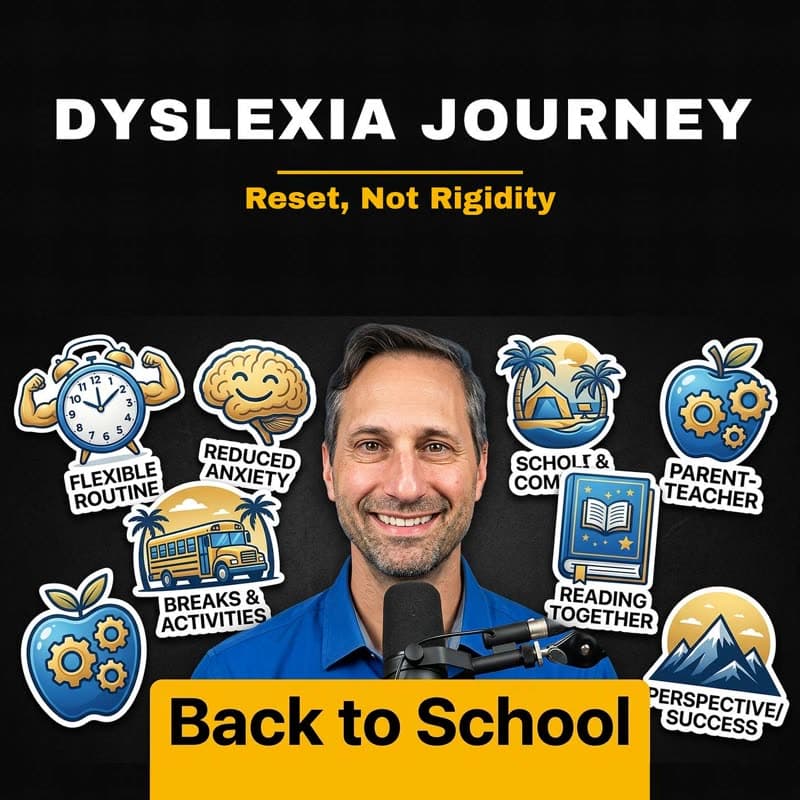
Back to School with Dyslexia: Reset, Not Rigidity
The first two weeks go great. Then, somewhere around week three, the crying starts, or the stomachaches, or the flat refusal to get in the car. If you've been through a back-to-school honeymoon followed by a hard crash, this episode is about setting things up so the crash doesn't take the whole year with it.
Never miss an episode
New episodes every two weeks. Follow wherever you listen.