
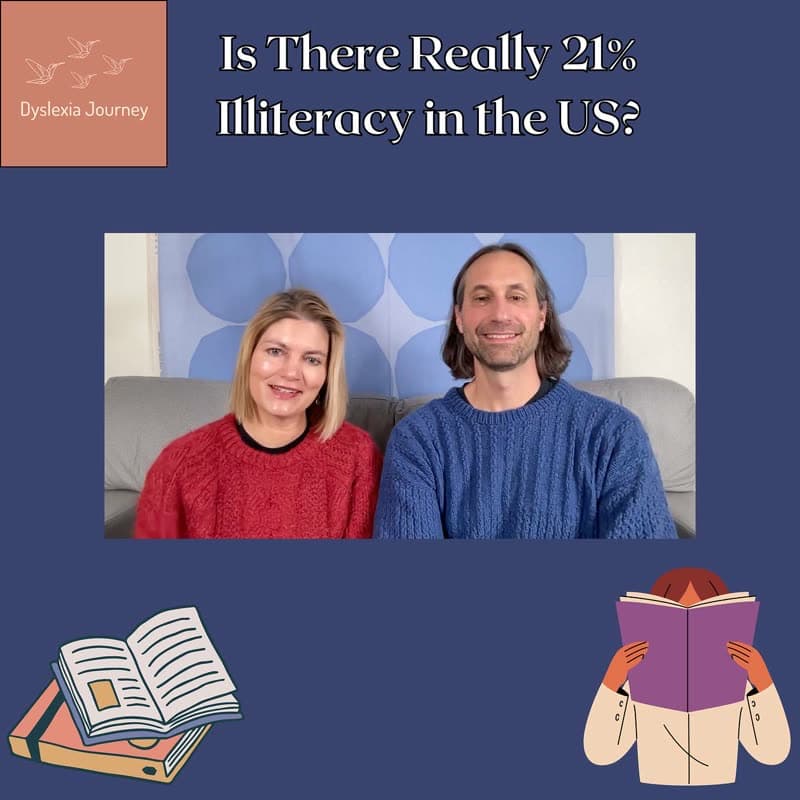
Are 21% of Americans Illiterate and how does it relate to Dyslexia?
About this episode
A discussion of literacy rates has trended recently on social media. The statistic most commonly seen is 21% illiteracy in the United states. Is it true that 21% of Americans can’t read, and how does it relate to dyslexia?
Transcript
Full transcript · 1,283 words · about 6 min to read. Press a timestamp to jump to that moment.
A discussion of literacy rates has been trending on social media, especially on X. The stat most commonly seen is that 21% of Americans are illiterate. Is that true? And how does it relate to dyslexia?
Hey, everyone. We're Nick and Sonja, and this is Dyslexia Journey. And today we want to talk about this 21% illiteracy rate that we're hearing so much about. So on the face of it, yes, it's true. So according to the National Literacy Institute, 79% of U.S. adults are literate, which would mean, of course, that 21% are illiterate. But what if we dig a little deeper? So the statistics actually comes from the Program for the International National Assessment of Adult Competencies, as summarized by the National Center for Education Statistics. So they do have that same stat of 21% illiteracy, but they do note that it's measuring literacy in English. So that's an interesting point, right? Is this number not including the 4% of the population, 8.2 million people who don't know English well enough to be tested for literacy in English, but also, but they could be literate in their own language, right?
So if we took that away, then it would be down to 17% illiteracy. Right. And then the other tricky thing about this number is that they measure five different levels of literacy. And they define illiteracy as they cut it off at level zero and level one. So it actually includes two different levels. and so illiteracy as, as defined for this 21%, it doesn't mean the inability to read at all. it's actually defined as the ability to understand, evaluate, use, and engage with written texts to participate inside in society, to achieve one's goals and to develop one's knowledge and potential.
but so, what's tricky is that functionally illiterate is actually only level zero, but the illiteracy rate of 21% includes level one, which is, more complex, analysis. It says most of the tasks at this level require the respondent to read relatively short, continuous, non-continuous, or mixed texts, to locate a single piece of information that is identical to, or synonymous with the information given in the question or directive. Right. So this isn't just like reading road signs or reading the labels of things in the store. This is actually being able to, read text and find things that are not worded in exactly the same way as something else and parse out the meaning.
Right. And so trouble with that. And the reason that this struck us is that sounds a lot like what dyslexic people have trouble with. Mm-hmm. Well, some, and sometimes it can be, of course, reading at all, but like often it's that layering in for various reasons we've gone into. Like one example is that sometimes, you know, if a dyslexic person is reading a longer passage and they feel any sort of time pressure around it, it's hard for them to read and make sense of it at the same time.
Right. Right. So that's one way I could look. Yeah. and so what's, what's interesting here is that actually only 4.1% of the U S population is at that level zero of literacy. Mm-hmm. Right. Right. So even leaving, being dyslexic out of it, it's just important to think about like that, like, what do we mean by illiteracy? And so, you know, it's still important, right? It's still important in either case, but if we're talking about like thinking of it as like being able to, being able to read, like is how we often think of it, that would be more like the 4%.
Yes, exactly. And then going back to dyslexia, it's really interesting to think about the fact that approximately 20% of the population is dyslexic. and obviously dyslexia is a spectrum, right? So, some people with dyslexia don't even know they have dyslexia. but so it's interesting to think, it just, again, struck us that they listed this illiteracy rate at about 20% and the rate of dyslexia is about 20%. And obviously that is not one-to-one at all, as we've already explained. Right. Right. but it is interesting that when people have been talking about the illiteracy rate on social media, that I haven't seen any mention of dyslexia or learning differences.
Yeah. Right. which is interesting because it's so related and relevant. Right. But yeah. And so what are some other potential reasons for this? Obviously, obviously nobody knows all the reasons for illiteracy. and there's a lot of different factors. but so learning differences is, is a key one. another one is that literacy instruction in the U.S. is kind of all over the place. not, there's, there's certain research, as many of our guests have described, there's certain research about the best way to approach literacy with something like an Orton-Gillingham approach. there are a lot of schools that don't do that.
Right. Right. Right. I mean, so, yeah, I mean, so a simple answer, if there's a literacy, which is, you know, I think a lot of the purpose in talking about this and why people put it out there is like, what can we do about it? Well, I mean, of course, addressing it in proper ways that have been researched is a big one. and identification goes into this as well, that kids often are not identified as being dyslexic or with other learning disabilities in school.
There's still a lot of like trouble at that level of just even identification. And if it's not identified, then how can you address it? Right. And so sometimes kids will get to that basic level of being able to recognize words and stuff, but not to the comprehension level, not to read for fluency. Right. Especially kids with learning differences. Like dyslexia. Right. Right. Right. And kind of along these same lines, the final point here is that there are still a lot of educational inequalities.
You know, there's lack of funding for literacy experts, in general, there's often differences between schools in terms of funding and what they can offer. And so there's a lot of that happening too. and so, you know, I think it really all comes back to, and of course that funding would address not only dyslexic students or learning differences, but everybody. and so a lot of it, yeah, it does come down to both, I guess, both realizing that there can be the learning differences playing in, which is, you know, the part where we come in and are thinking about being dyslexic and addressing that specifically, but also like funding for this problem and then addressing it properly in a research based way.
so, yeah, exactly. And so I think, the key takeaways from today's episode, one, the illiteracy rate is not probably not as high as that 21% number, especially not in the way we tend to think of it, where we just meaning someone can't read. but two, there is a problem here. and this overlaps very strongly with our discussion of dyslexia and learning disabilities and addressing, dyslexia and other learning differences will address, will help the literacy rate overall. So it's really win-win-win for everyone.
Yeah. So if you have any comments you want to make on this, go ahead and put those below and we'd love to hear from you as well. You can go ahead and email us if you'd like to, you know, let us know something more. If you have a question at parenting Dyslexia Journey at gmail.com, send us your thoughts and put them below and we'll see you next time.
More from the show
Learn to Love Listening ft. Cliff Weitzman, Dyslexic Founder and CEO of Speechify
In this installment of our Dyslexic Voices series, Cliff Weitzman, founder and CEO of Speechify (https://speechify.com/), tells us about his experiences growing up dyslexic, and shares his advice for how to succeed as a dyslexic child and adult.
The Definition of Dyslexia Changed: Here's What It Means for Your Family
For the first time since 2002, the International Dyslexia Association has rewritten its definition of dyslexia. The new version quietly removes two ideas that have kept kids from being identified for two decades: that dyslexia has to be 'unexpected' given a child's intelligence, and that a phonological deficit is…
"Everyone Else Can Read" Ft. Parent Fiona Rintoul
Fiona Rintoul, fellow parent of a dyslexic daughter, joins us to discuss her experiences. You can find Fiona online at https://purplecowrecruiting.com/.
Never miss an episode
New episodes every two weeks. Follow wherever you listen.