
About this episode
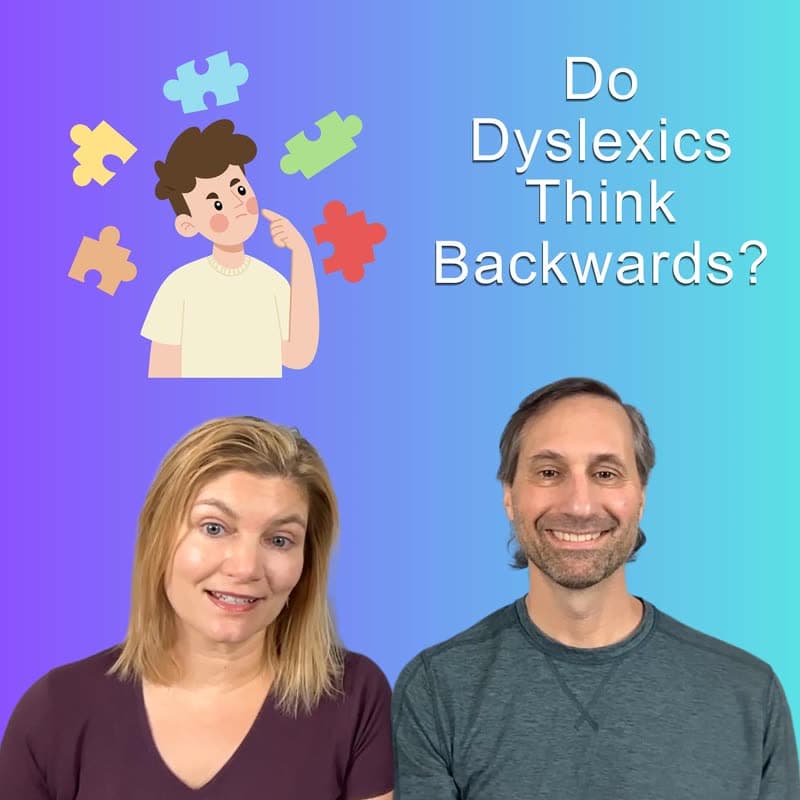
Do dyslexics think backwards? Kind of.
Based on an article in Drs. Brock and Fernette Eide's February 2026 Dyslexic Advantage newsletter (https://7ca50762.flowpaper.com/February2026Newsletterfinalcompressed/#page=6), we explore why many dyslexic thinkers start with the end in mind and work backward, building mental models instead of following step-by-step procedures.
And here is the podcast episode that Nick mentioned: https://podcasts.apple.com/us/podcast/the-fundamental-tension-at-the-heart-of-math/id1021340531?i=1000760017533 or https://open.spotify.com/episode/1CdX7qShEDhBSqQK76wDlM?si=fZ09jz4VSlKF_2Oh3dCtZA
Transcript
Full transcript · 3,272 words · about 16 min to read. Press a timestamp to jump to that moment.
Is it true that dyslexics solve problems backwards? It got me diagnosed when I was in third grade, and it was the most relieving day of my life because I finally had like kind of a place to hang my hat and say, see, I told you, I'm not lazy, definitely not stupid. I just learned differently. Like, that's totally okay. With dyslexics, we were often, you know, just set up for failure because, you know, we were given books and tasks that really are not appropriate for the level that we were at.
So, how do you expect anyone to be open to learning when their entire relationship with reading, with learning, is physical pain? I wish I had understood when I was younger that the fact that my brain worked differently than people meant that I would be good at things in ways that other kids were not going to be good at. I just assumed, I can't be dyslexic because letters don't jump up and down for me.
Dyslexia is not a disorder. It is not a disease. Once you sort of own it and embrace it, then you can have the power to deal with it. It's sort of empowering and also enriching to the whole community. To those who don't understand what dyslexia is, that it's not a negative, it's not a problem, it's like we keep saying superpower.
Hey, everyone. We are Sonja and Nick, and this is Dyslexia Journey. And today's topic is inspired by an article we read in the Dyslexic Advantage newsletter recently, which is the newsletter published by Drs. Brock and Fernette Eide, who are the authors of the book. This is Dyslexic Advantage and who we had on our show earlier in the season. So this was a super interesting article because it sparked a lot of discussion among us in our family and really resonated with us.
I felt like he was really highlighting something that I hadn't sort of consciously named, but that was already out there for me, too, not just for our daughter. Right. Exactly. So super interesting. So the title of the article is Why Many Dyslexic Thinkers Solve Problems Backwards and Why Real Understanding is Not the Same as Rote Memorization. And this was in the February 2026 Dyslexic Advantage newsletter. So let me just read a little bit from the beginning of the article to kind of lay the groundwork for what we're going to be talking about.
So we're kind of all on the same page here. In school, problem solving is usually taught as a forward march. First, apply method A, then follow steps B and C. Finally, arrive at the answer, ideally using the exact process demonstrated. This approach rewards consistency and compliance, but it quietly sidelines another way of thinking, one that is common among dyslexic engineers, builders, designers, and problem solvers. Many dyslexic thinkers do not begin with step one.
They begin with the end. Instead of asking, what steps do I apply, they ask, what does this become? From there, they work backward, testing possibilities, visualizing constraints, adjusting approximations, and constructing an internal model of how the system behaves in the process. Right. So that was maybe sounded like a lot, but we'll sort of break it down to as we're talking about the pieces of it and how we relate to it. So, I mean, I think really it's related to what we talk about often on this channel, which is that dyslexic people often learn best with conceptual learning in the sense that it's sort of grounded in concepts, if that makes sense.
So sometimes that means actually making it more concrete, right? Which is, we sort of think of as the opposite of conceptual, but in the sense of like knowing what we're talking about. We're not just abstractly talking about a number, for example, where we're talking about what that number means. So sometimes that, you know, in learning can mean making it concrete, but certainly means having the meaning up front. And then, and visual learning as well, I think relates to this as well.
Definitely. And I think it's really interesting how schools treat this kind of as like the only right way to problem solve. Well, yeah, let's talk about which way you mean. Right. This, this, sorry. Yeah, not the backwards thinking, obviously. Schools treat the, the forward sort of step-by-step approach is the only right way to do things. And I was kind of ingrained in that point of view. I think partially because I'm not dyslexic myself.
And so the kind of step-by-step. To think of it as a building blocks approach. Building blocks approach. It's often called that. Yeah, from, from sort of, from the givens to the, to the end or whatever worked well for me. And so that's how I've, I've generally solved problems. And that's how I tried to help our dyslexic daughter solve problems, like in math and science. Right. And it really didn't work for her.
And so it was a challenge for me to help her with, with these kinds of problems. I'd like to say it was a challenge at first, but honestly, it was an ongoing challenge. It was, I mean, I feel like, I feel like it was just so hard for me, as a non-dyslexic to, to just recognize that she had this fundamentally different way of approaching problems. Right. And, so I, I, I often would, sit down with her to, to help her with math or something like that.
And, and try to work through the problem saying, okay, like, let's write down this and what's the first step. And, and, she, she was just sort of baffled by that because she would, she would just say, well, what, like, what are we trying to do? Like what, you know, it's like, what's it going to look like at the end? What's the big picture? What's, and, and I kept trying to tell her like, no, let's not think about the big picture.
Let's just take this one step at a time, which was completely the wrong approach. Like that's not apparently the way dyslexics think at all. And I can say a lot about this because I do have this, this trait, this particular trait. So really big dyslexic is made up of a lot of different traits and I don't identify as dyslexic. I never had reading difficulties and so it's just not something, but I've noticed that I, that I have some certain traits that are similar in particular with learning.
And I wanted to add one more thing too, which is that the other aspect of this besides sort of having the conceptual grasp and the big picture, is that you could think of it as a systems approach. So, so that can sort of mean seeing the end first, but I think it also has to do with sort of comparing it. So you might even like want to do a problem or see like how a problem is done.
And it's not like to try to cheat and get to the end and just know the problem. It's because you want to start to recognize the pattern. So like pattern recognition is like someone might think, oh, they're just going to try to memorize it. They're not going to try to learn it deeply. And to me, it's the opposite. It's like, if I see that pattern, then I'm going to start to get the hang of it, get the sense of it.
It's almost like that systems of approach of approximating until you get it right. so there's a lot of that involved as well. So that's another way to think about this kind of learning. so for me, I have a great anecdote from college, which is that, I went in, it was, I think it was upper level, well, maybe not upper level, but kind of mid-level calculus class. and I went into the TA cause I was having trouble with a particular unit and she really tried to take me step-by-step through a problem.
And I kept trying to ask questions because I, and I, I didn't know this is what I was doing then, but I think it was that I, I couldn't. Start from that very beginning. She was doing the very starting from the basic building block, let's work our way up logically thing. and I just couldn't, I, I kept trying to ask questions because I was trying to get a handle on like, what are we even doing here?
I don't have, I just need something to like, hang on to, to start to, to try to get that conceptual understanding. And that's what I built from. But, but she got really frustrated with me, sort of partly for not following, but also probably cause I kept trying to ask those questions. And she told me, I didn't know how to think logically. She was, I mean, I didn't, I luckily for me, I didn't, I mean, I was mad that someone said that to me, but I didn't take it personally because, you know, I had done well in math and things.
And so I didn't really feel like that was, I mean, I didn't take it to heart, but of course it was still a terrible thing to say to someone. but now I'm realizing it just so much had to do with how, you know, how I learn and that I need some sort of conceptual grasp in order to help me. And I'm trying to think how to describe it because if you don't learn this way, it can be difficult.
You know, like you were saying, it's hard to sort of grasp what's happening, but it's kind of like, I'm just like floating in the middle of like a blank space. And I can't like start with something. I mean, I could start with something random, but it's meaningless. So it's like, it's just, I don't know. It's just like putting, putting together this random thing. And you're saying it's, you're saying, you're telling me that as we go step by step, that's, what's going to make it make sense.
And I know that it's not going to for me because I have to have like that grasp piece first. I have to have the footing first. I can't just be, I'm still going to feel like I'm just floating around with these random pieces until I have that grasp. And sometimes, you know, that doesn't mean never, ever can eventually a person pick it up who's dyslexic, but it would take them a lot longer because you're, you're, you're battling against the natural way that the person will learn.
Yeah, for sure. I have a couple things to say about that. First of all, that's terrible what that TA said to you. And it's good that you are already confident enough in your academic abilities that you didn't take it to heart. It didn't, it didn't damage your performance in school and stuff. But I, I think, I think it's worth thinking for a minute about how many dyslexic kids get told things like that a lot in school.
And at a younger age, perhaps, also, they are almost certainly not as confident about their academic ability. And so, it's really sad to think about that, the kind of damage that that does to people who are already struggling. Yeah. and so, and I think, as Cindy was saying, like, this really just comes from a, just a disconnect between, between different ways of thinking. And I want to make it clear, like different valid ways of approaching problems.
Yeah. Yeah. The ideas in this article, of course, are criticizing when it does become rote memorization, which it can for math problems done in, done in the building block way. but I, I absolutely think that it can be valid to do that kind of building block method where you really are, you know, in the way that you learn best, for example. Yeah. I mean, I always, I do like to take things back to first principle because I feel like then if you, if you sort of understand the principles and you can always build up and kind of, you know, rederive any formulas or something that way.
But, I've come to realize that that's not the only valid or useful way of approaching a problem. Well, when I went at it, and again, it doesn't even that you can't use first principles. It's that I have to, I would sort of need to see, this is the path we're going to go on. This is going to build to this and this and this. So now let's talk about this one, which is going to build, like, I would have to still see the route a bit ahead of time.
Right. It's not that I couldn't use the first principles. you know, although this does, this does lead to an interesting issue here, for dyslexic people often, which is the idea of showing your steps. I mean, it can be such a wonderful thing if you've been in school and done a difficult math problem and you get credit for your steps that you showed. Right. And you didn't know, okay, maybe you didn't come up with the correct answer.
And like, you'd think for dyslexic people, that would be, you know, because of often having calculation errors and things like that, that that would be great. And it isn't a way, but the problem is sometimes because of this kind of learning, there are skip steps. Right. And so I don't want to sound hypocritical here because we have, we have previously on this show, exerted, teachers to, be generous with partial credit for dyslexics because of the fact that they make these calculation errors.
But this is a twist that Sonja just pointed out that, when you approach problems backwards, as we're talking about, your steps are not going to look like the standard steps in the grading rubric or the standard steps that someone who approaches problems more like I do is going to think are the correct steps. And so we often hear about anecdotally, that dyslexics sometimes jump to the correct answer, things like that. Right.
And I think that's really a reflection of this way of approaching a problem. Like if you're approaching a problem backwards, from the standard part lines, right. it may look like you're just jumping to a solution. Right. Right. And I mean, one solution to this, it's, there's no perfect solution in how to, how to test and things like that. But I know sometimes when our daughter was able to give verbal answers, like explain to a teacher how, how the problem, you know, her understanding of the problem, just, just spit it all out.
Like exactly how she was thinking of it. They could tell she understood it and understood the pieces of it. So sometimes having, being able to get verbal answers can help. That's one possibility. certainly not the only one. and I guess I have one more anecdote for myself because it was remembering the thing about being told that, you know, totally I couldn't think logically reminded me that actually when I took the GRE, my actually top score was in the logic section.
And so I was just having a moment where I was like, huh, I wonder how that was because I do think of those kinds of problems as being in a way like so specific and stepwise and stuff, but, but I'm remember taking the test that I almost didn't know. So this is that thing about not knowing. I didn't necessarily like exactly know. I couldn't have necessarily in steps for each of those explained why I got the right answer.
It was almost more like the comparative pattern of comparing potential answers and, and just limit them intuitively feeling right. And so that, that reminds me a lot of the thing of getting the answer and sometimes like jumping to the answer because so, so I think that this, that, you know, this goes along with the system thing too, is that pattern recognition. There's a lot of pattern recognition and comparison that goes along with this style of learning as well.
Yeah. and this reminds me, I just thought of this, I was just listening to a podcast from quantum magazine about, kind of formal mathematics and how AI might be able to help with this. And it's interesting. I hadn't connected this at all to this topic until just this minute, but, in this podcast, which was based on an article that was published in quantum magazine, the author of the article was talking about how in mathematics, there's kind of these, kind of reaching conclusions informally, but then there's the formal step-by-step proof process that's required to sort of get it validated by other mathematicians.
And, and this is kind of, and so I think a lot of the way a lot of mathematicians work is they, they do approach problems holistically and perhaps backwards and, and things like that. And then they come up with these insights and then, and then they formally prove it. And so this is, you kind of historically have needed both types of skills to be a formal mathematician. and so interestingly, this, this article was talking about how AI can help with the actual formal proof stuff.
So yeah, I guess, let's see what are our takeaways here. I think our takeaways are, you know, that everyone has these different learning styles. rote memorization tends to not lead to the deepest learning no matter what, but there can be sort of the more step-by-step building block approach that one person might do better with. And then there can be either the more pattern recognition systems, or you could think of it as top-down or looking backwards from the answer to how it's, how it's built, way as well.
Yeah. So really the most important thing is the depth of understanding that the student will have, whichever their, their, sort of natural, natural best learning method is. Right. And I think, to be clear, neither of these ways of approaching problems has to be rote memorization. Right. Exactly. Yeah. Which I think we can all agree is not great for deeper understanding, the rote memorization part. Right. but I think what, what, if I could take a stab at summarizing what we're trying to say is that, whether you're approaching a problem kind of bottom-up or top-down or like forwards or backwards, however you want to look at it.
those are both valid ways to, gain deeper understanding of the problem situation. And in fact, the backwards approach is, almost certainly better in some cases. And this may be why dyslexics, often are better at diversion thinking and creative problem solving and things like that. Yes. Yeah. So hopefully that was interesting. Are we going to look at the article? Yeah. We'll definitely, we'll go ahead and link that article for you, below if you're interested in taking a look yourself.
Let us know if there's other topics you'd like us to cover. You can leave us a comment or you can email us. Parenting Dyslexia Journey at gmail.com.
More from the show

The Definition of Dyslexia Changed: Here's What It Means for Your Family
For the first time since 2002, the International Dyslexia Association has rewritten its definition of dyslexia. The new version quietly removes two ideas that have kept kids from being identified for two decades: that dyslexia has to be 'unexpected' given a child's intelligence, and that a phonological deficit is…

"Everyone Else Can Read" Ft. Parent Fiona Rintoul
Fiona Rintoul, fellow parent of a dyslexic daughter, joins us to discuss her experiences. You can find Fiona online at https://purplecowrecruiting.com/.
Back to School with Dyslexia: Reset, Not Rigidity
The first two weeks go great. Then, somewhere around week three, the crying starts, or the stomachaches, or the flat refusal to get in the car. If you've been through a back-to-school honeymoon followed by a hard crash, this episode is about setting things up so the crash doesn't take the whole year with it.
Never miss an episode
New episodes every two weeks. Follow wherever you listen.