
"Everyone Else Can Read" Ft. Parent Fiona Rintoul
About this episode
Fiona Rintoul, fellow parent of a dyslexic daughter, joins us to discuss her experiences. You can find Fiona online at https://purplecowrecruiting.com/.
Transcript
Full transcript · 5,286 words · about 26 min to read. Press a timestamp to jump to that moment.
It's definitely not a disability, it's just a difference, it's just a different way of learning than the textbook cookie-cutter way to learn, and it's nothing to be ashamed of, it's nothing to lose confidence over, it is just, it's unique, and it gives you a really special brain, in my opinion. It got me diagnosed when I was in third grade, and it was the most relieving day of my life, because I finally had, like, kind of a place to hang my hat and say, see, I told you, I'm not lazy, definitely not stupid, I just learned differently, like, that's totally okay.
We were dyslexics, we were often, you know, just set up for failure, because, you know, we were given books and tasks that really are not appropriate for the level that we were at. So, how do you expect anyone to be open to learning, when their entire relationship with reading, with learning, is physical pain? I wish I had understood when I was younger that the fact that my brain worked differently than people meant that I would be good at things in ways that other kids were not going to be good at.
I just assumed, I can't be dyslexic, because letters don't jump up and down for me, so... Dyslexia is not a disorder. It is not a disease. Once you sort of own it and embrace it, then you can have the power to deal with it. It's sort of empowering and also enriching to the whole community. To those who don't understand what dyslexia is, that it's not a negative, it's not a problem, it's, like we keep saying, superpower.
Hey everyone, we are Sonja and Nick, and this is Dyslexia Journey, and today we have Fiona Riddentool as our guest to talk about her experience parenting a dyslexic child.
Welcome, Fiona. Thanks for having me. So, we're just going to let you dive in, you know, wherever you want to start with your experiences, and then we'll ask some follow-up questions from there. So, yeah, like what has it been like for you? What has been your experience with us? Yeah, so, when my daughter was four, we live in Lexington, Kentucky, and I decided to send her to Montessori School. So, I don't know how familiar you are with the teaching, but the overall is it's learned by play, which I thought was really cool for the little ones to do, rather than delving straight into a curriculum.
So, she went to Montessori School, and then my son, who's three years older, came a couple of years after her. So, she had been in there for a couple of years, and then she was six or seven when I first started noticing, really, where there was a disconnect in her reading. She wasn't picking it up. She wanted me to read to her. She loved books, but she couldn't quite grasp the physical reading.
She could grasp the comprehension when you were reading her a story. So, I knew that there was just some kind of disconnect. So, we took her, we had a call and then a face-to-face meeting with the headmaster, or the headteacher, you call them here, the principal. And, basically, he was very unsympathetic, or he wasn't quite willing to take into consideration what we were saying. He said, she's young, this is Montessori, it's not traditional, and kind of brushed us off.
But at this point, my spidey sense as a mom was up, and I thought, there's something not right here. I'd been around a lot of kids growing up, I knew my friend's kids, and I just knew there was a gap there that she wasn't filling. So, we went again, and he said, well, Fiona, I don't know what you want me to tell you. We don't have the resources everyone else can read.
And at that moment, I thought, okay, things have to change. So, we are very fortunate in Lexington. We have a school called the Lexington School, and it's one of only two schools in America. that really treat this learning difficulty with, honestly, amazing resources. And it's like a three-to-one ratio for children, three children to one teacher. So, we looked into it, and it was very expensive. And, you know, we had got her independently assessed by a company here, and they had said she clearly has a form of dyslexia.
And hers is a little more unusual than some cases. And I can get into the mechanics if you want. But she really was, the way that her brain works, which is different from the way that the average American or universal child works. So, we decided to make the investment to send her to the Lexington School. And she was in a place called the Learning Center. And that was started about, I think, about 40, 50 years ago by Abercrombie, this amazing woman who, she had this herself and decided to do that.
She was very wealthy and had the funds to set this place up. And it was, quite honestly, the best investment of our lives. And I say that now because they've gave her the tools to be able to go into regular high school. She actually went into public high school through her demand. She wanted to go to a bigger school. She felt ready. She was confident. And she is thriving. And she's got a, she's got a, maintaining her GPA is 4.0.
Now, I will tell you, here's where it gets tricky. And here's where I was really disappointed. So, she left the Learning Center. She was an honor student. She was absolutely just amazing, quite honestly. I was absolutely so proud of her. When she went to public school, the Lexington school were really concerned she wasn't going to have the resources there. And it's so bizarre because in private school, they don't, they don't have as much, they say, as the public schools.
And they should have a lot more resources for kids with dyslexia. Now, I don't know what it's like in other states. But in Kentucky, dyslexia now is no longer considered a learning disability. And you don't get a 510 plan. I can't remember the exact name of it. So, they said the only way she can get that is if she's privately assessed. And then you get the documents. So, they were not going to assess her through the state.
So, we had to pay, I think it was $2,200 to get her privately assessed so that we could get her this document that basically gives her extra time to do exams. Right? So, you know, obviously we were going to do that. And I said to the woman, and I've had many conversations, I said, what about people that can't afford this? What about people that cannot afford to give their children the opportunity to get extra time?
And she said they have to sit it like everybody else. So, they would have that short amount, well, the same amount of time as everybody that learns universally. And they would not have the opportunity to have the extra time without this plan, which you had to get through a private assessment. And I just found it mind-boggling. I thought it was, I was so disappointed. And I felt, I'm an empath, and I felt so bad for these other children that just was like, you know, sorry, you have to just do your best.
So, yeah, that's a little bit about our journey. She, my daughter's called Stella, and she is very hardworking, and she truly goes the extra mile to try hard. She's a grafter. So, I think that makes a difference as well. I have a 14-year-old son who doesn't have dyslexia, and he gets by in a wink and a prayer. Like, if he had it, I would be really worried because he is lazy, and he is a shyster, and he basically, you know, gets by in the bare minimum.
Luckily, she's the other end of the spectrum, and she knows she has it. She wears it as a badge of honor almost, which is kind of cool. She likes to tell you all the people that have it and how well they've done in life, you know, the big entrepreneurs and things like that. But, yeah, that's, sorry, I know I talk a lot, but that's a little bit of a... Yeah, no, that's good to hear it, hear it, just how it unfolded.
Yeah, and someone's familiar to our journey with our child, who is, we've talked about her on the show a lot. She's 19 now, and we also sent her to private school until high school, and then she chose to go to a public high school. Okay. And was able to do quite well there with the accommodations, with the extra time, and so on. If she hadn't had that in high school, I can't imagine how it would have gone without those accommodations.
No, and I think having the two, I call them the tools, because when she was in the learning center in the Lexington School, she was taught a lot of techniques to help her, and these teachers have been through rigorous training to get to understand the way that the brain works. So, she understands kind of how to take a step back to slowly get the comprehension. Once she's got the comprehension, and she understands what the problem is, and I'll give you an example.
So, with math problems, her math is fine if it's numbers. If she can look at numbers, her brain is totally fine. When it starts adding in words to the math problem, that's where she, her mind, you know, grays over. So, that was one thing we learned was really interesting, that she actually could not compute both math and English together to get the answer. If it was one or the other, fine, but that's where her brain just didn't seem to work.
That, yeah, that makes a little sense. We've observed that as well. I'm curious how, sort of to go back to when you first started suspecting that she was dyslexic, how did you, like, were you familiar with dyslexia from other family members or friends, or how did you begin to suspect? Because, for example, for us, I mean, we just didn't have that much familiarity with it. It's not really, surprisingly, not really talked about that much, except to make jokes about it, right?
And so, it took us, like, quite a while to kind of realize that that was what our daughter had. We had the same thing with the spidey senses, right? Right. But we didn't pinpoint it as dyslexia for a long time. Yeah, I mean, quite honestly, I probably have it. So, I was very aware there were similarities in the way that she spoke or the way that she couldn't figure out a problem.
And, you know, I'm 46, so back in my day in Scotland, we didn't, they were like, you're fine, you're just a bit slow with some things. And, you know, they never really had it recognized. But if you ask my parents now or my husband, they would probably say that I definitely have, you know, and mine is more spelling and they're just different things. The way that I, and you'll probably get this from me, the way that I end up writing, and I write how I talk, and it's just, my grammar can be, like, I don't know.
But I'd suspect that if it was 40 years ago, they might have diagnosed me with it. But I was really, I remember being thinking, God, life's hard enough and now she's got this. And I was, you know, I'm a pretty reasonable person, but I was sad for her. And I was like, you know, she's going to have a little bit more of an uphill struggle. And I just, I just, you don't, you don't want your kids to have anything, but it's not an illness and it's not something that they can't overcome.
And she's a really unique, special kid. And I think it's because also how she looks at the world and you wonder if that is totally part of it. Now, when they do the assessment and dyslexia, it is so interesting because there's no, it's not a right or wrong answer. There's no, you know, black and white. You have, the answer is wrong. You have dyslexia. The answer's right. You don't. It's not like that.
It is such an interesting concept, how they actually test them.
But I think it's amazing how much you can overcome now. And I think as long as she gets that extra time, it is amazing how much of a difference it makes. She's not stressed. She's not getting overwhelmed. She's not, the words are not getting muddled up in her head. So I think that really helps. I'm curious too, because, you know, you were talking about, it's wonderful how she's really embraced it as part of her identity.
But I'm wondering, was there a shift in that? Like how, I don't know what you observed and how it was for her before she was identified and before she went to the Lexington School. Yeah, it's so interesting. So the Lexington School, again, there's only like 500 children and the learning center is really small. And in fact, about five years ago, they just renovated it all. And it is, it's really, really amazing.
So when she went there, I mean, it is like Hogwarts, you know, it's gorgeous. So that helped her confidence. And then she met her best friends. That helped her confidence because they were in the learning center. So they had this little close-knit type group of people. And they weren't ostracized from the other kids by any means. They would have music together or different things together, break time together. So I think it helped her confidence.
I think the school as a whole doesn't make them feel any different. Like your man that I spoke about that said, well, everybody else can read. Like they, you know, they wrapped their arms around her and always gave her the tools to succeed. And that builds your confidence. That makes you, you know, they bought them these, I'll never forget those sweatshirts and it says dyslexia rocks. And all these kids wore it with, you know, they loved it.
So, and her, it's funny because her two best friends to this day, one of them was in the learning center with her. And she now goes to boarding school. And she said that she is thriving because of the tools that she got at the Lexington school. And then her other friend goes to private school. And she's kind of like me a little bit. They had to really push. And that's a private school to get her the support she needs for the dyslexia.
And when she goes to college, so because she's been privately assessed and she was privately assessed again at 16, once you're 16 and above and you get assessed, that means that gives you the, it's the same document you need to get, to get extra time in college. If you're under 16, again, I don't know if that's state specific, but you'd have to get reassessed to get the college and to get the college extra time.
And I, it's funny, I'm in the process right now. She's going to be a senior of doing, going into college. And I'm actually not sure, I've got an advisor how it works with her dyslexia. And because I know I'll have to give in the papers, do you, do you announce it during our application? And she said she might want to do her essay on it, which is really cool. So it's, you don't want to make it, you don't want to give her a disadvantage by blaring it from the rooftops, but you also don't want to hide it.
So that's actually something that I'm dealing with right now that we're not sure what to do. Yeah. Yeah. I mean, I can tell you what our daughter did. Yeah, please. She also worked, she did work it into her essay, right? It was, it was part of. Oh, she did? Yeah, definitely her essay. And then the universities, the colleges, they all have disability centers and you just work with them over the summer before you start.
You send in the documentation and they approve the accommodations. And then pretty much every school is really well set up for this, actually. Yeah, although it can be sometimes useful to, maybe more so for a private school because public schools have their public mandate around it, to, you know, if you want to talk to someone, talk to the disability office head or talk to someone else who uses the disability office, another student in particular, that can sometimes be useful if you really want to make sure that they're doing things the way they say they're doing them.
Yeah. Go ahead. Yeah, that is a good point. We, we did visit the schools and visit the disability centers at all the schools. Yeah, yeah. But it can, you know, it's like anything where it's great that they have that and they are very well set up for it, you know, and when you have your assessments, you just turn those in. But it's, it's, there's always, I mean, as you, as you probably know, there's always steps still, though.
Like, for example, just recently, there's one thing that, you know, I think they just missed in terms of checking off the list of what, what, what was in the assessment that she, and so she had to resubmit it. So it's kind of, and, you know, she's going to have to learn, she transferred, so she's going to have to learn the new, the new testing center. So it's always that little bit that people don't understand, that it's not just like this, this, yeah, thing.
It's like, it, you know, it does take more work to actually have to put in to make sure it all goes right. It's actually an interesting example. The one that, the one accommodation they denied was to, she requested to not have to fill out Scantron sheets, which is where, you know, you just fill in the bubbles on this answer sheet that's completely divorced from the question sheet. Okay. And it's very difficult for dyslexic people to transfer, because it's like, you just have to find the little number.
And you can get a chance to, okay. Yeah. And, but, but very few people understand that that's like related to dyslexia, right? Yeah. Yeah. But, so anyway, so it's like anything where, but it is really nice that they have it. I would still say that they're much more aware of everything, though. Definitely. Than just every single public school, for example, or every single other school. It's so different. And, and, you know, we, we, I don't have dyslexia, but it's so different from when we were young and going to school.
Yeah. So hopefully getting better and better. Yeah. I'll tell you one thing that I do love. So I'm a reader. I mean, I love reading and I love books and she hated reading, hated it. Like she loved me to read to her, but right up until she was about 12, maybe, yeah, 12 or 13, it was a task when they asked her to read a book. But now I cannot fill her books, bookshelves.
Like once she got the confidence and also another thing that I found interesting is once she started reading what she wanted to read, because I didn't care. She could read the phone book if she wanted to and enjoy it. And then once she kind of picked up the type of books that she wanted to read as a young teenager, a young teenage girl, she loves books. I mean, she spends a fortune in the bookshop.
I keep telling her to join the library, but she has got, and she loves dystopian books and she loves schmuck. I call it as well. So nothing too crazy, but she always has a book on her bed. That makes my heart happy because I think reading is kind of a lost art sometimes nowadays, you know, with TikTok and social media. But the fact that she has her nose in a book is something that I never thought I'd see the day.
Yeah, I'm curious, did she, did she use audio books at all? She used me. Yeah, yeah. So, you know, I kind of was her audio book for so long because she loved the narrative and loved the stories. And, you know, I mean, I used to read to her for hours. I used to be, I used to sometimes dread bedtime, even up until she was 10, because she would love me to just read.
And it's exhausting, like after a hard day at work. And I would have these books and she would one more chapter. And I became like her audio book. It's amazing she doesn't have my accent because she listened to me time and time and time again. But no, she doesn't. She reads hardback books, not even paperback. She loves her hardback. She loves the feel of them, the texture of them. And she does comprehend it, which is huge as well.
And I'm so glad she does grasp the comprehension. She's not just reading words and it's not actually going to her head what it means. That's huge. Yeah. Yeah, that's great. Yeah, we read to our daughter quite a bit as well. And we do try to emphasize on this show the importance of that, of reading to your kids. Even as they get older, I think, because if they're not reading themselves as much, they're not getting exposed to all that stuff, right?
Yeah, it's everything. I mean, it's amazing how much it truly is connected. Now, you talk about audio books. So when we go to horror shows, so we travel, the furthest we go is actually Kansas City and it's about a nine, nine and a half hour drive. And I have become a little bit addicted to audio books. So I was podcast for a while and then I just found them like it just became too much for me in the car.
So I listen to audio books constantly and she listens to them with me. Now, I have to make sure they're appropriate and they've got a catchy story because you're on the road. So even if it's like, I don't know, a Frieda McFadden novel that's got a few twists, she loves that as well. But she won't listen to that in her bedroom, for example. She'll always have a book. Right. Interesting.
Just a little bit. I'm curious, sort of looking back over your journey this far, and it's probably hard to pick just one thing, but is there, what would you point to as something that would have been helpful along the way? Like what could have really helped? Well, there's a couple of things, and there are different parts of the journey. The first one would have been probably the Montessori teachers being a little bit more, aware and helpful.
I think Montessori is a brilliant way to teach little kids how to learn, and I think it makes it fun and it makes them want to be in a classroom. but the particular one we went to, I just felt really let down and I will never forget that meeting I had with the headmaster and he said, Fiona, everybody else can read. And that was, it was like, it's your problem that it would have been much better if they came to me and said, okay, we might not have the complete resources, but let's figure this out.
So that would have been, early recognition would have been, really beneficial. And then definitely the next thing would be for the public schools in Kentucky, I don't know if this is everywhere, to definitely recognize dyslexia as being a learning difficulty. And I've heard that this has only been in the past 18 months and, you know, there's, there's so many different things. Stella doesn't have any, behavioral issues. And I think a lot of ADD, ADHD, this instant gratification that kids have has kind of taken, not taken over, but it's, it's more common or more spoke about, or, it's a much more, I don't want to use the word popular, but recognized thing that people have rather than dyslexia.
dyslexia sometimes seems a bit like old news, I don't know, it's hard to explain. And again, maybe that's just the location that I'm in. but it would have been great to have a little bit more help from the public schools. And also, again, we are so fortunate that we could send her to this learning center that is very, very expensive. and I, I do feel for families that don't have those resources, because their kids are definitely in a disadvantage being in the average school system.
All kids do not learn the same. you know, they say it's like jungle animals, right? They can't all climb trees. So how do they survive? They learn different ways to do it. And I definitely think that, schools have to recognize that again. And I, I get that there are, because of different things that go on in the world now, there are different, difficulties like ADD and ADHD. But dyslexia definitely still has to be recognized.
It's not going away. Yeah, we've, we've noticed that too. autism as well, is, and again, I, I hate to use the word popular, but it's, it's, it's having, it's being recognized and talked about a lot. And, if you look at the numbers, I think there's more dyslexic people than there are autistic and ADHD combined. And, you wouldn't know that from popular media and stuff, right? well, and that there's a spectrum at all.
Yeah. Yeah. Yeah, there is. Yeah. Yeah. It's involved, you know, now. Exactly. And again, I, I don't mean to pit any of these against each other. Of course, it's just, it's just kind of fascinating to us how dyslexia is still so under-recognized and under-discussed. Yeah. I mean, and like the amount of people that are brilliant that have it and have been very, very successful is, a great example of that. And I think she, you have to make sure that your children are not ashamed of it or they're not embarrassed or they lose confidence over it.
quite the opposite. And I think it's, it, maybe I'm biased because she's mine, but I think it, the way that she thinks makes her remarkable. And, that's why I call purple cow, purple cow, because it's what makes you remarkable in this big, wide world. And, like, I hope she uses that as almost like a superpower. and you, you don't want your kids to struggle. And I think as they get older, if they can get that foundation that the learning center gave Stella to, to have the tools and the confidence as they get older, it won't even be an issue.
I think it's more when they're, they're struggling in school and middle school. that's another thing I'll just say briefly, the, the learning center, the Lexington schools, middle school is so beautifully run. It is so, confidence building, respect. It has a really, really nice cadence to it. that I think a lot of kids in middle school that don't have those resources and do have dyslexia, that's their worst nightmare. They're in the thick of things.
They're going through hormones. They are struggling with school. Their confidence is rock bottom. and I think if middle schools can kind of recognize that as well, when those kids are at pivotal, pivotal moments, then I think it could really help too.
Yes, absolutely. Yeah, for sure. so I guess, let's see, we can be close to wrapping up here, I think. what, what is like your top piece of advice for fellow parents? Parents of dyslexic kids. What was your gut to begin with? If you have a, a funny feeling that your kids, even at five or six, if you're an involved parent and you just have a gut feeling that there's something not right, at least get it seen too.
And you might be wrong. You might be wrong. They might just, be distracted or they might just be lazy. but I think definitely seek a professional, or, or their teacher or someone that you know that has dyslexia. Definitely get them help early because that can definitely help with their confidence and it can help with their learning. Now, I will tell you that Stella was probably, in fact, she was a year or two behind when she eventually reached the learning center because of the time it took for the Montessori to, to bring it to my attention.
and for me to really fight for it. So the earlier that you can get a grip of it, I think the better it can be. Yes, definitely. Well, and then we were just talking about how, you know, perhaps dyslexia right now, for whatever reason, isn't getting the recognition, you know, that it deserves people understanding how common it is and all of that. what's something you would want the world to know about dyslexia, if you could broadcast it to everyone right now?
They call it a learning disability and I hate that word for it. I think it's just a different way of learning. I'm not even sure how to put that in elegant, elegant words, but I would want you to know that it's, it's definitely not a disability. It's just a difference. It's just a different way of learning than the textbook cookie cutter way to learn. And it's nothing to be ashamed of. it's nothing to lose confidence over.
It is just, it's unique and it gives you a really special brain in my opinion. Yes. Yeah. Well, that's, probably a good place to end. thank you, Fiona for, for coming on the show. is there anything, website or anything you want to share, with our audience? No, I mean, just be your kid's biggest advocate. Nobody else is going to be it. I think teachers are overworked. They've got, you know, they can sometimes have 30 children in the class and it's, it's not their fault.
They can't give that one-on-one attention. So, be your kid's advocate until the bitter end and really, you know, fight for their, their learning experience, fight for their confidence, talk to them about it and try and stay on top of it. even, even, even through middle school, even through high school, don't just let it drop off the edge of the cliff. just stay on top of it because you can change, your mind can change, your aspirations can change.
So, yeah, your kid's biggest cheerleader. Yeah, that's great advice. Yeah. Thank you. Thank you. You're welcome.
More from the show
Not Your Granny's Grammar!
Patty McGee is the author of Not Your Granny's Grammar and an experienced teacher and educator. Follow us on Instagram! Also check out our YouTube channel!

The Definition of Dyslexia Changed: Here's What It Means for Your Family
For the first time since 2002, the International Dyslexia Association has rewritten its definition of dyslexia. The new version quietly removes two ideas that have kept kids from being identified for two decades: that dyslexia has to be 'unexpected' given a child's intelligence, and that a phonological deficit is…
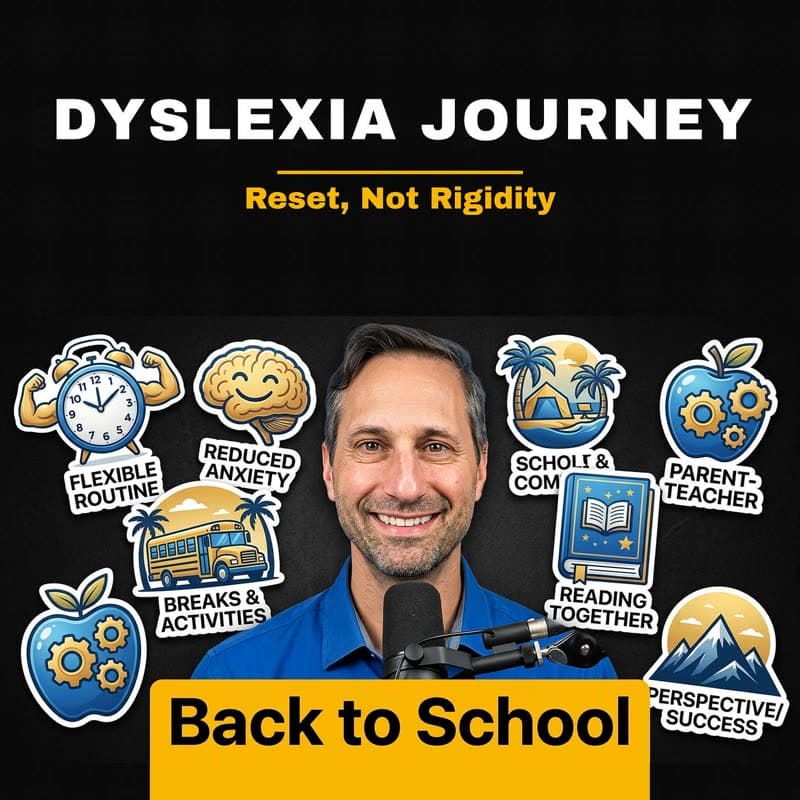
Back to School with Dyslexia: Reset, Not Rigidity
The first two weeks go great. Then, somewhere around week three, the crying starts, or the stomachaches, or the flat refusal to get in the car. If you've been through a back-to-school honeymoon followed by a hard crash, this episode is about setting things up so the crash doesn't take the whole year with it.
Never miss an episode
New episodes every two weeks. Follow wherever you listen.