
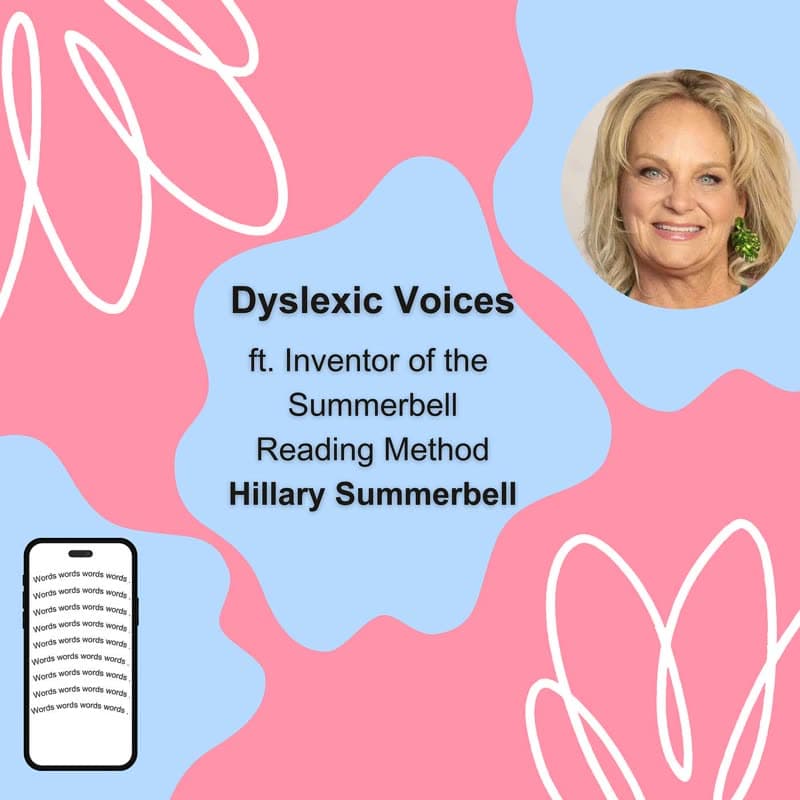
Dyslexic Voices ft. Inventor of the Summerbell Reading Method Hillary Summerbell
About this episode
You can find the Summerbell Reading Method online at https://www.summerbell.com/
Transcript
Full transcript · 6,563 words · about 33 min to read. Press a timestamp to jump to that moment.
Because it was a very important moment in my life when I realized that, because then I realized I wasn't stupid. I mean, literally, that was really the, I knew I was creative, but I always thought I was kind of stupid. So now I'm not, now I'm creative and smart. So that's cool, right? Now I believe I'm smart. Before I didn't really, I thought there was something wrong with me. It got me diagnosed when I was in third grade. And it was the most relieving day of my life, because I finally had like kind of a place to hang my hat and say, see, I told you, I'm not lazy.
Definitely not stupid. I just learned differently. Like, that's totally okay. We were dyslexics. We were often, you know, just set up for failure, because, you know, we were given books and tasks that really are not appropriate for the level that we were at. So how do you expect anyone to be open to learning when their entire relationship with reading, with learning, is physical pain? I wish I had understood when I was younger that the fact that my brain worked differently than people meant that I would be good at things in ways that other kids were not going to be good at.
I just assumed I can't be dyslexic because letters don't jump up and down for me. Dyslexia is not a disorder. It is not a disease. Once you sort of own it and embrace it, then you can have the power to deal with it. It's sort of empowering and also enriching to the whole community. To those who don't understand what dyslexia is, that it's not a negative. It's not a problem. It's like we keep saying superpower.
Hey, everyone. We are Sonja and Nick, and this is Dyslexia Journey. And today we are welcoming Hilary Summerbell to the show. Hilary Summerbell is the founder and CEO of Summerbell, a literacy technology company born from her own experience as a visual dyslexic. Hilary, welcome to the show. Thank you for having me. I'm excited to be here. It's my favorite these days. Oh, yes. Yes. And I was going to say, we really want to spend a lot of time focusing on, you know, this innovative new app that you developed, because that's really exciting.
But we also do a series called Dyslexic Voices. And I think people always love to hear people's different stories and journeys, and particularly in this case, when it connects so strongly with what you've come up with here. And so just to start with, like, maybe we could just start at the beginning. Like, what do you remember about life before you knew you were dyslexic? What age were you diagnosed? That kind of thing.
Sure. So it's interesting. I just called a friend of mine, Nancy, who I grew up with. So Nancy and I were in the same neighborhood with probably 12 other kids. And I was asking her questions about being in, you know, being in elementary school, Cooper and Langley with me. Nancy was a very good student. She was neurotypical and got straight A's from the beginning. And, of course, I wasn't, and I got, like, straight C's and, you know, whatever.
I don't know, below average everything. You know, it was ridiculous. Besides art, I did good in art. But I called her, and I just said, you know, I'm trying to kind of chronologically go back and remember teachers and remember, you know, homework. And I said, and, you know, remember what it felt like kind of like being in the slow learner's class. And she said that, you know, we were never in the same classroom.
And, you know, it just, and I was, I went to elementary school in the 70s. So I was probably, my mom was a, like, an artist. And she, in preschool, we would, like, kind of dig in the woods. And we lived in the woods, like, kind of near the Potomac River in Northern Virginia. And so my earliest experience was really just being creative. You know, painting, finger paint, digging in the woods.
You know, just, I was, what we were recalling that, you know, we would, we had these huge trees around us. We would make little fairy, you know, dollhouses out of acorns and go to the creek. So we really, I, my memory of being a young child, a 10-year-old or an 8-year-old was a lot of that until I went to school. And then when I went to Churchill Road, you know, I was separated from my peers, week included, probably first or second grade.
Clearly, I, I couldn't do the work, or maybe I tried to, I don't even know. It was just a very, I thought it was stupid, right? I mean, like, why can't I do the work? Why can't I read? Why can't I do my homework? And, and that was the beginning of the dip, right? The self-esteem dip. And Michaela and I were talking earlier that if I could have done it over again, if I could have asked for help, I would have just asked my mom to put me in art school or either kept me in public school, but supplement with home teaching, supplement with talking to me about my homework assignments, you know, like having somebody read it and I could answer it.
I would have done it differently. I would have maybe not thought that I was stupid my whole career of, you know, academia, you know, and it just, that's why I'm here today. I'm here today because it's hard to be dyslexic in a neurotypical public school system. I had tutors, I, you know, whatever, it didn't matter. They didn't teach me differently. And that really was the story. I mean, I can go into the tears, the, the homework, the showing up for class, not having my homework, even when I turned it in and was wrong.
I mean, there's so many nightmares. I mean, I honestly, at 62, I consistently have nightmares that I never graduated from high school because I didn't go to classes or if I was failing the classes. I mean, it just was a fricking train wreck. Until my mom put me in a private school. I was a junior in high school and I just said, I can't go back. I mean, I'm failing anything. I'm going to fail anyway.
So, I mean, I didn't technically drop out of school because my mother re-enrolled me, you know, for the next semester into a private school that taught me verbally. But for all intents and purposes, I mean, if I had been in a, maybe in a different economical, economic, situation, I would have, not had that opportunity. And who knows what if I, you know, I ultimately ended up getting an associate's in interior design, which is what I could do well because I was using my creative brain.
And so long answer, but does that explain a little bit? Yeah. Yeah, definitely. Oh yeah. There's, there's so much in there. So much that is, I mean, I think so, so much, your experience obviously is unique to you, but so much of it is shared by other people, who are dyslexic. I think most people who are dyslexic out there listening to this or watching this right now can probably relate to a large portion of, of what you just talked about.
Yes. It's really, really hard. So anyway, that's why, you know, that's why. I'm, you know, this is why I'm so happy to talk about it, you know, to see if we can change that for our young readers or our emerging, you know, any, it doesn't matter. Anybody who wants to read, give them the self-esteem that they deserve. Definitely. Yes. Yeah. So I'm curious when, it sounds like nobody in school even suggested that you might be dyslexic.
Like when did that sort of, surface? Yeah. It really was probably second grade, second, third grade, you know, on the dip happened because I mean, and then, you know, and then as time went on, you know, there was always like, I would, you know, me, you know, it was clear. I was dyslexic, right? Like it was abundantly clear. So, okay. So you were identified, were they using that term already when you were in elementary school?
you know, I don't think so. Not until I, I think I, when I, one, I went to the private school, when I went to the private school, I went to a school for, you know, it was, I think there were like 35 kids in the school. You know, I was definitely neurodiverse. Was I dyslexic? Probably, you know, what, you know, let's think we're talking late seventies ish, you know, Fairfax County schools, you know, that their methodology was just give me C's and pass me on.
Yeah. Yeah. Well, it sounds like, in terms of learning the compensation mechanism that ended up happening at this private school was that they would read aloud to you the material. did you find that you had other compensation mechanisms either back then or maybe as you then got. I mean, I could never learn a foreign language, right? I never learned to decode words. So I definitely couldn't learn a foreign language. It was all gobbledygook to me.
I didn't, you know, it didn't matter history, science. It was all bad because if they all expected you to read the book or read the chapter and make a book report, and then you have to try to spell and write a paragraph, which I wasn't very good at because I couldn't decode words. So writing was horrible. I actually had a sample of my writing when I was in, 10 years old that I sent to Michaela.
she, you know, compared to like a neurotypical 11 year old to Hillary, and, neurodiverse person. And it's, it's very clear that, I mean, it's, it's not organized in any way. it just, it was just a hot mess. I mean, honestly, hot mess express, right? Like, and I just sat in the back of the class and, I hated school. Probably my attendance and stuff. Yeah. And so as you went forward, you know, you got your associate's degree.
you know, obviously that's very visual based, but just being out in the world or doing that degree, how, yeah, how did you feel like you compensated then at that point to try to, you know, do the parts that were written? Well, so basically what happened is, most kids, you know, when they're 16, they like, you know, let's say they get a job. Like I had a job at Rite Aid and I got fired because I couldn't count the change.
so then I became a hostess, right? I could be a hostess. I couldn't be a waitress. so I ended up to, the way I compensated is I ended up picking things that I was good at, like that I wouldn't get, literally wouldn't get fired at. Right. So I became a floral designer. I became an artist. I got an interior design degree. I, you know, I just, realized early on that probably like, probably around 10 ish that I had a particular gift and my gift ended up being pretty after I was done with the gift.
Right. So whether it was a doll house, whether it was a drawing of a fish at the Creek, whether it was my bedroom, whether I was, you know, putting 20 bouquets in my mom's living room for mother's day. So I, I saw my creative early and I would, and I would only hope that parents would try so very hard to. So identify their children's gift. You know, I don't, don't talk to me about being 20 years old and I don't know what I'm going to do.
Now, when they're in elementary school, you can see it. Are they playing with Legos? Are they outside? Are they verbal? Are they not, you know, like what is their gift and whatever their gift is, expand on it. Even if you have to homeschool, I don't know, like just expand on the gift and then that will combat the low self-esteem of the school. Yeah. Yeah. That's like, yeah, that is such great advice.
Yeah. Yes. Yes. It's very important. And, you know, this may come up later too, but often dyslexic people have these certain other gifts that are specific to the dyslexic brain. Like, you know, we're not surprised at all to hear that, you know, visual, you have these visual strengths. Exactly. And we like to just always point out that it's not like really separate from the dyslexic brain, right? It's part of it. It's not.
And it's exactly right. It's the visual spatial part of your brain, right? You know, you have this like very, you know, part of your brain that's very, you know, boom, boom, boom. And my brain just didn't work that way. My brain got weird when I went boom, boom, boom. I just got all confused and everything. So I was much happier. Like now I live at the beach, right? I like horizons. I don't like New York City.
I like, it's cool for a couple of days, but like, I don't want to live it. It's too, too busy, too staticky. I don't like a lot. I don't like a lot of visual chaos, which is probably why I live, you know, at the beach. And it's all very kind of like horizontally, kind of flowy. So I don't know. It just was better. I was better there in those spaces. That's a really interesting statement that you just made because it does remind us, remind me of our daughter who also does not, is dyslexic, does not like cities, loves the beach.
This is the first time that I've heard that connected to being dyslexic. That makes sense. That's the visual aspect. Yeah. It was crazy. I mean, I grew up in, you know, fourth generation Washingtonian, you know, Georgetown, the whole thing, you know, everything. And I just, when I decided to leave there, and I left there because it was too busy. You know, my business was on fire. It was awesome. I was working constantly.
I was on the beltway constantly. And it just got too much. And then finally, I just said, I've got to find a place where I can relax. That's when I bought the cottage. And once I lived here during COVID, I literally never went back to that environment. Yeah. Because I'm much happier here. Yeah. Yeah. Even, even Bethesda McLean. I mean, I'm, I'll roll in, roll out, you know, just like, I'm done.
It's much, I'm much happier. Simple life. Yeah. So I'm curious how you, and this is going to start to get, I believe, into your idea for the app here. I'm curious about how, so I guess, I don't know which came first. So the idea for the app, or perhaps you realizing yourself that a certain, the certain method worked for reading or helped with the reading. Okay. So kind of like the, okay, so I told you like at the beginning of the story, right?
And then, you know, like what got my interior design degree. I know I've said it before and I said it earlier, I'd get fired if I worked for somebody. So I did work for somebody, a couple of people, but I never read. I just did design. But then when I decided to go out on my own as an entrepreneur, and you also will find a correlation between entrepreneurism and dyslexia for that simple reason.
I, so out of necessity, I opened up my own business, not, I mean, I do come from a family of entrepreneurs, but it was survival. I mean, I have four kids, you know, I need to put food on the table, college tuitions. It's like, I'm like, how am I going to make money, you know? And so the, the transition into designing, which I'll say today, I'll say designing the app has been something that, you know, I did it because I was, I thought I was going to lose my business.
I mean, bottom line is when you can't read, like, where would you guys be today if you couldn't read, right? So when you can't read, you have to depend on other people to read for you. And that takes a lot of trust. And, and I had a lot of people working for me. And one day I just decided that I needed to run my, I needed to figure out my business. And, and instead of just creating constantly, I needed to get into the words.
Like I needed to, I needed to be able to read or, or like look at stuff. Like I would normally just like blow it away and like, just say, you guys tell me what's up. Right. Well, and then, and so I, you know, I've been a TM meditator for 10 years. and you know, I just, and I, when I design, I, I close my eyes and I like, I just imagine everything in my head.
Like, so like if I were to walk into a space that somebody hired me to change, I just would like look around, probably pull out a pen and paper and then just sketch. And then my process is then when I really had to design it in my, I would just lay, I would just either meditate or do something, but close my eyes and I would design it in my head. Kind of like the queen's gamut kind of concept, you know?
And, so then, so then when it came to my urgency, my panic, my urgency, my freaking out, you know, I just said to myself, I've got to figure out a way to read. I mean, I don't even know what planet that is, but that's my planet that I need to be on, you know, and I got to figure this out. So the journey is, so intuitively, and this is what I'm trying to figure out, like you guys know it's a journey, right?
So intuitively I knew that, in design, when you have something that doesn't work, you take it away. Like let's say interior design. So if I walked into somebody's house and they had an ugly green sectional, I'd be like, be gone with it out the door. I wouldn't even try to fix it. I'm like, I hate your sectional. It's not going to work. Let it go. So when I designed summer about what I did is I just let go of the linear, that's it.
I just said, I hate linear. I hate it. So I don't want to, I don't want to expose myself to something I hate anymore because I, I have to fix this. And so that's what happened. I actually just, after doing interior design and being a creative for basically 50 years, took those master skills that I had and I designed my own reading program so I could see it. Does that make any sense?
But that's what I love. Yeah, that's fantastic. I love it. So let's dig into that. So what, what is the Summerbell reading method? So the Summerbell reading method is really kind of, it's an interface because it's software, right? So we are a software company that interfaces with the reader, right? And I say interface because I changed it, right? Like if you can look like in the back, there's, there's no, there's no advertisements.
There's, I mean, it's black and white, right? It is just fricking black and white. And I mean, you've seen the website, so you see it. So I took away all the visual clutter. I just took it away. I said, I don't want to see anything that is going to confuse me. So, so what I did is, so what Summerbell is, it's a, it's a software that interfaces with the reader to take away the visual overload that I, as a visual dyslexic experience and simplify everything for me, so I can engage with the text itself and not run away from the words.
I, it's almost like electric, there's like a, I'm comfortable reading the words in the arc. It just makes it easier. Yeah. So it works off a company. And the reason I say it's kind of like an interface is because our software is customizable. Custa, cus, tom, my, is, that's the word helper in my brain. Cost. What is it? Cost. Okay. Wait. C-U-S, tom, is that how you pronounce it? Tom, T-O-M, my,'s, M-I-Z.
M-I-Z, or S, maybe? A-B-L, B-L-E, customizable. Did I, was I close? Yeah. What was it? What did I screw up? What did I do or write everything? I was trying to do it on my own. That's what you were saying. That's right. I think, I don't think you left anything out. Yeah. Did I actually do it correctly? I think so. Did I do it correctly? I think so. That's like impossible. Like, the fact that I can even do that doesn't make any sense because I got F's in spelling.
But now I can see it. I can decode it. And I can change the arc radius so I am comfortable reading it, right? So, we already have, like, big text, you know, small text, different fonts, different colors, wah, wah, wah. You know, rock on. I like it simple. So, I, so when we say Summer Bell is a software that interface with the reader, they interface because they can make it custom to their own preference.
And it's not my way or the highway, it's their way. This is their reading program. And just for the people who are only listening to you on the podcast, because some people are seeing this, you know, on YouTube and some people are listening to the podcast and you have it behind you, sort of an example. Besides not having visual clutter, what we're talking about, let's see if, correct me if I'm not describing this the way you'd like, but it's kind of the look of the lines of the words looks like more of an arc.
So, like, if you think it's almost like a rainbow. And I think what you're saying, too, is that the customizability would be that the degree of how much, how much it's, I don't know, like a steep rainbow versus a more broad rainbow is what they can change. Yeah. It's how much it's arc. Like, I can control how much it's arc. You know, I can control how much space is between. And, you know, I was talking to a friend and we were talking about, you know, like, lawyers often double space, right?
Often double space, white sheet of paper. Why do they do that? Because you can comprehend. Because you're taking away the visual clutter, right? Yeah. And it's kind of the same principle. My stuff is different because when you're, for me as a visual dyslexic, it slows me down. It makes it more interesting. I have the ability using my word helper to decode a word. So let's say I'm reading in the arc and I see the word customizable.
I'm like, I mean, before I was just like, I just wouldn't, I would black it out in my brain. And that's why I did so bad. So now I slow down. I say, oh, there's a word that I don't know. Okay. So I try to sound it out. And if I can't sound it out, I use the word helper. I figure it out and then I move, I continue through and I, a good analogy is like when you're driving down a straight road, you go really fast.
When you're driving around curves, you slow down. Yeah. That's a good analogy. Interesting. Yeah. So how did you, come up with this idea of the arc? I mean, was it, was it like a, a single moment, like an epiphany or, or was it sort of a slow process of trial and error? No, it was an epiphany for sure. For sure. It was like, boom. And I just was like, ah, I figured it out.
I was like, no, no. In the beginning, I mean, it was a process. Okay. You know, if you go to my discovery video, my website, summerbell.com, you'll see, I, I pasted 50 pictures of my drawings on my daughter's wall in New York city. And, I, once I realized it, I was like, you know, you can almost like say, it's, somebody told me at Harvard, she went to Harvard and she said, I use graphic organization to solve my own reading problem.
So I did 50 drawings and I realized that I could read in a spiral without moving the paper, which was my first clue. That was weird. And it was like, and it was like an article that I copied out of, the Washington post. And it was, it was intense. I could read it and I was cool with it. Right. Like it didn't freak me out. And so, yes, there were drawings. I got to this because one day I was like, you know, you know, writing in circles and compasses and run, run, run, run, like anything with spheres.
I was like obsessed with spheres. I'm like, what's going on? I just, everything had to be for me in the round, right? Like space is not flat. It's, you know, dimensional. And, so anyway, I, and I was obsessed, right? I like, and, and one day I was playing with the words or something, and I didn't have a piece of printer paper, which was, I never use linear paper, by the way. If you're a parent listening to this, please take away all the linear paper in your house.
Just take it away. Just go to the staple store and buy 10 reams of printer paper and buy magic markers. Preferably you could do black, but just take away the lines. So anyway, I'm looking for printer paper on my desk, cause that's all I use. And I couldn't find any. And I just had the back of an envelope and an envelope, you know, is white and it's linear. Well, no, it's not linear.
It's vertical. And so I wrote my little story on the back of an envelope and I was, and I made consecutive concentric lines on back of the envelope. And so it took it. And even in the, in our software, the customizable piece, you can shorten. The, the lines, cause it's easier to retain or you can make them long, you know, like an iPhone, when you use it on, on, in the app, it's short, like a text message short.
So that was, that was the aha moment. When I put it on the back of the envelope and I was able to kind of like navigate the length of the line. So I could not, that was really the iPhone. That's what we, that's what we have. My, my, my back of the envelope and my iPhone app is no different. That's so interesting to hear. Both of the aspects and the process. I love hearing that.
You describe it very well. I want to make sure we also talk about, however, because sometimes people, you know, do figure things out for themselves and people can be individual. But I want to talk about like some of the research and outcomes because you have some information to share about that too. I'm allowed to say that John, the Johns Hopkins university did an evaluation of the summer belt reading program, not method program, because it's a software in Pennsylvania.
It is, on my website and you can listen to it or you can, read it. And yes, we have Hopkins did an evaluation of summer belt.
So you got to check it out, peeps, because that's a very fancy, I mean, what is it? The top university, research university in the world. And they came to me. Yeah. And you know, we're, they're exploring technology in the classroom and knowing that, you know, this is our future. The fact that summer belt is compatible with AI is phenomenal. So really basically what summer belt is, if, is, so we have three pieces of a suite of software, we have summer belt tools.com, which you can write in it, you can use the word helper and you can read in it.
Right. So you can, you, I think you can cut and paste. and then, so that's my first tool. That's just free. you know, just go there. The second tool is the Chrome extension, which is what we use in the classrooms. When we do, our, you know, we're integrating summer belt into the classrooms, right? So we use the Chrome extension and that's a beautiful thing. You can get it on the Chrome web store, super accessible, super affordable right now, you know, just get it.
and then the last suite is, I, you know, I use my iPhone constantly and I wanted, I told my software engineers, I'm like, can you put it on a phone? You know, like, is that possible? And I'm like, Oh my God, Hillary, like that's an app, you know, or, so what they ended up doing was they built a browser. So summer belt, we say it's an app. It's a browser that you buy on the app store.
Okay. So summer belt is no different than Safari Chrome. You can go into the summer belt browser that you purchase on the app store, right? And you can read an article in French. You can read about George Washington, you know, and the civil war or whatever. You can read anything you want on the internet and you can arc it so you can comprehend it. So that's, that's what we developed. That's great.
And it's so exciting that those results are coming out so that the students are getting the gains.
Yeah. You should check out this. Yeah. And, and so just for, for our audience, where should they, so they could look up summer bell in the app store or they can go to, what was the URL for the website? So it's summerbell.com summerbell is obviously my last name. and what I would recommend to your listeners and especially parents, it, you can just go to summerbell.com. You don't have to spend any money.
And I understand this whole like science reading and all this stuff has been all confusing and everything. And people are skeptical, but like, just go to the website, check it out by yourself for like 10 or 15 minutes. Like take a deep dive, listen to the videos, listen to the teachers, skim over the study, like really focus. Right. And then put it in front of your kid. You, we, we did these, assessment tools.
So like if your kid is in fifth grade, but reading on a third grade level, we put linear and then we put art and then you can print it out, show it to the kid and you'll know their preference immediately. You're going to say, Oh, this is cool. Or no, and it doesn't cost a penny, but what you're basically diagnosed. I mean, I can say this for my personal opinion, not for anybody else, but like, it's kind of like diagnosing visual dyslexics, you know, like if your kid likes it, it could be very possible they, and then if you could only moving forward, present texts in this format, there's no reason for them to be behind, you know, possibly, possibly, you know, it should help.
That sounds like, and I want to say really quickly too, in case people are here, I keep hearing, I think my hearing's going a lot, but I keep hearing bell instead of bell. So I want to make it clear to everyone that it's summer bell, like the two, those two words. Oh yeah. S-U-M-M-E-R-B-E-L-L.com. And of course we'll put it in the description box too, but just in case someone goes hunting around and they're not hearing it.
It's summer ball, right. so other thing that I'd like to just point out and I, when we did the study, like any study, you have a baseline, you have a baseline, you know, whatever it is. Right. So accadence is, is what we ended up using. The accadence is a linear format. Our students, the, the treatment group read in summer bell for a period of time, and then they were retested in accadence in linear format.
I think that's an important thing to point out. Yes. Yes. Yes. Well, something we always like to ask our guests as we wrap up is any, you know, any advice that they want to have for dyslexic people out there, perhaps their families. Sometimes it comes in the way of what, you know, people would want to tell their young selves, but I'm just wondering what, what, words of wisdom you'd like to leave our audience with.
So is, is it parents and teachers mostly? Is it just mostly parents? sometimes it's dyslexic adults as well. but I think for, yeah, parents and teachers, they might pass it along to a kid too. So anything can be to adults or to the kids or something different for each, whatever you prefer. Okay. So my first piece of advice, without saying things self-promoting, but as more of an exploratory, exercise and how you read, I would go to summerbell.com and I would try it.
You're not going to just try it. Like, and if you don't like it, go back to making an apple pie. Like, who cares? Just give a shot. Right. So that's my first piece of advice. The, to anybody that has a desire to try to understand themselves, not that you, you know, you just, because it was a very important moment in my life when I realized that, because then I realized I wasn't stupid.
I mean, literally that was really the, I knew I was creative, but I always thought I was kind of stupid. So now I'm not, now I'm creative and smart. So that's cool. Right. Now I believe I'm smart before I didn't really, I thought there was something wrong with me. I believe that dyslexic or I'll speak for myself. I think that we are special. I often wonder why I am. I, sometimes I even say to myself, like, what was, so, well, you know, we learned so many things from like autistic children.
Right. And, you know, so I guess is, am I dyslexic because I think out of the box because, you know, the universe decided that we needed a human that bought out of the box. And so they made it so I couldn't read very well. So I had to think differently. I had no choice. And are they looking for, like, are we, and there's also literature about this, you know, like the underutilized dyslexic population is a thing.
And I want to change that. I mean, there's, I've read articles where people actually hire dyslexic people to come in to try to help them problem solve and think out of the box. So I would say that if like, if I had one piece of advice, that would be kind of like a big thing. There's a reason and, and, and it's not a bad reason. And there's nothing wrong with you. You don't have to remediate your brain.
There's, I don't believe in that remediation thing. I believe in visual spatial reading. Yeah. That's beautiful. Thank you for sharing that with us. Well, it's important work, important work. We're going to get into the prisons too. Oh, wow. You know that almost, it's almost 50% of the prisoners can't read. That's a problem. Yeah. We're going to do. So Somerville, we are here. We are positioned. We are a force to be reckoned with.
We are a bunch of warriors. Oh my gosh. We're just, I have this incredible inner circle of people that are just fascinating and so smart. And really what we're doing now is we are being a bit disruptive, I could suggest maybe. But we have something, we have created something that is accessible, affordable, and scalable. And you don't need to train teachers to teach it to you. It's just, we changed how people interface with texts.
It's more than reformatting because we've given them the ability to customize and to go at their own pace. So we're not trying to change people. We're trying to adapt to their special creative processes. Yes. Yes. Well, we really appreciate you coming on, but especially this work you're doing. I mean, it's so important and it's so exciting. Yeah. Thank you. I am, I am here to help. We're writing a book, by the way.
Oh, wow. I'm so excited that's going to be coming out in a few, a couple, a couple weeks or no, two months, two months, I think it is. And just really about the experience, you know, not fancy pants, just, you know, what it's like. And I wanted to name it Forget Me Not, but I heard that that's been taken because I kind of felt like that. I felt like the little flower in the back of the classroom that people just said, oh, she's cute, but she's stupid.
And I don't want to be forgotten and I don't want your kid to be forgotten and I don't want all of these kids to be forgotten. I want them to stand tall and I, and it's a responsibility of the educators to, to educate them and, and come to them instead of always forcing the kids to come. I want the educators to come to the, the people, not the, not the, the people conforming to the typical, you know, linear system that was invented in the industrial revolution.
I think Ben Franklin needed to make an efficient typewriter and, paper, right. Yeah. Good perspective. Yeah. Right. I mean, that's, that's the truth. I know. So anyway, I would love to help in any way. you know, thank you for having me on your podcast. I am, I'm available. I'm here to, I'm here to help. I, they say, everybody says that, but I actually really get it. Well, thank you. yeah. Thank you for, for your time and for sharing your story today.
You're welcome.
More from the show

The Definition of Dyslexia Changed: Here's What It Means for Your Family
For the first time since 2002, the International Dyslexia Association has rewritten its definition of dyslexia. The new version quietly removes two ideas that have kept kids from being identified for two decades: that dyslexia has to be 'unexpected' given a child's intelligence, and that a phonological deficit is…
"Everyone Else Can Read" Ft. Parent Fiona Rintoul
Fiona Rintoul, fellow parent of a dyslexic daughter, joins us to discuss her experiences. You can find Fiona online at https://purplecowrecruiting.com/.
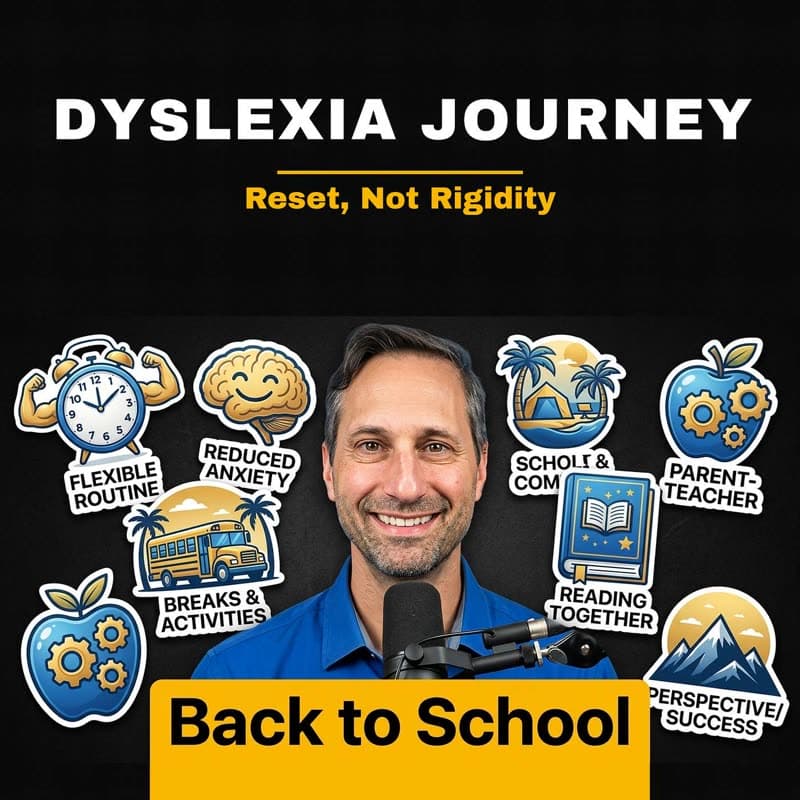
Back to School with Dyslexia: Reset, Not Rigidity
The first two weeks go great. Then, somewhere around week three, the crying starts, or the stomachaches, or the flat refusal to get in the car. If you've been through a back-to-school honeymoon followed by a hard crash, this episode is about setting things up so the crash doesn't take the whole year with it.
Never miss an episode
New episodes every two weeks. Follow wherever you listen.