

Dyslexic Voices: Growing up Dyslexic in Australia ft. Peter Wilson
About this episode
Peter Wilson is the author of "A Journey With Dyslexia: Alienation, Assimilation, Acclimation." You can find his book at https://www.amazon.com/JOURNEY-DYSLEXIA-ALIENATION-ASSIMILATION-ACCLIMATION-ebook/dp/B0DHKJ18M5/
You can reach Peter at peter47wilson@gmail.com
Transcript
Full transcript · 3,030 words · about 15 min to read. Press a timestamp to jump to that moment.
I had to teach the two hemispheres of my brain that I was reading the same thing, that, you know, if you read from left to right, as right-handed people do, you see was. If you read, as left-handed people do, from right to left, you see saw, but they reverse it.
Myself, I was reading from both ends of the line at the same time. Got me diagnosed when I was in third grade, and it was the most relieving day of my life, because I finally had, like, kind of a place to hang my hat and say, see, I told you, I'm not lazy, definitely not stupid, I just learned differently, like, that's totally okay. We dyslexics, we were often, you know, just set up for failure, because, you know, we were given books and tasks that really are not appropriate for the level that we were at.
So, how do you expect anyone to be open to learning, when their entire relationship with reading, with learning, is physical pain? I wish I had understood when I was younger that the fact that my brain worked differently than people meant that I would be good at things in ways that other kids were not going to be good at. I just assumed, I can't be dyslexic, because letters don't jump up and down for me.
Dyslexia is not a disorder. It is not a disease. Once you sort of own it and embrace it, then you can have the power to deal with it. It's sort of empowering and also enriching to the whole community. To those who don't understand what dyslexia is, that it's not a negative, it's not a problem, it's, like, we keep saying superpower. Hey everyone, I'm Nick, and this is Dyslexia Journey. Unfortunately, Sonja wasn't able to join the conversation today, but I am excited to introduce a guest for our Dyslexic Voices series.
His name is Peter Wilson, and he is joining us from near Brisbane, Australia. Welcome, Peter. Thank you, Nick. It's great to be here.
All right. Well, so, Peter, you have shared through a book that you wrote called A Journey with Dyslexia a little bit about your experience as a dyslexic child and adult. And so, I was wondering if we could kind of start at the beginning. What was it like as a child for you, particularly before you realized that you were dyslexic?
Confusion. I did not experience the same world as others. I just was alone the whole time because there was nobody else that I could talk about what I was going through.
My imagination ran wrong.
Sorry, I've got mosquitoes.
I would disappear into my daydreams and could see, feel, and hear everything in my mind. It was just like living in the outside world. Yeah. Did your parents, were they, did they understand what you were going through or your teachers? No, nobody, nobody, nobody, nobody even knew about dyslexia in those days.
Yeah, so, so it sounds like it was very isolating. When did you, when did you realize, I think you mentioned in your book that you were maybe about 16 when you started to realize, that, that you might be dyslexic? No, actually, I was 25, 25. Oh, okay, okay. I, I was a member of RILAR and I went to a RILAR meeting and they had a lecturer from Sydney who was a educational psychologist.
And as he was lecturing, he was like telling my story. I could recognize from what he was saying that he was talking about myself and he was talking about dyslexia.
So that's when and how I discovered that, I was dyslexic. Mm-hmm. And what was your reading ability at that time? Oh, I could recognize letters because I'd been told about, the alphabet and, and all the, all the letters. And by narrowing my concentration, you know, to see letters, each letter and deciphering which letter it was that I was looking at.
I could say, oh, that group of letters was a word.
And I'd go on to the next group of letters and, and work out what that word was.
But at the end of the sentence, I had no idea what I'd read. yeah. So were you able to, finish school?
Yeah.
I, I, I was, able to pretend to the readers by doing this and I got better at doing it. I could convince them that I could read, but I, I never wanted to miss a, a, a lesson in the school because if I was listening, I could, pick it up and learn what, what the teacher was telling us. And so interestingly, you, you already noticed in school when you were fairly young that, that you were thinking differently from other kids.
You describe an anecdote in your book about identifying how to solve a very difficult problem. That was a couple of years too advanced that nobody else in the class could figure out how to solve, but then you weren't able to compute the correct answer. That's, that's absolutely right. That was in grade six. I, had several occasions in grade six that, I don't confuse me. That's not the right word, of course. but the, one thing was that the teacher put a question on the board and asked us to solve it.
And I worked it out and I worked it out to, 54.
Then the teacher asked us to change page with the guy next door. So we did that. And then he, the teacher worked out the problem on the board and it came out 54. And I thought, oh, beauty, I got it right. And the teacher asked us kids, if you had the right question in your, in the page in front of you, which wasn't mine, put your hand up. And the guy next to me, didn't put his hand up.
And I said, hey, come on, Richard, I've got the right answer. And he said, no, Peter, you didn't. And he showed me my page back again. And he pointed to it and he said, look, you've got 53.
In my mind, I had 54. I told my hand to write 54. But there it was right there in front of me, 53.
And that really scared me. I was really scared after that. Then the teacher gave us the problem, not on the same day, of course, but later, that he asked us to give him the theory for solving the problem.
After a good while, I actually read the problem because I got bored waiting for the kids at the back of the class to solve it. And within a small while, I put up my hand and the kids told me, put down your hand, Wilson.
And I answered, I gave the teacher the right theory for answering it. And then the teacher said, work it out. And I couldn't do the mechanics to work it out.
And then the third thing that happened in the history was we went on, with the scouts, we went on a horse. And it was an adventure. There was seven of us that went away for two weeks.
And we hiked in a virgin country where there weren't roads or things like that. Fire breaks, but no roads.
And I did a show and tell in the class. And all the kids were really impressed. And some of the bullying that I used to get stopped after I gave the show and tell.
So there was different indications that I was both dumb and intelligent.
So the indications that I was intelligent were the first time that I really started to understand and that I could do something about this problem. And this is when you realized that you could create the neural pathways to help you read.
No, it wasn't until after the lecture at Rotaract that I was able to do that. And I formed a theory. And the theory was is that I had to teach the two hemispheres of my brain that I was reading the same thing. That, you know, if you read from left to right, as right-handed people do, you see was. If you read as left-handed people do from right to left, you see saw.
And I was reading from both ends of the line at the same time.
And I was seeing both was and saw, which meant that my brain was trying to make sense of this. And all I was seeing was words jumbling and merging and moving on the page. So what I decided to do was I had a blackboard at home and I wrote on the blackboard a sentence that I copied from a newspaper. Remember, I can do that letter by letter.
And then by covering my right eye, I would read the sentence.
By covering my left eye, I would read the sentence. And then I would read it with both eyes open. And I did this three times a day for about, I don't know, a week, maybe two.
And then I rubbed it off the blackboard. And I said to mum, can you watch me read?
And she said to me, okay, I'm a really good Bible student. You read to the Bible. And while she was still working in the kitchen or doing something else, she would listen. And I had three months off at that time because I had been very sick.
And by the end of the three months, I could read well enough that I understood what was at the end of the sentence. So, I just kept practicing reading. And in fact, I still practice reading.
And I'm well into my 70s. So, how old were you at that time when you had the three months off work and you really made that breakthrough? Yeah. I was 23. It was just after. It was just after I had the Rotaract experience. And so, at that point, you were already into a career, right? Yes, yes. I was a wardie at the base hospital, the Rockhampton Base Hospital. I was there for 40-odd years.
But you did go to college then, later. Yes, yes. Seven years after I got to practice reading, I went to university and got a Bachelor of Arts. Now, that was the biggest hurdle I had to cross in my entire life. If I was as prepared for climbing the mountain of tertiary education as if Sir Edmund Henry went to climb Mount Everest in dongs, shorts, in a singlet.
He wouldn't have gone from her either.
Yeah. It really brings it home, I guess, the analogy.
Yeah. And you've said, I think you said in your book that you've done some hard things in your life, but dealing with dyslexia has been the hardest. When I was 67, I was also diagnosed with Asperger's, which we now know is autism and also ADHD. And you can imagine how having all of that right from childhood would confuse a person. And it wasn't until I learned about autism that I could actually write my book because I had to remove all the jigsaw puzzles, pieces from autism, from the dyslexic jigsaw puzzle, so that I could write my book.
So speaking of the book, what inspired you to write it?
Well, I've always wanted to write, and I had started writing novels, and I joined a writing group. And during normal discussion, we talked about different people with different problems, the different people in the group, that is. And they said to me, and they said to me, Peter, you ought to write a book about your dyslexic experience. So I started doing that. Of course, they pulled my grammar, my spelling, my punctuation, everything to absolute pieces.
And I actually enjoyed that, but I ended up with the book that I've written. And it's my story, my words, and I'm very, very proud of having actually achieved that. Yeah, and what are you hoping for people who read the book, what are you hoping that they get from it? Well, one thing is inspiration, that they can think about their own problems or their students' problems with a different light.
I know that today, even today, the school system is failing dyslexic children. And I would like them to get that inspiration.
I would like them to go through, in my book, I've talked about my way of forming neural pathways three different times. Because the first one was my theory. The second one was what I thought when I was still including autism. And the third one was when I had started looking into dyslexia and what other people were doing. And I realized that I had left out important information in the first two. So that's why I've seen that three times.
Yeah, it's really interesting. I haven't heard, or nobody else who I've talked to has described anything quite like that. Yeah, that's my discovery. But you were able to help at least one of your children with that method as well, right? Two. Two, yeah. Two of my children, yeah. I had three children, the oldest and the youngest. And I helped them when they were in grade one. And they've not suffered with reading problems since grade one.
And they had this dramatic turnaround from showing them my neural pathways. My grandchildren, I've got an 11-year-old boy that I go to on Wednesdays, my grandson. And he, at the beginning of this year, yes, this year, he was failing with his reading. His reading was the worst in his class. And he has had a dramatic turnaround. Sorry, I'm getting emotional.
He, this year, is school captain in grade six for his school. And his reading ability has grown greatly in this 12 months. Yes. Yeah, that's amazing. And for my Northern Hemisphere listeners, I'll remind you that the school year in Australia starts in January, right? Yes. So, you know, we often talk about how dyslexia is difficult, which it is.
Do you see any advantages to it? Or have you noticed any advantages?
Oh, yes.
I'm amidextrous, and that is part of being the dyslexic. And it has nothing to do with reading, of course.
So, I have given the overall picture, the big picture, neurodivergent spectrum. That's what I've called it. That's not in my book. But since my book, I've realized that there is needed for people to understand that dyslexia covers a whole spectrum of things. But not specifically dyslexia, because it also has the arithmetic area of it, and the picture is part of being dyslexic. Einstein, if you look up Google, will tell you that he was, and his teachers told him that he would amount to nothing.
But it's that big picture that he had of astrophysics, that he was able to pull his theories. And there are many other things that come with dyslexia. One of them is reading columns instead of rows. That's a big, big thing for me. I don't know about other dyslexic people. One of my beta readers was a teacher, and she was teaching grade three at the time. And I said to her, and she's dyslexic too.
And I said to her, why don't you run an experiment in your class, where you write from the top of the blackboard down to the bottom, and see how your kids respond to it. Her reading class-wise improved immensely. Some kids hated it, but only about 5% hated it. And they actually need rows. So, what I'm suggesting is that our writing skills, writing formats, are 2,000 years old. And they need to add.
Yes, they need to add the columns for people like myself who are children. Children who are reading, learning from grade one, up, will then not have a reading problem. Yeah. So, yeah. So, speaking of children, and I think it's about time to wrap up, but I want to ask you a couple last questions here. So, thinking of children, thinking either of yourself as a child or of dyslexic kids who are out there now, what advice would you give, either to yourself as a child or to a dyslexic kid who's out there right now?
Stick with it.
Determination. It's what's got me there is that determination and forcing myself to focus, really, really minute focus. That is what helped me right from the word go. Yeah. Yeah. You've got to remember that autism and ADHD was bugging me big time. Yeah. I can imagine. Yeah. And then what – there's a lot of misconceptions out there, obviously, about dyslexia. So, what would you – if there's, like, one thing that you wish that the general public would know about dyslexia, what would you like to tell them?
Treat us as equals. Yeah. I thought that was a really powerful part of your book, where you ended a chapter or a whole section in your book saying, I felt like an equal. I thought that was really powerful. Yes, yes, yes, yes. Yes, I – I've always been running from behind, and now I feel I'm running with everybody else. Okay. Okay. Well, how can people – how can people get your book?
They can contact me if they like, but sending it to the North America probably would cost more than my price. But ExLiberous are the publishers, and you can buy it through them. You can buy it through – I can't remember their name now. Well, I'll put a link in the notes. My email address is peter47wilsongmail.com. I'll put that link in the show notes as well, or I'll put that email address in the show notes.
All right. Well, thanks very much. It was a pleasure. Yeah, pleasure chatting with you. Thank you for being willing to share your experiences, both in the book and in this interview. Yes, really appreciate it. Thank you very much, Nick.
More from the show

The Definition of Dyslexia Changed: Here's What It Means for Your Family
For the first time since 2002, the International Dyslexia Association has rewritten its definition of dyslexia. The new version quietly removes two ideas that have kept kids from being identified for two decades: that dyslexia has to be 'unexpected' given a child's intelligence, and that a phonological deficit is…
"Everyone Else Can Read" Ft. Parent Fiona Rintoul
Fiona Rintoul, fellow parent of a dyslexic daughter, joins us to discuss her experiences. You can find Fiona online at https://purplecowrecruiting.com/.
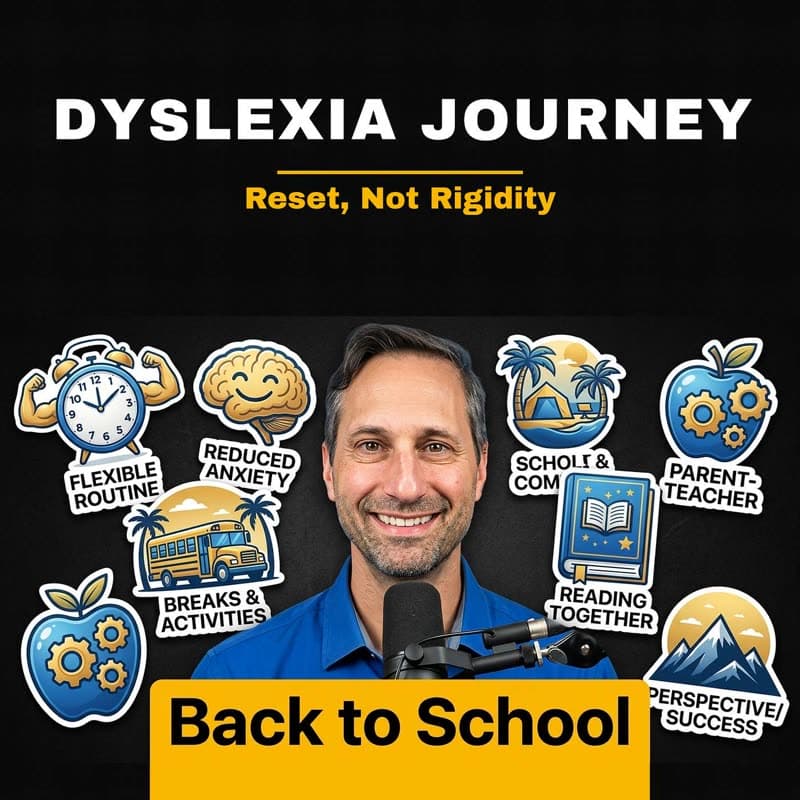
Back to School with Dyslexia: Reset, Not Rigidity
The first two weeks go great. Then, somewhere around week three, the crying starts, or the stomachaches, or the flat refusal to get in the car. If you've been through a back-to-school honeymoon followed by a hard crash, this episode is about setting things up so the crash doesn't take the whole year with it.
Never miss an episode
New episodes every two weeks. Follow wherever you listen.