
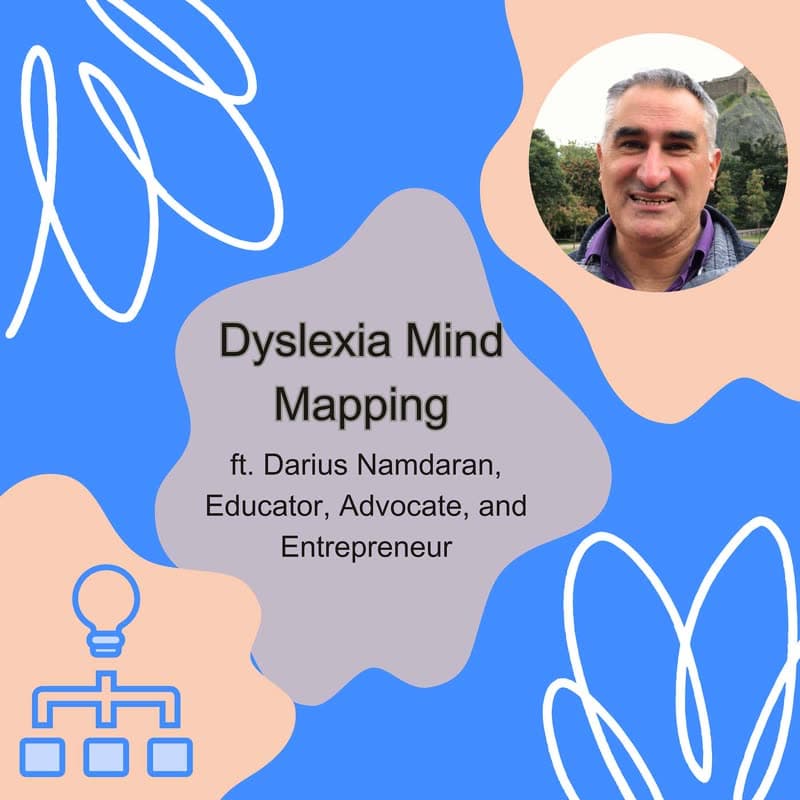
Managing Dyslexia With Mind Mapping ft. Darius Namdaran, Educator, Advocate, and Entrepreneur
About this episode
In part 2 of our interview with dyslexic educator, advocate, and entrepreneur Darius Namdaran, we dig into mind mapping, his own parenting journey, and his latest project!
Darius Namdaran is host of the Dyslexia Explored podcast and founder of iVVi.
Part 1 of the interview is available here.
Transcript
Full transcript · 5,998 words · about 30 min to read. Press a timestamp to jump to that moment.
Ten minutes before the exam, outside, I wouldn't speak to anyone, draw the map out, mark it, mark it, yeah, yeah, yeah, got it, got it, got it. I wouldn't speak to anyone, I'd walk into the exam, I'd say, can I have an extra piece of paper, please? They'd give me a piece of paper, and they'd go, you may begin, and instead of even opening up the paper, I'd just draw out the mind map furiously from memory and dump it, and I'm like, phew, I've got all the answers.
And I'd just use the mind map to answer all the questions, and boom, bash, bish, bash, bosh, I got it, you know? That was my hack, with a terrible memory. I have an atrocious memory.
Well, let's see. I want to make sure we include your experiences as a parent of dyslexic children, and now adults. So I guess I'll just keep it really broad. You can tell us whatever you'd like to about that journey. I'm just, I'm partly curious, though, to see how much, you know, how the similarities and dissimilarities to your own experience in terms of how, you know, dyslexia has played out for you, and then, of course, in identification as well.
Yeah. So, if I tie it in to law school, so law school I crashed and burned in third year of honours, and I went to my mum and dad and said, I want to learn how to be a joiner, basically a carpenter, builder of houses. And they were like, what? You just got into one of the most prestigious law schools in the country, and you're throwing it all away in the last nine months? You know?
I'm like, yeah, yeah, I can't do it anymore. You know? I basically burnt out. Because, anyway, I learned how to become a joiner. I got it out of my system. And thank goodness for Dr. Cairns, my director of studies. He says, Darius, I'm going to put you down that you're pausing university rather than leaving university. No, no, no, no, I'm never coming back. I'm never coming back. Anyway, a year and a half later, I'll knock on Mr. Cairns' door. He goes, you know how you mentioned pausing?
And he's like, yeah, yeah. Darius, great to see you back. Brings out his drawer. He goes, I've got the piece of paper here. And I'm like, can I just start again? Just go to the lecture, carry on. And I showed up for the lecture a week or two later, last minute as usual, and I finished my law degree, but there was a big difference. This is the first time I actually learned how to learn. Up until then, I was gaming the system, but I had this hunger to actually learn.
And that's when I learned mind mapping. So, you know, Tony Buzan's book, I read all of it and I implemented about 80% of it, except the mind mapping bit. And I thought I had a sociology lecture, which I did out of interest because I could opt for something and I'm like, sociology doesn't matter. So I can experiment with this. And so, you know, lawyers have a very condescending view of anything that's not law, maybe medicine, but, you know, and so went into sociology and I started to mind map using the principles, one key word on a branch and then another branch and then a doodle and so on from the center image.
And I started doing it and I started doing it and I was like, oh my gosh, I'm like in the flow and I'm like, I'm staying in hearing what they're saying, but I'm also capturing the key bits of information. So I'm not having to hold them in my head. You know, that whole tension between, should I write everything they say or should I just listen there and just get overwhelmed at a certain point?
I was just in the flow. And in the middle of that lecture, I was asking really intelligent questions because I had the big picture. No one else did because they were still doing the full writing and the lecture was like, gosh, that's yeah, that's interesting. Because what I started to notice was when I mapped out lecturers notes, there would be gaps, an area where I would intuitively say there should be a bit more in there.
And then so I'd ask a question saying, is there not something more to do with such and such? And they would say at the end of it, they would come to me and they say, well, spotted, Darius, that's in the extra reading. And that's how I know whether you've done the extra reading. I don't teach it to you in the lecture. When it comes to the exam, if you've done the extra reading, you'll be able to get that mark, but the others won't.
And so I was mapping out that it was this, this like puzzle again, to try and figure out what, what are they saying? What are the main things? What are the not important things? What are the main, where are the gaps, et cetera? And then I go away, do my reading, get the gap, fill in the gaps and so on. Until I got to the point where I could take the map of a whole law lecture, maybe 200 items onto a piece of paper.
And I would, I have a terrible memory. I can't remember anything for longer than about 20 minutes or 30 minutes, like facts and so on. Terrible. So what I would do is I would redraw the map from memory, look at it, and then I'd test myself from it. And I'd be able to retain it for about 20 minutes, half an hour. Okay. And then it would disappear. So I would do that just before the exam.
10 minutes before the exam, outside, wouldn't speak to anyone. Draw the map out, mark it, mark it. Yeah, yeah, yeah. Got it. Got it. Got it. I wouldn't speak to anyone. I'd walk into the exam. I'd say, can I have an extra piece of paper, please? They give me a piece of paper and they go, you may begin. And instead of even opening up the paper, I just draw out the mind map furiously from memory and dump it.
And I'm like, phew, I've got all the answers. And I just use the mind map to answer all the questions and boom, bash, bish, bash, bosh. I got it. You know, that was my hack with a terrible memory. I have an atrocious memory.
So court cases, reference dates, all this sort of stuff. So to tie it into your question with my daughter, 35, I went to university a second time. I couldn't believe in the 21st century that you still hand wrote your exams. I mean, what is that? I mean, handwrite exams? That's stupid. But still handwrite exams. Now, my writing is terrible. My spelling is terrible. My composition is terrible. My paragraph structure is terrible.
I want a word processor thing. So I asked them, can I just have a computer, please? Oh, only if you've got dyslexia. And I was like, well, I'm not dyslexic. But I thought, well, I'll chance my arm. You know, I'll chance my arm. I'll go do it. I was a property investor and developer at the time. So I had the money. It was fine. We'll go do the test. I sit down.
I do the test. And I'm kind of like, I just want to be able to type. Just give me the reason to type. And the dyslexia assessor at the end said, Darius, you've got dyslexia. I said, well, you know, to be honest, I don't really think I've got that dyslexia. Maybe very mildly. I said, no, it's not mild. It's moderate. You know, it's not extreme, but it's moderate. It is getting in the way.
And she showed some of the exercises. And I could see in the assessment where it was getting in the way. And I was kind of shocked.
And she said, you need to learn how to mind map. And I said, well, I do already. And I pulled out this huge file of mind maps, you know. And she was like, well, that's how you were, did your law degree, your primary school, teaching, your community work, and all the speeches you give and things like that. Because everything was a mind map. It was just this hack. But I never really paid it much attention.
I was just like, if I get stuck, I just did this mind map thing because it infuriatingly hit a roadblock. Right, I'll mind map it, you know. Until then, I realized, gosh, you've been a faithful servant, quietly serving me all these years. And that's when my daughter crashed and burned at 14. She was a grade student. And then suddenly something went wrong when she was trying really hard. And that's when I thought, right, you need to mind map when you're 14, not when you're 23 like me.
It's interesting because mind maps, I feel like, I mean, I've ever heard of them here a little bit, maybe more in the alternative schools, a little bit used here and there. But never, I haven't ever heard of them used. No. You know, specifically with dyslexic people. I've only, I mean, only from Darius. I mean, I looked at your website about that a while back, I think, actually. I have not seen it referred to here.
But it sounds like, because you heard it from the person there, it sounds like also, I know you're already doing it, but it sounds like it's bigger there. Is that true? Well, every single dyslexia assessment in the UK will have a recommendation for mind mapping. Huh. The British Dyslexia Association says that every company in the UK should provide an accommodation of mind mapping for their staff as a basic minimum. The government will even pay like £405 for a three-year mind mapping software in the UK for people with dyslexia in the workplace.
You know? What? That's really interesting. They will pay for mind mapping software for students at university because it's just universally realized that visual note-taking helps a lot of people with dyslexia. Not everyone, but a lot. And that's part of the story. Now, in America, just like you've started to delete the word dyslexia from your formal terms and so on, terrible, they call it visual organizers. They need a visual organizer, you know?
And now most people have imprinted a visual organizer as being a page with boxes in it that you fill in and so on. And you go, I've been so dyslexia friendly, I've given them a visual organizer. It's like, no, I don't need that visual organizer. I need space to think and to find the pattern because we're pattern recognizers, human beings. But with dyslexia, often we're hyper-pattern recognizers. We rely on the pattern to give us the answer rather than the answer or the detail or the etc.
So, yeah, UK, mind mapping, across the board. But there's a big problem, very big problem. Most teachers have no clue how to use a mind map. No, no. And so when you show a child how to mind map with dyslexia, I've done it, I've taught maybe 2,000 children to 3,000 children how to mind map in person, in a group or online or whatever. I've taken 150 different students through their high school on three to four year periods and turned their high school careers around with mind mapping.
And one of the things that I've discovered is that most people mind map to brainstorm and get ideas. So for listeners who are listening, a mind map is quite simply, you start with a cloud or shape in the middle of the page with your central idea or concept. You start doing a little branch coming out of it and you write a word on top and you do another branch off that and you write a word on top.
And then you kind of create this sort of web, okay, called webbing in America often of these keywords and ideas. The problem with dyslexia is that if you're like Nick, who's a real sequential learner and you do one of these maps, you will do the first branch will make sense. It will be a high ranking key idea and then the next one along and so on and there will be some inherent structure in it.
But when you do it with a dyslexic kid, there is no inherent structure at all. Everything trivial starts coming out first and everything important is out around the edges and gets confused and lost. And so I had to develop a whole different way of teaching kids with dyslexia how to mind map. Because I was like, when I met my daughter and I was teaching my daughter, I was like, why don't you get this?
This really worked for me. Why don't you get this? She didn't get it, you know? And I was like, I mean, I taught people at university how to mind map and if they got it, great. If they didn't, I didn't mind. No big deal. You get it, you don't. My daughter, I knew this would really help her and it's not like, oh, well, you got it, you didn't get it, it doesn't matter.
And I was like, you need to get to know this and trust me, this is a lifesaver.
So I kind of dedicated about seven years to try and figure out how working memory, processing, inhibitor control and cognitive flexibility changed the way a person learns how to think visually. And they think differently and they also take visual notes differently and they respond to visual organizers differently than typical thinkers. Oh, yeah. It's so interesting. I'm like, now I want to really go down the rabbit hole of that. That's really interesting.
Let's see. I know we're getting near the end of our time, so I want to make sure we pull in some of these questions we have for you to take however you want. I guess as a parent, so this could be about the learning, like you were just bringing up, this could be about other things. Like, what do you think has been key or the keys on your journey in parenting dyslexic kids?
And I know that's going to be different for you, of course, being dyslexic yourself than sometimes is the case.
I've taught literally hundreds of parents. So I used to teach parents and children how to mind map together. So they'd end up developing this common visual language, you know, so they'd hit an issue and it's like, right, let's go to the whiteboard and just draw this out, you know. Because what often happens is you're having a conversation about a trip, you're going to go on a holiday trip, and you talk about 0.1, 0.2, 0.3, okay, and you're just talking.
You mentioned 0.4, they have immediately dropped the ball on 0.1, and they're now playing catch-up because their working memory has got filled up. Your working memory is seven units, their working memory is three, and they're kind of playing catch-up all the time. And you're kind of looking at their eyes, and you're kind of like, are you not with me on this? Do you not want to go on this holiday? You're not excited about what we're doing?
And subconsciously, they're going, I just kind of lost track of here. Where are we right now? You know, oh, and we're going to do this, and then we're going to do that, and remember to bring your bathing trunks, and remember this. And you're like, oh, my goodness, this is all important, and I'm lost, you know. But it's all immediately solved. The moment you go to a whiteboard, and every time you mention one thing, you write one word, and there's seven words on the board, and they're totally with you.
They're totally focused. They're totally in the flow because you've extended their working memory with the board. And parents need to understand this, how important working memory is with dyslexia and how important working memory is with ADHD and executive function. And if you're a real verbal processor, you know, a person with dyslexia will quite happily rabble to on, like I'm doing right now, and just throw things out there. But on the other side, if they're listening, they're like, oh, that's way too much.
Hold on a minute. I need to somehow to stick all these ideas together. It normally involves something visual, and one of the simplest ways is a mind map. You just put a circle in the middle. That's what we're talking about. Start at one o'clock. That's the first one. Two o'clock, three o'clock, four o'clock, five. Oh, there's this other idea. Oh, let's put that over here. Oh, when we go swimming, we need to bring our goggles as well.
Oh, yeah, we'll put the goggles in. And then what happens is you start literally mapping it out, and they are kind of like being fed because they're like, right, I'm really getting the big picture now, rather than going in a list and getting lost. Yeah, I love that. I love that explanation of how to use it in practice like that, and I can definitely identify with that. Yeah, because I mean, sometimes it's not, yeah, you can even think of a kid who might have a good memory, but in those kinds of, like, exactly what you're describing is absolutely true.
I just never thought of a kid. That explains a lot to me as well. And I've always, yeah, been a little confused by that with our daughter, who has a fantastic memory for past events, for, you know, all kinds of things. But when going, you know, working through sort of, you know, I'll use math as an example, through sort of sequential things, really can only kind of keep in her head a couple of steps at a time.
Yeah. But, yes, like you said, to extend it that way, both, you know, in terms of how the information is more of that holistic way, but also visual. Yeah. Yeah. We have a rule in my house. There's a whiteboard in the kitchen, okay? And half of the whiteboard has to stay white all the time. My wife hates it. She likes filling the whiteboard with lots of lists and so on. I put this whiteboard up.
And I said, no, I need this space for when we're having a talk. I need to have a space that I can go straight to and trust and write it all up. And then I take a scan of it, put it into Apple Notes and wipe it away so that I can be with you and I can process this. I need it, you know? And so you were asking me what I think parents, what advice I'd give to parents.
So the advice I would give to parents is for them to understand their own dyslexia and for them to start implementing the tools that they wish their children have in the future. And then when your child is ready to receive that input, their ears are open, you're at the ready, not another coach or a training program or whatever. It's like you are the living embodiment of using this, okay? And so I've implemented that in my own personal life over the last three years.
I changed my whole business when I had this realization. I was like, I'm trying to teach these children these skills to become independent, okay? Independent, effective contributors, responsible citizens. How do I help them do that?
And the answer was, I need to make sure the parents learn those skills so they can give them to the child whenever they need them. Whether that child's 23 at university and doing an exam and you go, right, let's just map this out, kind of figure out where we're going or put it into the calendar. And I realized there were three skills that each one of the parents came to me. The parents came to me and said, look, Darius, this is just genius stuff that you're teaching.
Like, you need to teach us this for work, you know? You know, like one guy from the BBC, you know, said, I've had a screenplay in my head for, like, three years. And last night I wrote the whole mind map of the whole screenplay out. And I've got a proper outline of a screenplay. It's just like I've been stuck for all that period, but the map got it out. I organized it.
And that just commonly happened. And so I thought to myself, how do we teach these parents the skills they need in the workplace? And the workplace is different than college. You need a different set of skills, slightly different set of skills, but they actually match the set of executive function skills. It's all in the realm of executive function. Okay. I believe executive function solves so many challenges of dyslexia and ADHD in high school and in the workplace.
And, hey, because what happens is it boils down to three things. People need to learn to take notes, make maps, and set reminders. If you are feeling stressed and you go, I'm feeling so stressed and overwhelmed. You're like, oh, should we maybe take a note up on the whiteboard and get it all out? Oh, oh, yeah, maybe we do that, right? Oh, gosh, I feel so much better. Right, got it, you know?
Or maybe they've done that and they go, no, no, no, no, it's just all floating around in my head. And I, well, maybe you need to get a map. Maybe you need to just get it all on one page so you can see everything in one view. Because sometimes making a map is, do you have everything in one view? The big picture feeding that big picture. And they go, oh, no, I don't.
Right, let's find a way to do that, whether it's Post-its or Mind Map or a Miro or whatever it is, all on one page. That's a map. And then setting reminders. It's like Apple reminders on your phone, alarms. And then discovering your calendar as a book of promises, you know? It's like you, most people with dyslexia have not got a good relationship with their calendar, got a horrible relationship with their calendar, even until they're 50.
I meet executives and they sit down there with me and do the one-to-one coaching. And they're like, Darius, you're going to laugh. Don't, please don't laugh at me. I said, I'm not going to laugh at you. I couldn't use a calendar until two years ago, three years ago. I could put stuff in it, but it was not functional. My wife was my calendar, you know? And what happens is people with dyslexia start to use external prompts, like the meeting.
They'll see people get up from their chair and they go, oh, Mary, oh, when she gets up from the chair, you know, she's going to the toilet. The meeting will be happening in about five minutes. All right, I remember. Okay, let's go. Or, you know, Bob says, ah, see you tomorrow at three, you know, looking forward to it. Oh, yeah, yeah, yeah, yeah. And there's all these cues that you're kind of riffing off and then one or two fall through the holes.
But you have this underlying feeling of you're just about to drop the ball, you know? And you just can't cope with that until when you're 40. Because if you do drop the ball, people's jobs and careers are on the line now, you know? You're good at your job. If you mess up, your team feels the impact, not just you. It's not like, oh, sorry, I'll make it up to you. So they need to learn a new set of skills.
And it normally comes down to those three things. Yeah. I'm curious, too, if you could give this is what you've said is already advice for dyslexic people in general, too, as well as parents. But if you're thinking back to your younger self, because a lot of people, you know, are in all kinds of different stages of identification or not being identified, challenges, things going better. What would your advice be to your younger self or just thinking of those maybe younger or earlier in their journey, dyslexic kids?
Yeah, learn how to code.
A nickel like that. I was so frustrated with myself for not learning how to code. So frustrated. You know, because I tried coding, you know, when I was young. I got my Atari and I got my Sinclair C1 and someone gave me the typed out thing that I had to type out all of the code and it didn't work. And I was like, I don't know where it's not worked because I've done some dyslexic, you know, reversal and all that.
And it's so hard to identify these things and so on because it's so pedantic. One thing's out and you can't track it and so on. And that really was a big roadblock for me. And I just felt, oh, well, I'm not very good at that. So if there was actually, it's a strange thing to say, isn't it? But if there's one regret is that I wish I didn't, I hadn't coded. I got a law degree and I've done all sorts of things.
Joiner, stained glass, window maker and property developer, investor, et cetera. And actually now I've decided I'm building an app. I don't know how to code, but I've worked, I've got a co-founder who's the technical co-founder.
Okay, so that's the sort of semi-facetious answer to that. But going back, I suppose nine years old, boarding school, trudging back to school after a break with mum and dad, mum and dad saying, pull your socks up, try better this term. And that dread of being a disappointment and failure again, you know, basically people with dyslexia are battling, being a disappointment and a failure all the time.
I don't know, I don't know, what would I say to that boy?
There's nothing wrong with you.
Yeah.
I think that's what every person with dyslexia needs to hear. There is nothing wrong with you. And with the most sincere, you know, there is nothing wrong with you. No, no, no, really, there is nothing wrong with you. No, no, even that, there's nothing wrong with you. No, still nothing wrong with you. Oh, but no, no, nothing wrong with you. And yeah, I think there is that. And then it would be, explore dyslexia.
I think children need to understand their minds from an early age. They need to watch videos that make sense, dyslexia makes sense to them. They need to understand their mind. I think of our minds like they're all different shapes, like our feet are all different shapes. And when we go for a walk, we wear hiking boots. And if we wear hiking boots that are too small for our feet, then our feet get sore and hurt and bleed.
And we can be disabled by that ill-fitting tool that is on our feet. And we've got the same thing happening with our brains. We need to find tools and ways of working and processes that fit our minds rather than hurt our minds or overly unnecessarily tax them in the wrong way, like walking with shoes that are too small. So, but no one is, one of the things with a child is, it's a cruel thing, but the child has got to grow up faster with dyslexia.
Child has got to grow up faster. They've got to take more personal responsibility for what they've got. They've got to advocate for themselves. They've got to find new different techniques. They can't just go with the flow. So, all of these things are really very adult things to ask of a child, to self-advocate, all these sorts of things. Really, it's a big ask. But, you know, they've got to do it. They've got to understand their minds.
Because if you understand how your feet work and you can choose the right shoe to fit your feet, you know, if you understand how your brain works, you can choose the right tool to fit your brain. Yeah. Yeah, that's, wow, very powerful. Thank you for, thank you for sharing everything and such, such personal stuff about your, your childhood and everything. We really appreciate it. So, I guess to wrap up here, where, you want to tell us a little bit about your, your show and where people can find you online?
About eight years ago, I said to myself, I'm going to set myself the mission of teaching one million children how to mind map with dyslexia by 2030.
And I didn't know how I would do it. And now I do. I'm going to teach an AI how to mind map. Actually, I've taught an AI how to mind maps.
So, I set up a company three years ago, an app development company on the side to grow up and sort of wait for the AI wave to become, you know, better APIs and better services and functions to actually use it as a developer, which happened a year ago. So, I absolutely love AI. I think AI has been one of the best things for dyslexia ever. You know, like, spell check is AI.
Speech to text is AI. Text to speech is AI. You know, there's so much AI we've already been using, and we are the power users of it, people with dyslexia often. And when I was coaching adults and showing them how to use ChatGPT with a mind map and so on, it was just revelatory for all of us, you know, just that unlock that ChatGPT gave just to clean something up at the end of it, like extreme grammarly, you know, that didn't write the essay or the email or whatever, but it was just grammarly on speed.
And also starting to use AI to do this brainstorming side of things. You know, I want you to act like you are Tony Buzan and talking about mind mapping or Darius or whoever, you know, and you can have a conversation back and, you know, brainstorm. And there's just so much that can be done. So I think the whole area of dyslexia is going to, people with dyslexia have the potential to excel in the age of AI.
Because what we've got is this kind of lateral thinking and bigger picture thinking that isn't process driven, it's principle driven. So we've got Google, which is the knowledge base. We've got AI, which is the processing. AI is just an expert at processes. Tell me the process of doing X, Y, and Z. This is the process, writing an essay, writing, doing a health and safety report or whatever. Right. This is the proper process that people would be expecting.
But we've got that world where we're tied into of core principles and also wisdom, you know, discernment. So I'm really excited about AI with dyslexia. And I think I'm a bit concerned that, like I was speaking to Dr. Brock and Ede Fournette, you know, the authors of The Dyslexic Advantage. Yes. They did a great podcast on Dyslexia Explored, actually. We ended up talking about AI and a lot of schools were banning ChatGPT for they didn't want ChatGPT students to use it.
And what they did was they said, you're not allowed to come in and bring in a typed essay. And the consequence of that is all the children with accommodations for being able to type out an essay and bring it in from school because they got dyslexia, wiped. Can't do it. And so it's a retrograde step. And so we as parents and advocates need to really pay attention to AI and make sure it's being used for the good of children with dyslexia.
It's just phenomenal what you can do. I was going to go and talk about IV and what we're doing, but that's a whole other episode, I think. I've started this app to do all of this in real time. I'd like to have you on again just talking about that sometime. Yeah. That'd be wonderful. For today's episode, do you have a website we can link people to? Yeah. What website should we? Well, go to IV.app, that's spelled IVVI.app, okay, or IVVI.app, and that's where you'll find information.
At the moment, we're in stealth mode on building an app, but on the public-facing side, I do one-to-one coaching with adults with dyslexia. There's a grant in the UK where the government gave $1,200 to any adult with dyslexia in the workplace to get one-to-one coaching. And yeah, you won't believe it. It's like a different world. That's amazing. But most people don't know about it. But what I'm really excited about is I'm dreaming of a note-taking app that does three things in one.
It takes the audio recording of the meeting or lecture, it takes the transcript, and then it creates a live mind map from all of them at the same time. So you actually see in real time a visual map of images and keywords being created that is connected to the transcript. So every person can filter that meeting note into the language of their preferred language. Some people like to see maps, some people like to see outlines, and some people like to see the transcript.
And you can toggle between the three of them. So we're developing that at the moment. Oh, wow. That sounds wonderful. Yeah, we'll definitely want to hear much more about that. But we will put that link in the description box and information section as well as Dyslexia Explorer, of course, too. And if you're excited, join the beta tester waiting list. There's a waiting list. If you click on it, you can join our waiting list, and you can beta test, and then beta test it until it gets released in about three, four months.
That would be wonderful. Thank you. Thanks for sharing all of that. And thank you so much for all. Thank you. My pleasure. The goal is, see all this stuff that I'm talking about that I would teach one-to-one that's like, oh, my goodness, what you're talking about? You switch on Ivy, she just does it for you straight away. Yeah. And she just models it for you straight away. Right. Oh, is that how mind mappings really work?
Oh, is that how it works? Oh, right. I'll do it myself now. And so basically, if an AI can model best practice to you in visual note-taking, mind mapping, then you can do it yourself. Wonderful. Wonderful. Well, thank you so much. Thank you. And we'll be talking again soon. But for now, thank you for all that you shared and for all the work you do. Thank you. My pleasure. Thank you. Thank you.
More from the show
The Definition of Dyslexia Changed: Here's What It Means for Your Family
For the first time since 2002, the International Dyslexia Association has rewritten its definition of dyslexia. The new version quietly removes two ideas that have kept kids from being identified for two decades: that dyslexia has to be 'unexpected' given a child's intelligence, and that a phonological deficit is…
"Everyone Else Can Read" Ft. Parent Fiona Rintoul
Fiona Rintoul, fellow parent of a dyslexic daughter, joins us to discuss her experiences. You can find Fiona online at https://purplecowrecruiting.com/.
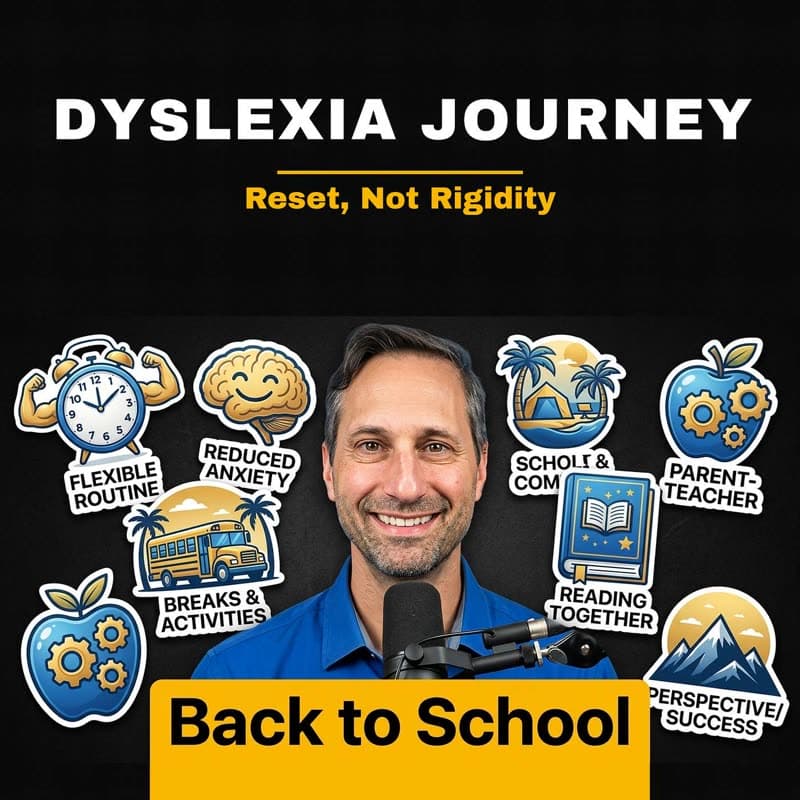
Back to School with Dyslexia: Reset, Not Rigidity
The first two weeks go great. Then, somewhere around week three, the crying starts, or the stomachaches, or the flat refusal to get in the car. If you've been through a back-to-school honeymoon followed by a hard crash, this episode is about setting things up so the crash doesn't take the whole year with it.
Never miss an episode
New episodes every two weeks. Follow wherever you listen.