
She Didn't Know She Was Dyslexic Until She Learned English ft. Haiyu Zhang
About this episode
Haiyu Zhang grew up in China and moved to the US as a teenager. You can find her online at https://hz2784.github.io/.
Transcript
Full transcript · 6,249 words · about 31 min to read. Press a timestamp to jump to that moment.
Maybe for dyslexia people, they need the information intensity to be higher than what quote-unquote the regular readers need. We need more information at the same time so that it can keep us hungry and keep us long to go forward. And if we have to read word by word, it could be too slow for us.
It got me diagnosed when I was in third grade, and it was the most relieving day of my life because I finally had, like, kind of a place to hang my hat and say, see, I told you, I'm not lazy, definitely not stupid. I just learned differently, like, that's totally okay. We were dyslexics, we were often, you know, just set up for failure because, you know, we were given books and tasks that really are not appropriate for the level that we were at.
So how do you expect anyone to be open to learning when their entire relationship with reading, with learning, is physical pain? I wish I had understood when I was younger that the fact that my brain worked differently than people meant that I would be good at things in ways that other kids were not going to be good at. I just assumed I can't be dyslexic because letters don't jump up and down for me.
Dyslexia is not a disorder. It is not a disease. Once you sort of own it and embrace it, then you can have the power to deal with it. It's sort of empowering and also enriching to the whole community. To those who don't understand what dyslexia is, that it's not a negative, it's not a problem, it's, like we keep saying, superpower.
Hey, everyone. We are Sonja and Nick, and this is Dyslexia Journey. And today we are excited to welcome Hayu Shang to the show. Hayu, welcome to Dyslexia Journey. Thank you. Thank you so much for inviting me, and I'm so excited for being here. So we're having you on as part of our Dyslexic Voices series. You're also going to talk about some work that you do that I think people will be very interested to hear about as well.
But let's start, I guess we can say at the beginning, your trajectory is a little different also from our other interviewees, though maybe not different from audience members who are listening to this, in that you realized you're dyslexic when you learned English, it sounds like. So I'm curious to hear, like, how that was for you. Like, what was it like before? What was it like? How did you sort of realize that?
What were your experiences like? Yeah, totally. I think, yeah, just as you said, like, I didn't realize I could be dyslexia. Or, like, in fact, maybe, like, put it in a more accurate way. Like, I don't even know the word dyslexia at all. Like, when I was, like, learning my native language, which is, like, Mandarin, I've been always, like, a super fast reader when I'm, like, reading Mandarin. I read, I process, like, fiction.
I really love reading fiction. So I sort of, like, process the fiction, like, block by block. Like, when, like, sometimes I read, like, paragraph by paragraph. And, you know, like, Mandarin is sort of character-based. So sometimes I just, like, glance at the paragraph and sort of, like, that character, like, jumps off to me. So I don't need to, like, read specific sentence, but sort of, like, the message is, like, jumping off to me.
And that's, like, one of my favorite experiences when I was a kid. I really love, like, just immerse myself into the book and sort of, like, finding important message to me. Like, to me, like, the, actually, like, whatever, the content doesn't matter that much. It's more about, like, what's that message that's, like, trying to jump off to me. And then, like, I came to the States when I was 16. And, like, reading English is very different from reading Mandarin to me.
Because first, English is a second language to me. And I don't have something that I later know is called pleasure read, which is I read just for fun or I read it for my, like, own interest. I read English mainly because either my teacher assigned the text or my parents wants me to, like, get a better school at SAT or, like, get a better school at TOEFL. But it was more like a task to me versus, like, when I'm reading Chinese is, like, a really fun activity to me.
I don't know, like, whether that makes a difference. But, like, when I'm reading English, I cannot, like, process block by block. I have to process word by word and maybe gradually line by line. That didn't change much, even, like, I got a, I got a comparative literature bachelor, like, in Columbia University. But, like, when I'm at Columbia University, I still got a lot of, like, assigned tasks. Like, things are getting better.
I'm sort of, like, processing it, like, line by line. But still, I, I think it's, like, I don't see the pleasure read, like, that flow moment when I'm, like, reading in Mandarin. Like, it's quite interesting how I realized I could be dyslexia. It's super late. It's, like, when I, like, last year, I got an eye surgery. And my eye was, like, super bad. So, I cannot, like, read at all. So, I began to listen to audiobooks.
And that was a moment I realized, oh, I can listen super fast. Like, that gives me a flow experience. Maybe, like, not just, like, listen to audiobooks. But, like, gradually when my eyes get better, I was reading Virginia Woolf's Waves. And that's the first time I got a flow experience by reading English texts. What I did is I, I listened to the audiobooks and read the texts at the same time. that, that was, like, really a new finding for me.
So, I was, like, oh, why is that? And then I learned about, oh, there's the whole thing called dyslexia. Like, people could have, like, like, different ways of, like, reading. Maybe my brain, it just, like, fired differently than, like, it's supposed to read English. And then I realized, oh, maybe I, it's not, like, my English is super bad. Like, I never improved. Maybe it's just, like, I need to use audiobooks. And I need to, sort of, like, use the text at some time.
And then I started to, like, learn more about this field. And I realized, oh, there's so many people like me. Like, yeah. Yeah, that's, that's super interesting. And I want to emphasize one point there, which is, that with your, sort of, natural experiment that happened when you weren't able to, read with your eyes, that, that sort of removed the, factor, or the question of maybe, maybe you just don't know English as well as Mandarin.
but when you were able to listen to the audiobooks, it was clear that you were fluent in English and were able to enjoy the audiobook. And it was, it's just reading English that is more difficult, right? Yeah, yeah. It is like that. Yeah. Because, like, at that time, I also had a theory, is, like, because I listened to a lot of lectures and I have to, like, you know, I'm, I'm sort of from the Zoom university era.
So I have to, like, watch a lot of lectures at, like, two times speed or, like, 2.5 times speed. So I'm very used to, like, listen to audios that are at a super fast speed. And when the audio gets, like, super fast paced, it's sort of similar to how I read in Mandarin because it's hard for you to capture every word. And sometimes you just need to learn how to grasp the important information in the fast speed audio.
So at that time, my theory is maybe I'm, like, more trained at, like, listen to audio. But I think, I don't know. Like, I don't know. Yeah. Like, yeah. And then, like, I start doing the reading, like, reading texts paired with audio books. And that's, like, something that's very helpful to me. I don't even know why. I think maybe it's just because, like, my sensory, I'll get some work to do. And they're, like, all happily busy, so nothing is, like, wondering.
And I finally get to, like, focus on the text so much that I can immerse into it. Yeah. And it just pings up quite a few things for me. And one of them is sort of the fact that dyslexics often do have more of a holistic way of taking information and a more visual way. And then also that dyslexic often do miss those small words, which it sounds like. I don't know Mandarin well enough to, particularly the characters, but my understanding is that there aren't so many of the small words, right?
It's more like you said that there's, the characters are, or are there small words? How does that work? Well, like, like, like the articles in English. Yeah. Oh, yeah. Like, hey, and the. Right. Like, you don't have that in Mandarin, right? Is it more incorporated into the character, sort of, or the whole? No, I don't think we have it. Yeah. Yeah. But it's actually different from what I said, though. Like, we, yeah.
In fact, we don't have it. But, like, I can totally relate to, like, the thing you were talking about. Like, it helps me to just grasp the important plot versus, like, I need to get into, like, the smaller details, like, how this thing is said. For example, you know, like, Russian literature. The Russian characters' names are, like, super long. A lot of people, the reason they don't like Russian literature is because the name is so long, and it takes them a lot of time to remember the name.
And to me, that was never a thing. Like, when I was a kid, I was, like, super proud of it because I get to, like, read the Russian literature, like, super fast. And, like, I just sort of compress the Russian name into just one word or, like, one character or two characters. And, like, I don't even name it. I don't even, like, name out, like, the nickname I choose for them. So I can, like, proceed in a faster way.
But, like, when I try to, like, discuss the plot with my friend, I realize it's so hard for me to, like, recall the name. Like, I never actually remember, like, the character's name. I just say, oh, you know, that guy, like, he divorced his life, blah, blah, blah. Like, I know the plot, but I don't know, like, the name of it. To me, like, it's just, like, not important. Yeah. And so that was reading Russian literature in Mandarin.
Mandarin, yeah. Yeah. Yeah. Okay. Oh, yeah. Like, and that didn't happen to me in, like, in English. For example, like, I know, like, the English name of the Russian literature's character. Although, like, yeah, it is still the same content. Yeah. Interesting. Yeah. Interesting. Oh, yeah. Yeah. Like, for example, like, now I can immediately think of, like, Raskolovkov. But, like, if you ask me what's the Chinese translation of Raskolovkov, I can only say, oh, it started with the first character, Luo.
But, like, after that, I don't know. Is there a, like, I know it started with RA, but after that, I kind of don't know. Interesting. Yeah. Yeah. That's really interesting. Yeah. So, I'm curious then, I mean, obviously, after you moved to the U.S., so you went to high school and university and grad school in English. What, like, how did you, like, how did you kind of compensate for your English reading? Did you just spend a lot of time on it or what was, like, you had a lot of reading to do, right?
Yeah. I don't know. I always thought it was just, like, I was not good enough. Like, I thought it was, like, natural for people, like, learning a second language. Like, because I don't discuss my experience with others, so I thought, like, it's supposed to be hard. Right. Yeah. But now, looking back, maybe it shouldn't be that hard.
Yeah. Let me think if there are specific tricks I would use. Like, did you have to read things more than once? Or did you use, did you use audiobooks at all in university or? No, no. I didn't use audiobooks that much. I wish I had. Like, it would help me tremendously.
Yeah. I think I was just, like, reading. Oh, yeah. One thing is, like, I don't check dictionary. That could be a thing. I don't even see it as a trick. But it's just, like, I need to focus on the text. And to me, checking dictionary is something that's distracting for me. And I don't like taking notes that much. I usually just, like, highlighting. And that's the same when I'm, like, reading Chinese.
Like, for Chinese, I almost never annotate. And, like, oh, I still remember, like, in high school, like, that's reading English. My teacher was asking us to read some fiction, I think. And, like, one of the homework is he wants to check annotation to make sure that we actually read. And I have to, like, yeah, I have to, like, first read a chapter and then go back to it, pretend that I'm, like, annotating to fake some, like, annotation.
And basically, I just write, like, plot summary, which is, like, very boring annotation. And to, like, say, oh, I actually read a chapter. Yeah. So, our dyslexic daughter had the same experience with that in high school. Annotation seems to be especially difficult for people with dyslexic. Right. Yeah. Yeah. Yeah, I totally relate. Yeah. I'm curious if you notice anything else maybe now more than before. Like, do you notice anything with fonts or anything like that that you find?
And maybe this is going to transition to your current work. I don't know, but, yeah, like, do you notice that certain fonts are more difficult for you or not as much for you? Yeah. Yeah, totally.
Yeah. I think, like, now, because I sort of, like, stand from a designer's point of view, I get to, like, do more research, which I like to learn about how people read. I see that, like, there's research suggesting, like, font matters. And to me, like, font doesn't matter that much. Like, I do have a preference on fonts. Like, I think some fonts are, like, prettier than others. And, like, I think I have, like, a very strong preference.
That happens to, like, Chinese. That also happens to, like, English. Because, like, when I'm reading, especially, oh, especially when I'm reading on Kindle, like, or, like, on those, like, digital devices, I care a lot about, like, the font. I think it has, like, but to me, the standard is different. It's not like it has to be clear. But it's, like, it has to sort of, like, mimic the experience I'm reading in paper book.
Like, I don't want it to be, like, a font that's, like, that's, like, a research paper. To me, that's kind of, like, a bad memory. I want it to be, like, a fiction or, like, a literature book, like, a pretty font. So, like, it makes me feel like I'm reading something interesting versus, like, something boring. Yeah. I think that's one notice which I don't find a lot of, like, research support. Interesting.
Yeah. Actually, I want to talk a lot more about the work you're doing currently. But I do want to go back to one question about the difference between Mandarin, Chinese, and English.
What are your theories for why dyslexia didn't show up for you in Chinese? Or, in general, why we don't hear as much about people being dyslexic in English? Yeah, totally. I have several theories, which I've, like, briefly discussed with you earlier.
Like, there's several things. I think the first thing is, like, Mandarin, essentially, is a character-based. And English is a phonetic and, like, sound-based language. So, in Mandarin, I don't need to, like, hear the sound at all. Like, for example, like, I don't know this word. Like, I've never seen this word before. And I don't know how to read it. But simply by looking at it, like, by how it writes, I can decipher, like, the meaning of it.
Maybe this sounds kind of abstract. Well, so I think, yeah, I mean, to help out for people who aren't familiar with Mandarin, and I don't claim to be an expert in Mandarin. But it's, each word is represented by a single. Right, right. And so it's one character, which has, which represents an entire word, as opposed to English, which is made, a word is made up of multiple letters that are broken up into phonemes, right?
Yeah, yeah, yeah. So, let me break it down. Yeah, I totally agree. So, it's like one character. Like, when we are kids, we learn about, like, the potential symbols that can composite a character. And once we learn about those potential symbols, you see, oh, the symbol is, the symbol A, it represents grass. Simple B, it represents water. Simple C, it represents fire. Something like that. And then, like, even we don't know about the character, but we can recognize some of the symbols we know in the character.
And then we know, oh, this character is fire-related because I represent the fire symbol. And that's, like, that's what we call, like, it's meaning-representing symbol. So, it represents the fire. And then the other part, usually there are, like, two parts in one character. And that's, the left part is the symbol representing. The right part is sound representing. It can sort of represent, oh, like, if you see this, it means it ends in on.
If you see this, it means it ends in mu. Something like that. So, you, like, even though you don't know about this character, like, you've never seen this character before. But simply by looking at this, you can still, like, at least you can have several potential guess of, like, how you pronounce this character and what this character means. And, like, when you're reading super fast, you don't care that much. You just see, oh, that's fire.
And you just go forward. And, like, because you're reading a paragraph versus, like, you're reading a character. So, like, even though you don't get, like, the 100% meaning of that character, it still doesn't matter. So, oh, yeah. And coming back to the earlier point of, like, I never checked dictionary in English. I think I supposed to check English dictionary. But, like, this kind of, like, trick ever since, like, I was a kid in, when I was, like, reading in Mandarin, because I don't need to check dictionary.
I don't care that much about, like, the details. Like, I just sort of, like, deciphering, like, oh, this work group potentially means this. And then I just keep going. So interesting, because a part of what you were describing reminds me of, like, the Davis method. You know, there's some methods here where they've tried to teach dyslexic kids by having them associate, like, a visual with each word. Like, maybe the look of the word, but then make it also visual.
Or even, yeah, making letters out of clay, like, a physical. Oh, that's cool. Yeah. It reminds me a little bit of what's naturally happening there anyway. Part of it. Not all of it. But, yeah. The other comment I wanted to make is that the way you describe it, Mandarin Chinese, sounds like the ideal language for dyslexics. Because many dyslexics are very strong in visual skills and art and pictorial representations, right? Yes, yes, yes.
Oh, maybe, like, it's not like my brain is dyslexia, but it's more like the way I read Chinese make my brain dyslexia. Like, it makes it fit, like, Chinese so well that, like, I have to learn a whole new set of skills when I'm, like, learning English. Which comes to, like, the point about, like, why I think it was so helpful for me to learn, to use audiobooks and text at the same time.
Because, again, like, it gets back to the experience of, like, guessing the word. Because I think, to me, English, like, I can still guess the word, but it's from the sound. Like, sometimes I never seen the word before. But somehow, I don't know, like, how I talk about those experiences. But to me, like, somehow when I hear a sound, I can kind of guess the meaning of it. Which is, like, in that way, like, when I'm, like, listening to audiobooks, I actually have the experience of, like, deciphering and guessing the sound.
Versus, like, in Chinese, like, when I'm reading it, I have the experience of, like, guessing the meaning. Yeah. So interesting. Let's talk now about some of the work that you're doing. You're working in particular with Zuntold Publishing, which has bibliotherapy also, in the UK. But how did you come to that kind of work? I don't know if they're the first company you've worked with like that, or were you already interested in it?
Yeah, I think they're, yeah, it's just, like, what they're working on is, like, so specific. And, like, there's really few companies that are, like, doing works that are similar. So I kind of, like, reached out to their CEO on LinkedIn. And I was like, oh, I'm so interested in your work. It seems so interesting. And we start, like, meeting weekly. And, yeah, I start to, like, working with them. I think the reason I'm interested in bibliotherapy is because I've been always interested in therapy.
And, like, until, like, until, like, my eye surgery, I didn't realize how important or how therapeutic reading fiction was to me. And while I was doing my master's thesis, I encountered this word, bibliotherapy. And that's the first time, like, something that's always been there has a name to me. Like, I always know I like reading fiction because it's the few moments that I can feel, oh, I'm so focused. I'm, like, hyper-focused and, like, hyper-focused and I also feel I'm, like, absorbed by the books that I'm reading.
But I didn't realize this could be a way of, like, being a therapy. So that's the moment that I began to learn more research, like, about it and see, oh, if there's, like, actual, like, applications about, like, bibliotherapy and how people are currently navigating it. And, like, if it's at all, like, related to dyslexia or if there are, like, two separate topics. Because, like, to me, I have, like, a lot of theory, for example, like, I think people's attention is deeply related to this.
And both related to dyslexia and, like, mental health, like, mental wellness and therapy. But I just don't know, like, if it's possible to, like, connect all these topics that makes me excited and, like, try to, like, blend them together. Yeah. Yeah, those are all really interesting topics. Yeah. And current. Yeah. Yeah. And I think you're actually doing some work very specifically around making this bibliotherapy more accessible to people with dyslexia, right?
Yeah. Yeah. So, right now, like, what I'm doing is I'm designing an immersive reading experience, which is what they call a living book for people like dyslexia or even just, like, people like to use audiobooks. So, what I'm doing is, like, right now, they have audiobooks and they have tags, but they are in two separate interfaces. And I am connecting the two interfaces so that, like, when people are reading, they can see, oh, the highlighting of the text.
And also, like, they can change the font. They can make it, like, more dyslexia friendly, for example, like, bionic, which is, like, highlighting the first one or two characters of the world so that, like, it can guide the eye and, like, lead attention. Yeah. That's really cool. Yeah. Yeah, I'm trying to, so, I'm trying to put all that together in my own brain. Yeah. So, yeah, so it kind of makes it, like you were saying, feel, you use the word immersive.
Yeah, yeah. What is, I guess, the experience that you feel like the reader would have if you can, if it's possible to describe it? Yeah, maybe I can show you, like, a sample, like, I can screen share it or. Sure. Okay, so this is, like, a super quick demo for, like, what we currently have. Yeah. It was still raining on Monday morning after a wet weekend stuck indoors with the olds, as Holly now called her parents.
Yeah, so what you can see is, like, we got these highlighting and when you're, like, listening to the sound, it has this highlight. So, it guides your eye, like, where you should focus instead of just, like, maybe you just, like, oh, it's raining. It's indoors. And then you jump to the second paragraph, which is what I do when I'm reading Chinese. And also, we have, like, the bionic function, which is, like, a highlight of the first character.
It also, what it does is essentially similar because it leads your attention. It helps you to focus, like, word by word. Yeah. And also, like, we can change, like, the speed and also we can change the font.
And also, yeah. Yeah, one thing that's so important also is that it's a natural voice, not a robotic voice. Yeah, yeah. Like, that's sort of, like, the benefit of, like, Zenhood because they've been always having human voice. And I guess that's very helpful especially when people are reading biblical therapy, like, like, fiction that are biblical, like, for biblical therapy because you don't want, like, a very robotic voice for biblical therapy. Yeah, and I saw that panel, how people could really customize it to themselves.
Yeah, yeah. And apologies to people who are listening to the audio-only version of this. I hope you got the sense of it from what we were saying. There was kind of a panel on the side that you could bring up to make adjustments of all sorts. And then within the text itself, it was highlighting the word that was being spoken. Yeah. But, like, last time, like, talking with Nicholas about this experience, actually, it helps me reflect some of the design decisions I made.
And, like, and I don't know, like, this is just, like, what I'm thinking. Because I think right now, how people are treating dyslexia is that they're kind of helping them to go back to, quote, unquote, the normal way of, like, reading, reading English or, like, like, reading whatever.
Like, for example, what I design is, like, I help you to, like, guide your eye to read word by word. And, like, instead of, like, using the, quote, unquote, the dyslexia of it, which is, like, picking out the important word from the paragraph, and then I just jump to the second paragraph. But when I was a kid, like, like, in China, and when I'm reading Mandarin, I was never, like, I was so proud of this skill.
Because, like, for people, for example, like, for my classmate, they need to read, like, a week to finish a book. And I only need to read, like, a night to finish a book. That's because I don't read, first, I don't read a lot of details. But second, I get a plot and get a meaning. And I think that's it. Like, I don't know. And I think that really helps me to create, like, a passion for literature and a passion for fiction.
And just as I was talking about this earlier, I think maybe there's something about attention that people still don't understand that much. Like, maybe for dyslexia people, they need the information intensity to be higher than what, quote, unquote, the regular readers need. Like, we need more information at the same time so that it can keep us hungry and keep us, like, long to go forward. And if we, like, have to read word by word, it could be too slow for us.
And I think maybe that's why, like, it helps me to read these audiobooks. Because first, in reading audiobooks, like, reading audiobooks with the text, I get to use both my sound, like, my ears, and my eyes. So, like, more parts of my brain get activated. So, it's, like, I'm happy about it because my attention has somewhere to go versus it just, like, wondering around I am. Am I just, like, thinking, oh, it's so boring, so boring, blah, blah, blah, blah.
And also, like, for the audiobooks, I can change it to a higher speed. So, like, higher information intensity creates. And my brain gets activated in a better way. And also, my eyes satisfy. My ears satisfy. So, together, that gives me a very good experience. Yeah. So, that's kind of my series. So, I don't know. I just feel like, like, right now, what I'm designing is still, like, following the research I'm reading, which is very good.
I think it could be helpful. But maybe, like, for dyslexia people, like, people have different reasons to be dyslexia. Like, maybe for some people, like, there's other ways to make dyslexia people more dyslexia. So, they can read and proceed and grow in their own way. Yeah, I mean, I think that's really true. There's been a lot of research that has been helpful lately. But I think there's still a long ways to go.
Yeah. Yeah, and I think you're almost describing a paradigm shift in the way that we approach dyslexia, really embracing even more the dyslexic strengths and their natural, the natural tendencies, rather than trying to, I mean, even the term remediation, which we use. You know, they use in school, I guess we should say. And that tends to always more slow things down. It's like make dyslexic people. Isolate things, which is kind of the opposite.
Yeah, yeah, yeah. And so, what you describe also is so consistent with what we have observed and what we have heard from dyslexic people. It seems like people who have dyslexia either kind of don't really get to be fluent readers and then don't really read that much. Or the ones who do become fluent readers, the way they describe it is like they see the whole page at the same time. Yeah. And they're just kind of reading holistically, like you said.
Yeah, yeah, yeah. Right. And that kind of reminds me of another thing. So, for some people, like they see the color of numbers and they see the colors of certain sound, they see the colors of certain words. When I was a kid, I kind of also have that. So, I think it was because like the brain was like connected with some like carous hands. Our daughter who has dyslexia, who is dyslexic, has that experience as well.
Right. And so, from our sample size of two here. Well, yeah. Of course, yes. As we know from our conversation with the ides, there are lots of different genes making up the pool of people who are dyslexic. But, yeah, I think that there are a good number of people where that's true. Yeah, yeah. And it kind of goes back to the way that we were discussing earlier. That, like, in that sense, it makes the world more visual.
So, you don't have to, like, process it so closely. The world, it just together, it gives you an image, which is so beautiful. Like, I think that's even a better experience of regular reading. Because it makes you really feel the text versus you understand the text. Like, sometimes you feel the text before, like, because when I was a kid, sometimes, like, I read very complicated fiction. And I wasn't mature enough to understand what's going on.
But I have a very good intuition. Like, I know, I feel the text. I know what's sort of talking about. And, like, the essential, like, the most important message, it kind of just lives in my brain. And, for example, I was reading Franny and Zoe when I was, like, 12 or something. Like, at the time, I can never understand, like, what does it mean? Like, the religion, blah, blah, blah. But I just naturally know this is so important and it's such a good fiction.
And when I grew up, like, I learned about Franny and Zoe in a literature class and I reread it. And this time, I definitely understand something new and I kind of, I get more mature. I know about the background information. But to me, the essential message is the same. It's something that I cannot describe as a word. But I know it is so important and it's specifically important to me. And it's therapeutic.
Yeah. That's such a beautiful way of talking about it. This might even be a good way to close out. Because it's such a beautiful way to talk about reading, I think, too. In a different way than it gets talked about often when we're talking about, you know, actually learning to read. And it becomes so technical. But, like, the meaning aspect and the way you're bringing it out and highlighting it and the way that can be for dyslexic people and everyone.
But it's just, yeah, I think that's wonderful. Yeah, yeah, totally, totally. Yeah, I think it's just, like, reading is something that's, like, so beautiful and, like, so, like, to me is such a, like, one of the greatest pressure in my life. And, like, the way now people are learning to read and especially, like, when I'm reading, for example, like, I'm learning to read in English. It's, like, so, so scientific that I almost, like, lose the beauty of it.
Like, it was no longer, like, pushed by interest. It's no longer, like, I pick up whatever work that seems interesting to me personally. But it's more like, oh, now you're at level one, so you read all the blue books and blah, blah, blah. Yeah. Yeah. I mean, I wonder, too, if there's sort of an evolution that will happen with reading. Because, you know, so many people are also talking about, I thought of even doing an episode on this, but I haven't quite figured out what I even wanted to say.
But, you know, people talk about that people aren't going to read anymore, right? There's all this visual, social media, that kind of interaction. But, I mean, the way we're talking about it now and the way you're describing it, it sounds like perhaps there could be some evolution of reading in that way. It's not like we're never reading again. It's just that it comes along with us into this world. Totally, totally. Yeah.
And I think maybe, like, it's not like we make the reading experience more fancy. We make it, like, more complicated. It could be just, like, we go back to, oh, we just read paper books and we get to take whatever you want. Yeah. Yeah. Yeah, no, because that's important, too, because you've got the tactile sense there. I mean, so it's, yeah. Yeah, yeah, yeah. Together, they give you an experience. It's almost like you choose a fragrance.
Like, you didn't just choose the smell. You also choose, like, the bottle. Oh, that's beautiful. I like that metaphor. The reading experience is choosing a fragrance. Yeah, that's good. All right. Well, I guess as we wrap up here, if people want to reach out to you, do you want to share a website or a contact information? Yeah, yeah. I can share my email, and also I have my personal website that people can reach out to me.
Okay. We will, you can save them now, and then we'll put them in the. Okay, yeah, my email is hc2784 at gmail.com. Yeah, that would be the best way to reach out. Yeah, and we'll put that in the description as well. Yeah. Well, thank you so much. This was so enlightening and such an interesting conversation, and I think it'll be very helpful for people out there to hear. So thank you for joining us.
Thank you, thank you. This is also very refreshing for me, and I got to talk a lot of, like, topics that I've always been processing quietly in the back of my mind, but I never get an experience to actually share it out. Thank you. Thank you. Thank you. Thank you.
More from the show
The Definition of Dyslexia Changed: Here's What It Means for Your Family
For the first time since 2002, the International Dyslexia Association has rewritten its definition of dyslexia. The new version quietly removes two ideas that have kept kids from being identified for two decades: that dyslexia has to be 'unexpected' given a child's intelligence, and that a phonological deficit is…
"Everyone Else Can Read" Ft. Parent Fiona Rintoul
Fiona Rintoul, fellow parent of a dyslexic daughter, joins us to discuss her experiences. You can find Fiona online at https://purplecowrecruiting.com/.
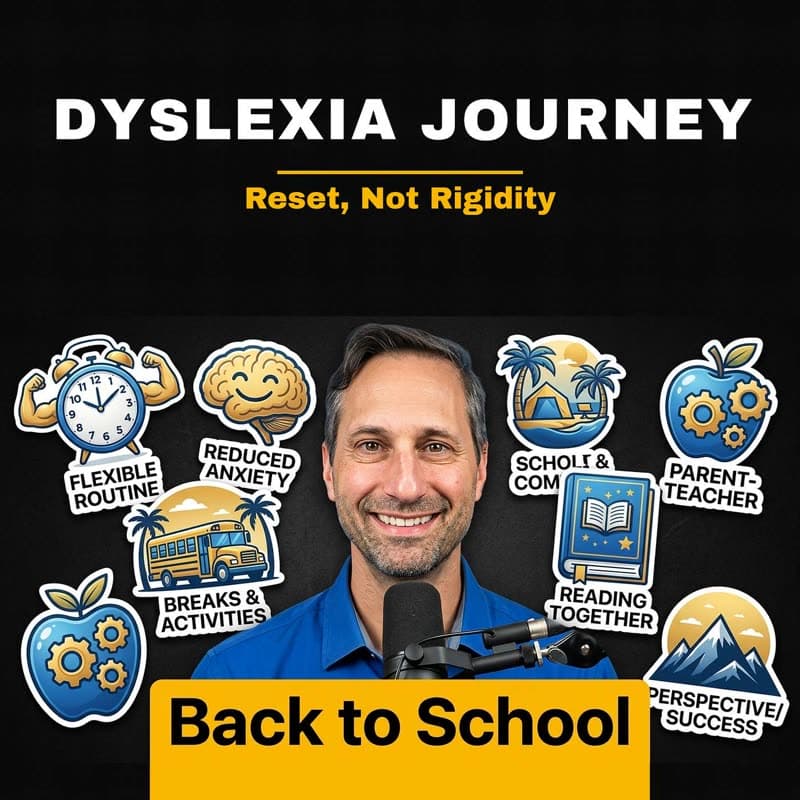
Back to School with Dyslexia: Reset, Not Rigidity
The first two weeks go great. Then, somewhere around week three, the crying starts, or the stomachaches, or the flat refusal to get in the car. If you've been through a back-to-school honeymoon followed by a hard crash, this episode is about setting things up so the crash doesn't take the whole year with it.
Never miss an episode
New episodes every two weeks. Follow wherever you listen.