
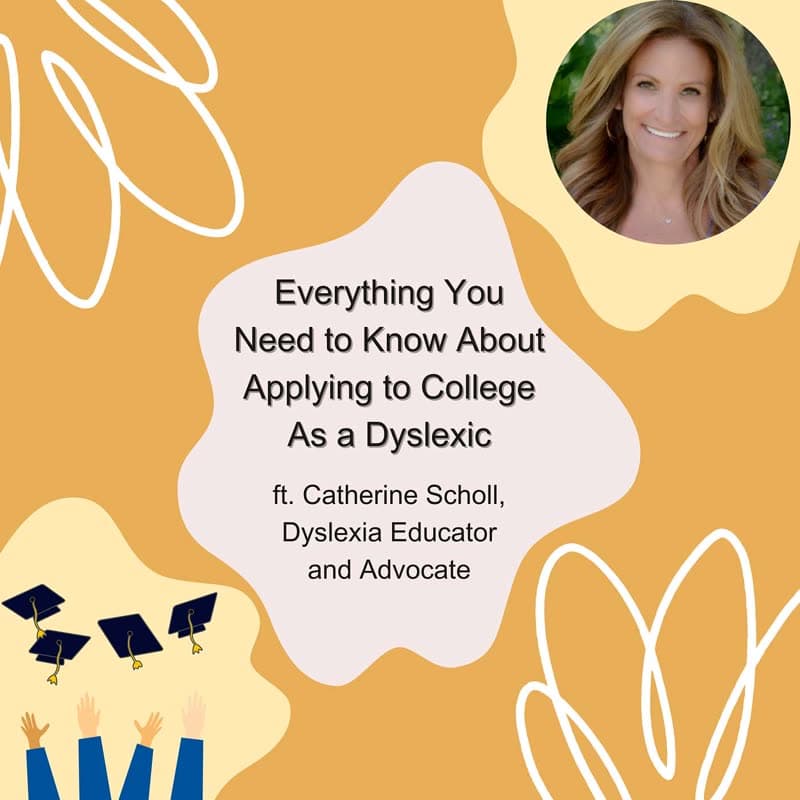
The Essential College Application Guide for Dyslexics ft. Catherine Scholl, Educator & Advocate
About this episode
If you are a dyslexic high school kid or the parent of a kid with dyslexia who is considering college, you need to listen to this interview! Chock-full of guidance about the college application process and the college selection process for dyslexic kids, this episode is essential viewing for anyone involved in the process!
Catherine Scholl brings a personal and professional perspective to educational advocacy, with extensive experience in Special Education, IEP, and 504 processes. She has worn many hats as a parent, special education teacher, and advocate, offering a well-rounded approach to helping families. Catherine holds a Bachelor's in Psychology and a Master’s in Education. She is also a certified Special Education Teacher and a certified Dyslexia Interventionist. She specializes in conducting academic evaluations and guiding families to ensure students receive the support they need for educational and personal success. Catherine is a member of COPAA and adheres to its Code of Ethics as a non-attorney advocate.
You can reach Catherine at https://www.righttoreadadvocacy.com/ or email her directly at cscholl@righttoreadadvocacy.com.
Transcript
Full transcript · 9,375 words · about 47 min to read. Press a timestamp to jump to that moment.
What schools, first of all, are test optional? So that kind of, you know, gives you a nice little bubble. Then from there, what schools are going to offer you or have really great disability centers or services? Because that's the other thing is that even if you get in test optional, you still need to succeed in your freshman year. There are colleges and universities that are more disability friendly. Hey, everyone. We are Sonja and Nick, and this is Dyslexia Journey. And today, we are happy to welcome Catherine Scholl to the show. Catherine Scholl brings a personal and professional perspective to educational advocacy with extensive experience in special education, IEP, and 504 processes.
She has worn many hats as a parent of children with learning disabilities, a special education teacher, and advocate, offering a well-rounded approach to helping families. Catherine holds a bachelor's in psychology and a master's in education. She is also a certified special education teacher and a certified dyslexia interventionist. She specializes in conducting academic evaluations and guiding families to ensure students receive the support they need for educational and personal success. Catherine is a member of COPA and adheres to its code of ethics as a non-attorney advocate.
Catherine, welcome to Dyslexia Journey. Good morning. Thank you so much for having me. So, we're so excited to talk to you right now about the journey through the college application process, you know, for a dyslexic kid and a dyslexic family. But we're also going to have another interview with you about your professional roles as a special education teacher and as an advocate. So, I just want to tease that a little bit. We'll have an upcoming interview also with Catherine about that.
So, let's dive in about college, though. The college application process, the whole thing. I think it can be overwhelming for anybody, but, you know, perhaps there's some nuances for a dyslexic kid and their family. So, let's start just personally with the present day for you. So, tell us about your dyslexic daughter today. Like, was she going to school? Was she studying? Can you just give us that little hint of where all this ended up, at least for the present day?
Sure. So, I have three daughters, and Ellie is my middle daughter. She is 18, and she just started her freshman year at Elon University, which is in North Carolina, which is way too far for me, because we're in Connecticut. She's in the nursing program there. And it was definitely a long and challenging journey to get her there. There were times throughout the journey that we did not think that she would be college-bound, and extremely proud that she is where she is.
Yeah, that's fantastic. So, we'd love to, yeah, let's dig in a little more into the whole journey, because I think it's helpful for people to sort of see that trajectory, too. Yeah. So, let's maybe go back to how your dyslexic journey began with her. At what age was she identified?
So, as parents of dyslexics know, sometimes that identification process is very gray. It's not black and white, unfortunately. And for us, there was a lot of hoops and challenges to get through to get her, what I say, classified in the traditional academic setting, which was very different than her diagnosis. So, starting from a very early age, you know, when she was having issues talking, I knew that there was something different about Ellie.
She had a really hard time with word retrieval, even as a little kid. And she had a lot of frustration. She was a late talker. And then, even then, after she started talking, she had a really hard time with silly nursery rhymes or rhyming words or word plays that we would do. And then, she started in preschool and, you know, really was not able to grasp the sound to cymbal with the alphabet.
She had a hard time even writing her name or recognizing the letters in her name. So, I knew from the very beginning of her, you know, what I call the academic career, that there was issues. And we, you know, we did, we worked really hard. I did everything that I, that I knew from my educational background on, you know, how to increase the, her learning the letters and the alphabet. And we would do nursery rhymes and all that fun stuff.
Then, when she started formal education at five in kindergarten, again, she was noticeably behind her peers. And even after stressing my concerns to the school and her teacher, this was the common response that I would get. She'll catch up. She's fine. She's going to be great. Some kids are just late bloomers. But, I knew in my heart of hearts as a mother that there was something going on. So, the, at that point, by first grade, I had started doing my own assessments for her.
And she, you know, it was uncovered that it was probably dyslexia. So, the medical diagnosis of dyslexia came there, but then trying to get school to recognize that in the academic classification setting and give her the strategies and tools that she needed to succeed in school did not happen until middle school. So, it was about five years later that we actually were able to get, and we still weren't able to get the word dyslexia written into her IEP or her 504.
They would just recognize that she had a specific learning disability. So, you know, through those years, I was doing interventions such as Orton-Gillingham instruction and tutoring for every subject that she, you know, wasn't grasping. And then the school finally recognized it. And at that point, it was a little too late for her social-emotional well-being because she had already figured out that she was different than her peers. And she already, you know, would call herself stupid and hated school.
So, we were seeing the school avoidance. We were seeing the anxiety. All of those things that come with undiagnosed or unclassified dyslexia in the school setting. So, I always like to tell, you know, parents that there is a very big difference between being diagnosed and being classified because the academic setting sees them very differently. Yeah. Yeah. That's really interesting. So, I'm curious as it went along then, like once she was classified, I mean, you said it was a bit too late for the socio-emotional, but I'm curious what the trajectory was then.
And did some of that, both in that way, like did some of the confidence come back then, you know, and was she able to use accommodations? And then how did that go, like as you get to high school and you get, you know, have to pick different classes and all of that? Yes. So, middle school is a whole different beast than elementary school because I feel like in elementary school, it's like a bubble for these kids, especially students that have special needs, right?
The teachers kind of just do it naturally. The accommodations come naturally for an elementary school teacher for the most part, right? If they see the kids struggling, they're going to let, they're going to give them space to themselves. They're going to give them the extra time. When you get to middle school, it's not like that because now you've got the executive functioning piece of the student needing to organize seven or eight different classes at once, right?
Where in elementary school, they weren't. So, even though she was technically classified dyslexic, trying to get her those services and the accommodations within each class and get buy-in from the staff at the school that she needed that, it was another uphill battle. So, we did a lot of work at home with, you know, the homeschool communication. You know, I was in constant contact with every teacher and then also trying to teach Ellie to advocate for herself.
And say, okay, because she was starting to, she was starting to realize how she was as a learner, right? They get to a point where they know it works. They know, okay, I do need the extra time or maybe I don't need the extra time for this class or maybe I do need a separate setting. Maybe I do need a graphic organizer. So, a lot of that education was happening at home to teach her what she needed as a learner and then go in and let the teacher know what she needed as a learner.
So, that, you know, that was a process. And I think the social emotional piece at middle school was a lot harder for her than elementary school because now she's mixed in with kids she's never met. You know, she came from an elementary school where she was with the same kids for six years. So, they kind of all, you know, they kind of all knew Ellie. They kind of knew, you know, that she wasn't going to be the kid to raise her hand in class, right?
And now she's in a different community where kids are cool. And I think at that point, the social emotional piece became even harder for her than the academic piece. And, you know, a long story short, the school that we were at was not giving her what she needed. And that social emotional piece kicked in hard. And we had to look at different options. We had to look at specialized schools. We had to look at, you know, moving to different areas where schools would give her what she needed without sending her to a private school.
So, I think the older she got, the more cognizant she became of her disability. And that actually increased the anxiety. So, we were working on the academic piece, right? We kind of felt like we were getting her to a place that she needed to be. But the other piece still wasn't being covered. And then you fast forward into high school where that comes with other issues because now kids start talking about taking AP courses, honors courses, college-bound or college-represented courses.
And now here's a kid who barely was making Bs in the regular classes and having to work, you know, three times harder than her typical peers to even get those grades. And so, then it becomes, you know, kind of trying to keep up with her peers because, of course, she wants to push herself. She wants to take honors. She wants to take APs. But she wasn't there yet. So, it becomes a whole other, you know, kind of bundle of challenges for her.
But with Ellie, I think because she had been dealing with it in three separate settings, elementary into middle into high school, she was able to figure out who she was as a learner. And we didn't see that until maybe 10th or 11th grade where she started verbalizing that she wanted to go to college. You know, and we had always said to her, you know, college isn't the end-all be-all. There are other avenues that you can take to get where you wanted to go.
And she knew from a time that she was very little, I want to say, you know, four years old, that she wanted to be a nurse. You know, and as parents, especially as an educator myself, knowing how hard the nursing track is, we didn't discourage her. But we also, you know, tried to be very realistic with her on the expectations of nursing. It's a lot of science and math, and it's a lot of organizational skills that you need to have.
And so she knew that by 10th, 11th grade, she, in her mind, knew that she would have to do other things outside of the academic setting to show that she had the passion and the ability to do this. So that's where we kind of come to this realization, okay, college is going to be put on the table now, and now what do we do? How do we get there? Wow, okay, that's interesting.
So I guess to follow up on just that piece, and then we'll dive more into the whole application journey, which is the rest of this interview. But you mentioned that she felt like she had to do some other things. So already in high school, does that mean, did that mean, like, volunteering, like, activities-wise? Was it that, like, she sought to strengthen her application, what would be her application in that way? Yes, because unfortunately she, like most dyslexic students, do not do very well on standardized tests.
And what we see a lot of times is in high school is we look at their courses and their grades, and we see that they have excellent grades for participation, for in-class assignments, for group work, right? Like, all of these things that we try and, like, foster for the kids, which is part of the organizational piece. And they're doing great, great, great, great in those pieces. But then all of a sudden, they take that first assessment, and we see the D or the C.
And, you know, unfortunately, the reality is that those big assessments count more towards their final grade than that participation, you know, the grasp of the content. And so that was Ellie's story as well, is that she knew the material, and she worked really hard to internalize the material. But then when she was assessed on it, she would bomb because whether it was the format of the testing, it was 100 short-answered questions, or it was a timed exam.
And so we knew that we, that college would be looking at standardized testing. They would be looking at either an SAT or an ACT. So starting from that point in 10th grade, we had her take a practice SAT and a practice ACT first to find out which test better suited her learning profile. And so once we found that out, then we were able to get her some tutoring in that specific test.
So it turned out that Ellie was better at taking the ACT than the SAT, right? It was just a different type of test for her, easier for her to take. She had the accommodations going in, so we did apply through the college board for extra time, separate setting, which was very helpful for her. And so we knew that the ACT was going to be the way to go. Now, with a lot of my families, I do recommend that if they aren't going into a major that requires a standardized test, I would not take it.
It's a very stressful process. But because Ellie knew she was going into nursing, all of the nursing programs that we were looking at required a minimum of a 23 on an ACT. So we knew that if she wanted to fulfill her lifelong dream of getting into nursing school, this was going to be what she had to do. It was a very, very stressful junior year trying to get to that point. But besides that, besides her just being looked at as a number, she knew that all of her classes, like we were talking about before, about how her grades were, you know, Bs.
And then if you dig, you know, and you would dig deeper and you would see that it was all of the standardized testing or the exams, that's where she bombed. So Ellie decided that she was going to become an EMT. So as a junior in high school, she registered for a national certified EMT, emergency medical technician course, which was very rigorous and time consuming. So she would go three nights a week.
I believe it was four hours a night. And then all day Saturday for 10 months. And it was grueling. But she did it. And she was amazing. And at the end, she had to take the national certification test. And because of her disability, she did qualify for accommodations through ADA, which was extra time. So the clinical piece, so part of the exam is that you have to go in and it's clinical.
You have a panel of people who are watching you. They give you scenarios and you have to go through the medical scenarios. She flew through that and, you know, 100% passed that. But now she has to sit through that standardized exam. She failed the first time, which was, you know, very tough. But then three months later, you know, we figured out where she was weak on and she studied and studied and she was able to pass it.
So that to the colleges, I think, showed her motivation and her determination. Even though she, you know, had the obstacle of having a learning disability, she found other ways to let herself shine and shine different than her typical peers that were applying to these nursing programs that were coming in with, you know, five APs and five honors courses. And the science and the science and the stat. So she did that. And then after she did, was certified, she continued to volunteer in our town as a volunteer EMT.
So she had a lot of really interesting stories to share during the interview process in college. So the whole point of it is that students with dyslexia or any kind of specific learning disability, if you know what your weaknesses are, let's not focus on that. Let's look at your strengths and hone in on that and really excel in something. And it doesn't always have to be something in the classroom, right? It can be other things.
We have, I have students that have decided to volunteer for the Special Olympics. And so they start in 10th grade and they volunteer many, many hours working with students that are, you know, participating in Special Olympics. They become coaches or mentors, mentor peers. So that's also another avenue. It's a lot of times we see the profile of a dyslexic learner explore other ways that they have strengths and other ways that they can give back to the community.
And I feel like that is really a great way to go to stand out in the college process, because if you're looking strictly at numbers, sometimes it's really tough to stand out. Yeah, yeah. And just a quick side note on the SAT, ACT, you started to get into this a bit, that sometimes you can go test optional. So it seems like you have to always look, but you can't just assume from year to year.
So, you know, for people, people, if they have an idea of some schools they're thinking of, should definitely keep on top of that. Because I've noticed, you know, it had been going more and more that way. And now people are pulling the test back in in a lot of schools. So, so, so, yeah. So, so for the, for that practical side that people often think about, just important to like be aware of what the possibilities are, if you can be test optional or not.
Yeah. So the, during COVID, the many schools went test optional. And for those students that were applying and were accepted during that time, even, even students who did well on tests would choose to go test optional. Now we're seeing the pendulum swing the other way. We're seeing that schools are saying that research shows that ACT and SAT are big indicators on success freshman and sophomore year in college. And so now, now we're back to that.
It really is a disservice to our, our dyslexic students, right. Who don't do well on those tests. But yes. So what we're seeing now in the last two years is that many of these schools that were test optional are no longer test optional. So my advice is always, you know, and it's really hard to ask a 10th grader, okay, where do you think you want to go to school, right. But by 11th grade, they usually are, they're starting to think, do I want to go to college, first of all.
Okay. Do I like the warm weather? Do I like the hot weather? So you start kind of like honing in on that list, right. With Ellie, we started honing in on that list and it was a little bit easier for her because she was nursing. So we knew right off the bat, we, she was going to go nursing. But for example, I had a student that I worked with through high school.
I was her dyslexic specialist for four years and, you know, she had severe dyslexia, severe anxiety on test taking. We knew that she was not going to be, she was college bound, but she was not going to be able to sit for an SAT or ACT. And if she did, she was probably not going to be able to turn those scores in. And we started working pretty early on coming up with a list.
What schools, first of all, are test optional? So that kind of, you know, gives you a nice little bubble. Then from there, what schools are going to offer you or have really great disability centers or services? Because that's the other thing is that even if you get in test optional, you still need to succeed in your freshman year. There are colleges and universities that are more disability friendly. And so compiling that list, right, and then thinking about what area of the country you want to look at.
So then you're kind of really, you know, carving out a list and then looking at those lists and seeing what courses are required freshman year, right? Some colleges require a foreign language and some don't. So if you have a dyslexic student that has been exempt from foreign language during high school, but then you're picking a school that they need a foreign language, We may want to rethink that, right? Or does a college have, a lot of colleges won't exempt that world language piece, but they may have a substitute for it.
So then we have to start digging deeper into what does that substitute course look like? So the 11th grade and 12th grade year of high school really is the planning stages for college if you have a college-bound kid. Now, I've also worked with students who get to that point and say, I don't think a four-year, you know, college is appropriate for me because I, you know, I need to find a test optional.
And then we start looking at technical colleges or two-year colleges where they have great success. And then from that two-year college, you know, preparing and getting organized and figuring out, you know, what college is all about and then moving into a four-year school. Because remember, if you're moving from a two-year to a four-year, you don't have to take the SAT or the ACT. So there's so many different nuances and it's, you know, it's hard to say to put it all into a box because it really is very different with every student that has dyslexia.
But there are so many resources out there nowadays to help those students and to help them onto the path if they're college-bound. Wow. A lot of, a lot of great advice there. Let's go through maybe kind of the rest of the application components. So we've covered the grades, the tests, and activities. There's also the essay. And so that is often, I think, a challenging aspect for dyslexic kids. What are your thoughts on that?
Yes, the essay. That is always the biggest stressor, at least from my experience with my own children and the students that I work with, they, a lot of times you see them procrastinating and they'll do everything else and then that essay is still sitting there, right? And the essay is super-duper important. It is. I'm not going to, like, you know, like sugarcoat it. It's extremely important. A lot of colleges now will say that they are doing the, what they call the whole student process where, you know, they'll tell you that we're not just looking at the SAT.
We're not just looking at sports. We're not, you know, we are literally doing, we're looking at the whole student. So, and, but again, it goes down to what your college list is because the larger state schools or the, you know, the larger schools, if they're, you know, if they have 35,000 students that go to their school and they're looking at 18,000 applicants for a freshman class, guess what? They're probably not reading every essay, right?
So that's where that, the rest of the application process comes in. So they start weeding out first by, you know, maybe class ranking and then rigor of schedule. And then they go down to activities, right? Are you a three-sport athlete? Or, you know, are you, do you have the community service? Are you on student council, right? So that's like kind of the bigger schools. But if you're looking at a smaller school, that essay really does become important because they really do read them, you know, working with college counselors.
And these are the questions I ask. What are you looking at first? When you get an application, what's the first thing you look at, right? And that, remember, all of these applications are coming in digitally. So it's a lot easier to drill down, to come down with a manageable pile. The smaller schools are, they're looking at those essays and they're reading them. So back to the essay and the student and what does that look like senior year?
Usually you start working on that essay middle of junior year, you know, May, June of junior year. And because you want to have your applications complete by August, that's usually my advice is to kind of have all of that done in a nice little, you know, buttoned up box. I, my advice always with the essay is let the student just free write, right? You first have them free write, you know, sit down in a comfortable room and just write.
Like, I like to give like starters, like looking back at the last four years, you know, what am I most proud of? Okay. Have them free write about that. Next, what were my biggest challenges? And then you just have them, you know, sit on it for a little while, then go back and reread it. The, the most successful essays that I've, that I've written and that I've had students write are the ones that come from the heart that really are, content driven from them.
college counselors can tell immediately if they've been written by somebody else or if they are, you know, one of those, you know, generated, essays from a college counselor. and nowadays we see more and more students using college counselors, but those authentic from the heart pieces are the best. Now, I'm not saying that those pieces come back, ready to be sent to a college, right? Because we know that dyslexic learners have a really hard time.
Some of them have a hard time organizing the thoughts after the free write process, right? So it comes back to just maybe like one run on sentence, but the content is there. You know, anybody who is trying to get a feel for the student will get it from that piece. Now the hard work begins of helping them edit it, helping them put it into paragraphs, helping them pull out the important parts.
And that is really the process that comes next. And that does take a lot of help from, either a parent or a teacher, an English teacher, a special ed case manager, somebody who's going to read it and say without butchering the kid's words, right? Because we still want to maintain that, that heart. you know, and for example, my daughter's essay, she, it took her months of drafts and drafts and ideas, she knew what she wanted to say, but getting it into a, short, concise, because remember the essay on the common essay, I think it is 600 words.
Imagine trying to like put in your four year or your, you know, your whole life story into 600 words, she decided to write on something very, dear to her, her passion of becoming a nurse and how she knew she had obstacles in front of her to get there because nursing programs are extremely hard to get into. And she talked about how she knew she had to do different things and just get good grades.
And she talked about the EMT and she talked about a one moment that she was on the ambulance that she realized that this was the right choice for her. And she was going to do anything that it took to get there. So she could help people. And her whole thing was like, I've been helped my whole life by other people. And now I want to give back. And I think that message resonated, with, with the college admissions counselors, because so many of them talked to us about her essay and talk to us about how they were so impressed by her essay.
So I think that, even though it's an important piece of the, it is an important piece of the process, you have to do it in baby steps and it's not something that's just going to be written in one sitting. It really has to be thoughtful and it takes a village, you know, so, to get that done. Yeah. As a follow on to that, because, you know, she was speaking of her challenges in that essay.
so that's one form of disclosure. And I think sometimes, you know, cause usually there's at least some sort of report from the counselor as well. It's often probably going to come through, about being dyslexic. But what would you say to someone who's unsure about disclosing? That question comes up a lot, not necessarily from the student, but from the parent, right? Because there is still a stigma around, do I disclose that my child has a disability?
Is that going to inhibit them from wanting to accept my child? Because this child is going to come with the need for accommodations, right? The need for extra help. And what I have found in the last, especially since COVID, I'd say in the last five years is that colleges now are really embracing these students. They are really recognizing that they have so much to offer, right? There is, there, there isn't a stigma.
And we know that dyslexia is, these kids aren't, you know, and I hate to use this word, but this is what my daughter always says. Like, they're not stupid, right? They're, they cognitively are capable. And, you know, you know, to quote somebody else, like dyslexia is their superpower, right? As long as we can help these students, like figure out, you know, how to access that superpower, they are amazing assets to the community.
They are amazing assets to the college community, to whatever program they're in. So my advice is, listen, at the end of the day, you have to do what you're comfortable with. Some parents really don't want that stigma. And, you know, it's heartbreaking because you, you want, you want the students to embrace their dyslexia. But it has to come, it has to really be the child's decision. With LE, and to go back for a second, there is no space on the application that says, check off if you're dyslexic, right?
There's no space that you even can disclose a disability because there are laws against that. So it really is a choice of the student to disclose in other ways, right? When we send our transcripts to colleges, it cannot list that they had a 504 or an IEP. So the college has no idea just looking at that transcript. If that child, they don't even know if they had accommodations for an SAT or an ACT.
So that's first off. So if a child wants to go into the college application process, not disclosing at all, there, you don't have to. There are ways, there are creative ways, right? That we can disclose it without screaming, I'm dyslexic. So those ways typically come out in that essay. It typically comes out in maybe some of the clubs that they've been involved in and some of the activities that they do. And also, my daughter did have quite a few interviews.
And so in the interview process, you know, I remember one of the admissions counselors asked her, I noticed that you didn't take any AP or honors classes and that you, you know, your grades were basically a B. Why do you think that we should accept you into the nursing program? You know, how do you know you're going to be able to handle this? And her answer was because I'm motivated and determined to do it.
And, you know, I do have a learning disability that, you know, that makes me have to work harder, but I am willing to work hard and I am willing to put the hours in. And so she kind of talked about it from that aspect, that she, it has actually made her so self-aware of her weaknesses and strengths, which actually is a strength, right? When you can, when you can identify as a learner, how you learn best, there are a lot of kids, you know, I haven't, I have a, my older daughter who is, you know, a high achiever.
But if I ask her, like, how do you, what works best for you when you study? Like when she went to college, she was like, oh my goodness, like I have this huge stat test and I don't even, it's so much information. She had no idea how to, how to, to, to like go at it. My dyslexic daughter right away was like, oh my goodness, I'm breaking it down. I'm breaking down my vocabulary on this side.
I'm breaking down the terms on this side. I'm studying them in isolation and then I'm putting them together because that's what she was taught as a dyslexic learner. So she went into this interview saying like, these are the tools and strategies that I use that are going to be helpful so I can be successful. Yeah, that's so important. That's so important. So did I answer your question? I'm like, that is absolutely, yeah.
Great tip, yes. Great advice. I mean, yeah, really good advice. So I guess continuing with the components of the college application, the teacher recommendations I think are often a struggle for dyslexic kids because they may not have been like the best student in any of their classes. They may not feel like they have a sort of, you know, teacher who really, is going to, like, it's sort of unsure how the teachers are going to think of them, right?
So how do you recommend approaching that? I actually see it as a positive because the students most of the times are great self-advocates. And when you're a self-advocate, that means that when you're struggling, you're going to the teacher. And this is all part of, like, what we, you know, we really work with with students starting in middle school is how to self-advocate and how to know who and how they are as a learner.
And so in my experience, that really fosters amazing relationships with their teachers, right? Because they're going to them and they're saying, listen, I'm having issues. Can you help me? And, you know, teachers are human and they recognize that and they love to help. From my experience, most of the time in a high school level, the relationship that a student and a teacher has is more of a collaborative experience with a child that has an IEP.
Because first of all, the teacher is bound by the IEP, which is a legal document, right? To follow what's in the IEP. And second of all, they want to see these kids succeed. So what I have seen in my personal experience as a teacher and a parent is that they have students with dyslexia or learning disabilities have tighter, closer relationships with their teachers. I'm not saying with all of them, because there are some teachers that are like, you know, they will fight you tooth and nail to give extra time because they don't think it's fair.
That's a whole nother story. But those teachers that embrace it, you know, my daughter had at least five teachers that she could ask for recommendations for. And she did. She asked for them for different places in the process, right? Because then, you know, moving on to scholarships, you're going to need recommendations for scholarships. So different teachers will fulfill different parts of those recommendations. So my advice would be use your case manager and special education to foster relationships with your core teachers, right?
So if you know you're going to go into engineering, make sure that you are emailing your teacher a lot, talking to your teacher before class, after class, making your name known and your face known and allowing them to help you access the curriculum, right? And those relationships will grow. And I see it, those recommendation parts, you know, again, it's daunting, right? For some kids, it's daunting to go and say to a teacher, you know, can you write about me?
And then wondering what they're writing about you, right? But I think that if you start the relationship process from the beginning of the year, it's going to be a no-brainer by the end of the year. And the other point, too, is that a lot of teachers, how do I say this? There are a handful of teachers in each school that get asked by all of the kids for recommendations, right? There's always those favorites.
And those teachers will get, you know, every year about $100. requests for recommendations. A teacher can't write 100 recommendations because then it saturates the recommendation, first of all, right? So my advice is always to think outside the box when asking for a recommendation. Make sure that it's within your, if you have a major, it's within your major. And then also ask early. So if you ask in the beginning of your junior year, right, because we're sending the applications in the beginning of senior year, you're kind of planting the seed for that teacher.
You're putting it in writing. You always put everything in writing that you, you know, go back and forth with your teacher. Beginning of the school year, maybe October. I'm really enjoying your class. I feel like we have a connection. You know, thinking ahead, because I am really excited about college.
I'm wondering if you would be willing to write a recommendation for me when the time comes. And just kind of planting the seed, right? You're kind of like thinking about it. So that way, when April comes and your college counselor is saying, okay, where are your recommendations? You've already, you've already planted that seed with two or three instructors, with two or three teachers. And then, and then they know, the teacher knows.
So now they're thinking, you know, a lot of teachers will then start jotting notes down. Like, this is what I saw in November. This is what I saw in February. She was struggling and she came to me, right? These are all things that will go into an authentic recommendation. And colleges know right off the bat, just like they did with the essay. They know if that recommendation is a form letter. They will know because they will, they will immediately recognize if this teacher has a one-on-one relationship with the student.
Yeah. Yeah, that's really important. I think we've covered all the parts of the application now, I think. We did them a little out of order, but that was perfect for the flow of the conversation. Looping back, because you already told us quite a bit about factors to consider in choosing a college. And even, like, really stepwise process, I thought that was wonderful. I want to pick back up on something you said, though.
So how does one know? How would you go about knowing that piece about how good a college is with accommodations? And is it different between even just, like, public versus private? Or what's your experience then with that? Oh, goodness.
It's a process. It's really about doing your research. It's about reaching out to somebody who is experienced with the process. Because the process for a student with dyslexia may look very different for a student who is a typical learner. There are, and I've interviewed a hundred colleges, you know, from my own child, and then also for the students that I work with, about, okay, they may say on their website, we have disability services.
Okay, but what does that look like? Does it include a free writing center? Free. Or, I shouldn't say free. Included in tuition. Right? There are some colleges that they will advertise that they have a disability services, but then you have to pay extra for it. There's one college in particular that has an amazing program. It's a private college. Amazing disability service program. And I wish every kid could go there that had dyslexia.
But guess what? It's $15,000 extra over the tuition cost. Wow. So parents have to be aware of that, right? A lot of parents can barely pay the tuition without having to pay because your child has a disability. I think that is not fair. You want to look for disability services that will offer, that will evaluate your academic plan from high school and immediately take those accommodations, right? And that's also a process.
So that process is you reach out to the counselor, disability counselor, because they have their own office and they have their own people that run it. You reach out to them and say, this is what my child receives right now. How likely is it that my child is going to get it in your school? And what does that look like? So, you know, for example, with my daughter, we narrowed it down to 15 schools that the disability services offered, free writing center, free literacy center.
They offered peer-to-peer tutoring, you know, free as well. So she could literally, and she's utilizing it now in college as a freshman because she's, you know, she's struggling. So those, those places, if you are struggling, you immediately go to the service and they will match you with a tutor, right? So you want to, you want to do your homework starting when you're doing your college visits. When you're out there doing, you know, traveling to all these colleges in sophomore and junior year, you're, you're, one of your main stops is going to be to the disability services office.
You're going to have a list of questions that you're going to ask and, you know, and, and don't be afraid or embarrassed. I mean, your student probably will be, my daughter was mortified when I went in there with my list. and really just don't be afraid because this is, this is going to be the make or break of success for these students in college and getting them used to going to the center and then, you know, having that counselor again, forming that relationship with the counselor, the disabilities counselor, who immediately you can send an email.
I just failed my bio test. Now, what, how can you help me? And these are one of the questions that I asked the counselors, even before we picked a school, I would give them the scenario. Okay. My child is there a month. She's failing bio. What does she do? What does that look like to you? What does that look like for her? and, you know, giving them those real life scenarios and seeing their answers.
And you'll be able to figure out pretty quickly, if it's just smoke and mirrors or if they really are dedicated to helping those students. And there are, amazing schools out there. I know Villanova university. I'm not sure if you're familiar with Villanova university. It's a, you know, a very strong academic school. They just started a whole program for dis for students with disabilities. and those types of programs are growing. They're growing Syracuse has one Villanova has one.
and even a lot of the larger state schools, UConn has an amazing disability center for free. They offer peer tutoring writing center. So if your student has to write a, you know, a paper for English one-on-one, you know, second month of college. And there I'm going, oh my goodness, I have to cite, I have to do a citation page. And I have no idea how to do a citation page. Right. because I didn't take an AP course or an honors class.
They go right to the writing center and they get help and it's free and it's amazing. but some colleges don't offer that as easily. And they feel that if you're here now, you know, it's all up to you to get the help or where they have to pay for tutoring. So the disability services is, is, a huge factor when deciding on a college. Yeah, that is, that is very helpful. I really, I, I think this is going to be so useful for all those, parents out there.
I want to pick up on one thing you, you alluded to, which is the, paying for college aspect. So, as we all know, it's, it is daunting to think about how to pay for college. what, what advice do you have for, for dyslexic kids in, specifically looking for scholarships? Are there scholarships out there that are specific to dyslexic kids or people with learning disabilities? Yes, there are a lot of opportunities for scholarships.
And, just like the disability centers that are growing now across the country because they're seeing the need for them. remember one in five students has dyslexia. Now it doesn't mean that one in five is, diagnosed or classified, but we are seeing such an influx of students that have special needs and they need unique plans. And so colleges are realizing that they're recognizing that and they are planning for it. It is the same thing with the scholarships, right?
And from my experience, the scholarships are typically, they typically come from families who have, who have had students that have had challenges with dyslexia. Or, a lot of them are kind of combined. I, I, what I've seen is a lot of scholarships that are ADHD slash dyslexia. And, the way to find those again is through research, or going to your special education teacher at school. A lot of times they've had experience with the scholarships, the school counselor.
if you are working with a college, a private college counselor, which a lot of the students are now, the private, college counselor will hopefully have a list of scholarships that you can apply to. me personally with my daughter, it was literally a lot of hours at night when everyone was sleeping online and, researching them. We, there is one, I think I can mention it. It's the, Morelli scholarship. And, my daughter did apply for that and she did, get it, which was amazing.
And that scholarship is a national scholarship for dyslexic learners that are going into a STEM field. So, you know, you will see a lot of them are, like niche, right? They're for kids who are either going into engineering or English or, or whatnot. The scholarships also come with, an application process. So you will have to write an essay for most of them, the ones that she did, and the other students that I've worked with.
There will be an essay piece. A lot of times there's an interview process. the other thing to look at besides the outside scholarships is looking at for inside scholarships within your own, the college that you choose to go to. So once you have been accepted, yay, and you're on your road, you know, you're on your way to going to that school, you want to start looking internally at the scholarships that they have.
they have fellowships. Colleges will all have fellowships that they offer. A fellowship, what that will come with is, is a nice, amount of money, right? So they'll say, if you get this fellowship, we will give you $15,000 a year, right? That's like, you know, it could be $10,000, it could be $15,000, whatever it is, depending on the, on the school. And that fellowship, the one, you know, my daughter did apply for a fellowship.
She did get it. That also includes extra resources for her. So she has a, through the fellowship, she has a, a professor that she works one-on-one with in doing research. So through that research, she's now forming a really great relationship with that professor that she will be with for four years. She gets extra money. She gets to do research. She gets to do, and it's a cohort. So you start with your fellowship.
She, I think there's 20 fellows in her year and they all, they all move together every year in this fellowship program. So it's another layer of, you know, being part of a community, having, support in that community. And then it's also another financial incentive, but it's a process. Again, you have to interview, you have to, you, you have to be willing to put in the extra steps to get these scholarships. and then also look towards your high school.
Every high school, in my experience will start advertising local community scholarships about January, February. And, there's so many of them. Like my daughter applied for the, the EMT one, our local EMT. And those scholarships tend to be a little bit smaller. but it all, adds up and it's all, you know, very helpful. So I would, I would say to these students, look to clubs. A lot of the clubs in high school will offer, scholarships.
Like if you have a lion's club in your town or you have, you know, if you do community service at the library or you are in a sport, a lot of sports boosters clubs will offer scholarships. So, there are lots of different ways for my daughter. she applied to a lot of scholarships that were, like women, in fellowship or women leadership, national scholarships that look for women who are making change in their community that have overcome challenges and obstacles.
So, so for her, it was with the dyslexia. She had to overcome a lot of challenges, but still was able to be successful and get into college. So, there are a lot of opportunities. You just have to like know where to look. you have to know what questions to ask. And, you know, podcasts like this help, right? Like these, like this, getting the information out to the parents because parents might be saying, oh, this sounds so great, but how do I know what questions to ask?
Where do I know where to look? Right. so it's so nice that you're offering this information to parents because it is so important because there's so many parents that get to finally get to high school and say, now what, how am I helping my child? Because they've been working for years, right? Getting them, getting them thus far. And now it's like college is a huge beast and it's overwhelming. Yeah, no, that's such great advice.
And I think just to open people's minds to all those different places and even that there's some dyslexia specific ones. so we can perhaps put, you know, some links that we find below as well. But I think a key point too, is just to really look widely, also because sometimes just one list doesn't have everything there. so that's great advice. well, and speaking of resources, we're going to make sure to put your information in the description box as well.
And like I said, in the next interview, we're going to talk about much more about what you offer in your professional journey, you know, special education and also being an advocate. but if you could just tell us briefly here, here already what you offer and your information. and then if you want to leave us just maybe with a top tip that you have for this process. So I love, I love working with high school, college students.
I just, you know, I think cause I've been through the whole process with my daughter starting from childbirth and then getting her into college. It's, it's such a transformation and it's so amazing to see them, you know, succeed. so I do a lot of, coaching, I like to call it coaching, but it, advocacy. So if a parent, a family is having, a hard time finding those connections, finding the services that their children need to succeed in school, that's where I come in.
and my philosophy is to coach more than advocate because I feel if I coach and I give the parents and the students the tools so they can do, so they can advocate on their own. And then they don't need me anymore, right? That's my goal, right? I'm so happy when we're like done. I mean, I, I miss them, but then I'm happy because now I know that they have the tools to speak for their own selves instead of me.
So, I do that. I do the coaching or from, you know, preschool all the way through college. I also do literacy evaluations. So if a, you know, a student, parents have an evaluation from a school that they don't agree with and they need an outside evaluation, I, I also do those. but I really do, enjoy working with the, the kids with dyslexia and helping them find a path to be successful. And so I am, with, right to read advocacy and you can reach me at, C Scholl at right to read advocacy.com.
or you can call me directly anytime for a consult to see if I can, you know, if we're a good fit with your needs. And my, and one tip, my, my, my number one tip always to parents is early intervention. If you feel, and as parents, you know, you, you feel it in your heart that there's something wrong. You see that red flag. Don't let somebody tell you that you're wrong. Early intervention, fight, fight, fight, never take no for an answer because the earlier we, we get these kiddos intervention and remediation, the more successful at an earlier age they're going to be.
And it avoids all of those other emotional issues that we see by the time they hit fifth grade. so early intervention, key, key, key, trust your instincts as a parent. Thank you so much. That's wonderful advice that we definitely agree with. and we look very much forward to our next interview with you as well. Thank you. Thank you.
More from the show
Learn to Love Listening ft. Cliff Weitzman, Dyslexic Founder and CEO of Speechify
In this installment of our Dyslexic Voices series, Cliff Weitzman, founder and CEO of Speechify (https://speechify.com/), tells us about his experiences growing up dyslexic, and shares his advice for how to succeed as a dyslexic child and adult.

The Definition of Dyslexia Changed: Here's What It Means for Your Family
For the first time since 2002, the International Dyslexia Association has rewritten its definition of dyslexia. The new version quietly removes two ideas that have kept kids from being identified for two decades: that dyslexia has to be 'unexpected' given a child's intelligence, and that a phonological deficit is…
"Everyone Else Can Read" Ft. Parent Fiona Rintoul
Fiona Rintoul, fellow parent of a dyslexic daughter, joins us to discuss her experiences. You can find Fiona online at https://purplecowrecruiting.com/.
Never miss an episode
New episodes every two weeks. Follow wherever you listen.