
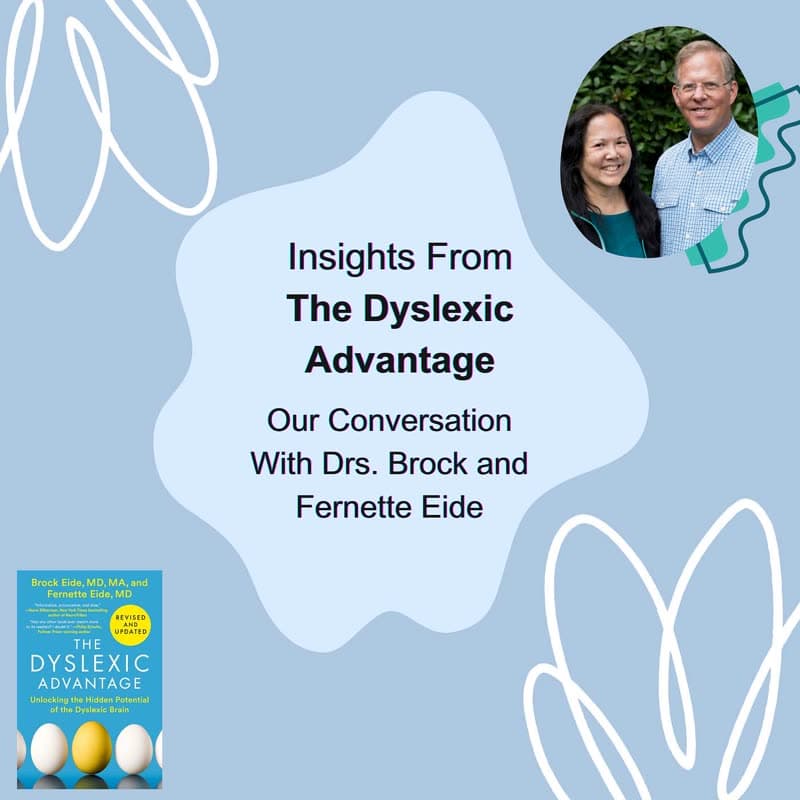
They Changed How We See Dyslexia! Ft. Drs. Brock and Fernette Eide
About this episode
Drs. Brock and Fernette Eide are the authors of the bestselling book, "The Dyslexic Advantage": https://www.amazon.com/dp/0593472233/
You can watch their new movie, also called "The Dyslexic Advantage" here: https://www.dyslexicadvantage.org/
You can find their dyslexia screener here: https://neurolearning.com/
Transcript
Full transcript · 9,068 words · about 45 min to read. Press a timestamp to jump to that moment.
Genetically, dyslexia has been linked to at least 40 different genes, 40 plus genes at this point, and what we see clinically, you know, we have a screening test that looks at four different really basic factors and then several different factors in terms of outcome performance, and we get multiple patterns with that. We get at least 15 clear different patterns, and about seven of those account for 90 plus percent of the people that we see with dyslexia, but it is a spectrum. It's not just a tight cluster, and so every person with dyslexia is completely unique.
It got me diagnosed when I was in third grade, and it was the most relieving day of my life, because I finally had, like, kind of a place to hang my hat and say, see, I told you, I'm not lazy, definitely not stupid. I just learned differently, like, that's totally okay. We dyslexics, we were often, you know, just set up for failure, because, you know, we were given books and tasks that really are not appropriate for the level that we were at.
So, how do you expect anyone to be open to learning when their entire relationship with reading, with learning, is physical pain? I wish I had understood when I was younger that the fact that my brain worked differently than people meant that I would be good at things in ways that other kids were not going to be good at. I just assumed, I can't be dyslexic, because letters don't jump up and down for me.
Dyslexia is not a disorder. It is not a disease. Once you sort of own it and embrace it, then you can have the power to deal with it. It's sort of empowering and also enriching to the whole community. To those who don't understand what dyslexia is, that it's not a negative, it's not a problem, it's, like we keep saying, superpower.
Hey, everyone. We are Sonja and Nick, and this is Dyslexia Journey. And today we are very excited to have the authors of The Dyslexic Advantage on our show. So, Drs. Brock and Prunette Eide are leading experts in the field of dyslexia and co-founders of the nonprofit Dyslexic Advantage and the social purpose corporation NeuroLearning.com. They have served as consultants to the President's Council on Bioethics and is visiting lectures at the Stanford Graduate School of Education.
The first edition of their book, The Dyslexic Advantage, was an international bestseller. And for those of you who are watching the video, here's the book. So, Dr. Brock and Prunette Eide, welcome to the show. Thanks very much for having us. So, we thought we'd start, and we may get into, you know, some more details as we move along here, but we thought we'd start with sort of like a really big overview.
So, I'm wondering what your definition is of dyslexia, and then what is the dyslexic advantage? So, we usually think of dyslexia, you know, in a little bit different terms than the, for example, the IDA definition, which really has been focused in on the learning deficit. And we see dyslexia as a broad neurological difference in processing that includes both challenges and strengths. And the fundamental process that's involved, we think at this point, is a difference in acquiring automaticity, a difference in the ability to process repetitive patterns the same way every time, that leads to more reliance on conscious processing rather than automatization.
For example, in areas like basic skills, doing your phonics, doing your math times tables, doing a lot of repetitive things that become automatic over time with practice. What we see, you know, on a research basis is that dyslexic people tend to be a little slower to acquire automaticity in those kind of skills. As a result, a lot of things that are done below the level of conscious processing in most people get pushed up into conscious strategic problem-solving type modes.
This has disadvantage for some kinds of tasks, like things that you're supposed to do the same way every time, do them very quickly, do them without thinking about them. It's disadvantageous to have to kind of think your way through that. But as a result of pushing all of that into conscious processing and especially into using forms of memory that are based on experience, episodic memory or personal memory, there are secondary benefits in terms of creativity.
And there's a deep research literature on creativity that shows that the more that you use this kind of personal memory, the more creative you become. And that's what we think is responsible in dyslexia for this dual nature that we see, challenges with a flip side of strengths. And as some people have said, it's why for people with dyslexia, a lot of times it looks like easy things are hard and hard things are easy.
Yeah, that sounds very familiar. Yeah. So I guess let's dive a little deeper into the dyslexic advantage. So your book is really nicely organized in the way that you've categorized the advantages of dyslexia into four categories, which you call the mind strengths. Could you tell us a little bit more about that? Well, so the acronym, so it stands for material reasoning, interconnected reasoning, narrative reasoning, dynamic reasoning. And initially when we discovered these, we were interested because, you know, historically, and I'm a neurologist, historically, as you might know, Samuel Orton was a neurologist who first began a detailed characterization of dyslexia.
And then over this past century, he actually looked at all kinds of cognitive differences. It was early at that time, but he was actually a very good clinical person in terms of looking at different types of, you know, features, different strengths. He recognized certain superiorities that dyslexic students had compared to non-dyslexic students, for instance. And then over the century, it got really narrowed. It was, you were saying, 1980s, is that right?
1980s, it really began focusing on phonological weaknesses. And so it's, you know, there's a historical kind of change that comes with it. So we were very interested when we wanted to approach comprehensive testing of dyslexic children and adults to see what were these broader kind of profiles. And with detailed serving of our community of over 12,000 people, dyslexics and non-dyslexics, trying to identify the phenotype, we identified these kind of four mind strengths.
Do you want to talk more about that or? Yeah. I mean, do you want us to just kind of list them quickly? Yeah, I think it'd be really helpful to go through them and kind of talk about the features of each of them. Okay. Just very briefly, M-strength stands for material reasoning. And it's basically reasoning about objects in the material universe. So shape, movement, just features in three-dimensional space. I-strength stands for interconnected reasoning.
And that can be thought of generally as thinking about conceptual connections and relationships, but includes things like a preference for seeing big picture as opposed to fine details. So seeing forests instead of trees. And also seeing how things work together to form systems. M-strength stands for narrative reasoning. And that's basically a preference for reasoning, using stories, cases, examples, simulations in the mind of things happening as opposed to using abstractions, to using principles, definitions, formulas, or things like that.
So playing things out in the mind. D-strength is kind of an extension of M-strength. So it's using mental simulations, but it's to make predictions about processes that exist in the real world. So in strength, you can simulate things that are real, things that are imaginative. D-strength, you're really focusing that down and saying, if I simulate a process that takes place in the real world, and I run that forward through time, either into the future or backwards into the past, what will things be like, what must things have been like, if this process takes place over time.
And so it's basically this kind of predictive ability. Yeah. And so in your book, you also, well, you go into much more detail, of course, with examples and diving into each of these. And then, but you do discuss trade-offs, as you call them, with each kind, too. I was wondering if perhaps you could just give one example of sort of like a way it might look where it's the advantage and then a trade-off.
Yeah. I think one of the, on the surveys that Fred mentioned that we did with people, we showed that there was a direct inverse correlation between three-dimensional spatial ability and also a tendency to feel like people had difficulty putting their ideas into words. So a tendency to mentally simulate space was kind of inversely correlated with a tendency to think and reason using words. And there was actually some really interesting research that looked at just a few cases, a family cluster, and then also Albert Einstein's brain in a vat at Princeton University, that showed that people that tended to have very strong spatial ability, in some cases, also had a very different allocation of cortical space in parts of the brain between two more visual and spatial areas.
And those were directly kind of taken from language processing areas. So there are reasons to believe both kind of structurally and also just in terms of empirical observation of people with spatial ability, that there is this kind of trade-off between spatial strengths and kind of linguistic fluency. Yeah, and just to be clear, the visual-spatial reasoning, like we often have observed in dyslexic people, that when we say they have strong visual-spatial reasoning, that is in the M category, the material reasoning, right?
Well, it can be used in any of the categories. For example, if you're replaying... Like visualization, for instance, as opposed to, right? Yeah, well, it can be used to imagine a story. It can be used to sort of simulate any kind of thing. We would say it's really part of the simulation system. We also talk in the book about, you know, not too completely clustering visual and spatial simulation, because there are a lot of people that simulate well spatially that don't visualize well.
If you have both good visualization abilities in the sense of seeing clear pictures plus spatial reasoning ability, then you can have very clear movies kind of playing out in your head. But there are a lot of spatial people that reason well spatially that see in their mind kind of ghostly images or a sense of movement or where things are out of position, rather than clear pictures. So visual clarity, which is kind of, you know, something that takes place in the back of the brain, and the spatial matrix, which is more of a hippocampal, perihippocampal thing, kind of deep in the brain.
Those are two things that can work together, but they can also work separately. Yeah, and I would say that sometimes, you know, when, if there is a transit, it's not that you, I mean, it's as far as we know that you're born with this outstanding strength. Sometimes there's this talent and then a person who is building all the time as a kid and then as a teen and then as an adult, right, they develop their spatial imagery even more, and that might have been based on actually physical experiences.
So it does, it kind of merges, and then later on, those are the people who are running these experiments in their heads. So it might have started with a lot of physical materials and then translated into this kind of kinesthetic, you know, memory and projection. Yeah, that's really interesting. Yeah. A good distinction, too. Yeah, because I had been thinking of them as pretty interlinked, yeah. One thing I wanted to mention is that you also emphasize that none of this is binary.
So there are spectrums, and you emphasize that it's multiple different spectrums. So there could be a dyslexic person who is very strong in material reasoning, but not as strong in narrative reasoning, for example. Yeah, absolutely. Yeah, we're really not dealing with a condition at all that's, you know, produced by a single gene, like, you know, a sickle cell anemia or something like that. We're really talking about a syndrome with multiple different contributing factors to it.
You know, genetically, dyslexia has been linked to at least 40 different genes, 40-plus genes at this point. And what we see clinically, you know, we have a screening test that looks at four different really basic factors and then several different factors in terms of outcome performance. And we get multiple patterns with that. We get at least 15 clear different patterns, and about seven of those account for 90-plus percent of the people that we see with dyslexia.
And then, you know, it is a spectrum. It's not just a tight cluster. And so every person with dyslexia is completely unique. And, you know, in the book, we talk about a discussion that we had with a really brilliant guy named Manuel Casanova, who's boarded in three separate medical disciplines. He's a super brilliant guy. And he used the example of, you know, modularity, of, like, taking electronic components and plugging them together with different ones, you know, like one of those electrical sets that you can get as a kid.
And how different you can get when you plug a power source into multiple different kinds of electrical devices. And that's pretty much what we see with dyslexia. When we talk about dyslexia, we're really thinking about kind of that central power source, that central set of characteristics. But the manifestations can be really different depending on what you plug it in with in other parts of the brain. Going back to the trade-offs just for a moment, I noticed something that made me curious about distinguishing dyslexia and ADHD specifically, you know, more of a dyslexic brain versus an ADHD or brain.
And, yeah, it was just simply when I was reading a couple of the trade-offs, it reminded, you know, it was kind of like, I can't remember the exact example, but someone would be, let's say, writing an essay. And then the focus would stay in a way, you know, that wasn't desired by the teacher. And so just kind of that sense of the focus or the way the reasoning takes going a certain direction or another or perhaps getting sidetracked is how it would be looked at, right?
So, yeah, it made me curious about, like, whether someone like that would get diagnosed with ADHD. And then also, yeah, so I was just, it made me curious, I think, more generally, though, like, are there some, like, overlap? Is there some overlap here or how do you see that? Is there a lot of mistakes out there? Yeah, there's a high degree of overlap. And, in fact, so in our new movie that got released this month, The Dyslexic Advantage, we actually talk about that with John Euron Laws or Jack Laws.
Because early on, he was seen as very distractible in the classroom, but actually his, his, he actually had a lot of sensory awareness. It's true. But once he went out in nature, it really, it was environmental. It actually was his strength. He would notice a lot of things and he also dealt deeply. It wasn't this, this sort of clinical picture of just inattentiveness and flitting from topic to topic. In fact, he needed to get engrossed in particular things and ask questions and go more deeply.
And so this trait of restless mind was really present as a kid, you know. And at some component, it's, you know, because now he leads these tours to the Sierra Nevada and he notices things, he notices, you know, bird noises. He notices, you know, different patterns of aphids and plants and things like that, that, that are actually functional, that are really valuable. And I, you know, and so some of that is definitely environment.
Might his working memory have been weaker when he was a kid? Probably, yes. Also for most people, because working memory does expand. And so there is a lot of understanding about attention and working memory. How much can you give to one person at a time, you know, and have them take it all in and balance it? That can get misinterpreted in many ways. And also, you know, there's at some point where it becomes, you know, significant, more like a disease, you know, where it's really impacting in all aspects of learning, for instance.
But the percentages are much smaller for those situations compared to a lot of, you know, energetic young kids. I don't know what you think. Yeah, I mean, just to add, you know, go into kind of the left brainy mode for a second. So the research studies show that about 40% of people with dyslexia also will qualify for a diagnosis of ADHD. So 25 to 40%, depending on the study. The flip side is also true.
People who were initially identified with ADHD, about 40% of those also will qualify for a diagnosis of dyslexia. And, you know, it's important to recognize that with both conditions, you're dealing with spectra of cases. So within ADHD, there's a big difference between kids that, for example, are just slow processors, kids that sometimes they say have slow cognitive tempo, and kids that are, like, highly distractible, that have more of a peripheral environmental focus, and sort of less persistence with tasks, and also kids that are just hyperkinetic, that are always moving all the time.
So, you know, there's different groups, but one of the really central kind of cool things about both dyslexia and ADHD is that there's a big overlap of these kind of outwardly focused, highly creative people. And some of the same studies that have been done demonstrating a creativity advantage for dyslexia have also been done with ADHD, and we get the same results. And, you know, it's been really interesting over the last couple of years as artificial intelligence has developed.
We see actually manifestations within AI systems that are reflections of this kind of spectrum activity in cognitive processing that we see in the human population. So, for example, you can control on your AI models, for example, something called the temperature of the model, which will control how closely related the answers that the model will consider, or if it will kind of broaden its considerations a little more distantly and make more distant connections.
What we see in people are that people with, a lot of people with ADHD, a lot of people with dyslexia are just processors with a higher cognitive temperature in that respect. So, if you're asking an AI model to give you an exact answer, to reproduce something, give you a definition, for example, if the temperature is high, it may give you a definition that's technically wrong, but may be more interesting, a different example.
So, in cases where you want just a very tight example, what did this person say on page 3055 of their book? If you have a temperature wave, the model may hallucinate and give you an answer that's not quite right. But if you're asking for a creative answer, you want, you know, what are five possibilities for things I could do in this situation? You want that little higher temperature. You want that creativity.
On the flip side, if you have a task that calls for creativity and the temperature is really low, you may not get a good range of answers. And, you know, I think that what we're seeing over the last, you know, 10, 15 years or so, where that people are starting to think of people with ADHD, of people with dyslexia, as being positive contributors in the sense that they bring that creative possibility and they're starting to understand the tasks where those kinds of minds have advantages.
I want to add a little riff, like a neuroscience riff on that, because we were, Brock and I were just talking about default mode network the other day. And this, you know, kind of daydreaming network, and it's a classic kind of thing. Initially, it was called default mode network because when they would kind of put test subjects in the scanner, it was the resting state. It was no task that they were supposed to be focusing on.
Default mode was like when people would be daydreaming about, you know, what would they do? What was the day going to be like? Or, you know, things like that that weren't on task. They were off task. But since then, there's been an explosion of literature about the default mode network, this daydreaming network, and the source of creative ideas. And so, for instance, if you were to get somebody with asking them to repeat back verbatim a story, okay, that would be like Brock was saying, it's exactly what we're asking for.
If you want word for word exactly what was said, that is the task network. If you wanted them to go on a creative riff and create a story, that's originating in the default mode network of brain. And that's an area that actually has a lot of greater activity and synchronicity, you know, especially in the right hemisphere. So, this kind of expanded. Now, it's a lot of what we do is with both sides of the brain.
But this area is really interesting because historically, a lot of right hemisphere contributions to things like, you know, reading, understanding, and idea generation have been devalued over the years. It was as if it was like, oh, the left brain is where it's at. And now, in books like The Master and His Emissary, we're realizing, whoa, you know, who's the master, who's the emissary? There's a huge role for the importance of the right hemisphere in actually having this, you know, integrated, holistic understanding of the world.
I think that's a perfect segue into, let's talk a little bit more about what is happening in the brain with dyslexic people. And what's identifiable, I think, too, right? Like, because we're talking, I think we're talking so much about how there is the spectrum and it's, you know, 40 different genes. But are there some commonalities we could say when we look at the brain, for example? Yeah, you know, I think earlier studies were so focused in on what the brain does during the task of reading, particularly in the language areas, that if you look back at some of the older literature on dyslexia, like, you know, what characterizes the dyslexic brain, you get a million studies that look at what's going on during word recognition tasks, for example, or decoding tasks.
But when people step back and look more broadly at what dyslexic brains do when they, for example, listen to people saying words or when they're, you know, engaged in other kinds of tasks that involve visual processing and things, and that people with dyslexia tend to tend to use areas that relate to the processing of experience and the processing of kind of imaginative, creative topics more for all sorts of things. And that's been kind of a theme that's been developing, and that's one of the things that we tried to bring out in the book, is that it's not just in the reading task that people with dyslexia show different patterns of brain processing.
It's with just pretty much anything that you can think of. They'll show broadly different ways of using their brain to go through tasks and to process tasks. And I would say that the lack of understanding of that breath, I think for, you know, tutors, teachers, specialists, who really see this broad array of learning differences, you can take advantage of them the more specifically you know. But if, for instance, it gets relegated to dyslexia is taken care of by the reading specialist.
I mean, there's a lot of importance in remediating difficulty with decoding, for instance. But, you know, there's so many people who will talk about, you know, trouble with, you know, trouble with foreign languages or trouble with mathematics. And it's just not on the little roadmap for phonological awareness. But these are patterns that have been documented by research as well as strategies to help. And I think that part of it and just not recognizing how to use strengths to overcome areas of weakness, but also, you know, how to let those strengths really carry through, you know, into whatever careers they want to pursue is a big miss when it comes to education.
Yeah, that's another interesting point to dive into a little bit more is why it's or why is it, and you kind of answered this already, but if you want to talk a little bit more about why it's so important for dyslexic people to figure out what their strengths are, like sort of framed around the mind strengths, I think, but just in general, I don't know if you want to, if you have anything to add to that.
Yeah, I think this is, I think one of the areas that we're sort of most heavily focused on currently in our thinking is how to begin applying an understanding of the different ways that, you know, your brain can process information and that you can achieve certain kinds of tasks that are available to you, that you have a whole menu of different options to choose from in solving problems and performing different kinds of tasks, and that a greater understanding of your own strength and weakness profile will allow you to select the proper options from that task.
So, for example, in the area of mathematics, you know, obviously math breaks down into really road aspects like calculation, and then more cognitive aspects like problem solving, and then, you know, higher mathematics with a very spatial characteristic to it. And understanding sort of where your strengths are in those areas can allow you to kind of break tasks down into component parts and focus on the things that you do well and then use supports in areas where you don't.
So, for example, we have, we've been at this business now for long enough that we're starting to see, you know, the adult lives of people that we saw as children a couple of decades ago. And so, we have a number of people that we saw, you know, way back in the day that are now, you know, engineers and computer scientists at top companies that were brought to us for being unable to pass their, you know, second or third grade math class, and they were being held back in math.
Yet, they were extremely good math reasoners and very poor calculators. And by breaking down the component, components of math into understandable bits and saying, yeah, we need a little bit of support for the calculation, but for the reasoning component of it, you know, let them move ahead at their own pace. And suddenly, students that were, that were failing were, were now accelerated. And, you know, it's really, it's really important for all of these things, you know, similarly with reading, the task of just getting the information off the page is very different than the task of processing information.
You know, you're talking a moment ago about how dyslexic people do things differently. There, there was a study recently that looked at college students with dyslexia and without dyslexia, actually, at reading comprehension. And they actually found that in untimed situations, the dyslexic college students showed superiority in certain aspects of comprehension that related to being able to, you know, compare ideas with different ideas and understand the implications of things. And so, again, understanding that when it comes to reading, you may have a special strength in terms of really understanding themes within a book or understanding how that information relates to what you learned in another subject and bringing those things together where you, you also, at the same time, have weaknesses in a time situation, sitting in a test room with, you know, 60 minutes to answer a whole bunch of questions on a red topic.
You might miss some words, you might misread them or whatever. These things happen. So you can have these, you know, kind of like paradoxical strengths and weaknesses in the same field of reading. I mean, just knowing the details is really important. And also, I want to make a plug, too, for there, we do have a free mind strengths assessment, which generates a report. So dyslexic advantage helped help fund that with our community.
And so it's available for free at Neural Learning. Hearing about all this work you've done and for, you know, so long now, we're really curious, actually. How did you come to be interested in dyslexia specifically? We had kids. So it was in the family. Yeah, so we were both working academic jobs. This is back in the 1990s now, the last millennium. And when we had our first child, you know, we expected that, like us, he would just take to school without a problem.
And so we took him first to preschool. That was sort of a, you know, a little more academic type of preschool. And he ended up, you know, failing all the really difficult subjects like, you know, walking in line or, you know, sitting on the line or not covering your ears during music time. And so we started realizing that he was put together a little bit differently than either of us. And it was really that investigation.
And then when we had our second child, and she showed pretty classic dyslexic type issues, that we started realizing that we probably needed to learn a little bit more about these things. We were both in areas of medicine that weren't directly related to learning at that time. And we went into the literature, and we found that there was a huge amount of information that was really relevant and really helpful in understanding our own kids.
But this information wasn't really penetrating the clinical discipline of dyslexia support or learning support more broadly at that time. So there was a huge emphasis for kids that were struggling to focus at that time on medicating them. And, you know, it's still in place. The things that they were doing at that time for kids with behavioral issues were really, in our minds, just barbaric. We were seeing kids on four and five medications that looked like little zombies that could hardly walk.
And the shakes when they write. It was like sad. Yeah, it was really. And that seemed to peak, and then it's improved. But, you know, you'll still see some people who were, you know. Yeah. Things have definitely gotten better. But all of these things just led us to want to get more involved in the learning situation. Now, so about 25 years ago, that was really how we got involved in this field.
And it was kind of a forward and backward period of discovery. You know, we learned more and more about what was going on with our kids and also about our clinical cases. But it also became really apparent to me that as we learned more and more about this, that my father was dyslexic as well. We always had sort of laughed about the discrepancy in his grades. He was a straight A student in his accounting classes at university and a straight D student and just about everything else.
You're terrible. You're still teasing. Well, you know, he always thought it was just simply on the basis or even try to pass it off as a basis of interest. But when we got into it further and started doing some kind of rough evaluations of it, it was clear he just, you know, had really significant issues with reading. And that recognition that there were people all around that had these learning differences that weren't being respected, I think, and recognized was a big insight to us.
And he also just classically showed some of the cognitive strengths of dyslexia as well. And I think that was why we were so, I think… We were amazed. I mean, it was amazing. I think we were prepared from the start to recognize that people combine these great strengths with these great challenges. And understanding why that was, how they could be connected, that it wasn't just you could be, you could have strengths in spite of the challenges.
It wasn't just, you know, Lance Armstrong, you can have cancer and then you can win the Tour de France, you know, whether you go up or not, that's still a pretty good thing. Or Franklin Roosevelt, you can be in a wheelchair and be the president. It wasn't that kind of thing. It was, it was, these things are connected because we see these things over and over and over again in a way that just can't be explained by compensation or by random chance.
And I would add on to that, the shortcomings of, it was only when I had this different role of mother and not just, you know, physician that I could see the shortcomings of medicine. Because if the kids looked kind of okay, when they came in, they, you know, supposedly had school difficulties, but didn't look so bad when you tested them. And so it didn't seem, you know, it's clear. So if a child is seizing, you know, that that's a medical emergency, but yet this thing that really is going to impact their whole life as a parent, you think this is a problem.
And, and from the medical point of view, it just didn't seem like it was that bad. And, and when I had the second role also, suddenly I also had to help with homework and stuff like that. And, and you're not thinking about that when you put your medical hat on, that's not your domain, that's education. But then you realize that if, you know, to understand a lot of the neuroscience, now I realize that there's some, you know, there's some super teachers and learning specialists who actually do that extra training and try to really work deeply with their students.
But it's kind of too much because they're working about classroom management and things like that. And that's the thing is that it seemed like if you, you know, because I was familiar with adults who had to rehab and the neuropsychological implications and this little piecemeal literature that wasn't using what you knew about the brain, because it's, it's often parallel systems. It's not like, oh, being, you know, wrote memories, you know, for math facts is gone.
There's nothing else you can do. I mean, that's not how the brain's wired. There's, there's, you know, you've got two hemispheres, you know, you don't have one. There's a lot of different ways that you can strategize. And, and that wasn't pieced together. I think in the last decade or two, there've been definitely more efforts to try to reconcile neuroscience in a practical matter to help with things like, like learning so that, you know, it helps, you know, a child their whole life long.
But that wasn't really how things were organized then. It was just like, well, if this is an attention problem, gee, a categories of kids who go on this medication may help them perform better on this clinical test. That's what it was. It wasn't really because education had nothing to do with medicine at the time. So, but even now, you'll, you'll get into these different schools and it's a little bit of the problem when there's so much information, you don't get people who try to integrate the threads.
Yeah. I mean, it's, it's definitely true in our experience that most physicians won't even try to diagnose dyslexia or identify dyslexia, right? You get referred out to a neuropsychologist or somebody like that. That's right. That's right. Well, that's why, you know, that's why Brock, for the most part, I helped a little, but Brock, for the most part, developed this, you know, this pretty extensive dyslexia screener, which is meant to be much more affordable and has, has helped, you know, kids, but also adults.
Right. Do you want to mention that? I think it's pretty cool. You know, when, you know, when we started, when the first book came out, we were contacted by, by a rather wealthy, eccentric, dyslexic person who wanted us to put on a conference about, about dyslexia and dyslexic advantages. And it turned out he really wanted us to put on a conference about what a great guy he was. And so that didn't exactly work out, but in the process of doing that, we were, we were sort of found by a nonprofit foundation that then set us up as a nonprofit organization and helped to expand our work.
And we held a number of conferences on dyslexia and talent, you know, for that being writing the dyslexic advantage newsletter in the magazine. And one of the things that also came out of the formation of that nonprofit was recognition of the fact that one of the big challenges for the dyslexic community is that at least three quarters of dyslexic people didn't realize they were dyslexic. And so, one of the initiatives that we started at that time, was, was a screening program.
And, we eventually moved that out of the nonprofit because it wasn't really possible to get money to fund a software company inside of a nonprofit, structure very easily. So we set that up as a separate company and that became neural learning. And, so we've been, we've been offering a screener for, for use by people since, 2019. And, that, that's something that, that we've been doing there. So, but it's machine, right. Machine learning.
And it has like data points for people because you don't like, you have things like, well, we're screening dyslexia in the schools. And then it'll have like dimples or something like that. Right. Yeah. And well, it's based on the same sort of principles that we talked about before, or we recognize dyslexia as a, spectrum. It's a, it's a, a syndrome condition that's created by a number of different processing factors. And the interventions for different people with dyslexia are going to be a little bit different depending on which contributing factors they have.
So, we really try to isolate the contributing components and then figure out how to tie that in with, with, with interventions. I think that's what separates what we do from. So it includes things like auditory processing, visual processing, working memory. I mean, a lot of these kinds of things. And in fact, I mean, it, it's, it's been able to, it is not a diagnostic, but as helps students, for instance, qualified for 504s.
And even in some cases, you know, adult licensing accommodations, it's often has to be presented with other information by clinicians who know them. But it's another piece of information usually when applying for accommodations when you've got this atypical route. For instance, we know of a physician who was going for, specialty boards and wanted more time to read. And this little screener was able to help qualify them for the extra time that they needed to read the questions.
So there are these kinds of things. It's just meant to help people in a practical way, but not necessarily have to do, you know, an examination, which otherwise might cost $5,000 or $6,000. So I'm wondering along the way, with your journey, with dyslexia, if there's anything in your discoveries, that has been surprising to you, or perhaps that you think would be surprising to the general public. Could be both. I think, well, then one that comes to mind is, I mean, this is now years ago, but it was, it was, well, there's a couple of surprises, but one that comes to mind is just that you can identify someone might be dyslexic.
But just by looking at their strengths, I think that's, that was kind of, initially, I think we were wondering, and then we saw that more and more, and that was kind of interesting to us. The other big surprise scientifically that comes to mind is that in the first book, we, we came up with the MIND acronym based on this survey, but it was only by the second book, we realized that the science kept pointing to the default mode network as the source of this.
And it tied together, and it tied together the mind strengths. So that was really kind of cool. And then there've been a handful of papers actually looking at, because it's, it's not reading. So, you know, there's a lot of funding for the phonological aspects of dyslexia, but, you know, it, you know, it's, there's less funding for this other aspect of it. Even though, like we've mentioned, it has a lot of ramifications, but that part for the update was really fascinating to us because then it gave us an opportunity to look into default mode network and pre-coneus, for instance, where there's a lot of imagery and, and how dyslexia was connected to that side.
Not looking, I mean, there's an importance of recognizing that, that some of the left hemispheric connections make it difficult to fluently read, but also important to recognize, you know, the, the more extensive network in the right hemisphere and kind of plumb the strengths that are over there to understand that and kind of a balanced way.
Yeah. Let's, let's talk about the, your new film, which we watched. It's, I think a really great, you know, accessible in a different medium exposure to the ideas that you talk about in the book. But can you tell us a little bit about the film and, and your hopes for it? We love it. I love it. I just love it. I love it so much. And I think a lot of what I love about it is that I just, I've seen a lot of films on dyslexia and I've heard a lot of stories and media about dyslexia.
And for me, it was just so wonderful to, you know, to just spend some time in film with some wonderful dyslexic people in their natural habitat, habitat, doing things they love to do. And it's such a contrast to focusing only on second or third graders or sometimes fourth graders in the classroom. And I think, I love how much the people are cast shared about their personal journeys and also shared about how they found their niche.
I just, I love so many aspects of it. And I'm totally grateful to all the people who contribute to the film because they're amazing people. You know, I've known, I've connected them with other young people. They're wonderful mentors. And I think, you know, I would love to see more, more time spent with adult dyslexics just sharing, you know, their, their path and also their instruments of success. I just think there's a lot the world needs to learn about that.
So I just, I found it wonderful. you know, you want to add something to that? No, I, I think the, I think it reflects really well what we found when we started, holding conferences for adult dyslexics, which is that there's this incredible commonality of experience that people in the community share that comes from going through this long period early in life where you're just fundamentally misunderstood and, undervalued in many cases. and, where in a lot of cases expectations are just very, very low, for you in your future.
and then just showing what people look like when they reach a time where they no longer need to be defined, and held back by the things that are challenging for them, but where they can really focus on the things that they do well and how differently it looks. I think, you know, one of the things that, became really obvious to us early on when we started working with families is that teachers who work with dyslexic kids just have no idea what these kids can look like in 30 years, you know, or 20 years.
And they see the second or third grade child that literally just cannot spell cat or read a single word. And they think that, you know, this kid is going to just grow up and be a failure or they're going to be packing groceries or whatever. And then, you know, 30 years later, they own the grocery store chain, you know, and it's just, letting people know that what they're looking at when they're looking at a young child who's just struggling in a really dramatic way with things that so many of the classmates are doing easily.
You know, they may be looking at a child who is, you know, a future, you know, physicist or a future entrepreneur or a future artist in that those struggles do not have a thing to do with that child's intelligence or with their capacity or with their capability. And just recognizing they're dealing with a really local phenomenon, not a general phenomenon that describes that child's entire cognitive potential. And there are implications that come from that understanding that will, you know, should impact the entire organization of our educational system and educational philosophy that really haven't penetrated yet.
But it's really important that teachers understand that when they're looking at these kids that are really struggling, that, you know, those kids may, may eventually grow up and have a fantastic future ahead of them. We've had so many people that we've worked with that have been told along the way is, oh, you're, you know. Not college material. You're not college material. You're not the kind of person that could become, you know, X or Y.
Yeah, you can't do this. You can't be a, you can't be a space scientist. You can't be an entrepreneur. And just your goals or just your expectations. Yeah. And it's so incredibly off, you know. And so the more, and, and, you know, part of the difficulty, the intensity of that negative experience when you're young makes people not want to talk about it. And as a result, I mean, we have seen so much of a stronger sense of, of people talking about their adult experiences and also reflecting the childhood.
But, but I think that, that helped with their book. And I think the more that comes out, then it'll help that other generation because it's really empowering. And there's, I mean, a lot of just amazing, surprising people who are dyslexic. And, you know, it's like Steven Spielberg. You know, it took him years to actually come out, you know, more significantly. I think they waited on his interview for years is what I heard, you know.
And there, there are a lot of people like that, but, you know, thankfully so, because, you know, I, I think, I think it really helps the whole community. The more people who are willing to talk about it, even though it's, it could be a source of, you know, embarrassment or shame early on. It's not, it's a, it's a source of empowerment and, and, and excitement and, and beauty. So, I mean, one thing we definitely do not want to underplay is that there, you know, these people are all strong enough to make it through very difficult situations with their belief in themselves intact and with their ability to keep trying intact.
And they're exceptional in that way. And there are a lot of people who have been defeated and have stopped trying. And this is not a film about those people. It's a film about the potential of those people, given the right environment to become the people that we show in the film. And there are many, many, many people that are being defeated by this constant experience of being put in situations where they don't understand why they're struggling and other people aren't.
And where they begin to internalize the negative messages. And the film is really to encourage people to recognize that we're, you know, we are losing a lot of people along the way and we need to rethink our systems. You know, the, the, there's all this information trotted around all the time with studies that look at, you know, if we don't teach the kids to read well by fourth grade, half of them are going to end up, you know, with these horrible outcomes and whatever.
As if that was a study about dyslexia. That's not, that's a study about our educational system. And it's not interpreted that way. It's not, it's interpreted as if it's saying something about those people. It's not. It's saying something about us. It's saying something about the fact that we don't know how to cultivate the potential of people learn to read along a different time frame. And we don't provide them with the educational options they need after fourth grade to develop into the kind of people that we show on the phone.
And so if we can really just break some of these stereotypes, some of these really narrow tracks that characterize thinking in this field about what it means to be a person with a dyslexic kind of mind, then that's, you know, we'll have achieved the goal that we've really set out for. Yeah, that's such a helpful way to discuss it, helpful framework. So as we, as we wrap up, and you've been doing some of this already with particularly that advice to teachers, we're just curious if you had any, you know, final words of wisdom or advice, perhaps for a dyslexic kid or their parents or the general public.
And we'll link to the film and we'll link to the film. Oh yeah, we're at dyslexicadvantage.movie, but we've also now put that dyslexicadvantage.org. We also have a library for parents and teachers and tutors at dyslexicadvantage.org. But yeah, I think it's a good, we recently spoke to a mom who was just saying that she had listened to the book, but the movie helped her peg a lot of the ideas because, you know, then it was set with more pictures and the animations and things like that.
And I think it could be a helpful way. I mean, I, you know, I heard, I guess I heard from her grandmother too, who was watching with her grandson and her husband, you know, just talking about how, how there might be some practical strategies that they could do because they were helping him, you know, with schoolwork. And, you know, and I think it's, I think it, you know, we wanted to have help on a lot of different angles.
It's not, it's not simply a feel good movie. I'd like it to be a feel good, but it's not just that actually. I do think a lot of people have told us that understanding themselves was really the key for a lot of success later. And part of this is just an introduction to understanding yourself and understanding the advantages that come with your particular set of thinking. Yeah, I would, you know, I think the one message that I'm trying to get across the most right now, just in terms of this, you know, know yourself kind of thing is understanding.
What you can do with a mind that's geared to learn through experience and through imagination as opposed to through rote. And to, if you can really start to understand how multi-purpose a tool, a good personal memory, a good episodic memory, a good memory for experience is, and what you can do with that to learn in an imaginative way, in a way where you, you know, want to create stories for yourself or pictures for yourself or acting things out for yourself or come up with rhymes or songs or raps or whatever.
Or it's going to be different for different people, again, with that modular brain, what you plug it into. But it's going to be some form of experience as opposed to just drill, drill, drill, drill. And getting people to really understand what a mind like that is good for, how putting yourself imaginatively in a historical situation is the best way to understand history for a mind like that as opposed to reading a bunch of facts.
Or, you know, getting in conversations with people as opposed to just reading things. Those are the kinds of self-understandings that are going to unlock school and unlock learning for dyslexic kids.
It's not all about reading. Right. Yeah, that's easy for people to think at the start because often when people find out about dyslexia, it is because of reading, right? But it's not just about reading. Yeah. Well, thank you so much for coming on Dyslexia Journey. We highly recommend both the book and the movie. We really appreciate all the work that you have done and continue to do around this area. This was a very important book for us when we discovered it a few years back as part of our journey with our daughter's dyslexia.
And so we really appreciate you spending this time and sharing this with our audience. Well, thanks very much for having us. Yeah, thanks for having us. Thank you.
More from the show
The Definition of Dyslexia Changed: Here's What It Means for Your Family
For the first time since 2002, the International Dyslexia Association has rewritten its definition of dyslexia. The new version quietly removes two ideas that have kept kids from being identified for two decades: that dyslexia has to be 'unexpected' given a child's intelligence, and that a phonological deficit is…
"Everyone Else Can Read" Ft. Parent Fiona Rintoul
Fiona Rintoul, fellow parent of a dyslexic daughter, joins us to discuss her experiences. You can find Fiona online at https://purplecowrecruiting.com/.
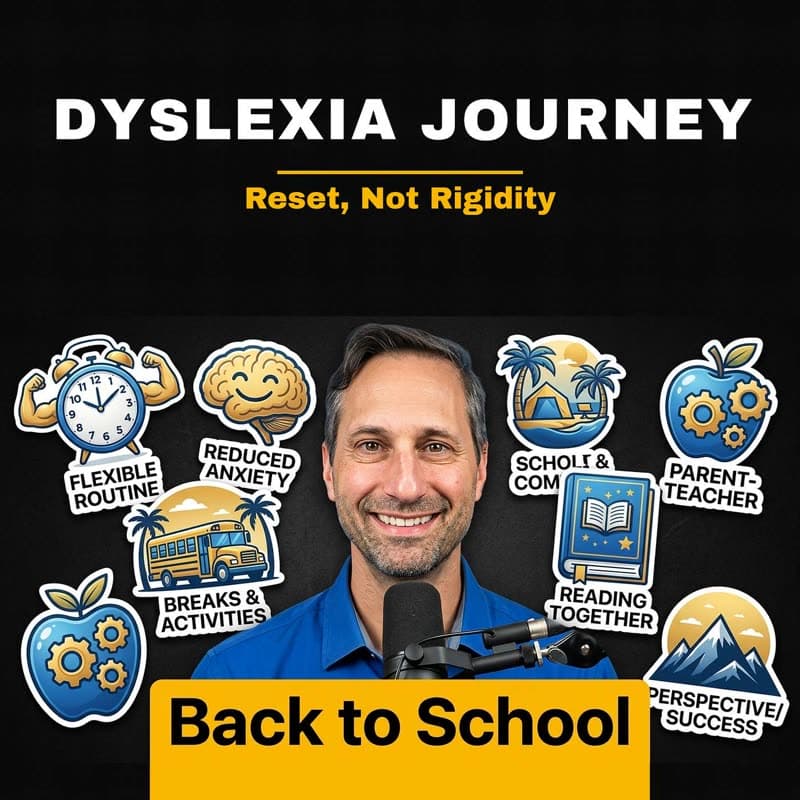
Back to School with Dyslexia: Reset, Not Rigidity
The first two weeks go great. Then, somewhere around week three, the crying starts, or the stomachaches, or the flat refusal to get in the car. If you've been through a back-to-school honeymoon followed by a hard crash, this episode is about setting things up so the crash doesn't take the whole year with it.
Never miss an episode
New episodes every two weeks. Follow wherever you listen.