
Top Signs of Dyslexia in Elementary School Kids
Re-aired Jul 20, 2024.
About this episode
Do you suspect that your elementary school-aged kid has dyslexia? Here are some of the top indications to help you identify your child's learning difference.
As always, if you suspect that your child has a learning difference like dyslexia, you should consult the appropriate professional for an assessment and diagnosis.
Transcript
Full transcript · 3,000 words · about 15 min to read. Press a timestamp to jump to that moment.
If you suspect that your child might have a learning difference and you start searching online, the amount of information that comes up on checklists, it can be overwhelming. So in today's video, we want to help you understand that information a little better. And in today's video, we're going to focus on the elementary school age child.
Hey everyone, we're Nick and Sonja, and this is Dyslexia Journey, where we help you support the dyslexic kid in your life. So today we want to talk about the situation where you might start to suspect that your elementary school aged kid is, you know, struggling in some way. You start to think maybe there's a learning difference going on and how to start to assess what's going on. So elementary school, which in the United States is around age 5 or 6 to 12 or so, is often when reading and writing related learning differences like dyslexia generally become apparent, simply because that's when they're starting to learn those skills.
However, as we've discussed in many other episodes, dyslexia is massively underdiagnosed and missed in far too many kids for too long. So you can't assume that your child's school will identify your child's dyslexia and you as the parent need to be aware of the signs and indications and might need to then seek outside assessment. Yeah, and so really the purpose of today's episode is to give you some kind of guidelines of what to look for in general to kind of supplement that, what the schools might be looking for, because as we said, the schools often miss it.
And of course, we do need to caveat this, that we are not educational specialists, so we can't obviously diagnose your kids, and we are not providing comprehensive advice for diagnosing your kids in this episode. If you do suspect that your child has a learning difference, you should take them to a professional, like an educational psychologist, to get them assessed. And you can, we'll link to our recent interview with Linda Silverman, who is an educational psychologist who does these assessments.
Yeah, and just to say a little more from what Nick said, like when you start to actually do some of your own initial searches, you know, Google searches or whatever, there are comprehensive checklists. And so you should definitely check those out too, but they can be overwhelming because some of the information almost seems contradictory. And a lot of it is because there are different nuances to every child and their particular mix of signs and indications that may be true for them.
And so hopefully we can help you with the trends that we're going to talk about here to think about it in a more holistic way as you make that decision about getting them further assessed. Yeah, it's important to look at these checklists that you can find online, but it's important to realize that they're not necessarily going to be 100% accurate for your particular child. So you might go through the checklist and say, well, my child only hits like half of this, half of the things on this list.
That doesn't mean your child doesn't have dyslexia. It just means that that checklist was developed for, based on children with a different kind of dyslexia, perhaps, or that manifests differently. Because obviously every child is unique. Okay, so let's start off with one of the main trends, let's call it, to look for, which is the obvious one, which is the more like apparent reading and writing related indications. So that includes things like difficulty with phonics, difficulty recognizing sight words, trouble with spelling, mispronouncing words.
So, you know, particularly if they're trying to read them, they might mispronounce the word. And then poor reading comprehension. And reading comprehension is that ability to understand the content of what's read. And this is really kind of, this sort of checklist that Sonja just went through is really kind of covering the different aspects of reading fluency. So you need phonics, which is being able to decode sort of the sounds that the specific letters and combinations of letters make.
Sight words, recognizing specific words without having to decode every sound. And then, you know, going up through actually comprehension, actually sort of understanding and getting meaning out of what you're reading. And so someone with dyslexia could exhibit problems in kind of all of those areas or maybe any one of those areas. It can be a little bit confusing because they might not, for example, have as much trouble with phonics as someone might think.
But they might have a lot of trouble with reading comprehension. Right. And so that varies somewhat from child to child. And, you know, this is something that schools will do some of the tests for. But they could miss it either because your child is stronger in that particular skill. And it's also tricky, of course, for schools because, you know, this is the time when kids are learning these skills anyway. So there are there's some truth to the fact that people learn at different rates or they might mispronounce some words, you know, when they haven't seen them before.
They're still learning those skills. So I think that's also why it can be a little tricky to to figure out, even though they seem like they should be obvious clues. Yeah. And children do learn at different rates and children learn to read at different times. And so you can't you can't necessarily or you don't necessarily need to be worried if your child isn't hitting milestones. But but also you shouldn't ignore that.
Right. Exactly. Again, I want to emphasize that the elementary school years. So the age is sort of six through 12 is when, as Sonja said, everybody is is learning these skills and learning at different rates. But at some point, if your child has dyslexia, at some point along that that elementary school path, some sorts of problems are going to start to exhibit themselves. Which is probably some of the clues as to why you're starting to think about this yourself.
Yeah. So and then it's important to note that, you know, while that's true, that they're probably falling behind or you're noticing some struggling. They don't necessarily need to be failing or like completely at the bottom of the class by many any means in the skills in order to have dyslexia, because often children have developed compensating techniques and that can mask their difficulties. So that's what makes it a little extra tricky, too.
It's not like they're necessarily performing the worst in their class, for example. And often it's going to look, again, different for different children. So some children with dyslexia might be completely unable to read in first or second grade, you know, ages six or seven. Some children with dyslexia might be reading at grade level in first or second grade. They just might struggle with some more subtle aspects. And there might be some some other indications that you might need to look for.
So a different area of indications that your child might be dyslexic are some kind of more general things to look out for. They don't feel maybe as directly related to reading as those previous indications that we gave. So, for example, one of it is is simply avoidance of reading and writing or school in general that could even look like defiance. And so it's important whenever that kind of thing is going on to try to figure out whether it's dyslexia or something else, what's going on with the kid, because there's some reason why they're doing that.
It doesn't you know, of course, it's true that some kids may be like, you know, want to be outside playing more than in school. But I think to assume that it's only that is a mistake, we should always like try to see if there could be something else going on as well. Yeah, that's a really key point that I want to emphasize, especially in the elementary school years. If your child is resisting school, is upset when they come home from school.
Obviously, if they're they're saying they feel stupid, that that they feel like they're not doing well in school, that that would be a little more obvious. But it might not even come out even to that level. It might be that that they just they just aren't happy about going to school or or they're just really, you know, kind of grumpy when they come home from school. Those are some possible indications of some sort of learning difference going on.
And again, it could be something else, too, but it's worth exploring. And then another another indication is needing extra time on tests like written tests, for example, and or to even to respond to oral questions. Needing more time can be associated with being dyslexic. And again, this is something that can sometimes, you know, be considered, oh, they weren't paying attention when they when they were taking the test, that kind of thing.
So we can have these other assumptions that we make about why it's true. But if they do seem to need more time and tests, don't finish that kind of thing. It's important to check for something like dyslexia as well. This reminds me of an example. We did an interview recently with Lois Letchford, who wrote the book Reversed, which is a memoir about her son's journey with dyslexia. And we'll be airing that interview soon.
And so to just give you a teaser of that, her son was really slow at responding to questions. He would sort of take sometimes minutes just sort of sitting there without saying anything before responding. And people just assumed he was not intelligent. And it took a number of years before he was actually diagnosed with dyslexia. And they really realized what was really going on in that case. Another indication is poor handwriting, as dysgraphia is often also associated with dyslexia.
And so that's just another thing to be on the lookout for when you're making this global picture of what's going on with your kid. And the last sort of general indication in this category that we want to mention today that might give you a clue that your elementary school child might have dyslexia is if there's any close family member who struggled with reading or who just doesn't like reading. Because as we did discuss in an episode a while back, there is a genetic component to dyslexia.
And so that actually is a really good clue. And it could be that you don't know they struggled with reading specifically, but you know maybe they struggled a bit in school. Or they always felt like they didn't live up to their potential or something like that. Could be the way it shows up as well. Yeah, exactly. Okay, so a third category of indications to look for when trying to assess if there's a learning difference going on with your kid.
Particularly if they might be dyslexic, actually are some positive indications. So things that we think of as positive things that are correlated with dyslexia. So the first one is that they can often have strong comprehension of stories read to them. And actually I didn't make the caveat, but the caveat here is that this is going to look very different from kid to kid. Because people also can sometimes have associated other learning differences.
So definitely, again, don't assume that, you know, if your kid doesn't have all of these or even any of them, that doesn't mean they're dyslexic. But it's true that they can have this strong comprehension for stories read to them. Yeah, and we, so I want to emphasize with that, that this is oral comprehension we're talking about. So, and again, this isn't true for every dyslexic kid, but for a lot of them, they have trouble when they try to read the stories themselves because they're faced with all the issues we talked about in that first section, the phonics and the word recognition and all that stuff.
But they often are sort of naturally good at understanding verbal expression and have probably, you know, mid elementary school years at least have developed even better oral comprehension to compensate for their weakness in the written comprehension. Right. So certain kids, you know, will be able to do that as their compensation and then that's, that's why they're especially good at that oral comprehension. Yeah. And so kind of along those lines, they might even have a larger vocabulary than average for their age, both in understanding it and in actually using it.
Mm-hmm. And then for these, these next few things that I want to mention, I also want to refer you to a book that we recommend a lot on this show called The Dyslexic Advantage that, that really talks about the different strengths and the different kinds of strengths that dyslexic individuals can have. And so, and so again, not every dyslexic person has these particular strengths, but, a lot of dyslexic people do really enjoy, kind of puzzles and logic games, especially ones that involve three-dimensional reasoning.
So if your child, sort of has an affinity for, you know, jigsaw puzzles or building complex structures out of Legos or, or any of these kinds of kind of, real world, three-dimensional tasks, but yet they're struggling in, in school, in first or second grade or, or elementary school in general, then that could be an indication. and sort of related to this, strong visual spatial skills could show up in other ways, like, for example, knowing where everything is in a room, kind of having that sort of visual attention that allows people to be aware of their surroundings in that kind of a way.
That's definitely been true for our daughter, where she's the one who can always find things if they're missing in the house. Yeah, and we did a whole episode on this a while back that we can link to as well, on, the, visual spatial strengths for, dyslexic individuals. And finally, a strong memory could be part of how a child is compensating in particular with dyslexia. And so, again, that's going to be very different for different kids because memory is its own thing.
But, you know, if they have a pretty strong memory already, they might very well be using it to compensate and then they're strengthening and strengthening and strengthening that skill. So that's another possible positive indication. Yeah, and so those are just a few examples of, kind of, some of the strengths that go along with dyslexia that, are often overlooked in these checklists. but it is important to, like we said, to examine the, the, the whole child, when you're trying to figure out these kind of learning differences.
Because it's not just about how they do in school. And so, to kind of leave you with a, a final tip, which is more of a general guideline, if, if there's like one thing that you should look at more than, than anything else, it would be a discrepancy between sort of, your, like observations of your child at home. When they're not in a, in a school environment and not being forced to try to read, how they, how they are, what their curiosity is, what their, abilities are, what their intelligence is, compared to how they are able to sort of demonstrate, that kind of, intelligence when it involves reading and writing, when they're in school.
And so if your child has a learning difference, there's going to be a discrepancy there. And, you know, it could look quite obvious if they're very different in terms of how they present, you know, outside of that setting that has to do with reading and writing in school. You know, maybe your kid is shyer or they're very interested in something that doesn't seem, you know, where you can tell that curiosity as much in those ways.
But it, then in those cases might show up in a particular interest or, you know, like in the case of Lois Letchford's son, it was just a few instances where she really noticed the difference. Like suddenly she could see that really deep thinking and, and that happening. so it doesn't mean it has to present all the time that way, depending on the kid again, but you would notice like, Hey, this seems different from whatever that is, whether it's a moment or a particular area that they're interested in.
This seems like really different from how they are with their struggles at school. And a good, educational psychologist who does an assessment, is going to be looking for that discrepancy. It's going to be looking for the difference between, your child's potential and how they are able to demonstrate competence on specific reading and writing, tests. So hopefully this was helpful. You know, those three large categories to consider are the kind of more classical reading and writing signs, the signs that don't look quite as related to those particular areas.
And the ones that are sort of more positive things about your child are strengths that could be indications of being dyslexic. and so again, you know, there's a wealth of information. There's like lots of things on the checklist. The main point is to sort of go with your guts if they're really struggling and you feel like there's something going on there. And then just remembering that it will be your own child's unique pattern of each of the potential things on the checklist.
So every kid's going to look a little different.
More from the show
The Definition of Dyslexia Changed: Here's What It Means for Your Family
For the first time since 2002, the International Dyslexia Association has rewritten its definition of dyslexia. The new version quietly removes two ideas that have kept kids from being identified for two decades: that dyslexia has to be 'unexpected' given a child's intelligence, and that a phonological deficit is…
"Everyone Else Can Read" Ft. Parent Fiona Rintoul
Fiona Rintoul, fellow parent of a dyslexic daughter, joins us to discuss her experiences. You can find Fiona online at https://purplecowrecruiting.com/.
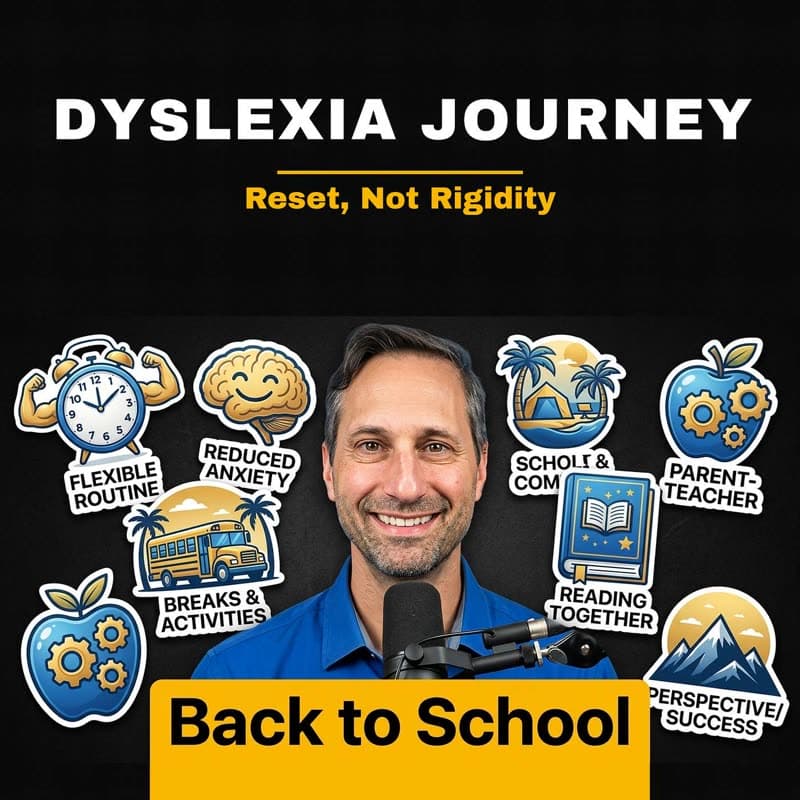
Back to School with Dyslexia: Reset, Not Rigidity
The first two weeks go great. Then, somewhere around week three, the crying starts, or the stomachaches, or the flat refusal to get in the car. If you've been through a back-to-school honeymoon followed by a hard crash, this episode is about setting things up so the crash doesn't take the whole year with it.
Never miss an episode
New episodes every two weeks. Follow wherever you listen.