
Top Things We Learned About Dyslexia This Year!
Transcript
Full transcript · 1,805 words · about 9 min to read. Press a timestamp to jump to that moment.
It's been a wonderful year on Dyslexia Journey, and we've had so many wonderful interviews, and hopefully some topics that we're illuminating for you as well. Today, we want to discuss our top things that we learned this year. It got me diagnosed when I was in third grade, and it was the most relieving day of my life, because I finally had, like, kind of a place to hang my hat and say, see, I told you, I'm not lazy, definitely not stupid. I just learned differently, like, that's totally okay.
We dyslexics, we were often, you know, just set up for failure, because, you know, we were given books and tasks that really are not appropriate for the level that we were at. So, how do you expect anyone to be open to learning, when their entire relationship with reading, with learning, is physical pain? I wish I had understood when I was younger that the fact that my brain worked differently than people meant that I would be good at things in ways that other kids were not going to be good at.
I just assumed, I can't be dyslexic, because letters don't jump up and down for me. Dyslexia is not a disorder. It is not a disease. Once you sort of own it and embrace it, then you can have the power to deal with it. It's sort of empowering and also enriching to the whole community. To those who don't understand what dyslexia is, that it's not a negative, it's not a problem, it's, like we keep saying, superpower.
Hey, everyone, we're Nick and Sonja. Welcome to Dyslexia Journey, and this is sort of an end of the year video. It's going to be pretty quick for us here. Rather than doing a full roundup of the year, we've had so many different interviews and hopefully some topics that we did, you know, that you gleaned some information or support from. But we just wanted to do a quick video where we talk, you know, each are sort of picking one thing, one thing that we felt like we learned this year that we want to share with you.
So I'll go first. So I feel like fairly often I bring up how, you know, I truly believe that dyslexic kids can be good at language arts and at language and, you know, things we think of as language arts and story. Usually for me it's come across as talking about how, you know, dyslexic kids can be good at story and understand that even if they're struggling with mechanics of writing or mechanics of reading.
So usually I've been talking about it that way, but for me just recently, and this was, this really came together for me in the interview with the IDs that we published pretty recently. So I encourage you to check that out. The IDs are dyslexia researchers as well as doctors and they, and they've published the sort of seminal book. It's called The Dyslexic Advantage. Right, called The Dyslexic Advantage. And I think for me, it was just like hearing a couple of different things they said.
So I'll tell you the things that pinged for me, but it's really sort of wider than this as to what it opened up for me. So at one point, I think it was Brock, Dr. Brock Eide mentioned, because he was talking about just, you know, just different aspects of like this might be this way for a dyslexic kid and this might be more of a challenge for a dyslexic kid and there might be a strength here.
And he mentioned, I think, I think he mentioned this in contrast was, for example, a dyslexic kid might be really good at seeing themes, right? Like coming up with themes for a paper or seeing themes in something, but then they might have a really hard time if a test is timed, right? So it's kind of like these divergent things that he was talking about, but he was just bringing up these two different aspects.
And then a different time, he was definitely going into processing reading and actually processing reading the words and sort of the complexity involved in that step of, well, not just one step, actually. So like there's a lot involved in processing in what we think of as reading. And so just sort of hearing those things, pinging for me sort of with how I'd already been thinking about things, it just really opened it up much more deeply where I realized kind of both on the strength side and on the side of challenges and what dyslexia is like.
Even for me, I still sort of was thinking of dyslexia so much like with regard to reading as we have thought of reading. But I guess what I wasn't thinking of, I still, you know, I'm pretty limited in my knowledge of all the brain processing, for example, that goes into reading. So, you know, for me, it tends to be that approach to the words and how we're seeing that sort of from the outside.
And I hadn't been thinking about those aspects that we don't even really think of as reading, like processing time or speed or things like that. So like that, there's these aspects that go into dyslexia that are sort of beyond, you know, what we generally think of. And then on the flip side of it, you know, going into things like themes was just broadening out for me to all the different aspects and how much wider they are, that there are advantages often to having a dyslexic brain to do with things that are associated with reading.
Yeah. So the themes, I guess, was like that example. And then just to take it one step further, that, of course, was just making me think about how, you know, in general, this is so true, right? We sort of have these ways of thinking about things. We can't help it. That's just how our brains work as we start to categorize things and learn about things. So we think of, you know, reading and we have had this set schema for how we think of what reading is for so long.
And it was just sort of reminding me that, like, really, with everything, it's really just so much broader than that and wider than that. And everything's so connected. You know, like I said, the later brain processes are connected or like femur story are connected or there's just lots of things that aren't really as separate as we think they are. And so, yeah, it was just making me think about that with regard to this whole journey.
And, you know, it's just something sort of as a foundational thing, I think, to keep in mind underlying everything. Yeah, I definitely agree with that. Interviewing the doctor's ID definitely helped me think about similar topics in a new way. And that was also kind of a highlight of the year for me, interviewing them, because The Dyslexic Advantage is one of the first books that I read to try to really understand our daughter's dyslexia.
And so being able to talk to the authors of that book and have them on our show was really exciting as well. Yeah. So just there's so much to learning. I mean, life in general, too, right? But learning, like, there's just so many components that isn't what we're normally thinking about. Yeah. Did you want to go next? Sure, yeah. So I think the main thing is I'm thinking back on the year and all the wonderful people who we interviewed, all the things we've been thinking about in terms of dyslexia.
And the one thing that stuck out to me that I really learned this year was about how much progress has been made in dyslexia identification. So I'm specifically thinking of an interview we did with Stanford professor Jason Yateman earlier this year. He has developed a new online reading assessment that he calls ROAR, the Rapid Online Assessment of Reading. That's the acronym.
And his assessment is being adopted, I think it's, if I'm remembering correctly, it's been adopted by the state of California, for example, to institute in schools. And there's just a lot more, I guess, research on maybe quicker ways to identify struggling readers and readers, young children with dyslexia or who might have dyslexia, you know, quicker than the sort of two-day barrage of assessments that some of us have experienced or our children have experienced.
Also, the doctors' ID have developed their own assessment that they use in their clinic, I believe. And so it's just, it's really, it's really encouraging to learn about these new ways of identifying. So at the same time, these improvements in identification is making me even more motivated to try to figure out how, as a society, we can get more kids tested and identified. Because unfortunately, there's so many people still slipping through the cracks that it's kind of this disconnect between on the research, sort of education research side of things.
It feels like we know how to identify kids, and we know how to help them once they're identified. But it seems like in our school systems, both public and private, honestly, it's not being implemented effectively still. Yeah. And so that's the frustrating aspect. Yeah, I find it very frustrating. Yeah. Yeah. But there's some movement there. But there's hope, too. Yeah, so we said, it's good that we have those. Yeah, so I was able to interview a Colorado state senator earlier this year, Chris Colker, who sponsored a bill that did actually pass to require mandatory reading assessment, dyslexia assessment in Colorado public schools.
So that's encouraging. People understand that there's a problem and are taking action. So I think, I guess, my summary here is that on the research side, we're making amazing progress. On the implementation side, I'd say we're making slow progress. Yeah. But some progress nonetheless. Yes. So we'd love to hear it if you have any particular topic that was extra helpful to you this year, or if there's something you found out that you didn't know before, go ahead and put it in the comments.
And as always, if you have a topic you want us to cover, or you have a question, you can send that to us, and we will work it into an episode in the future. Yeah, definitely. You can email us at parentingdyslexiajourney at gmail.com. And if you're watching or listening to this around the time we're going to publish it, we hope you have a very happy new year.
More from the show
The Definition of Dyslexia Changed: Here's What It Means for Your Family
For the first time since 2002, the International Dyslexia Association has rewritten its definition of dyslexia. The new version quietly removes two ideas that have kept kids from being identified for two decades: that dyslexia has to be 'unexpected' given a child's intelligence, and that a phonological deficit is…
"Everyone Else Can Read" Ft. Parent Fiona Rintoul
Fiona Rintoul, fellow parent of a dyslexic daughter, joins us to discuss her experiences. You can find Fiona online at https://purplecowrecruiting.com/.
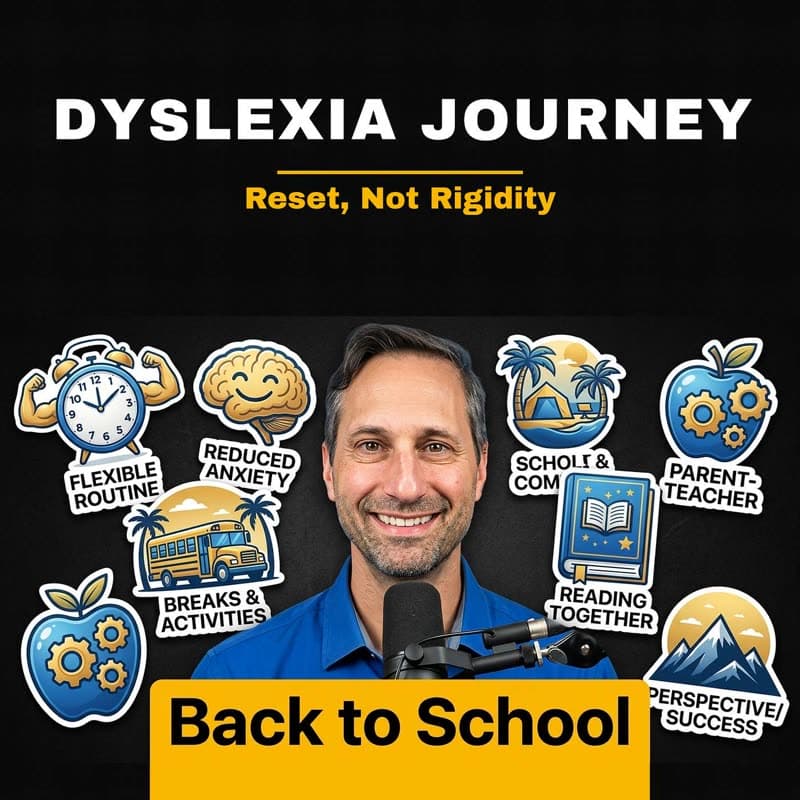
Back to School with Dyslexia: Reset, Not Rigidity
The first two weeks go great. Then, somewhere around week three, the crying starts, or the stomachaches, or the flat refusal to get in the car. If you've been through a back-to-school honeymoon followed by a hard crash, this episode is about setting things up so the crash doesn't take the whole year with it.
Never miss an episode
New episodes every two weeks. Follow wherever you listen.