
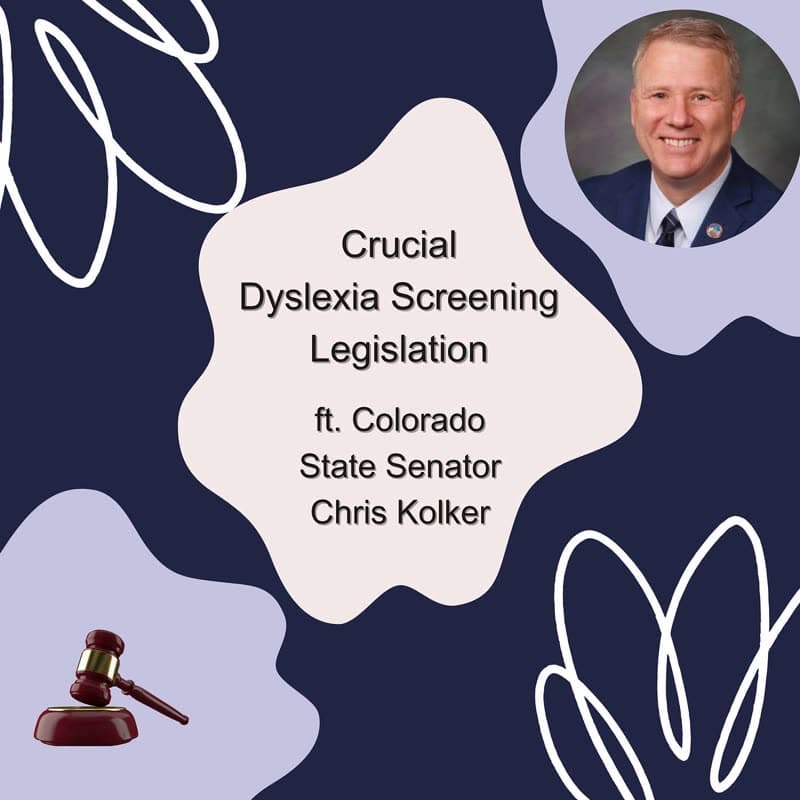
Universal Dyslexia Screening ft. Colorado State Senator Chris Kolker
About this episode
I was excited to host Colorado State Senator Chris Kolker this week to discuss his universal dyslexia screening bill, education funding, and a few other topics!
You can find Senator Kolker online at https://leg.colorado.gov/legislators/chris-kolker
The dyslexia screening bill is https://leg.colorado.gov/bills/sb25-200.
As of this posting, the bill hasn't passed yet, so call and email Colorado senators and representatives and encourage them to pass it before the end of the session!
Transcript
Full transcript · 3,377 words · about 17 min to read. Press a timestamp to jump to that moment.
Sometimes I think you feel like nobody's listening or you feel like maybe you're banging your head against the wall and trying to get services for your kid. Just don't stop. I mean, you're going to find people, hopefully I'm one of them, that are going to come to your aid and you're going to find people who are going to listen and do everything they can. It got me diagnosed when I was in third grade and it was the most relieving day of my life because I finally had like kind of a place to hang my hat and say, see, I told you, I'm not lazy, definitely not stupid. I just learned differently. Like, that's totally okay.
We dyslexics, we were often, you know, just set up for failure because, you know, we were given books and tasks that really are not appropriate for the level that we were at. So, how do you expect anyone to be open to learning when their entire relationship with reading, with learning, is physical pain? I wish I had understood when I was younger that the fact that my brain worked differently than people meant that I would be good at things in ways that other kids were not going to be good at.
I just assumed I can't be dyslexic because letters don't jump up and down for me. Dyslexia is not a disorder. It is not a disease. Once you sort of own it and embrace it, then you can have the power to deal with it. It's sort of empowering and also enriching to the whole community. To those who don't understand what dyslexia is, that it's not a negative, it's not a problem, it's like we keep saying superpower.
Hey, everyone. This is Dyslexia Journey, and I'm Nick. So, you couldn't make it today. So, it'll just be me interviewing our very special guest. Today, we have Colorado State Senator Chris Kolker. And we're excited to talk to him because he has sponsored a dyslexia screening bill that I believe has made it out of committee. And so, we're going to talk with him about the bill and the next steps. So, Senator Kolker, welcome to Dyslexia Journey.
Thank you for having me. I appreciate this. Well, thank you for, first of all, taking time out of your, what must be an amazingly busy schedule right now, because I know we are just a couple of weeks from the end of the legislative session, right? Ten days, but nobody's counting. Yeah, right.
And also, thank you very much for your work around dyslexia. So, let's start with this, just to jump into the bill. So, it's SB25-200, I believe. Yes. Can you tell us a little bit about it? Sure. So, SB25-200 was a bill that actually Representative Eliza Hamrick in the House and I worked on extensively over the interim. So, we've been working on this for about nine months, started with how do we improve reading in schools?
How do we improve? We have a bill called, a law called the READ Act. How do we improve the READ Act and what are some of the deficiencies that it isn't really addressing? And one of the deficiencies it wasn't addressing was dyslexia. Now, we've had a dyslexia task force, I believe since 2018, recommending universal dyslexia screening for kindergarten through third graders and above, you know, but never was implemented. We had bills in the past that tried to do it.
There was always something political or something technical that caused the bills not to pass. And so, we just stripped it down and tried to make it as simple as possible. And we found a way to pass universal dyslexia screening for kindergarten through third grade. And we're doing it using our Department of Education's process in selecting interim assessments for every school district. So, the State Department of Colorado's Department of Ed, they, every five years, review interim assessments that are given throughout the school year to help kids and teachers understand where they're at, both in math and in reading.
And they have to come up with different parameters. And so, we created the parameters for selecting an assessment that included a dyslexia screener. And we're one of seven states that does not have a universal dyslexia screener for these kids. And I said this on the floor, and I think I might have said it in committee, but I'm sick and tired of being in the top, excuse me, in the bottom 10, sick and tired of being in the bottom 10 in the country in education-related issues.
And let's get this done. And that's what we did. That's what this bill does. And it's currently in the House. We passed it unanimously in the Senate. So, I think it was the only bill that passed unanimously in the Senate so far this year. Excellent. And do you have a co-sponsor in the Senate as well? Yes, Representative Eliza Hamrick. Okay. She's, like myself, is a former teacher. She's a retired secondary social studies teacher.
I didn't retire from teaching, but I was a secondary social studies teacher also. Okay. So, does your interest in dyslexia come from any, come from your teaching experience or any personal things around dyslexia? This comes from constituents. This is constituent-driven. This is from, you know, hearing from the people in my district. We have a core group of parents who are advocating for their kids, advocating their kids are dyslexic. And I've been meeting with them since 2021, since I was first elected.
And just continuing to work, continuing to work, the old saying, you know, don't give up. Keep going, keep going, keep going. My dad gave me this card that says, never, don't quit. And it goes through all the different areas, you know, how you should keep fighting. And that's what we did. And I've been working with them since 2021. We're on the cusp of getting this passed. That's great. And yeah, we appreciate your tenacity here, because I believe this is the third legislative session that has been proposed.
Something like it. Yes, I believe you're correct. And that's enough. Three times the charm. Excellent. And has the governor signaled anything around it? I'm confident he'll sign it. I'm very confident, you know, because really what we're doing is making sure that the screeners are going to be selected, that they're supported and selected in every school district. So we have the next step is getting the interventions and the support, making sure that we have reading specialists, that we have intervention specialists.
My daughter, my youngest struggled reading coming out of kindergarten, and she wasn't, she isn't dyslexic. It's just that she struggled, and she was able to get an interventionist. And I know how important that is. I know how, when you can get kids on a small group basis, or one teacher to three kid basis, how impactful and effective that is. And so the screener is the first step. The next step is get the funding and get the supports in every school, so that we have specialists that can focus on kids and continue to increase their reading capabilities.
Yeah, definitely. What's the plan for getting that funding? Well, I've got a lot of creative ways to do it. And to be honest, you know, we can fund up to a certain amount. We did an adequacy study, two studies actually, in this last year that we paid. We had two different companies come in and review the adequacy of our K-12 education and the funding. And they used two different formulas, and they both came up with about $3 to $3.5 billion that we are short in funding adequately our K-12 system per year.
And so I have a plan just to fund our new school finance formula, but that's still not going to be anywhere near what the adequacy studies are telling us. And so we're going to have to either go to the people or get even more creative in finding ways to do this. And ultimately, we're going to have to go to the voters, I do believe. Okay. And this is a little bit off topic, but while I have you, what impacts are you anticipating from the, shall we say, changes at the Federal Department of Education?
That's a great question, Nicholas. We did, I commissioned our Senate hearing. I'm the chair of the Senate Education Committee. So I commissioned last Wednesday a hearing that we've never done before where I found two recently fired Department of Ed, U.S. Department of Ed employees who oversee the data for grants that go out to every state. And the way to describe this is they get all the information from the local districts, whether or not, you know, the programs, the grants are working, who it's targeting, how effective they are.
And they bring that back and they determine, you know, if those grants should continue to go or if more money needs to go out, if it's getting to the right people. They came and testified about the major cuts to this program, to the Department of Ed. I think everyone in their department was cut. So there's no one left to, to analyze this and, and to make sure that the money's going to the right places.
We also had someone from Disability Law Colorado come in and speak who used to work in the Office of Civil Rights in the Department of Ed, talk about the cuts to, to that program, to that office, and how that's going to affect kids with disabilities. And it's, it's heart wrenching. I mean, people were in tears hearing about this. Colorado used to have an administrative office for the Department of Ed's civil rights office that oversaw five states.
Because of these cuts, they've expanded Colorado's office to oversee 13 states all the way out to Indiana and Michigan and cut their staff just to 24 people. Previously, they were investigating 600 cases of violations of disability law, of violations against students who are disabled. And now they're at 2,800 cases. And they cut their staff, I think, from 100 to 24. Yeah, and I'll put in a plug. Last week, we interviewed a special education attorney about this as well.
And this is exactly the type of, exactly the stuff that she was telling us that we should be concerned about. Absolutely. So what happens is what we heard from the former employees was in July 1, they start their grants allocation for the next school year. And that's when school districts around the country can start seeing how much they have and start allocating and taking, taking it in a stream for the, for the coming school year.
Not knowing exactly what the budget's going to be, because the fiscal year for the federal government's October through September. This is money that was already allocated from the previous year. But it's, it's the process. Where is it going to go? Well, my fear is that not having the people who are doing the documentation, who are, who are in charge of making sure the money goes to the right place and the right people, that it turns into a, a pseudo block grant.
You know, this is what the current administration really wants. They just want to give us X amount of money, right? But they want to be efficient. This isn't efficient. This isn't getting money efficiently to the people that need it. Because if it goes into a block grant, you leave it up to the States. We have to recreate the U.S. Department of Ed systems to determine where the money goes. If we want to continue to have that money go to those different programs.
There's over a hundred grant programs that they administer. So, how, how do we do that? We're already underfunded and understaffed. And I think we get 800, over $800 million, not including for food, for meals, including meals. We get over a billion dollars in grants from the federal government. But just for the academic portion, we get over $800 million. That's, that's, that's a huge amount. Now, it's not supposed to supplant our education.
You know, the funding that we're giving from the local and the state level, it's supposed to supplement. But we still rely on it. I mean, we've become accustomed to it and we're relying on it. And all of a sudden you cut 800 million. Well, our education budget combined between local and state share is $9 billion. So, it's almost 10% of our total budget. And if that gets delayed or messed up, disorganized, you know, what are we doing to, to these kids?
This is not an auto, you know, this is not a car manufacturer where you cut employees and you're impacting the assembly line. You know, if you want to think of the assembly line as our kids, I mean, a car doesn't care who's putting them together. But a kid cares who's teaching them and cares how you're able to get those programs to them. That is impactful. And any disruption there, it's just, it has negative consequences that I'm scared to try to understand and to measure.
Yeah, for sure. Well, we appreciate that you're doing everything you can here at the state level. That's the purpose of doing it was to put a shine a light on it because it's not being done at the federal level. So, I've sent a letter to all eight of our congressional members, both Democrats and Republicans, stating what I did and asking them to do the same thing at the federal level. To ask these questions, to find out what's happening before the disruptions happen because once they happen, then how many kids are we impacting and are we able to come back and fix it in time?
Yeah, exactly. A couple more questions, but feel free to cut me off if you need to get back on the floor. No, we're done. We're done for the day. I'm trying to write my newsletter for the week. Okay, excellent. So, circling back to dyslexia, what plans do you have for ideas that you might introduce next session? Anything around dyslexia, learning differences? Well, school finance, funding schools is important. And any way we can increase that funding, and then if we can create what's called a categorical of specifying the funding for interventions.
And that's one thing I want to keep working on. Now, we're in such a bad shape budget-wise. We had a $1.2 billion structural deficit this year that we balanced by rearranging money and being very creative. We cut very little. Next year, we'll be cutting. And it's going to be real hard. But I'm committed to coming up and prioritizing education funding. I mean, the two things that I really look at prioritizing, and it's a bipartisan agreement, is education and services for our poor through Medicaid.
So, those are the two most vulnerable populations. And, you know, the disabled included in Medicaid. So, if we can, if we prioritize those and stop balancing our budget, you know, at the risk of harming those two and balance our budget on other programs and getting the message out, those are the things we need to prioritize. So, that's how I was raised, you know, help people that are in the most vulnerable, people in the most need.
And to me, it's an investment. By day, I'm an investment manager. I'm a financial planner. And you can't have a better investment than the future of our state, our country, is in our kids and their education. And that just expands and expands by making sure they all get a quality education.
The other thing I'm doing is going to be working with disability law on an office of civil rights in the state of Colorado, maybe replacing what was lost, you know, in the cuts of the Department of Ed. If we can replace that just for Colorado, again, that's going to cause a fiscal note and there's going to have to be some kind of financing. But I'm bound and determined to make sure we're not going to let that go.
Okay. Those both sound like very important issues.
More than just issues. I mean, really, whole entire ways of approaching legislating. Anything else that you'd like our audience to know about dyslexia or education in general? I want to say to the parents who are out there advocating for the kids, never stop. Never stop. You know, sometimes I think you feel like nobody's listening or you feel like maybe you're banging your head against the wall and trying to get services for your kid.
Just don't stop. I mean, you're going to find people, hopefully I'm one of them, that are going to come to your aid and you're going to find people who are going to listen and do everything they can. Those that do not have kids or relatives with dyslexia but are listening and concerned.
And even maybe parents who are new to discovering their kids with dyslexia. One of the things that I did is I took a dyslexia simulation early on in this process. Oh, my God. Just an eye-opener to try to get to understand what anyone with dyslexia is experiencing and understanding, you know, how we talk and how people can react because the person running the simulation was acting like a teacher. It's like, come on, why are you so slow?
You know, what's going on? Are you not paying attention and not trying to understand what was happening? And it just breaks my heart, right? It just breaks my heart. So, for those who are new and want to understand, I think doing the dyslexia simulation, we offered that to some of our legislators here to go in and do. I think it's very vital and important to try to get a better understanding. For those that do understand what's going on, you know, parents, keep advocating.
Never stop. You love your kids. We love your kids. Because, you know, everyone is important and someone is going to hear you. Just keep doing it.
That's great. I think that's a great place to end. So, Senator Colker, thank you for coming on Dyslexia Journey and thank you for all your great work that you're doing in the Colorado planet. Thank you, Nicholas. I appreciate you doing this and I appreciate your advocacy and we need more and more people to understand the struggles people are going through. The hard part is most people go through their day and their lives just thinking about their daily activities and issues like this doesn't impact them unless it happens to them, unless they know somebody.
But to be honest, you know, the reason we passed this unanimously because once we brought it to the floor, our senators from both sides of the aisle got up and started telling stories about someone in their family or themselves. And it is impactful and it does impact so many and so many of us or at least somebody we know. And we got to keep you, by doing this, hopefully what you're doing is getting that message out because just because it may not impact you doesn't mean you shouldn't think about it.
You should definitely, people need to be more aware. Yeah, definitely. I mean, the percentage of people who have some form of dyslexia is quite high. And so even if you don't think you know someone who's dyslexic, you almost certainly do. This is why we need to fund education. Yeah, I'm going to keep saying it and pounding the table. No matter what state you're in, what city you're in, we need to fund education.
This should be the number one priority everywhere we go all across this country.
Absolutely. Thank you so much. You have a great weekend. Yeah, thank you. You too.
More from the show
The Definition of Dyslexia Changed: Here's What It Means for Your Family
For the first time since 2002, the International Dyslexia Association has rewritten its definition of dyslexia. The new version quietly removes two ideas that have kept kids from being identified for two decades: that dyslexia has to be 'unexpected' given a child's intelligence, and that a phonological deficit is…
"Everyone Else Can Read" Ft. Parent Fiona Rintoul
Fiona Rintoul, fellow parent of a dyslexic daughter, joins us to discuss her experiences. You can find Fiona online at https://purplecowrecruiting.com/.
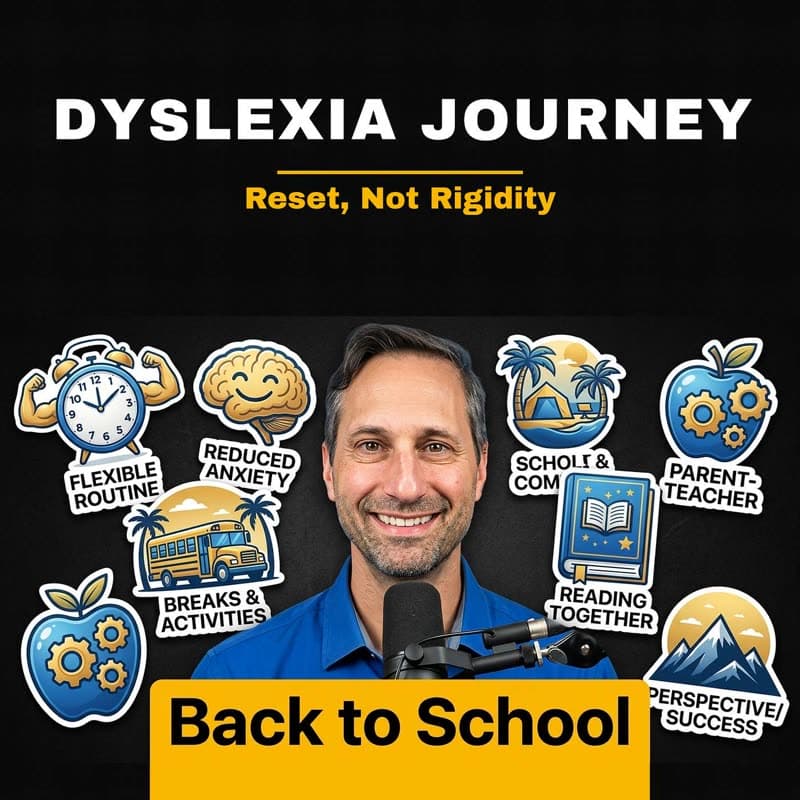
Back to School with Dyslexia: Reset, Not Rigidity
The first two weeks go great. Then, somewhere around week three, the crying starts, or the stomachaches, or the flat refusal to get in the car. If you've been through a back-to-school honeymoon followed by a hard crash, this episode is about setting things up so the crash doesn't take the whole year with it.
Never miss an episode
New episodes every two weeks. Follow wherever you listen.