
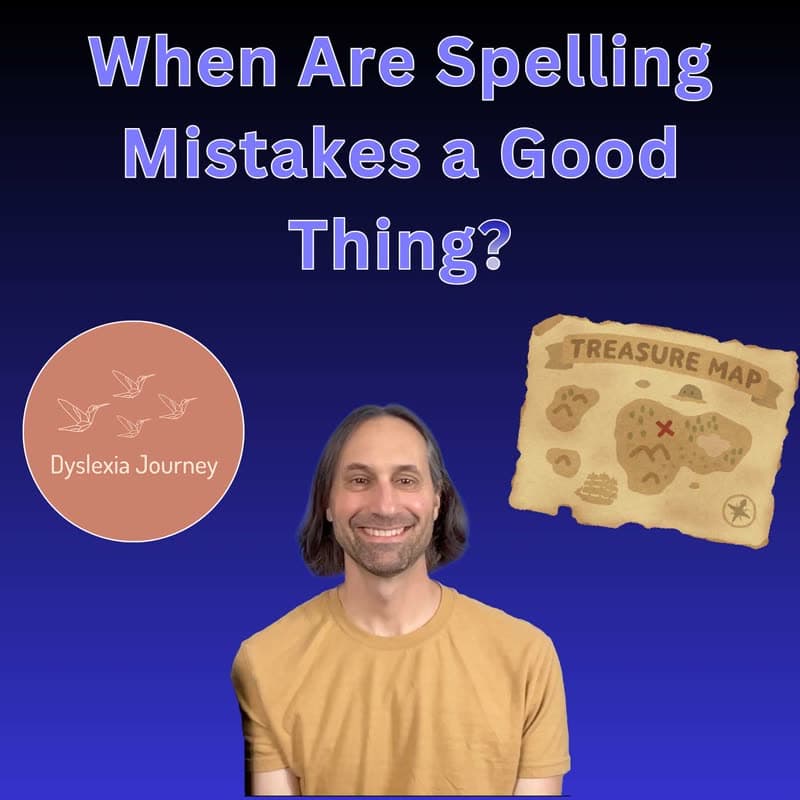
About this episode
Listen to Nick's diatribe in defense of "creative" spelling!
Transcript
Full transcript · 1,414 words · about 7 min to read. Press a timestamp to jump to that moment.
Today on Dyslexia Journey, why spelling mistakes can sometimes be a good thing.
It got me diagnosed when I was in third grade, and it was the most relieving day of my life because I finally had like kind of a place to hang my hat and say, see, I told you I'm not lazy, definitely not stupid. I just learned differently. Like, that's totally okay. With dyslexics, we were often, you know, just set up for failure because, you know, we were given books and tasks that really are not appropriate for the level that we were at.
So, how do you expect anyone to be open to learning when their entire relationship with reading, with learning, is physical pain? I wish I had understood when I was younger that the fact that my brain worked differently than people meant that I would be good at things in ways that other kids were not going to be good at. I just assumed I can't be dyslexic because letters don't jump up and down for me.
Dyslexia is not a disorder. It is not a disease. Once you sort of own it and embrace it, then you can have the power to deal with it. It's sort of empowering and also enriching to the whole community. To those who don't understand what dyslexia is, that it's not a negative. It's not a problem. It's like we keep saying superpower.
Hey, everyone. Welcome to Dyslexia Journey. I'm Nick. And unfortunately, Sonja couldn't join us today, but she'll be back for the next episode. So, it's just me today. And so, today, I want to kind of give a quick defense of creative spelling. And this was triggered by something that I recently came across in my house. So, I found some writing that my dyslexic daughter did when she was about 10, I think. And for those of you watching the video, I'll hold up a few of these.
These are some clues that she wrote for a treasure hunt. And as I was reading over them, I realized that her spelling on these clues was quite creative. For example, this one says, Pirates maps inside. But Pirates is spelled P-I-R-I-T-S. Maps is spelled M-A-P-E-S. This one says, I jump, I hop, except hop is spelled H-O-P-E. This one says, in part, you found the answers, except answers is spelled A-N-S-A-R-S. So, this was for something that my daughter was doing on her own volition, on her own initiative, at home, to have fun.
And a lot of parents, a lot of caregivers, would be tempted to correct the spelling on these clues. We didn't do that. And so, why not? Well, first of all, she was having a lot of fun. And what she wrote was understandable. It was written phonetically as to how she was hearing the words. When we were following the clues, we could understand them. There was no need to correct it. And thirdly, and perhaps most importantly, she was actually writing.
As a dyslexic kid, she, well, in fact, I'm not sure if we knew she was, I don't know if she'd been identified with dyslexia yet, but as someone who was struggling with reading and writing, the fact that she was writing as part of something that she was doing just for fun was a win in and of itself. And so, let's think about what would correcting her or correcting these spelling errors have done?
Like, what would actually have transpired? And so, first of all, I think it would have made her self-conscious. It would have made her feel bad. It would have made her feel corrected. Secondly, it would have turned a spontaneous, self-initiated, fun activity into something that felt more like learning. And to go back for the first point, for someone who was already sometimes feeling bad about herself in school for being corrected, for not being able to read as well as some of her peers, it would have turned this self-initiated fun activity into school.
And the kind of, even worse, I think that correcting her could very likely have made it less likely that she would do something like this for fun in the future. So, I decided in the moment that the most important thing was that she not always associate writing with shame and stress. Okay. So, a lot of you out there are thinking of some probably counter-arguments to this. Maybe this is making you feel a bit uncomfortable.
I think one of the most compelling arguments about that maybe we should have corrected the spelling is that the argument that if a child is writing words incorrectly, that they are going to kind of ingrain that spelling, both mentally and physically, in the act of writing it, and ingrain that incorrect spelling, and then it will be harder later for them to learn to correct it. So, I think that's, I mean, that argument has some validity.
And there are probably some other arguments that I haven't thought of, sort of around pedagogy there. But I still believe that it's better not to correct the spelling in this case. First of all, I don't think, I think it's highly unlikely that she would have remembered the correct spelling of those words the next time she tried to write them. Because it wasn't being taught as part of any comprehensive approach to spelling.
It wasn't being taught as part of an ordered curriculum. And so, I really don't think it would have had really any beneficial effect on her spelling ability moving forward. And I guess, to add to that, it's like she needed more of a bottoms-up approach to comprehensive approach to spelling, not just like one-off corrections to specific words.
Okay, secondly, and the more important point here, is that I firmly believe that it's really important to keep the kind of mechanics of writing, the spelling, the punctuation, separate from the content. I think that too often, dyslexic kids or other people struggling with literacy are hampered by their inability to spell correctly, are hampered by poor handwriting, are hampered by inability to punctuate, they don't capitalize correctly. And this all gets in the way of their creative expression.
Or in the case of learning to write nonfiction essays, it gets in the way of their argument. And so, it's super important, especially for dyslexic kids, to let that creative freedom or logical argument flow freely as they are writing.
And for them to not have to worry about the mechanics of the spelling in the moment that they are actually writing. Spelling, especially for dyslexic kids, is something that should and can and should be taught completely separately from expression in the form of writing. And so, I think this is true for home activities like this. I think this is true for school, too. I believe that dyslexic kids should be recognized for their written work, should be recognized for its content and not sort of criticized for its spelling mistakes.
And so, people reading their work should not let the perhaps spelling mistakes get in the way of analyzing their logical thought, their expression, their creativity, and so on. And this is actually a pretty common accommodation, at least in the U.S., for dyslexic kids to be able to type, to be able to use spell check, to be able to use grammar check, and to have their work evaluated and to not lose points or get a lower grade because of spelling mistakes.
So, in summary, to sort of wrap up my defense of creative spelling here, is as caregivers or parents of dyslexic kids, we should be applauding their creative expression whether or not the words are spelled correctly. It's most important that they be engaging in reading and writing. In my daughter's case, that was spontaneous. That was self-initiated. She was enjoying it. There was no reason to ruin her day by pointing out to her that she had spelled these words incorrectly.
All right. So, that's my diatribe for today. Maybe some of you disagree with me. I'd love to hear from you. Or maybe you have your own stories of your kids' creative spelling. Let me know. Email us at parentingdyslexiajourney at gmail.com. Or if you're watching this on YouTube, put a comment. And we will be back in another couple weeks with a new episode.
More from the show
The Definition of Dyslexia Changed: Here's What It Means for Your Family
For the first time since 2002, the International Dyslexia Association has rewritten its definition of dyslexia. The new version quietly removes two ideas that have kept kids from being identified for two decades: that dyslexia has to be 'unexpected' given a child's intelligence, and that a phonological deficit is…
"Everyone Else Can Read" Ft. Parent Fiona Rintoul
Fiona Rintoul, fellow parent of a dyslexic daughter, joins us to discuss her experiences. You can find Fiona online at https://purplecowrecruiting.com/.
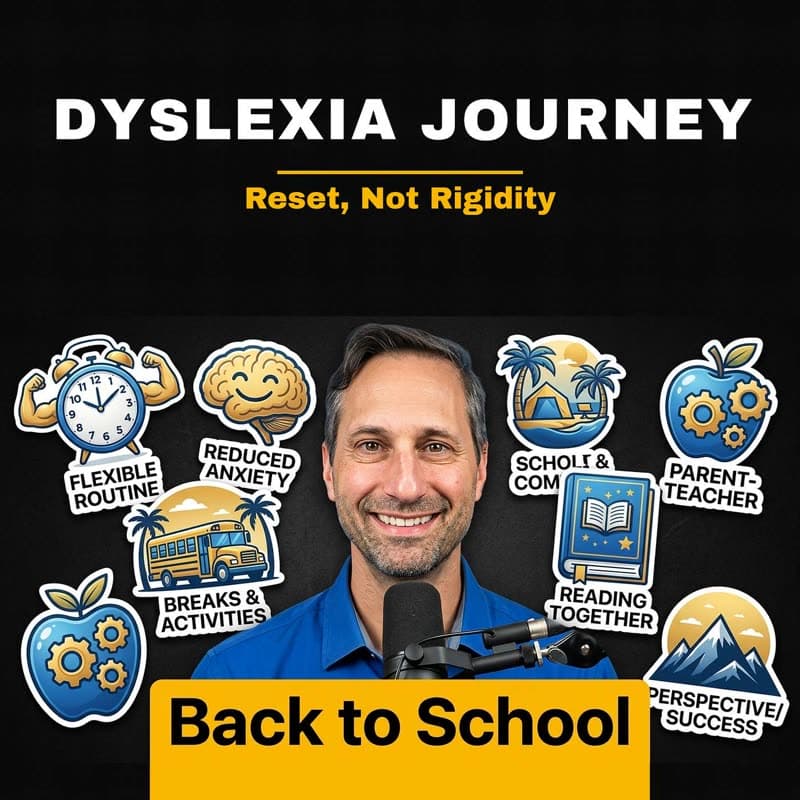
Back to School with Dyslexia: Reset, Not Rigidity
The first two weeks go great. Then, somewhere around week three, the crying starts, or the stomachaches, or the flat refusal to get in the car. If you've been through a back-to-school honeymoon followed by a hard crash, this episode is about setting things up so the crash doesn't take the whole year with it.
Never miss an episode
New episodes every two weeks. Follow wherever you listen.