
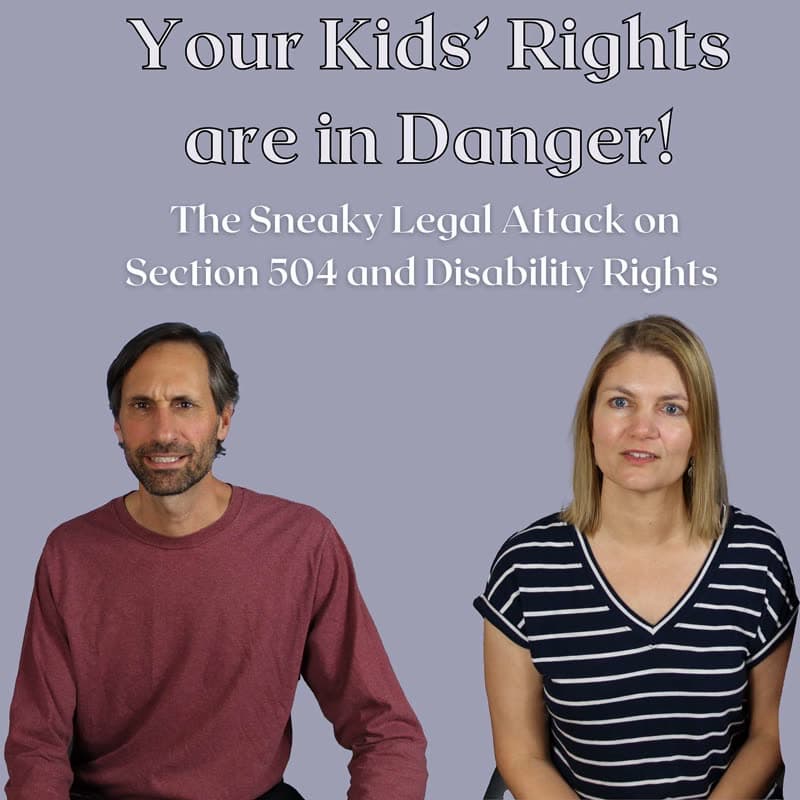
Your Kids' Rights Are in Danger! The Sneaky Legal Attack on Section 504 and Disability Rights
About this episode
In this episode, we discuss the current legal challenge to Section 504 of the Rehabilitation Act of 1973, which could have profound affects on your dyslexic or disabled child!
For more detail about Section 504 and your children's rights, see our interview with attorney Laura Heneghan:
Part 1: https://youtu.be/rw-cnFPhKdo
Part 2: https://youtu.be/PK0iEPyBmZ4
Here are the articles we referenced in the episode:
https://www.forbes.com/sites/petergreene/2025/02/13/17-states-sue-to-end-protections-for-students-with-special-needs/
https://www.hhs.gov/sites/default/files/ocr/civilrights/resources/factsheets/504.pdf
https://www.nea.org/resource-library/know-your-rights-section-504-rehabilitation-act
https://www.copaa.org/page/section-504-facts
https://www.ksl.com/article/51253834/i-hear-you-parents-utah-attorney-general-responds-to-concerns-over-section-504-lawsuit
https://theeducatorsroom.com/in-a-new-lawsuit-17-states-sue-to-do-away-with-504-protections/
Transcript
Full transcript · 2,192 words · about 11 min to read. Press a timestamp to jump to that moment.
Your dyslexic kids' educational rights are in danger. This is a very important episode to listen to, where you can find out about a current lawsuit that's going on and what you can do about it.
It got me diagnosed when I was in third grade, and it was the most relieving day of my life because I finally had, like, kind of a place to hang my hat and say, see, I told you, I'm not lazy, definitely not stupid. I just learned differently, like, that's totally okay. We dyslexics, we were often, you know, just set up for failure because, you know, we were given books and tasks that really are not appropriate for the level that we were at.
So, how do you expect anyone to be open to learning when their entire relationship with reading, with learning, is physical pain? I wish I had understood when I was younger that the fact that my brain worked differently than people meant that I would be good at things in ways that other kids were not going to be good at. I just assumed, I can't be dyslexic because letters don't jump up and down for me.
Dyslexia is not a disorder. It is not a disease. Once you sort of own it and embrace it, then you can have the power to deal with it. It's sort of empowering and also enriching to the whole community. To those who don't understand what dyslexia is, that it's not a negative, it's not a problem, it's, like we keep saying, superpower.
Hey everyone, we're Nick and Sonja and this is Dyslexia Journey. And so, as I said in the intro, today we want to talk about something very current that's going on. There's a current lawsuit going on in the United States that's very important because it could affect your dyslexic kids' educational accommodations and their rights. It's actually beyond dyslexic kids, actually to all people with disabilities, but we want to go into it. Of course, we're in Dyslexia Journey, so we talk about it in context of dyslexia, but we wanted to share with you today what's going on and why it's important and also some steps you could take to try to help get your voice heard in this situation.
Yeah, so to jump in and to kind of explain what's happening, the state of Texas filed a lawsuit against the federal government in September, just this past September, September of 2024, which has since been joined by 16 other states. So, there's 17 states now that are part of this lawsuit. And so, the lawsuit on its surface is just about adding gender dysphoria to the list of disabilities covered under Section 504. Specifically, the Biden administration had added that to the 504 accommodations.
Yes. And when Nick says superficially, he means like when you first start reading the lawsuit, that's what it's talking about. Right. And so, a lot of the news coverage has only covered that aspect of it. So, you'll see headlines like State of Texas sues to remove gender dysphoria from list of covered disabilities. So, this lawsuit, however, goes much further than just the topic of gender dysphoria. And in fact, I'm going to quote an article from Forbes magazine, which says, quote, The suit argues that Section 504 is coercive, untethered to the federal interest in disability, and unfairly retroactive, and therefore unconstitutional.
And also, in the demand for relief in the lawsuit. So, this is specifically in the lawsuit. In the lawsuit. Yeah. It says, in the demand for relief, to, quote, declare Section 504 unconstitutional. And then it also says, issue permanent injunctive relief against defendants enjoining them from enforcing Section 504. So, that's legalese. It just means stop. The states wouldn't have to enforce 504, right? Right. Like the way of saying it. Yeah. Yeah.
Yeah. And so, again, like, this is not being talked about properly in a lot of the media, and unfortunately, by a lot of the politicians in the states who have joined the lawsuits, who are claiming, in our opinion, disingenuously, that they're actually trying to protect Section 504. When, in reality, this lawsuit is, in fairly clear language, for a legal document, requesting that Section 504 be declared unconstitutional. So, why is this important?
What effect would it have? So, we'll link to an episode, two episodes, actually, that we had, where we spoke in detail with a lawyer about, you know, parents' rights and students' rights, and 504 came up big time in that. But we'll go into just a little bit of why it's important here, as well. Yeah. And so, I guess the first point to make is that even if you live in a state that is not one of the 17 states that's part of this lawsuit, that any, a result from this lawsuit could have a nationwide effect.
Right. Because it would be effectively declaring it unconstitutional, right? So, that's broader. So, it wouldn't just apply to those states. Right. Okay. And then the second point is to, I'm sure to remind you exactly what Section 504 is. So, it's a national law that was passed in 1973, or it's part of the Rehabilitation Act of 1973, that protects qualified individuals from discrimination based on their disability. And the key aspect of this law that we're interested in from a dyslexia perspective is that the discrimination, the anti-discrimination applies to learning, to education, to schools as well.
Right. And so, the effect of this law has been that public schools are required to provide a, quote, free and appropriate public education. Right. And you've probably heard, if you've been around dyslexia long enough, you've probably heard that term. That's, this is like, like, I don't think it's an overstatement to say that this is like the fundamental bedrock law in this country that allows our dyslexic kids to get a, to benefit from the public school system.
Right. And to, and, you know, just to add to it, I know we are coming from the dyslexia perspective here, but it's, you know, it's things like, so a student who has a wheelchair for sure having a ramp, you know, that can be affected by this. It can be someone who, you know, needs some sort of special hearing aid or, or, you know, someone who's blind having someone having access to Braille.
So, it does affect a lot of, a lot of other, other kinds of accommodations as well that are part of this. You know, we just want to cover the dyslexic. Pieces specifically. So, it would be things not only like extra time and tests, but it could be access to text to read kinds of things. So, it can, it can be access to any sort of special groups or tutoring or educational, you know, things for people who, who need extra reading help.
So, all of that. Yeah. I mean, this is like, without this law and, I mean, basically my understanding is without this law, schools would be allowed to essentially discriminate against kids with disabilities, physical or mental. Right. Like, like, this is the law that says, okay, you have to allow kids in wheelchairs to be able to access the school. Right. And I mean, you might think, oh, well, the schools would try not to do that anyway or something.
But think about this. Think about, like, the budget things that happen, the budget fights that happen at schools. Things do get prioritized that have to be prioritized. And we aren't, you know, don't fund our schools very well. So, so it actually could be very under threat. And we can't, you know, we feel that we can't just rely on not having the actual disability rights in there. Right. I mean, maybe our school district wouldn't take this away.
Maybe our state wouldn't take this away, but you can't count on that. Well, it might be partial. It could be partial, though. Even somewhere you think that they wouldn't. Maybe when they're balancing out two budgetary things, they, you know, their decisions would be a little different. Right. And so without that federal enforcement, essentially, there's no guarantee. Right. Exactly. Yeah. So this really, literally would set us back 50 years in terms of civil rights.
Right. For disabled people. In 1973. And this was put in place. Keeping that in mind, too. And as I think, as is really common in situations like this.
Taking away this protection is going to affect the, I guess, poorest people, least privileged people the most. The people who can't afford private schools. The people who can't afford private tutoring. The people who can't afford to educate their child, to advocate for their child in the way that that disabled child needs are going to be the most affected by this potential change. Okay, so what can you do about this? Let's say you're someone who's in one of the states, and I'm going to read you the names of the states, and we can put them in the description box below as well.
If you're in one of the states, you can call your attorney general and your representatives and ask them to withdraw your state from the lawsuit. So that's the way you can make your voice heard there. And that's definitely already happening. I did just read an article today about some pushback in Utah that didn't, unfortunately, lead to the attorney general withdrawing from the lawsuit. But at least he has had to publicly defend his position.
He's getting a lot of pushbacks. Right, okay, so here are the states. It's Alaska, Alabama, Arkansas, Florida, Georgia, Indiana, Iowa, Kansas, Louisiana, Missouri, Montana, Nebraska, South Carolina, South Dakota, Texas, Utah, and West Virginia. Importantly, if you don't live in one of those states, it's actually still really important because, like we said, this could affect things federally. And your state is going to potentially give documentation. Like the lawsuit or like whoever's doing this lawsuit, they're a party to it in a way.
They're going to be asked, well, I don't know if they're being asked, but they are allowed to submit documentation regarding this from their perspective. So these are the ones who aren't joining the lawsuit. So if you live in one of the states that I didn't list, you can also still contact your attorney general because you can ask them to file documents in support of keeping 504. Exactly. So like we're in Colorado, we hope that our attorney general would support keeping Section 504.
And so we are going to call or write to him very soon, encouraging him to file documents in defense of Section 504. I believe the documents have to be filed by February 25th. I saw that in one of the articles. So don't delay. Yes. Go ahead and already contact somebody in any of these cases. Yeah. And then everyone, wherever you live, please help spread the word about this. This is, I just want to emphasize that this is, this is really a nonpartisan issue.
Like, we're not trying to be overly political or partisan on this show, obviously, because dyslexia and disabilities affect everyone. And so I think anyone who has a dyslexic kid in their life, anyone who has a kid who's disabled in any way in their life understands the importance of these protections, regardless of your political views and identification. And so, you know, hopefully this is something that we can come together on and really advocate on what's best for our kids.
And I just wanted to conclude, just to make, you know, extra clear what all this was that we were talking about, this fantastic summary that I'm going to quote from, which was in this article that we'll also link below, from the Educators Room. And so it was written, you know, it was just written by the staff, so I don't have a particular person's name who wrote it, but I'm going to quote here.
The states behind Texas v. Becerra argue that the federal government overstepped its authority in implementing the updated Section 504 rules. However, rather than targeting specific provisions, the lawsuit seeks to dismantle Section 504 in its entirety. If successful, this case could strip away fundamental protections, making it easier for discrimination against disabled individuals to go unchallenged. So, we encourage you, as we will do, to go ahead and contact your state representatives and state's attorney, depending on which state you're in, to, you know, either withdraw the lawsuit or withdraw the state from the lawsuit or to file some documents in support of that billboard.
Yeah. And please share, you know, if you want to share this episode or just in another way, tell people about this. Because I think everyone, I don't think this has gotten as much press as it deserves, and I think everyone wants to know about this. Yes, and it's happening right now. So, yeah. Thanks, everyone.
More from the show
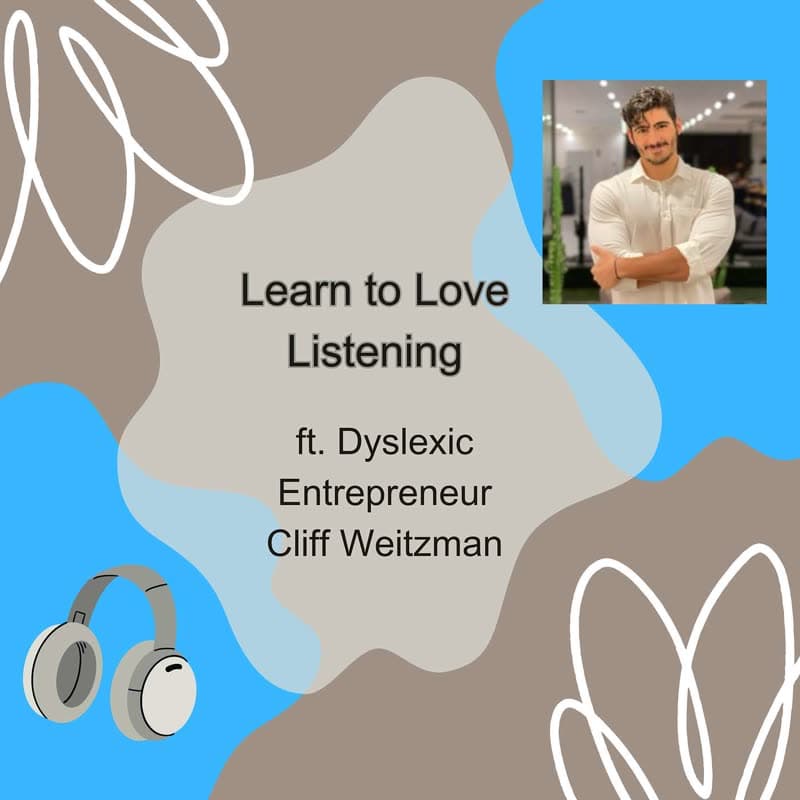
Learn to Love Listening ft. Cliff Weitzman, Dyslexic Founder and CEO of Speechify
In this installment of our Dyslexic Voices series, Cliff Weitzman, founder and CEO of Speechify (https://speechify.com/), tells us about his experiences growing up dyslexic, and shares his advice for how to succeed as a dyslexic child and adult.

The Definition of Dyslexia Changed: Here's What It Means for Your Family
For the first time since 2002, the International Dyslexia Association has rewritten its definition of dyslexia. The new version quietly removes two ideas that have kept kids from being identified for two decades: that dyslexia has to be 'unexpected' given a child's intelligence, and that a phonological deficit is…
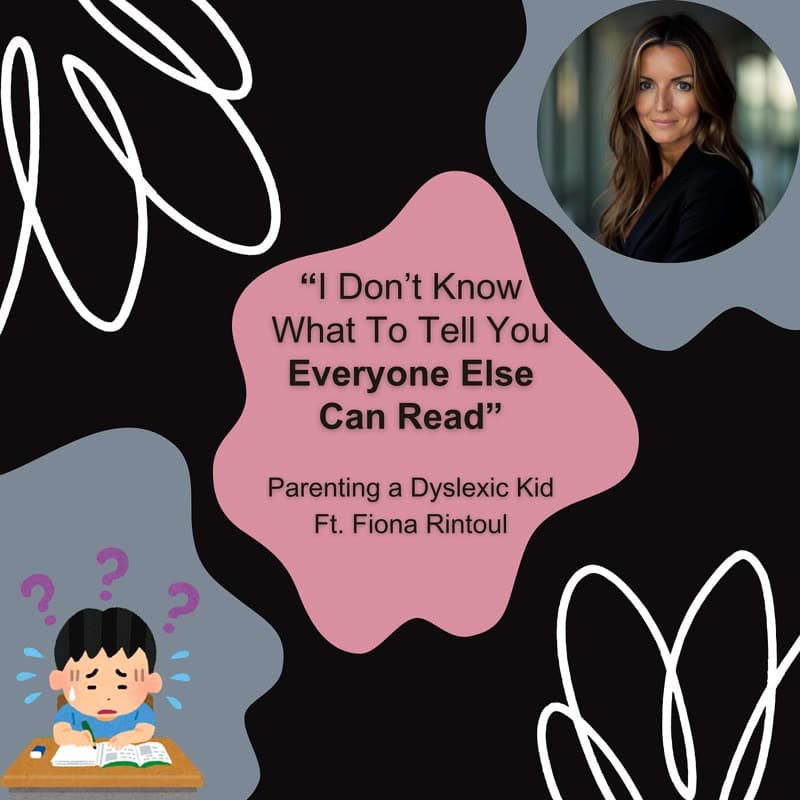
"Everyone Else Can Read" Ft. Parent Fiona Rintoul
Fiona Rintoul, fellow parent of a dyslexic daughter, joins us to discuss her experiences. You can find Fiona online at https://purplecowrecruiting.com/.
Never miss an episode
New episodes every two weeks. Follow wherever you listen.