
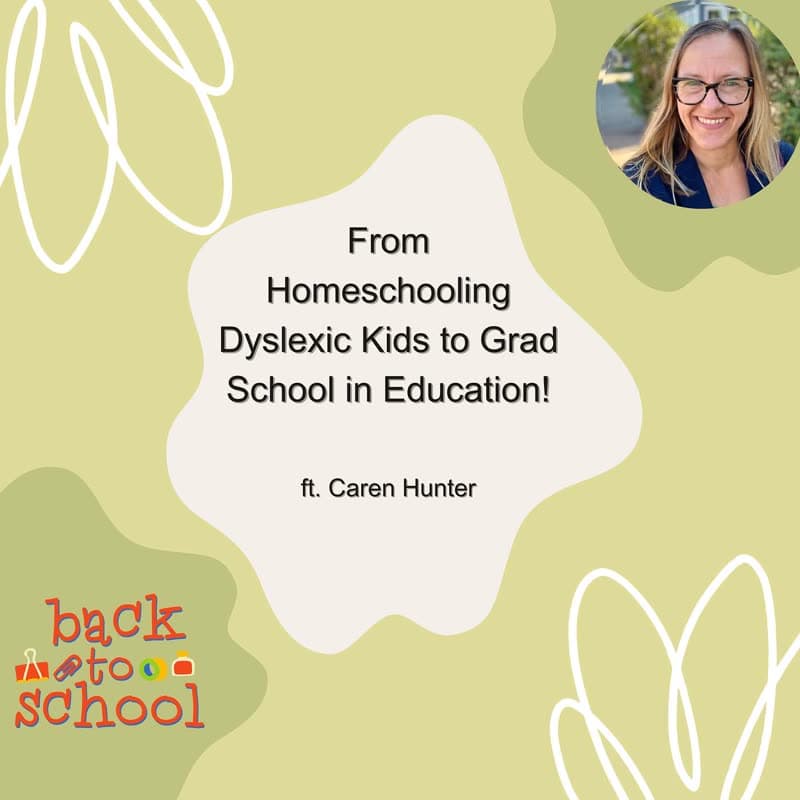
From Homeschooling Dyslexic Kids to Grad School in Education! Ft. Caren Hunter
About this episode
Caren Hunter is a mother of several dyslexic kids who went back to school to study education and social work. Learn about her experiences and journey with us in this episode!
Watch a video she created for one of her classes, "I'm Keira, and I have Dyslexia": https://drive.google.com/file/d/1W4tRXFhnOA29lc7bhd23U_9xAtrCAYUN/view?usp=sharing
Transcript
Full transcript · 6,651 words · about 33 min to read. Press a timestamp to jump to that moment.
If we teach all kids in the ways that kids with dyslexia learn how to read best, then all kids learn. And that's, so that feels hopeful that there are systems that are growing in that space. It got me diagnosed when I was in third grade, and it was the most relieving day of my life because I finally had like kind of a place to hang my hat and say, see, I told you I'm not lazy, definitely not stupid.
I just learned differently, like that's totally okay. Be dyslexics, we were often, you know, just set up for failure because, you know, we were given books and tasks that really are not appropriate for the level that we were at. So how do you expect anyone to be open to learning when their entire relationship with reading, with learning, is physical pain? Wish I had understood when I was younger that the fact that my brain worked differently than people meant that I would be good at things in ways that other kids were not going to be good at.
I just assumed, I can't be dyslexic because letters don't jump up and down for me. Dyslexia is not a disorder. It is not a disease. Once you sort of own it and embrace it, then you can have the power to deal with it. It's sort of empowering and also enriching to the whole community. To those who don't understand what dyslexia is, that it's not a negative, it's not a problem, it's, like we keep saying, superpower.
Hey everyone, we are Sonja and Nick and this is Dyslexia Journey. And today we are pleased to welcome Karen Hunter. Karen, welcome to Dyslexia Journey. Thank you so much for having me. So let's just start at the beginning with how your journey with dyslexia as a learning difference began. So, I'm a parent of four children. I knew once I started dating my husband that he had dyslexia, but at that point I didn't have any sense at all about the way that that would impact our kids.
He was actually diagnosed when he was in, he was eight, which is sort of unusual, like in the 80s, you know, like we had parents who were pretty on top of it. And so then he experienced sort of like the whole gamut of like the early ways you're trying to address this use of like, including like, you know, strange tinted glasses and, you know, having fonts that are all whatever. But his parents then were pretty, just fierce advocates that he would stay, they kind of like moved him out of mainline classes.
And then at, in middle school, they were just like, oh, this is not going to work for him. Or he's clearly really intelligent, but he just doesn't read very well. And so they fought really hard to push him back into that sort of regular classes with the rest of the kids. And then his experience in middle school and high school was pretty terrible then as he's trying to just navigate without any support.
But so I guess in some ways we had some sense of, oh, if any of our kids have dyslexia, this will be something that we're up against. But then in second grade, so my oldest was in second grade and then just really not reading. It wasn't coming together. And she wanted to read, but we, you know, we were, felt like we were doing all the things we knew how to do and that she could do.
And the school, I had a conversation with a teacher who just said, you know, some kids are kind of rebellious. And some kids also are just maybe not that good at this. I was like, wow, this is really early for you to be telling me that my kid maybe doesn't have much of a future for. So we tried to get some services within the school, but she just wasn't far enough behind at that part for her.
You know, they're like, she, you know, she can get some of the letter sounds or some pieces that come together. So they suggested a little computer program for her in the back of the room. And I was like, she's going to have to teach herself how to read with a computer. She's also a super social kid. And also, I think the way I would describe it is that Annika chooses success. And so I asked if the computer program would make her advance to another level if she had mastered one.
And he said, no, every time she would have to choose. And I was like, oh, she's going to pick level one every time because once she gets it, she's going to be like, I did it. You know, and the next one would be hard. And so we, I had a conversation with the principal at that point. It was midway through second grade. And I said, you know, I feel like this isn't really working.
We're not getting anywhere. If we went and had some testing done, we were living in Michigan at that point. So in Ann Arbor, but it was, I don't know, we came back at that point. Somehow my understanding now is that Michigan didn't recognize dyslexia as a learning disability in a way, in some form, at least at the school. At this point, we live in Boston. There's different things. But it was just like, there was so much confusion at that point.
We didn't understand. So we came back with these test results. The principal was like, you know, I don't really, I don't have a good option for you. And so I said, you know, I'm just kind of thinking about homeschooling. And I really appreciate at this point that she said, you know, if you have a plan, you'll probably do a better job than we're going to do. At this point, I would have, I have a different sense of the advocacy that I could have done.
But I was really appreciative at, you know, in hindsight, you know, like, oh, it's just really great that she said, you know, just try and go for it. You know, Annika at that point was telling me she thought she might like to drop out of school. And I was like, oh, it's second grade. It's so early for you to want. To be, to quit. And I felt like just this, she's a kid who loved learning.
And for her to get to a place where she felt like she didn't want to keep learning was so discouraging. And so that was my goal in homeschooling was just to find a way for her to love learning again. And so, you know, we did a lot of reading aloud. We did a lot of, I feel like I kind of stumbled into the things that I didn't know I needed to do.
You know, like really teaching, decoding, really working on phonemic awareness, really working with like those like alphabetic principles. I didn't know, but just like in the research of like what might work. And, you know, she went from really struggling to read like, you know, Green Eggs and Hand, The Cat in the Hat to like finishing through, you know, just like, I mean, we worked our way through so slowly, but like reading the first Harry Potter book, you know, like.
And just to see her feel success, you know, I'd read a page, she'd read a page and, you know, like if it took her a half hour, then it took a half hour. So subsequently, I have four kids, three of them have dyslexia diagnosis. And so Anika's my oldest, she's finishing up at, she just finished up at BU. She's graduated with a marine science degree. So I love being able to say that, that I have a marine scientist daughter.
So she's actually working for Save the Harbor, Save the Bay this summer and is, you know, teaching other high school kids how to do, work through the scientific method. And so it's just so fun that she both like loves learning and loves teaching and is not afraid to be like an academic. And I think that's just really cool. My number two son, Garrett, has both dyslexia and dysgraphia and ADHD. And he is a, just finished up his sophomore year at the University of New Hampshire.
He's studying mechanical engineering and sustainability. And then I have a third daughter, Nora. She is studying, she's at high school. She's going to be a senior. She's studying, but she's a vet tech, working to be a vet tech. And then my youngest, Elias, is 12 and he will be starting middle school next year. So pretty exciting. But Elias is the last one that has both dyslexia and dysgraphia. Follow up that I haven't had the chance to ask anyone before.
Yeah. And just any thoughts you have on this. Just having, you know, three of your kids having dyslexia, but they're obviously also different people. I'm just wondering if you have any thoughts on that. Because, you know, like, were there ways that you really had to much more individualize? And, you know, it probably helps, on the other hand, to recognize it earlier, that kind of thing. But, yeah. How was that to sort of like have three different people, but they all three have dyslexia?
Certainly, like, the ways that you teach them doesn't change, right? You're still going to be working on those paces. The way that they, you know, so the degree by which they struggle with things is different. Garrett with ADHD was another one that I was, you know, he just doesn't sit still. I didn't know. We homeschooled through eighth grade for all of them, except for Elias, like the youngest one. And so, actually, when we had Garrett, all of his testing redone in high school, I hadn't considered that he might have ADHD.
Because in some ways, you make an IEP at home. So, when they were asking me if he had trouble sitting still, I said no. But then, when I thought about it, I was like, oh, I guess I didn't need him to. And so, we were able to create a really, an environment that worked for him. So, he could, like, play Legos the whole time that he's working on other things. So, they do, I mean, certainly, they are all very different.
There's things that motivate them differently. So, understanding that is sometimes a helpful thing to, you know, you got to figure out what your kids' carrots are. And the things that motivate them. So, I wouldn't have, I would have considered actually homeschooling all the way through high school, except for that Anika was such a peer-driven learner. And so, for me, it felt important. She was always like, you know, like, why do I have to do more if Garrett, you know, he's two years younger.
You know, like, how come I have to write three pages if he only has to write one? I was like, oh, we need to find you some other people who are also writing three pages. Whereas Garrett is so just driven by himself. And so, he could, and I didn't, I didn't homeschool him all the way through as well. He went, he wanted to go to this technical high school. He studied environmental science.
And so, but he could have been fine, you know. And then, I feel like Elias is my one who, like, he'll take as much time as you give him. You know, so it's like, if you need to finish this in 15 minutes, or you need to finish this in 30. And he's like, I'll finish it in 30. He balloons to the time. So, you know, understanding who they are as different learners feels like it matters.
Right. Yeah. So, it's not about, like, the techniques will still be useful that, you know, have been proven. But it's more around, yeah, like, the motivation and how they interact with assignments, that kind of thing. Yeah. Right. Okay. That's interesting. I really admire that you were able to homeschool multiple kids for that long. We have talked about, we've talked about homeschooling a fair amount on this show. And as we've talked about many times, our dyslexic daughter, we homeschooled her for one year.
And that was, I mean, in many ways, it was a very important year for her. But in many ways, it was very challenging as well. She was already very resistant. Yeah. Well, you know, it's sometimes, sometimes the school resistance has already translated to the resistance to anything that looks like school. Yes. Yeah. Right. So, I think that was why. But it was, yeah, it was still the right decision, I think. It's just, it ended up being more of that time for the break than anything else.
And it sounds like with your kids that you homeschooled them through eighth grade and then they kind of chose to go to high school then. Yep. Yep. So, I guess for Annika, I was interested in having her pursue something else. So, I didn't, we called ourselves the Hunter Academy. I didn't say that the Hunter Academy is closing in eighth grade, right? But we did really challenge her to think about, you know, what does it look like?
The phrase I had for her was like a chorus of voices. I was like, it seems like other people are important in your learning journey. And so, how do we find a chorus of voices for you? So, she ended up at a small private school and she did really well there. And, but it was a hard, she wasn't initially sure that that was the thing that she wanted to do. Right. Right.
Yeah. That makes sense.
I want to go back to the diagnosis. Yeah. You said when you were in Michigan that they weren't even really correctly identifying her daughter, your daughter. How did you actually end up getting your children identified? So, in the end, it's actually not until we move out here to Massachusetts and we end up, you know, repursuing testing. So, we'd had Annika tested and then we moved to, we were in, let's see, we moved in 2015.
And so, once we moved here and we like enroll in the Malden Public Schools, just, you know, like as homeschooling. But then I quickly, I knew at that point that I could ask for testing even though we were homeschooling. And so, I said, hey, listen, I'll, I know at least at that point, I was like, I got two kids that I know we need to test. And, and then you just, it's that, you know, saying this is going to happen.
And then they say, okay, fine. But I didn't know, like the first round, I didn't know that. But, you know, like the learning through some other people of just, hey, once you, once you sign them up, you're going to ask to have them evaluated. And so, the schools here offered some good support. Annika ended up, you know, they, she has a, she ended up with a family. I, before Garrett ended up with an IEP right out the gate.
And so, he actually did some summer school stuff through the public schools here. We did, you know, home stuff. And then we, we did use some of their, you know, just extra support for his learning just to sort of supplement all the extra, all the things that we were doing just to help him get some extra laps in on some of those pieces. So, I'm guessing you're, I'm guessing, and tell me where I'm wrong, that your journey was a little different.
Like, we usually ask the question about, like, you know, what, was there a change after being identified, you know, because a lot of people didn't know. But it sounds like, it sounds like you probably did know, kind of, right, because you'd expected that it could happen. So, your kids, even before they were formally identified, were already identified as dyslexic. So, there maybe wasn't as big a shift in terms of identity and why this is happening and all that.
No. Although, I think in getting a formal diagnosis that for all of my kids, there was a sense of, oh, this explains something. It gives a name to something, an experience that I have. But, you know, I think for all of them sitting in a classroom and just watching, just have that sense that other kids are, this is coming together for other people, but it's not coming together for me. And so, why, and so being able to have an actual name for it was helpful for all of them.
So, it's still, yeah, so it still was helpful. Yeah. That actual, yeah, formal identification. Yeah, the formal identification. We feel like that was true for our daughter as well. But I know that there's, there is disagreement about, about labels and so on. Yeah. Yeah. Yeah. I'm, I'm curious, around sort of what resources you use to do your homeschooling and sort of what advice you would have for other parents who are, you know, either currently or considering homeschooling the dyslexic kids.
Yeah. So, for, you know, like once I had to teach kids how to read, like that all about reading program and all about spelling, those were really great. And we, you know, even with some of my older kids who felt like they had, you know, some pieces coming together, we would just, we'd come back to those foundational skills. I read a lot of books out loud. and so that was just one of those, I love that time.
I actually, you know, like if I could keep reading out loud to them, the chance to read stories with your kids, you know, like I read all the Harry Potter books out loud, you know, like, I just would look forward to that space every day. And so we would, you know, read in different contexts and read different stories and the, the opportunities from there to have really interesting conversations about, you know, who characters are and how they develop.
And, and so I would, they, you know, one of those beautiful things about kids with dyslexia is just some of the ways that their brains can work and pick, pick up big ideas and think about things. And so sometimes their ability to hold on to like an arc of something was even better than, than my ability. And the way that they would like hang on to character details, sometimes I was always so surprised by, you know, Anika would be like, oh, this is this tiny little character that's come back.
And I was like, no, and she'd be like, no, right at the beginning, right here. And this, and sure enough, we'd go back and it was, it was just amazed by that. And so I, I think that's the other thing I really have come to learn and love about dyslexia is just like, man, their brains are so powerful, and they just function differently. And it's such a great, to, to be able to come at it with like a sense of curiosity, and just be like, you know, how do you see the world?
and it's, you know, it's different than me, but it's, it's so, it's so vast and so beautiful. And so I've just, I feel like I've come to like have just more and more curiosity and wonder about them as they continue to learn. And so, other things that we use, I mean, we, we get into learning ally, my youngest guy uses speechify a lot, both actually all of the kids use that, you know, for translating some of their school stuff.
And, you know, learning ally was so valuable to Garrett in high school because they had like his like AP bio textbook was on there and we couldn't find that any other place in a way that would be like auditory. And so we, that was, you know, like one of those things fighting through, I was reading aloud his AP bio textbook. Like the same thing, my daughter just graduated high school and, her, AP psych class last year, the textbook was only available on the iPad, which we couldn't run the e-reader on.
And it was like, you basically read it to her, right? Yeah. And then you just find ways to read it. Like it's a fun story, you know, like, let me add lots of inflection to this. Like it's captivating. Yep. Yeah. yeah. And I'll just put in a plug that we have the founder of speechify on last year or the year before. Oh, awesome. he's great. He's a dyslexic himself and so super motivated.
Yeah. Yeah. So those are definitely some things that we came back to. I think another, just a core question. principle I would come back to regularly was like that I needed to hit the big ideas, but I didn't need to necessarily like some of the fine tuning things. So like, you know, does my kid need to do 20 math problems? No, if they can figure it out in, in five, you know, like that's, we're going to hit, we're going to hit five.
so those are some things that I would say to other parents, you know, they don't need to do the same quantity if you can get a sense of their mastery of things. Yeah. I mean, that's something that's often in accommodations too, but that's one of the harder ones to actually, to actually have happen. I feel like, but yeah. So especially if you're homeschooling, I think that's a really good point. I think in the public schools, it's often, you can have it sort of in theory, like you don't have to do repetitive work, but then yeah.
In practice, it's hard to do that when the teacher is expecting, oh, you have to do these 20 problems or whatever. Yeah. I'm wondering, oh, go ahead. Go ahead. In that space, I feel like it's the space of one of those key skills for your kids is just helping them figure out what does it look like to be a self-advocate and to be able to say, this is, this is something that I get.
And then I, as they get bigger to be able to ask the question of like, do you want my help in advocacy or do you, do you want to try? And so that they increasingly got better at saying, no, I want to try first. I'm going to go to my teacher. I'm going to go like, and having a sense of what the channel is of who they're at, who the people were in their corner and who they would need to ask for help.
And then, okay, if you've tried these three things, then are you ready for me to try and watching them really grow in that skill, which Annika had to use all the way through BU. I don't know if that's been your experience there or not, but it's not been the easiest place to have services work there because it's a very large school. Yeah. I think any big school especially is like that. Yeah.
But that's actually a perfect transition because I was going to ask you about then the next part of your journey. So, because then you did go to BU and study some of these things. So how, I guess just first, how did you, you know, get that idea that you wanted to do that, that you wanted to go and study more about learning differences? Yeah. So, hitting this point of like, oh, all my kids are in school, what's the next phase for me?
What do I do now? And having this really unique set of skills, like I'm like a great homeschooling generalist, you know, what do I do with this and how do I use this in a different way? For one year, I actually volunteered and tutored with PB Green, which is an organization that does tutoring in prisons. And so, I went and taught writing at MTI Framingham and I loved that. That was really fun.
But that gives me a different flavor of what does it look like to do advocacy work and to think about that space and how many people in prisons then actually like there's just undiagnosed learning disabilities everywhere. And so, you know, sense of that. And then, so like, I love that mix of social work and then education and trying to figure out, you know, what does it look like to be an advocate in this space?
I don't have learning disabilities and it's just been a, it's been a great journey for me to come alongside these sort of less traditional readers and figure out what does it look like for them as they've learned how to, and to realize it's just sort of like a difference by kind, not, you know, like it's not, they're not so different. And so, what does it look like then to be an advocate and that that would be, sometimes I say like, you know, like reading's my superpower, but how do I use it then for you?
And then also feeling like I'd stumbled into so many techniques just because of, you know, being a parent who's, you know, like looking for websites and looking, you know, parent groups and trying to figure out what is this and then how do I get into that space? And then discovered that BU had this dual degree in social work and education. And so it's like, oh, if I could go back and, and then figure out, you know, how do I use this?
And then, so that part, we haven't exactly, I have one more semester to finish up the education degree. And then we'll see, you know, whether that's like as a school social worker, particularly being like special education focused, we'll see. Here's what your experience was like coming, I guess, coming to the classroom after, after having such practical experience. Did you, did you find some of it kind of, I guess, I don't know, just tell me about that, I guess.
Yeah, I don't exactly know. Sometimes some of my education classes felt like I was studying myself or my own experience. There was a particular article I remember reading about a kid who had both a dyslexia and dysgraphia diagnosis, where they had posted in the article, some of the kids handwriting. And I had never seen another kid who wrote like my son Garrett did. And I just started crying. And I like, like, I feel like that seems sort of like sense of emotion that comes up right now.
It's just like, oh, I've never, I've never seen somebody else. And then the thing that was so heartbreaking for me actually was the trajectory of that kid's story was that he like, was in a really troubled place at the end of high school rather than, and like, so for Garrett being, having him start his journey at UNH at that same time, as I'm watching, reading this other article and seeing this kid's handwriting.
I mean, Garrett, if you look at his handwriting now, you know, you might think it's like a five-year-old, you know, like, it's really, like, his ability to regard the lines on the page. It's like, they're not even, you know, like, I don't, I don't even know. So there were some times where things that I didn't expect to be, like, particularly emotional, just learning about the diagnoses or the language of things or just having new definitions for stuff that was like, oh, this defines my experience.
And so I really, I liked that piece of learning because I feel like it gave me a whole different set of vocabulary and different sense of tools. And I do feel like being able to go back into systems at this point to be able to relate to other people in that space as both as a parent and then as an advocate. How do you find the, this is a really broad question, but I'm not quite sure, I'm not sure what it's like at all.
So I'm curious, like, how those classes are, like, with regard to learning differences. Like, I assume they have their latest research and, you know, like, a lot of those aspects, like, in there about techniques that are the best or, like, what sort of things do they cover, I guess, now if you were to go study and have a focus on learning differences? Yeah, so there's certainly a lot of research that you get to read.
And sometimes that's actually really discouraging because you're like, oh, wow, the latest research says, you know, these, this is a real thing. And there's these real techniques that could help you. And then I think about my, the experience of some of my kids in school right now, where they continue to bump up against. And so, you know, hearing about how research lags behind, you know, like somewhere like the eight years. The other thing that's interesting is to, is to be in a classroom with a whole bunch of, you know, like, sometimes I'm in a classroom with like 23 year olds who just, you know, like starting grad school.
And, you know, certainly some of them come at this because they have personal experience in the space, but then others is just a sense of curiosity. And so that, that range of, you know, how do you learn alongside people sometimes is, is a fun experience. And then getting to bring my experience as a, as a parent with a lot of just learned, lived experience feels like it, it applies itself well. And I just, I do really just like learning.
And so being able to read and, you know, hear, you know, from a whole bunch of different places. And so I don't know, I'm sitting here in the midst of resources, like we read like this, like demystifying dyslexia, a disability. Have you ever read that? It was just such a simple book that was, you know, it's talking about like what to know, what to say and how to be an ally. So there's just some fun resources that feel like they are emerging.
And so then to be in education at this space where, like in a research university where they're really trying to think about how do you, what is, what is research, what is evidence-based? What is really working? And I like asking that question. Yeah. And you mentioned the disconnect, which I think we are all aware of between the research and what we know is best practice and what actually happens out there. I'm curious if like in anything you learned, there were particular items that gave you hope for where things are headed.
Certainly that in that space of like that multi-tiered system of support, right? You have, if everybody gets really great instruction that helps them understand how to decode, then that's much more quickly going to help you identify some kids that are struggling in that space. And if we're doing just regular testing for everybody, you know, like in simple ways, it doesn't require this like super deep dive. Then we can see whether or not these kids are, you know, is it a teaching problem or is it a problem with the kids?
And that there's a lot of times where it's a teaching problem. But that if you can sort of like work through that gap of let's get our teachers to understand they need to both, that they need to do more than teach kids just like how to guess of, oh, there's a picture or use a context clue. But really working through those decoding skills and understanding the phonemic pieces will help them and all kids and that there's just that even for kids across the United States having that trouble with learning how to read if you teach that other skill.
Sometimes then they get pretty good in the early years, but then they have that drop in eighth grade or seventh grade again. And so that if we teach all kids in the ways that kids with dyslexia learn how to read best, then all kids learn. And that's so that feels hopeful that there are systems that are growing in that space. Sort of on the flip side of that, I'm curious, was there any anything that was kind of covered in in class where you kind of said, huh, that doesn't really match my lived experience with dyslexic kids?
no, not necessarily. I think if anything, just the way that some of I had one class in particular that sort of like started at the beginning of just like our, our learning disabilities a myth. and so like to navigate in that space, you know, at the beginning of just like, you know, maybe it's really not a thing at all. and maybe it's just this sort of like social construct. And that was really hard for me to kind of try and hang in that space.
Cause I was like, no, that's my experience is this is not, a social construct where somehow just, we haven't tried hard enough, to close this gap. Interesting. could you tell us a little bit more about your final project too? Cause that's something you shared with us that we can share the link for. Yes. Yeah. we were challenged to come up with something that we thought would be useful out in the world in some way.
And I thought about how many websites I've gone to that are just so text heavy. And so as parents are trying to learn about something for the first time, then there's a lot of resources that are, have a lot of text base, but for kids then to have something that. So I made a video that's just like, Hey, you just learned that you have dyslexia and what does it mean? And so just trying to have something that was simple, that had the audio track that actually matched up with the words.
Cause I think that that's a really important skill. I love that learning ally will do that for you. You know, like you can hear the words, but you can also, cause you still need to learn how to work the letters. and so trying to have the audio match, the, the letters that are on the screen, the words that are on the screen, the phrasing that's on the screen. but as a resource then for, you know, a parent, maybe to show their kid or even for a kid to be able to say, Hey, I just learned this about myself.
And then to be able to begin that skill of advocacy for themselves, to be able to bring it to somebody else and say, Hey, I learned this about me. This describes something about me. and if you want to watch this with me, that might help you understand a little bit about how I learned. Yeah. So we'll definitely, yeah. Put the link to that so that people use that as a resource. That is a really good, I don't feel like I've seen anything like that myself.
So that's wonderful.
I guess, sort of starting, starting to wrap up, we always like to ask our guests for advice that they have. so what advice would you give to other parents of dyslexic kids out there? one, I would say just, man, fall in love with your kid and then just be able to like, continue to find that sense of wonder and curiosity for them and with them. And so being able to, in their places of discouragement about the, where the spaces they're at with learning, like, how do you find things that they are interested in?
And then how do you go there with them in that space? And I think about what, what it's like as an adult to encounter something that's difficult and how quickly we would not choose that. but for kids facing a long road of school, they don't have the option at that point to just say like, I'm not, this isn't for me. and so how do you just continue to be somebody who's relentlessly for them?
and that can be, I think it's hard. but to, you know, oh, we're going to decode cat again. Yep, we are. And I'm not going to get frustrated that you haven't, that you can't do it because we're just, yep, it's still, oh yeah, we're going to act. Yep, here we go. We can do it again. and just being willing to do the laps with them because having somebody who comes alongside and just as your cheerleader, there's enough discouragement in the world sometimes to just be like, yep, I'm going to, I'm going to continue to figure out how to be for you.
yeah, that's one thing I think. And then finally, anything else you want to add perhaps to the general public about dyslexia or about your journey and what you would share for them to think about? again, just reminders that there's a lot more people who struggle with learning differences. It's an, you know, it's an individual, sorry, invisible disability, right? It's something you only have to disclose if you want to, but just means that there's a lot of people out there who struggle with reading.
And so, you know, if there's ways that we can think about that, and we can, you know, make, make ways forward that doesn't necessarily always require that, or to not be so quick. Sometimes I feel like my husband at this point continues to encounter that, you know, he's, he's a very successful adult. He has a master's degree, you know, like, but there's just times where people get very frustrated with his ability to read something.
And, I think just like, what does it look like to have a little bit of grace for where people are at and just, you know, there's a lot of people, I guess those, the numbers coming back that, you know, probably like one in five, somebody has some kind of learning difference in that space. And so what does it look like for us to be just a little bit more gracious with each other?
yes, yes, I think that's very important. Well, thank you so much for joining us. It's so interesting to hear everyone's unique journey and yours definitely is one in both, you know, now with regard to your career as well. Yes. Yeah. And I appreciate the space that you guys are occupying in the world that we just need more people who are willing to just provide voices. and this is a fun, this is a fun thing that you guys are doing.
Thanks. Thank you so much.
More from the show
Should I Pull My Dyslexic Kid Out of School?
As a followup to our previous episode about when to consider homeschooling (https://www.buzzsprout.com/2077817/episodes/15731825), this episode covers making the decision to pull your kid out of school, and some factors to consider when you make that leap.

The Definition of Dyslexia Changed: Here's What It Means for Your Family
For the first time since 2002, the International Dyslexia Association has rewritten its definition of dyslexia. The new version quietly removes two ideas that have kept kids from being identified for two decades: that dyslexia has to be 'unexpected' given a child's intelligence, and that a phonological deficit is…
"Everyone Else Can Read" Ft. Parent Fiona Rintoul
Fiona Rintoul, fellow parent of a dyslexic daughter, joins us to discuss her experiences. You can find Fiona online at https://purplecowrecruiting.com/.
Never miss an episode
New episodes every two weeks. Follow wherever you listen.