
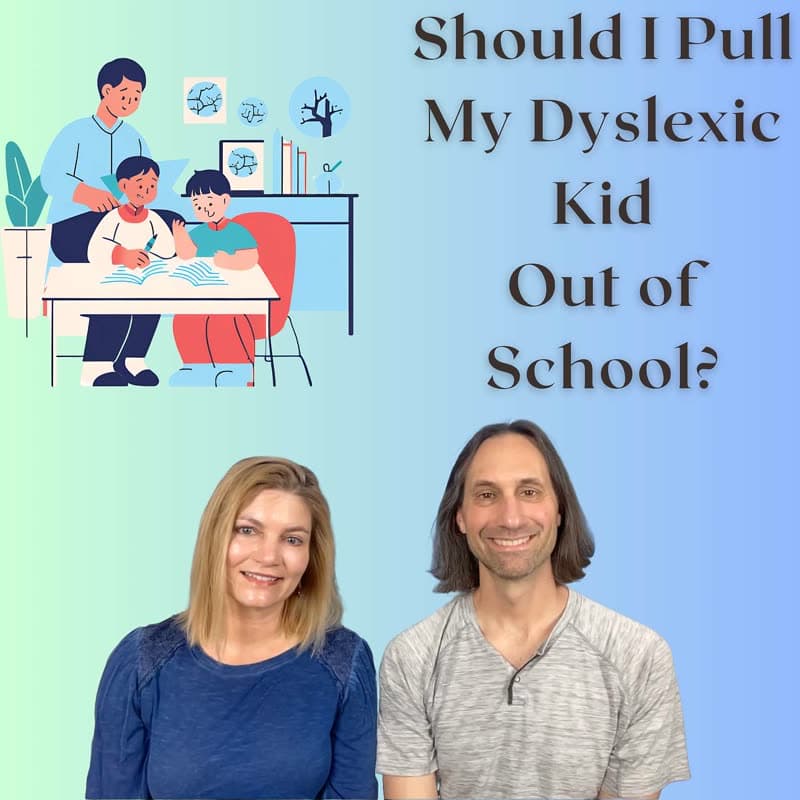
Should I Pull My Dyslexic Kid Out of School?
About this episode
As a followup to our previous episode about when to consider homeschooling (https://www.buzzsprout.com/2077817/episodes/15731825), this episode covers making the decision to pull your kid out of school, and some factors to consider when you make that leap.
This interview with a special-education attorney is invaluable to understanding your rights if you keep your child in school: https://www.buzzsprout.com/2077817/episodes/16095504
Transcript
Full transcript · 4,045 words · about 20 min to read. Press a timestamp to jump to that moment.
Have you ever thought of homeschooling your dyslexic kid? In today's video, we're going to talk about some things for you to consider if that's coming up for you.
Got me diagnosed when I was in third grade, and it was the most relieving day of my life because I finally had like kind of a place to hang my hat and say, see, I told you I'm not lazy, definitely not stupid. I just learned differently. Like, that's totally okay. With dyslexics, we were often, you know, just set up for failure because, you know, we were given books and tasks that really are not appropriate for the level that we were at.
So, how do you expect anyone to be open to learning when their entire relationship with reading, with learning, is physical pain? Wish I had understood when I was younger that the fact that my brain worked differently than people meant that I would be good at things in ways that other kids were not going to be good at. I just assumed, I can't be dyslexic because letters don't jump up and down for me.
Dyslexia is not a disorder. It is not a disease. Once you sort of own it and embrace it, then you can have the power to deal with it. It's sort of empowering and also enriching to the whole community. To those who don't understand what dyslexia is, that it's not a negative, it's not a problem, it's, like we keep saying, superpower.
Hey everyone, we are Sonja and Nick, and this is Dyslexia Journey, and today we are revisiting a popular topic, which is about homeschooling your dyslexic kid. We have done a previous episode about this, which we will link to, this is, we're revisiting that topic because we have some new thoughts, and because we keep getting questions about it. Some of it will be kind of similar, but there are some different points too, so we'll definitely link it to this video in case you want to hear our take from, I don't know what that was nine months ago or something.
Exactly. And also, we think that toward the end of the school year, which is when we're filming this particular episode, that people might be thinking about what they want to do for next year with their dyslexic kids. So it's a good time to be thinking about, you know, a fresh start for next year. Yes. And, you know, it really can happen any time of the year, but that often, because it's transitional anyway, I know a lot of people do make those considerations about where to go to school next year and how to do it at this time of the year.
So we're just going to split this up into two sort of categories. The first one being how, you know, considerations for making the decision in the first place about homeschooling or not. And then for the second part, if it's a yes, some things to think about because it's a yes. Okay. So the first consideration when you're trying to decide about pulling your kid out of school, you know, and then homeschooling them yourself is to see, have you talked to the school, to the counselor at the school, to the teacher?
Like, is there something that could change? Because presumably there's a reason you think it's not working or that it could work better homeschooling. But it can often be a good thing to, we absolutely always, you know, believe and trust in your gut. But it can be worth considering, like, have you communicated yet? Because I think that's different for people just even based on personality, all kinds of reasons. Like, maybe you just haven't given it a chance yet to talk to them about what could change.
Or maybe you just haven't thought of an idea, but they've had experience with a kid who's done something very different. And then, you know, you're like, oh, well, maybe that actually would be something where they could thrive in the school because of that. So it's always worth just taking sort of an inventory of how much have I already talked to people? Is there someone more that would be worth talking to, to have all the information before making the decision?
Yeah. And if it's a specific resource or specific kind of need that you think is for your child that you think is deficient in that school, it's worth going back and watching a couple of our episodes where we talked to an attorney about what your actual rights as a dyslexic kid and as a parent are. Because there's a lot of rights that you have that we didn't realize when our kids were younger.
And that also, I think that we might not have been aware of even at the time we did our previous episode about homeschooling. So you do have the legal right to demand a free and appropriate public education for your child. So if you are interested in pursuing that instead of homeschooling because of specific kind of that they're not making progress, things like that, it's definitely worth trying to research your rights and talk to the school about it.
Right. OK. And that's a really good one. And then also because it's important, you might not. I really think it's worth watching that. Like, it's definitely gets, you know, pretty detailed, but like you can watch it over again or even if you take some key points from it. I think it's something that's I mean, it's just hard for us to be informed about that without without having sort of an expert talk us through it.
OK, so another consideration, if you're considering homeschooling your dyslexic kid is if they're thriving in other ways at the school. So trying to sort of again, again, it's going to probably come down to somewhat of a gut level decision with you and your kid deciding about this. But I think that also means that it's holistic. Usually when we say a gut level decision, we're actually taking in a lot of information and holistically deciding it.
And so part of that thinking of it holistically is to think about, like, are there aspects that are going really well? Are they thriving in some aspects? Are they thriving socially at the school? Do they have particular classes that they really like? Do they have particular activities associated with the school that they really like? And you can consider in that, like, can they can continue any of those, of course. But I think it's also to try to get the full picture of how their life at school is going.
And so try to see, is it like just the academic piece or is it just even just one class? So trying to see because if it is more like one aspect and they're overall doing pretty well at the school, you might want to consider that there's something different that could be added. Like, maybe you haven't had them have a dyslexic tutor yet and there's a way to have that. For example, if it's just that you don't think the reading part is going well, which is important, of course.
But, you know, you'll want to take all of the big picture into account. And so try to consider the positives as well when you're considering whether or not you went to homeschool with them instead of having them at the school that they're currently at. Yeah, I mean, another way to look at this is, like, if some aspects of your kids' lives at school are going well, really think twice about disrupting that.
But on the flip side, if your child is super stressed out at school, is regressing in any way, is really having a tough time in any area, whether that is academic or social or anything else, that can override everything else and make it really important to take them away from that damaging environment. Right, to give them a change or a reset, particularly if you think it's not remediable or it's gone, they're in a point of enough difficulty that they really need a big reset.
Yeah. I think that can be really important. And then another thing to consider, and this is kind of a hard one, I think, but it's good to face it straight on, is, like, how much of what's going on and of you wanting to pull them out and maybe homeschool them, even that part of it, right? Because in a way that feels protective, like you're the one they're interacting with. They don't have to interact with other things out there.
How much of it is your own expectations or feelings versus your kids? So that, I mean, hopefully you'll see some of that if you look at holistically how they're doing, but that could look in a lot of different ways. So it could look like you have certain academic expectations for them that aren't realistic, like even for being dyslexic, that they are going to potentially be, you know, quote unquote, behind their peers for like a while in terms of reading.
So try to really look at, like, what is actually happening for your kid in their daily life versus what might be your expectations. Are you trying to protect them? And so, again, if you really see that they're, you know, doing poorly, you know, it's important to protect them, right? So we're not saying never protect your kid, but it's also really hard to see, no judgment at all on any of this, because it's hard to see your kid struggle, whether it's they're struggling academically and you feel like you can see, like, how smart they are and you know they could do so much better.
Or whether it's, you know, whether it's something else that's a challenge for them, but maybe they are dealing with it. So really try to look at your own, you know, where you fall in the whole things, just so you can see it clearly in the whole picture of everything. And I think you kind of have to look at it to know what that is. You can't, you sort of can't assume you have to sort of look at it straight on and say, what are my expectations?
What am I, I think, feeling here myself, all of that. Yeah, and I think ultimately it has to be your gut instinct, really your, you know, only you can really assess whether this current struggle of your child, is it something that they are going to get through and that's going to help them become more resilient and grittier? Or is it something that is going to set them back and damage them? Yeah, and maybe get, you know, getting your, you know, if you have a partner who's parenting with you or someone else who's close to the child, get their opinion too on it.
Because that helps a little bit with, you know, that our own lens going on there and definitely be listening to what the kid says. But it ultimately actually will, especially if the kid's younger, be, but even otherwise sometimes will probably be your, your call because, you know, and you of course try to get the buy-in of the kid as well. Absolutely, but like, in terms of like, going one direction or another and really feeling it out and deciding, because sometimes kids, you know, sometimes in a given day, they're just like, I hate school.
And it's not, it's like, there's a particular hard time going on, but it hasn't been as long lasting. Or on the other hand, like they might be in denial themselves, they might not be in touch with their own feelings about it and what's going on. You know, particularly if they're young, they might not have access to that. So you might be the one seeing it. They don't know why they're regressing, you know, that kind of thing.
So, so as the parent or caregiver, it's going to be, it still is going to be like a lot of your responsibility to be figuring this out. So even though you want the kids buy-in. Right, and I do want to encourage you, and I guess maybe this is actually a separate point, is also set aside societal expectations. So Sonja talked about setting aside kind of your own expectations. Which often come from that.
Right, but societally, we expect children to go to a public school generally, right? And so there's some pressure there, even for, even though public schools are not ideal for a lot of our kids. And so you really need to examine this in the context of your, and your child's individual circumstances and situation. Right, and then hopefully from there, you'll find, you'll find what's right for you. But, but trying to, trying to have it be a decision about what's right for the child, you know, first, and then going from there to figure it all out.
So that kind of transitions into the next, next part of this video, which is, what are some tips that we have for you if you're thinking you do want to try homeschooling? Okay, so one thing to consider, and so this is, so it's kind of a separate decision. We could, obviously you could think of this as just pulling them out in general too, but we wanted to do it mostly through the lens of if you're considering homeschooling in this case.
so, so, you know, this is given that you're pulling them out and you're considering like what's best for them in terms of their actual education. It might be comparing, if you're on the fence about a particular school and going further with what a teacher or someone else is wanting to change, it could be that you let that go longer because you're not sure about homeschooling. But what to consider if you're thinking of homeschooling, you're kind of like going that direction, would be, so one thing is to consider yourself as the teacher, being the teacher.
Like, how do you think that's going to work? And maybe you have to try some of it to know, but you might have an inkling already based on, you know, helping them with homework and various things. How is it going to be for you to be their teacher? because I think there's very different dynamics between, in different families and between different parents and different kids, personality styles, all kinds of things go into this.
And so you want to really think, how will this affect your relationship with your child? Like, maybe that's a fine, like maybe you do, you're already like kind of good at teaching them. And that's why you've gotten this idea to homeschool them because you feel like you already teach them reading better. Or, or, you know, maybe you already are a teacher, have been trained as a teacher, or maybe, and it works to do that dynamic with your kids.
Sometimes it still doesn't work if it's your own kid. But, so you want to think about like how that might influence your kid, or is it more like you think every day is going to actually be like your homework struggle is every night with your kid? which never, which somehow you always have, you know, tension around. So it's worth considering that when you're considering whether homeschooling is right for you. Yeah. And then along those lines, you also need to think about how much support you have and be realistic about how much support you'll need.
so, are you working outside the home? Do you have a partner who, is also working outside the home? I mean, do, you know, between you, do you actually have the time to spend with your child? And other kids too, other kids and their needs too, if you have other children. and then do you have family or friends who can help, maybe not even necessarily help with the, instructional part, right? If you're the, maybe you'll be the main teacher, but then you'll need other people to, give you breaks, right?
So maybe other people to, do other activities, fun activities with the kid to give you a break. and then are there any homeschooling groups in your area where you can, kind of share, resources and instructional time and things like that? Right. And, and do you, or do you think you'll absolutely need some extra tutoring? Like maybe there's particular, depending on the age of your child, especially, like maybe there's a particular subject that you don't think that you could teach.
So just sort of considering like, how would that look? What resources are needed? that's going to be important. Even if you decide, yes, I'm still going for it based on all this. It's going to be the important first steps anyway, to be figuring all of that out. Yeah. And also, you need to, and I guess this is a separate point again. you need to, think carefully about how you want the homeschooling to be structured.
do you want it to be totally child directed? Do you want it to follow or sort of the other extreme? Do you want it to follow very specific curricula? like you need to figure out sort of what your own philosophy is around that. And also what you, especially what you think will work best for your child. Right. Exactly. Based on their own personality and what seemed to work best for them from what you know from school already.
And another consideration, if you're thinking to homeschool your kid is the social aspect. So that could mean anything from trying to keep up with friends they already have from various activities or from the school that they were attending that can look like finding a homeschooling group that does outside activities, you know, specifically social. Like sometimes they have the curricular piece as well, but I'm, I'm talking about more of the social side of it in this case, or maybe it just means, you know, maybe they're already in activities where they have friends from those activities and making sure those continue, or maybe you want them to, maybe they'll have a little more time.
If it's, if you're having a little less time each day, you're spending on it than they did in school. And maybe they could start a new activity that they've been really interested in. So just keeping in mind that social aspect, because it can be more of a challenge when they're not in school to make sure that all of that is still happening. Yeah. And, also slightly tangential to that extracurriculars as well.
So specifically, like a lot of extracurriculars are through the school. So like theater, drama, music that starts, you know, depending on the age of your child, a lot of that starts in elementary school. There's often a school, you know, a play each year that they can participate in. and then in later years in, in middle school and high school, in, in the U S, sports are, are most often through the school as well.
And so is there, are there a community theater, community sports teams, et cetera, that they could participate in. Right. Okay. So one more thing to think about as you are contemplating homeschooling your dyslexic child is, you should probably go into it, assuming that they're going to be school resistant for a while. And so. Particularly if you're pulling them out because they've started regressing or gotten really resistant, you know, gotten resistant doesn't mean that will go away automatically.
Yeah. I mean, there are other situations. There are definitely situations where your child was bored at school and you need to give them more, more, enrichment at home, more, challenge at home, but in, in some cases they may be super burnt out and then they're going to be resistant to you imposing any, academic structure on them. Or perhaps they had some, you know, unfortunately that can happen where they've had a bad experience and, you know, as a dyslexic kids start to feel dumb or that kind of thing.
So, so if it's more that kind of thing, you might feel like, I mean, you're doing it for the reset, right? but sometimes that part doesn't reset immediately because they're still associating learning with that. And so it can take a lot longer than you might expect sometimes just, just be ready for it. Okay. Just don't be like shocked if that happens and try to remain calm that that is something that just happens.
And then, then if it is continuing for quite a while, it's worth though considering is, is it because homeschooling isn't the right fit? Like, so you'll have to make that assessment then like, does, do they just need a little longer? Are they starting to come around? Do I actually think it's because the structure of this doesn't work or our relationship, you know, in this context doesn't work, but that's something for down the line.
So we won't cover that completely here. And then finally, something else to consider is let's say your initial impulse has been, as we've been discussing here, that if you're pulling your kid out of what school they've been in, that you will homeschool them. It's definitely worth considering if there are other options that would be available that might actually be better for them, or at least that you could sort of like be researching just in case, like if it doesn't go quite the way you thought it was going to, and you decide, you decide you'd like to have that option to try later.
And so that can be things like other charter schools, like within your public school system, maybe they have a particular focus that your kid would like. That can be even a private school because, you know, maybe you're able to afford it, but sometimes they have scholarships. So it's worth looking into at least. And, or maybe it's just a different school that you've heard like does really well with dyslexic kids. If that was, if you think the issue was a lot around, around being dyslexic, for example, maybe it was about some other aspect of your kid's personality and you think a different school would fit.
So really it's about, you know, investigating that fit for your kid and then seeing if you can make it work, whether it's a financial reason, whether it's far away, whatever, whatever that is that, you know, might or might not be a barrier to it. But, but I think it's always worth doing the research like upfront because either maybe you want to try that first and then you could always homeschool, or maybe you want that sort of in your back pocket just in case it goes differently than you expected.
And often those charter schools have wait lists and things like that. So it's, you know, as a backup plan, it doesn't hurt to get on the wait list. You can always turn it down. Right, right. And we would love to hear from you. Have you tried homeschooling or dyslexic kid? Or maybe you do. And how has that gone? Or do you have any more tips about like having made a decision like this ever?
Whatever the way the decision went, go ahead and put it in the comments if you'd like. Or if you're listening to this as a podcast, you could just send us an email and we might share your experience like at the beginning of one of our other videos. We also love it if you send us ideas for topics or any questions that you might have. Yeah. Our email address is ParentingDyslexiaJourney at gmail.com.
Thanks, everyone.
More from the show
From Homeschooling Dyslexic Kids to Grad School in Education! Ft. Caren Hunter
Caren Hunter is a mother of several dyslexic kids who went back to school to study education and social work. Learn about her experiences and journey with us in this episode!

The Definition of Dyslexia Changed: Here's What It Means for Your Family
For the first time since 2002, the International Dyslexia Association has rewritten its definition of dyslexia. The new version quietly removes two ideas that have kept kids from being identified for two decades: that dyslexia has to be 'unexpected' given a child's intelligence, and that a phonological deficit is…
"Everyone Else Can Read" Ft. Parent Fiona Rintoul
Fiona Rintoul, fellow parent of a dyslexic daughter, joins us to discuss her experiences. You can find Fiona online at https://purplecowrecruiting.com/.
Never miss an episode
New episodes every two weeks. Follow wherever you listen.